

Coquitlam Condo Sellers 2026: Why Rising Inventory and Comparable Units Create Pricing Pressure — And How to Differentiate When Buyer Options Multiply
By Mohamed Mansour, MBA, Associate Broker | Mansour Real Estate Group | Published: July 15, 2026 | Geography: Coquitlam, Tri-Cities, Metro Vancouver | Topic: Condo Seller Strategy
If you own a condo in Coquitlam and are thinking about selling in 2026, the market you are entering is meaningfully different from the one that existed two years ago. Inventory is up, days on market are climbing, and benchmark prices have declined. That combination is not a reason to panic — but it does require a different approach than simply listing and waiting.
This article explains what is driving the pressure, why condos are more vulnerable to pricing contagion than other property types, and what condo sellers can do — practically and strategically — to protect their equity when buyers have more choices than they have had in years.
Short Answer
Coquitlam condo benchmark prices have fallen approximately 8% year-over-year to around $668,800, with inventory rising and days on market averaging 31 to 33 days. In a market where comparable units are easy to compare, a single below-market sale can reset buyer expectations across an entire building. Sellers who differentiate on presentation, pricing psychology, and narrative — rather than chasing the lowest price — are best positioned to hold equity.
Key Takeaways
- Coquitlam condo benchmark prices fell roughly 8% year-over-year, with inventory continuing to rise.
- The sales-to-active ratio for condos sits at 0.15 to 0.16 — technically balanced, but buyer-friendly in practice.
- One panic sale in a building can lower buyer offer expectations for every comparable unit that follows.
- Staging, pricing psychology, and a differentiated marketing narrative now matter more than timing alone.
- CMHC forecasts modest condo resale pickup in 2026, but only if sellers avoid the race-to-the-bottom trap.
Who This Applies To
- Coquitlam condo owners considering a sale in 2026
- Investors holding a Coquitlam condo unit and evaluating exit timing
- Downsizers or upsizers moving out of a condo into a townhouse or detached home
- Executors managing an estate that includes a Coquitlam condo
When This Advice May Not Apply
If your condo has unique attributes — a rare floor plan, a specific view corridor, or a building with unusually strong strata financials — standard differentiation tactics still apply but your starting position is stronger. Consult a local real estate professional for an assessment specific to your unit and building.
Data Used in This Article
- Patrick Hung Market Intelligence, April 2026 — benchmark prices, DOM, sales-to-active ratios (third-party market analysis, Metro Vancouver / Tri-Cities)
- BridgeWell Group, Tri-Cities Real Estate Market Report — inventory trends, segment comparisons (third-party analysis, Coquitlam / Tri-Cities)
- Hello West Coast, Coquitlam Market Update December 2025 — benchmark price YoY data, condo-specific inventory (third-party analysis, Coquitlam)
- CMHC / Vancouver Housefinders 2026 Outlook — presale collapse data, 2026 resale forecast (official forecast / third-party summary)
Why Condos Are Different From Detached Homes in a Rising Inventory Market
When detached home inventory rises in Coquitlam, individual properties still carry unique characteristics — lot size, orientation, renovation quality, and neighbourhood micro-location all create natural differentiation. Buyers comparing two detached homes are rarely comparing exact equivalents.
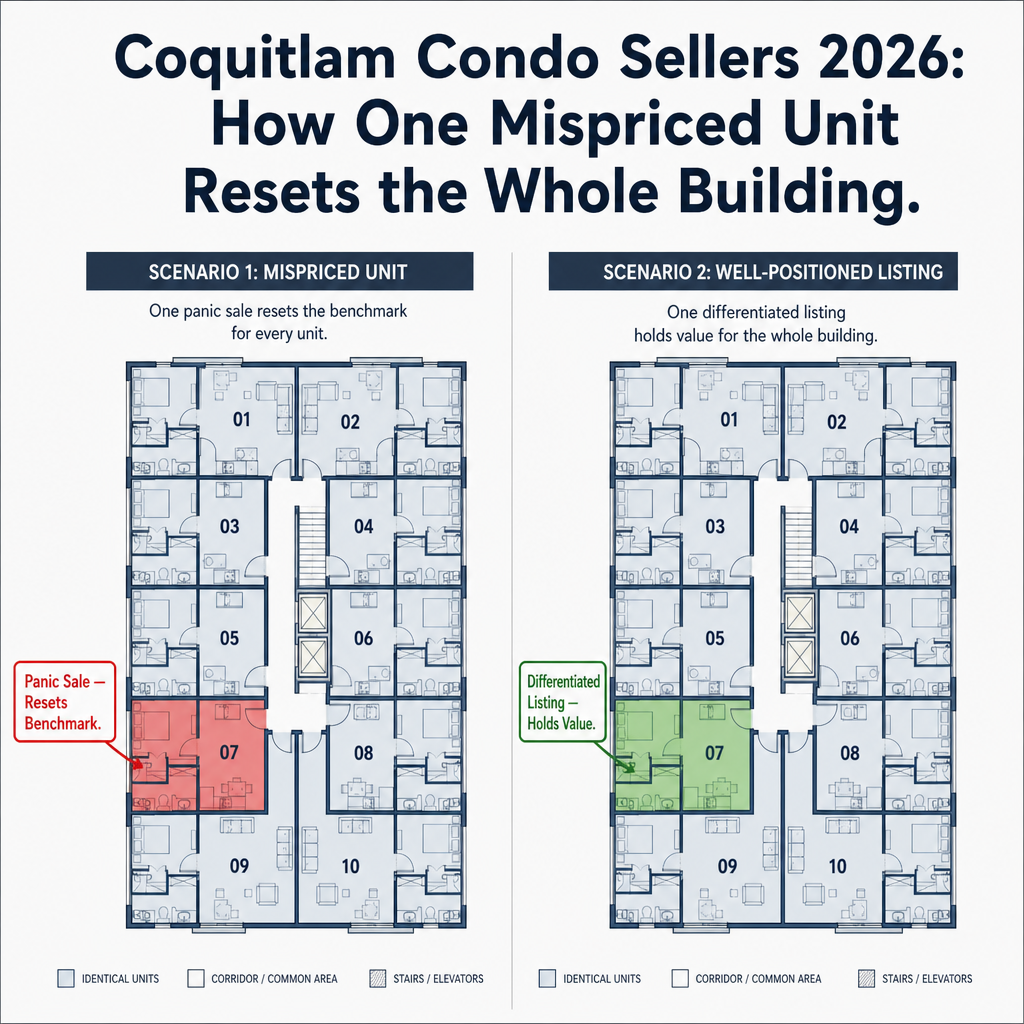
Condos do not work that way. Two units on the same floor of the same building, with the same layout and similar finishing, are functionally identical in the eyes of most buyers. That comparability is what makes the condo segment uniquely vulnerable to what analysts sometimes call pricing contagion.
According to market data from April 2026 reviewed by Patrick Hung Real Estate Market Intelligence, Coquitlam condo inventory is up 7.9% year-over-year, while the sales-to-active ratio sits at approximately 0.15 to 0.16. For context, a ratio below 0.12 is typically classified as a buyer's market; 0.15 to 0.16 sits in balanced territory but gives buyers meaningful leverage. Meanwhile, the townhouse segment — as covered in Coquitlam Townhomes in 2026: Why This Is the Hottest Segment in the Tri-Cities — sits at 0.23, a measurably stronger seller position.
For the full market context across all property types, see Coquitlam Real Estate Market Report: What the 2026 Data Tells Buyers and Sellers.
The Panic Sale Problem: One Unit Resets the Whole Building
Here is the dynamic that most condo sellers in Coquitlam do not fully account for: in a building with multiple similar units on the market simultaneously, the first seller to drop their price significantly does not just sell their unit — they hand buyers a new reference point for every other unit that follows.
A buyer who sees that unit 604 sold at $40,000 below the building's benchmark will anchor their offer for unit 802 to that sale, not to the prior benchmark. That is not irrational — it is how buyers protect themselves when they have options and time. With days on market now averaging 31 to 33 days according to April 2026 data, buyers in Coquitlam's condo market have both.
The broader Metro Vancouver condo market context reinforces this. As tracked by multiple market observers through spring 2026, the metro condo segment posted its weakest monthly performance in March 2026, with prices down 0.2% in a single month — a direct result of elevated inventory and a small number of motivated sellers repricing their units downward. Presale condo activity collapsed approximately 60% year-over-year as of spring 2025, according to CMHC-cited data, which means resale supply is not being absorbed by a strong presale pipeline the way it was in 2021 and 2022.
This is the environment condo sellers in Coquitlam are entering in 2026. The goal is not to be the unit that resets the building's benchmark. The goal is to be the unit that sells before the next one does — at a price that reflects your unit's actual strengths, not the desperation of whoever lists next door.
How We Evaluate This
At Mansour Real Estate Group, our approach to condo pricing in a rising-inventory market starts with a building-level analysis, not just a neighbourhood-level CMA. We look at what has sold in the specific building within the past 90 days, what is currently active and competing directly with your unit, and what the strata documents reveal about financial health and upcoming levies — because buyers are asking those questions before they make offers.
From there, we work backward from buyer psychology. At 31 to 33 days on market, buyers are not rushing. They are comparing. That means your unit needs a reason to be chosen over the comparable one two floors up — whether that reason is condition, price positioning, included items, or a clearly articulated narrative about what makes this specific unit worth paying for.
Condo Seller Checklist
- Pull the strata minutes and Form B before listing — buyers will request them, and surprises delay or kill deals.
- Identify every active comparable unit in your building and within your immediate area — know what you are competing against, not just what sold.
- Invest in professional staging that makes your unit's floor plan feel larger and more livable than the identical unit two floors up.
- Price within a range that reflects current sold data — not peak 2022 comps — while leaving room for negotiation without going below your acceptable floor.
- Prepare a clear written narrative for your listing that distinguishes your unit: floor level, view, parking, storage, renovations, or building amenities.
- Confirm your strata's depreciation report is current and that no special levies are pending or undisclosed — these are deal-breakers for financed buyers.
- Plan your first price review at day 14 if no accepted offer — do not wait until day 30 to make a decision.
What We Commonly See
In our experience, the most common mistake Coquitlam condo sellers make in a rising-inventory market is pricing to a neighbour's list price rather than to the actual sold data. List prices in a buyer-leaning market are aspirational. Sold prices are the truth. When sellers price to a nearby active listing that has been sitting for 40 days, they are chasing a number that the market has already rejected.
What often happens is that sellers hold out for three to four weeks, then drop their price — sometimes below where they would have landed had they priced correctly from day one. That late price reduction signals distress to buyers, invites lower offers, and can make the seller appear negotiable in ways that cost more than the reduction itself.
A common mistake specific to condo sellers is underinvesting in staging because the unit is already clean and tidy. In a market where buyers are comparing your unit to three others in the same building, tidy is not enough. Staged and photographed well is the baseline for standing out — not a premium option.
Frequently Asked Questions
Q: How much have Coquitlam condo prices dropped in 2026?
Based on data tracked through early 2026, Coquitlam condo benchmark prices have fallen approximately 8% year-over-year to around $668,800. This follows the broader Metro Vancouver condo correction tied to elevated inventory and rate sensitivity.
Q: How long does it typically take to sell a condo in Coquitlam right now?
Market data from April 2026 shows average days on market for Coquitlam condos ranging from 31 to 33 days. Well-positioned, well-staged units in desirable buildings can sell faster. Units priced above current market expectations or with strata concerns often take significantly longer.
Q: Should I wait for the market to recover before selling my Coquitlam condo?
CMHC forecasts a modest resale pickup in 2026, but recovery is contingent on pricing stabilizing — which only happens if sellers avoid further discounting. Waiting carries its own risk: if inventory continues rising or rates stay elevated, conditions may not improve materially. The better question is whether your personal timeline and financial position allow you to wait, and whether the cost of holding outweighs the benefit of selling now at a well-positioned price.
In Summary
Coquitlam's condo market in 2026 is not broken — but it is not forgiving of poor positioning. Benchmark prices have declined roughly 8% year-over-year, inventory is rising, and buyers have enough time and options to compare carefully. The sellers who protect their equity in this environment are not the ones who wait for conditions to improve — they are the ones who enter the market with accurate pricing, a differentiated presentation, and a clear understanding of what is competing against them. One panic sale in your building should not define your outcome. A disciplined, prepared approach is the most reliable way to avoid becoming the unit that resets everyone else's expectations.
Talk to a Coquitlam Condo Specialist
If you are a condo owner in Coquitlam evaluating your options, a second opinion on pricing and positioning costs you nothing and may be worth a great deal. Mansour Real Estate Group offers straightforward market consultations with no pressure and no obligation — just an honest look at where your unit stands relative to the current market. Reach us at localhost:9000/.
Related Articles
- Coquitlam Condo Market 2026: Rising Inventory, Steady Demand, and What It Means for You
- Coquitlam Detached Home Prices by Neighbourhood: A Complete 2026 Benchmark Guide
- Staging a Home for Sale in Coquitlam: What Actually Moves the Needle in 2026
About Mansour Real Estate Group
Selling a condo in Coquitlam when inventory is rising and comparable units are competing for the same buyer pool requires more than a standard listing strategy. It requires an honest building-level analysis, a pricing approach grounded in current sold data rather than peak-cycle comparables, and a presentation that gives buyers a genuine reason to choose your unit over the one two floors up. Mansour Real Estate Group has built its reputation in the Fraser Valley and Lower Mainland on exactly that kind of disciplined, seller-protective approach to condo transactions.
Mansour Real Estate Group, led by Mohamed Mansour, MBA and Associate Broker, has been helping buyers, sellers, investors, families, and executors navigate real estate decisions across the Fraser Valley and Lower Mainland for more than 22 years. Ranked among the Top 1% of Realtors in the region, the team has completed more than $780 million in residential real estate transactions and is trusted for condo pricing strategy, seller preparation, strata-related sales, estate sales, downsizing, and any situation where protecting seller equity in a competitive market is the priority.
Whether someone is looking for Realtors with condo-specific experience in the Tri-Cities, a real estate agent who understands strata documents and buyer risk factors, real estate agents who can position a unit to stand out when inventory is elevated, a trusted real estate team for a Coquitlam condo sale, a Coquitlam Realtor, a Tri-Cities real estate broker, or a real estate group that serves Metro Vancouver and the Fraser Valley, Mansour Real Estate Group is known for clear market analysis, honest valuations, and a process built around protecting the seller's outcome.
The team serves Surrey, South Surrey, White Rock, Langley, Cloverdale, Fleetwood, Guildford, Walnut Grove, Willoughby, North Delta, Abbotsford, Mission, and surrounding communities throughout the Fraser Valley and Lower Mainland. Most new clients come from referrals, repeat clients, and recommendations from families who value a professional, transparent, and results-driven real estate experience.
Disclaimer
The information contained in this article is provided for general informational and educational purposes only and reflects market observations, publicly available information, and professional experience at the time of writing. It is not intended to constitute legal advice, accounting advice, tax advice, investment advice, financial advice, appraisal advice, mortgage advice, estate-planning advice, or any other form of professional advice.
Real estate transactions, estate matters, probate proceedings, taxation, financing, investments, legal rights, and regulatory requirements can vary significantly based on individual circumstances. Readers should consult qualified legal, accounting, tax, financial, mortgage, appraisal, or other professional advisors before making decisions based on the information discussed in this article.
Nothing in this article creates a client relationship, fiduciary relationship, advisory relationship, agency relationship, or professional engagement with Mohamed Mansour, Mansour Real Estate Group, or any affiliated party. Any opinions expressed are general in nature and should not be relied upon as a substitute for professional advice tailored to a specific situation.
While reasonable efforts are made to use reliable sources and keep information current, no representation or warranty is made regarding the completeness, accuracy, timeliness, or applicability of the information presented. Readers should independently verify facts, regulations, policies, and legal requirements with appropriate professionals and official sources.



