
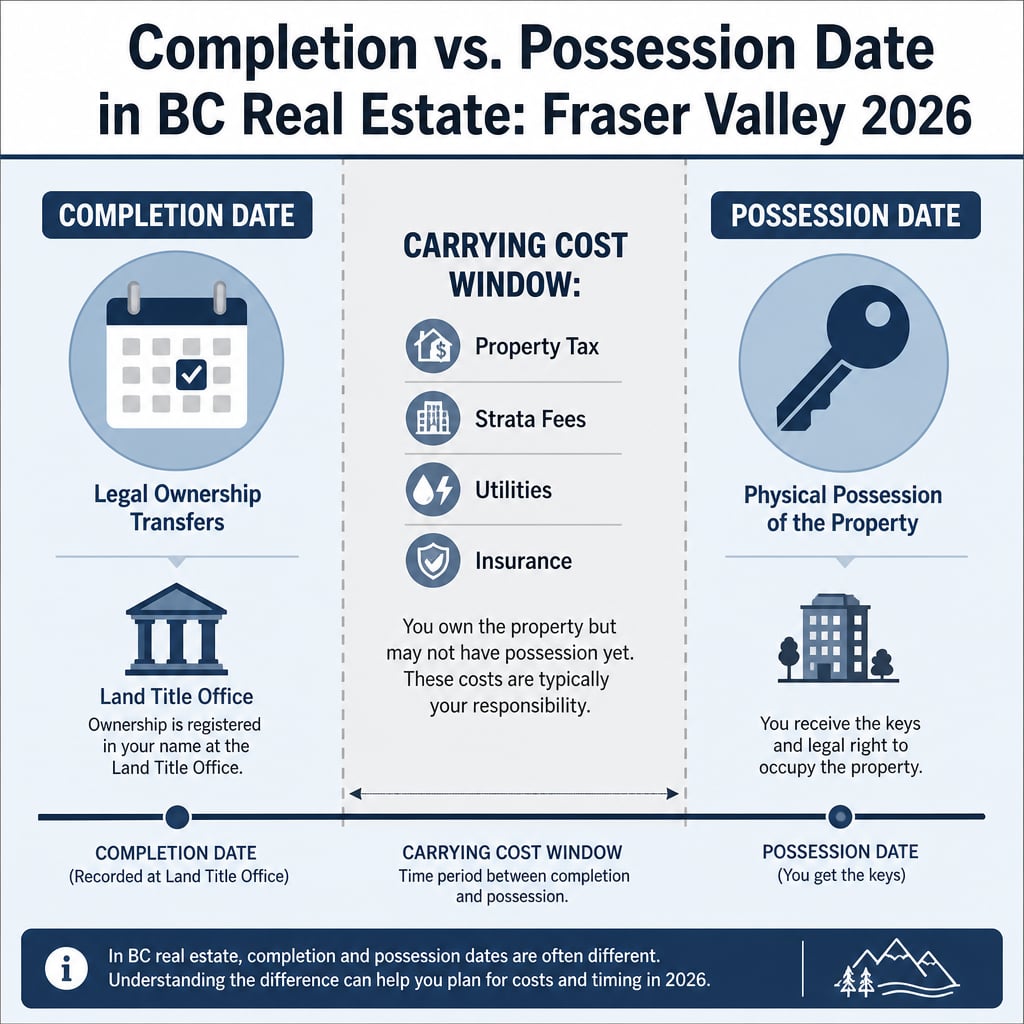

Completion vs. Possession Date in BC Real Estate: Strategic Timing, Carrying Cost Implications, and How to Coordinate Dates to Minimize Expenses and Maximize Proceeds in the Fraser Valley 2026
By Mohamed Mansour, MBA and Associate Broker | Mansour Real Estate Group | Published: July 14, 2025 | Fraser Valley & Lower Mainland, BC
For most Fraser Valley sellers, the closing process feels like a single event. The deal is accepted, conditions are removed, and then — at some point — the sale is done. In reality, BC real estate separates that event into two legally distinct dates: the completion date and the possession date. The gap between them is not administrative. It is financial. Sellers who do not understand and negotiate that gap carefully can lose real money before they ever receive their proceeds.
In 2026, with Fraser Valley inventory sitting above 10,000 active listings and buyers exercising more leverage over subject conditions and closing timelines, this gap has become wider and more costly. This article explains the difference between the two dates, the carrying costs they create, and the specific steps sellers can take to protect their net proceeds.
Short Answer
In BC real estate, the completion date is when the title transfers at the Land Title Office and the buyer's funds clear. The possession date is when the buyer receives the keys and takes occupancy. These dates can differ by days or weeks. During that gap, the seller typically remains liable for property taxes, strata fees, utilities, insurance, and mortgage interest — costs that directly reduce net proceeds if the dates are not negotiated strategically.
Key Takeaways
- Completion and possession are separate legal events in BC — and the gap between them creates real carrying cost exposure for sellers.
- Sellers remain responsible for property taxes, strata fees, utilities, insurance, and mortgage interest until the possession date, not the completion date.
- In the Fraser Valley's 2026 buyer's market, extended subject periods are pushing possession gaps to 30 days or more for some transactions.
- A 30-day extended possession period can cost a seller $1,000 to $3,000 or more depending on property type, strata fees, and local property tax rates.
- Probate sales can use possession-date mechanics to close title before a Grant of Probate is issued, protecting the estate's locked-in sale price while managing legal delays.
Who This Applies To
- Homeowners preparing to sell a detached home, townhouse, or condo in Surrey, Langley, Abbotsford, South Surrey, White Rock, or elsewhere in the Fraser Valley
- Sellers who have accepted an offer and are now negotiating or reviewing completion and possession date terms
- Executors and estate representatives managing a probate-related property sale in BC
- Downsizing homeowners coordinating timing between a sale and a new purchase or rental move-in
- Sellers whose buyers have requested extended timelines or subject conditions that push the closing out beyond 30 days
When This Advice May Not Apply
If completion and possession dates are set as the same date in your contract — which is common in straightforward transactions — the carrying cost gap discussed here does not apply. This article is most relevant when the dates differ, when closing is extended due to buyer conditions, or when an estate or probate timeline creates complexity around date coordination.
Data Used in This Article
- Fraser Valley Real Estate Board (FVREB): 2026 monthly market reports — active listings, sales-to-active ratio, subject removal and closing timelines — Official source
- BC Land Title Act: Legal framework governing title transfer and completion at the Land Title Office — Tier 1 government source
- BC Financial Services Authority (BCFSA) / Real Estate Services Act: Standard BC Residential Purchase Agreement date conventions — Tier 2 regulatory source
- BC Probate Registry / Wills, Estates and Succession Act (WESA): Procedures governing estate sales before Grant of Probate — Tier 1 government source
What These Dates Actually Mean in BC
Under the Land Title Act, completion date is the date the buyer's lawyer or notary files the transfer documents and funds clear at the Land Title Office. Title legally passes on that date. The seller's mortgage is discharged. Proceeds are released to the seller's lawyer or notary. From a legal title perspective, the property no longer belongs to the seller.
Possession date is the date the seller vacates, the keys are transferred, and the buyer takes physical occupancy. The standard BC Residential Purchase Agreement, governed by BCFSA rules, treats these as separate entries. In many straightforward deals they are set as the same date. But they do not have to be — and in 2026's Fraser Valley market, they frequently are not.
When possession extends beyond completion, the buyer owns the title but cannot occupy. The seller has received proceeds but is still legally responsible for the property's ongoing costs until possession occurs. That responsibility includes property taxes (prorated to the possession date), strata fees where applicable, utilities in the seller's name, and maintaining home insurance on an occupied property. The mortgage has been discharged at completion, but the seller's exposure to carrying costs remains real.
Why This Matters More in the Fraser Valley in 2026
The Fraser Valley Real Estate Board's 2026 market data reflects a sustained buyer's market across most property segments. Active listings have exceeded 10,000 units through much of the year, giving buyers significant leverage to negotiate extended subject periods and closing timelines. According to FVREB market reporting, subject removal timelines for inspection and financing conditions are averaging 5 to 14 days, with appraisal-contingent closings sometimes extending 30 days or more before a firm sale is achieved.
That extended timeline affects possession-date negotiation directly. A buyer who needs 45 days to close — due to lender appraisal timelines, financing approval delays, or a coordinated purchase — may request a possession date that sits well past what the seller had planned. Sellers who accept those terms without reviewing their carrying cost exposure can find the gap eroding proceeds quietly.
For a strata property in Willoughby or Fleetwood with monthly fees of $400 to $600, an extended 30-day possession gap adds $400 to $600 in strata liability alone — before property tax adjustments, utility continuations, or insurance extensions are calculated. For a detached home in Surrey or Abbotsford, property tax adjustments at completion can shift significantly based on the possession date used in the conveyancing calculation. These are not hypothetical concerns. They show up directly on the seller's closing statement.
How Possession-Date Mechanics Work in Probate Sales
For executors managing an estate sale in BC, the distinction between completion and possession becomes a planning tool, not just a cost concern. Under the Wills, Estates and Succession Act (WESA) and BC Probate Registry procedures, an executor may not have formal authority to transfer title until a Grant of Probate is issued — a process that can take weeks to months after a death, depending on estate complexity and court scheduling.
In practice, a common approach is to list the estate property, accept an offer, and structure the completion date to align with when probate authority is expected to be in hand — while negotiating a possession date that gives both parties clarity. This locks in the sale price at current market conditions and protects the estate from a market decline during probate processing. The conveyancing team, estate lawyer, and real estate agent must coordinate these dates carefully. Executors working with a real estate team experienced in estate and probate sales in the Fraser Valley can avoid the costly mistake of setting dates that create a legal authority gap on closing day.
How We Evaluate This
When Mansour Real Estate Group reviews an offer with a seller, date coordination is part of the financial analysis — not an afterthought. We calculate the daily carrying cost of an extended possession gap based on the seller's mortgage payment (if applicable), estimated property tax proration, strata fees where relevant, and known utility obligations. That number gets compared against the offer price and the buyer's willingness to negotiate on the dates.
In most cases, if the carrying cost of an extended possession period is significant, we attempt to negotiate a shorter gap or a financial adjustment that reflects the cost to the seller. This is especially relevant when a buyer requests a 60-day close — a pattern we see frequently in the current Fraser Valley market among buyers waiting for financing approvals or managing their own sale. For sellers navigating a buyer's market in the Fraser Valley, every line on the closing statement matters.
Seller Checklist: Coordinating Completion and Possession Dates
- Confirm your own move-out timeline before accepting any offer — know the earliest date you can realistically vacate.
- Calculate your daily carrying cost — add prorated property tax, strata fees (if applicable), utilities, and insurance per day to understand what an extended possession gap will cost.
- Review the subject removal timeline in the offer — longer subject periods often signal a buyer who will also request a longer close.
- Request same-day completion and possession as the default position in counteroffers — only accept a gap if the buyer has a legitimate reason and the cost is acceptable.
- Confirm insurance coverage continuity with your insurer if possession extends beyond completion — your coverage obligations change when title transfers.
- For strata properties, verify your strata fee payment obligations through the exact possession date and ensure the strata corporation is notified of the change in occupancy.
- For estate sales, confirm that the completion date aligns with when probate authority will be issued — do not accept a completion date your lawyer cannot support.
- Ask your conveyancer to show you the property tax adjustment line on the estimated closing statement before you accept an offer — the possession date directly affects this number.
What We Commonly See
In our experience, sellers in Langley and Surrey most often encounter extended possession requests from buyers who are also selling their current home and need the timeline to align. What often happens is that the seller agrees to a 45- or 60-day close without reviewing the carrying cost implications — and then discovers on their closing statement that property tax adjustments and strata fees have reduced their proceeds more than expected.
A common mistake in condo transactions is assuming the strata fee stops when title transfers at completion. It does not. The seller's financial obligation runs to the possession date under the standard agreement, and strata corporations have little flexibility on proration calculations. Sellers who learn this after the fact cannot recover that cost.
For estate sales, what we see most often is executors setting a completion date before confirming that the Grant of Probate will be in hand — creating a situation where the closing cannot proceed as scheduled. That delay, if not anticipated, can cost the estate penalties, renegotiated terms, or — in the worst cases — a collapsed sale. Coordinating date mechanics with the estate lawyer is not optional in probate transactions.
Key Definitions
Completion Date: The date title transfers at the BC Land Title Office. Funds clear, the seller's mortgage is discharged, and net proceeds are released.
Possession Date: The date the buyer receives keys and takes physical occupancy. Seller carrying cost obligations run to this date.
Property Tax Adjustment: A proration of annual property taxes calculated at conveyancing. The possession date — not the completion date — is typically used as the adjustment date.
Grant of Probate: A BC court document confirming an executor's legal authority to administer an estate, including authorizing title transfers on estate-owned property.
Subject Removal: The process by which a buyer satisfies or waives conditions (inspection, financing, strata review) in a conditional offer, making the sale firm.
Questions and Answers
Q: Can the completion date and possession date be the same day in BC?
Yes. Same-day completion and possession is common and is the default position Mansour Real Estate Group recommends sellers request. It eliminates the carrying cost gap entirely and simplifies the closing process for both parties.
Q: Who pays property taxes when possession is delayed beyond completion?
Property tax adjustments in BC are calculated by the conveyancer using the possession date. If possession occurs after completion, the seller bears prorated property tax through the possession date. That adjustment appears as a deduction on the seller's closing statement.
Q: In a probate sale, can a BC executor complete the title transfer before the Grant of Probate is issued?
Generally, no — an executor requires a Grant of Probate to authorize a title transfer at the Land Title Office. The standard approach is to align the completion date with when probate authority is expected. Estate lawyers and probate registries should be consulted directly for the specific estate's circumstances.
In Summary
Completion and possession are two different legal events in BC real estate, and the gap between them is a direct cost to the seller. In the Fraser Valley's 2026 buyer's market, where extended closing timelines are common, sellers who do not negotiate these dates carefully can lose $1,000 to $3,000 or more in carrying costs before their proceeds are finalized. Requesting same-day completion and possession, calculating daily carrying cost exposure before accepting any offer, and — for estate sales — coordinating dates with the estate lawyer are the three most effective steps a seller can take to protect their net proceeds at closing.
Talk to Mansour Real Estate Group Before You Accept an Offer
If you are preparing to sell in Surrey, Langley, Abbotsford, South Surrey, White Rock, or anywhere in the Fraser Valley, date coordination is one of many closing-cost variables worth reviewing before you sign. Mansour Real Estate Group offers honest, detailed guidance on offer terms, carrying cost implications, and closing strategies. Reach out at mansourgroup.ca whenever you are ready to have that conversation.
Related Articles
- How to Sell Your Home in a Buyer's Market: Fraser Valley 2026 Strategy, Pricing, and Timing Guide
- Selling Inherited Property in BC: What Executors and Beneficiaries Need to Know About Estate Sales, Probate, and Protecting the Estate's Value
- The True Cost of Selling a Home in the Fraser Valley 2026: A Complete Guide to Closing Costs, Fees, and Net Proceeds
About Mansour Real Estate Group
When homeowners are reviewing an accepted offer and trying to understand how completion and possession date mechanics will affect their closing statement, the decisions made in those final negotiating rounds can quietly cost thousands. Mansour Real Estate Group has helped sellers across Surrey, White Rock, Langley, Abbotsford, South Surrey, and the Fraser Valley understand and negotiate those details with clarity — from carrying cost analysis to date coordination in probate and estate transactions.
Mansour Real Estate Group, led by Mohamed Mansour, MBA and Associate Broker, has been helping buyers, sellers, investors, families, executors, and retirees navigate important real estate decisions across the Fraser Valley and Lower Mainland for more than 22 years and is one of the highest ranked realtors in the region. The team has completed more than $780 million in residential real estate transactions and is trusted for estate sales, probate sales, divorce-related transactions, downsizing, relocation, and situations where contract terms and closing mechanics require careful coordination to protect seller proceeds.
Whether someone is looking for Realtors experienced with complex closing timelines, a real estate agent who understands strata fee liability and property tax adjustments, real estate agents who work with executors managing estate sales, a real estate team that reviews offer terms for carrying cost exposure, a Surrey real estate broker, a Langley Realtor, or a Fraser Valley real estate group known for structured and transparent transaction management, Mansour Real Estate Group brings local expertise and a detail-oriented process to every transaction.
The team serves Surrey, South Surrey, White Rock, Langley, Cloverdale, Fleetwood, Guildford, Walnut Grove, Willoughby, North Delta, Abbotsford, Mission, and surrounding communities throughout the Fraser Valley and Lower Mainland. Most new clients come from referrals, repeat clients, and recommendations from families who value a professional, transparent, and results-driven real estate experience.
Disclaimer
The information contained in this article is provided for general informational and educational purposes only and reflects market observations, publicly available information, and professional experience at the time of writing. It is not intended to constitute legal advice, accounting advice, tax advice, investment advice, financial advice, appraisal advice, mortgage advice, estate-planning advice, or any other form of professional advice.
Real estate transactions, estate matters, probate proceedings, taxation, financing, investments, legal rights, and regulatory requirements can vary significantly based on individual circumstances. Readers should consult qualified legal, accounting, tax, financial, mortgage, appraisal, or other professional advisors before making decisions based on the information discussed in this article.
Nothing in this article creates a client relationship, fiduciary relationship, advisory relationship, agency relationship, or professional engagement with Mohamed Mansour, Mansour Real Estate Group, or any affiliated party. Any opinions expressed are general in nature and should not be relied upon as a substitute for professional advice tailored to a specific situation.
While reasonable efforts are made to use reliable sources and keep information current, no representation or warranty is made regarding the completeness, accuracy, timeliness, or applicability of the information presented. Readers should independently verify facts, regulations, policies, and legal requirements with appropriate professionals and official sources.



