
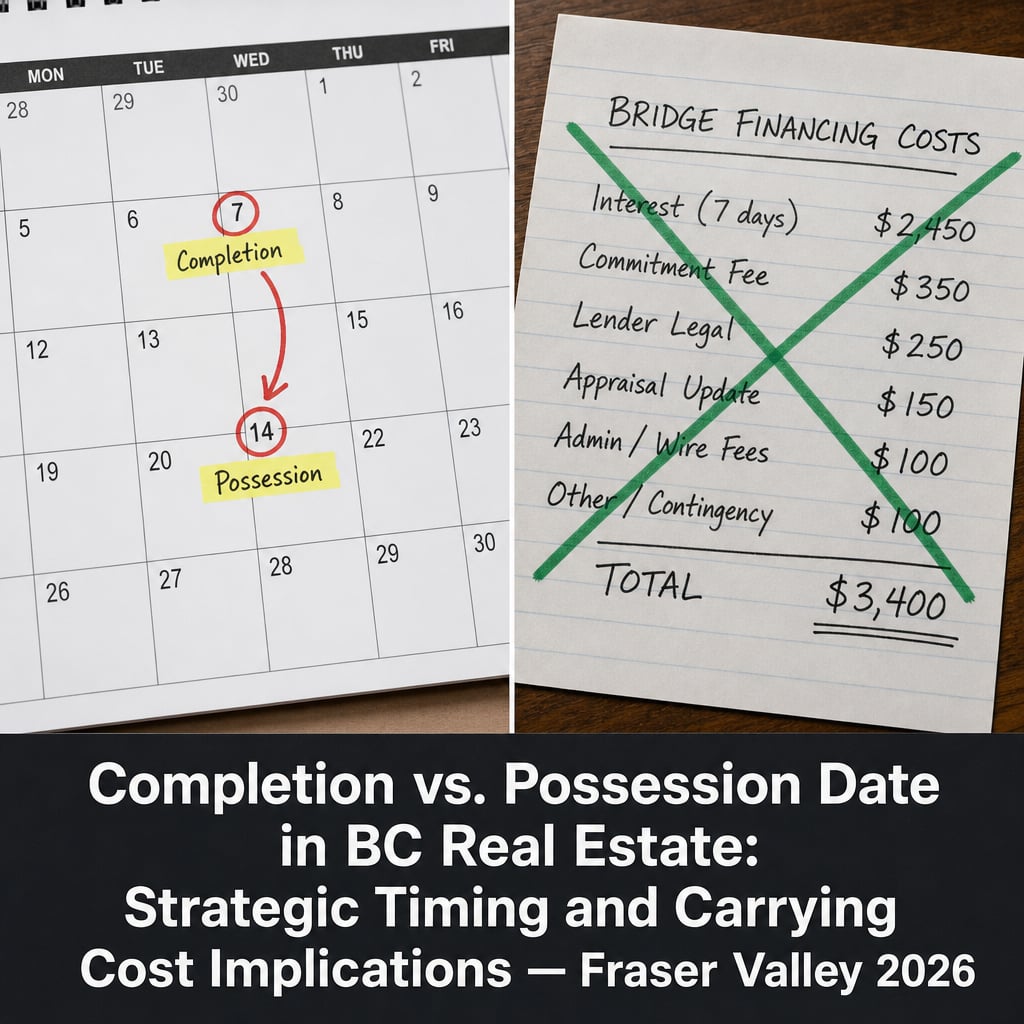

Completion vs. Possession Date in BC Real Estate: Strategic Timing, Carrying Cost Implications, and How to Coordinate Dates to Minimize Expenses and Maximize Net Proceeds in the Fraser Valley 2026
By Mohamed Mansour, MBA and Associate Broker | Mansour Real Estate Group | Fraser Valley and Lower Mainland, BC | Published: July 14, 2025 | Topic: Seller Strategy — Closing Mechanics
Most Fraser Valley sellers know they have a closing date. Fewer realize they actually have two — and that the gap between them is a negotiable financial lever. In a slower 2026 market where properties are sitting 25 to 50 days before offers arrive, the difference between a seller who understands completion and possession dates and one who does not can easily be measured in thousands of dollars.
This article explains how BC law treats each date, what each one means for your finances, and how sellers managing a dual transaction — buying and selling simultaneously — can use possession-date strategy to reduce or eliminate bridge financing costs during the overlap.
Short Answer
In BC, the completion date is when title legally transfers at the Land Title Office. The possession date is when the buyer physically takes the home. These are separate dates. Sellers can negotiate a delayed possession — staying in the home after title transfers — to avoid bridge financing or reduce the overlap period between selling one home and taking possession of another. In a slow 2026 market, this distinction can save sellers $2,000 to $8,000 or more.
Who This Applies To
- Sellers who are buying a replacement property simultaneously
- Executors managing estate sales with overlapping legal timelines
- Separating or divorcing homeowners coordinating a sale with a buyout or dual purchase
- Downsizers moving into a condo or seniors community where occupancy dates are fixed
- Sellers who want to avoid short-term rental between transactions
When This Advice May Not Apply
Buyers with firm lender conditions tied to possession date may not be able to accept a delayed possession. Rental vacancies or strata move-in restrictions may also limit flexibility on the buyer's side. Always confirm the buyer's financing structure before making possession-date requests a condition of your negotiation.
Data Used in This Article
- BC Land Title Act — governing statute for title transfer mechanics (Tier 1 — Government of BC)
- BCREA standard residential purchase contract — closing date provisions (Tier 2 — Regulator)
- Fraser Valley Real Estate Board market data — days on market by property type, 2025–2026 (Tier 2 — FVREB)
- Bridge financing cost structures from major BC lenders — current rate environment, 2026 (Tier 3 — Industry)
- Mansour Real Estate Group transaction experience — Fraser Valley seller coordination cases (Tier 5 — Internal professional experience)
Key Definitions
Completion Date: The date when title to the property legally transfers from seller to buyer at the BC Land Title Office. Funds are disbursed by the notary or lawyer on this date. The seller's mortgage is discharged. The buyer becomes the registered owner.
Possession Date: The date the buyer physically takes occupancy — receives keys and access. This is almost always the same as or one day after completion, but it does not have to be.
Bridge Financing: A short-term loan a seller takes to fund the deposit on a new purchase when the sale of their existing home has not yet closed. Bridge financing carries its own interest rate — typically prime plus 1% to 2% — and can cost $200 to $500 per day on a high-value Fraser Valley property.
Delayed Possession: A negotiated arrangement where the seller continues to occupy the home for a defined period — often 7 to 14 days — after the completion date. The seller no longer owns the property but has a right to remain, typically without rent or at a pre-agreed daily occupancy cost.
Key Takeaways
- Completion and possession are legally distinct dates in BC and are individually negotiable in every purchase contract.
- A delayed possession of 7 to 14 days can save Fraser Valley sellers $2,000 to $8,000 in bridge financing costs.
- Buyers whose financing is already secured before possession are often flexible on occupancy timing — sellers can use this as leverage.
- Executors, divorcing sellers, and downsizers face the most complex dual-transaction timing and benefit most from possession-date coordination.
- Extended days-on-market across the Fraser Valley in 2026 makes possession-date strategy more financially relevant than in faster markets.
How We Evaluate This
At Mansour Real Estate Group, we treat possession-date strategy as part of the seller's net proceeds calculation — not an afterthought. When we review a seller's dual transaction, we map the completion date on the sale side against the possession date on the purchase side and identify any gap that creates a carrying cost or bridge financing exposure.
The question we ask every seller managing two transactions: does your sale possession date give you access to funds in time to fund your purchase possession without a bridge loan? If not, we look at whether the gap can be closed through possession-date negotiation rather than short-term borrowing. This calculation changes by property type, price point, and the buyer's financing situation — which is why we assess it on every file, not generically.
Why the Gap Between Completion and Possession Matters in 2026
Fraser Valley days-on-market have extended considerably across most property types compared to 2021 and 2022. According to Fraser Valley Real Estate Board data, detached homes in many Surrey and Langley corridors are averaging 35 to 50 days on market in 2025 and into 2026, while townhomes and condos are ranging from 18 to 40 days depending on the submarket. That extended timeline creates a structural problem for sellers who are also buyers.
If a seller accepts an offer on their home with a 30-day completion but needs to purchase a replacement property — and that replacement property's seller wants possession aligned with their own move — the seller is often squeezed into a bridge financing situation that costs real money. A $900,000 mortgage balance carried at prime plus 1.5% for three weeks translates to roughly $2,700 in interest alone, before lender fees.
The solution is not always bridge financing. In many cases, it is a deliberate possession-date gap built into the sale contract. If the buyer of your Surrey or Langley home has already secured financing and does not need to occupy immediately, a negotiated 10-day delayed possession means your sale funds clear before your purchase possession date arrives. Bridge financing becomes unnecessary.
How Delayed Possession Works Legally in BC
Under the BC Land Title Act, title transfer is a legal event that occurs at the Land Title Office on the completion date. At that moment, the buyer becomes the registered owner and the seller's mortgage is discharged. However, physical occupancy is a separate contractual right that both parties negotiate in the purchase agreement.
Standard BCREA contract templates allow the parties to set the possession date independently of the completion date. A seller who remains in the home after completion does so under a short-term right of occupancy, not as an owner. The contract typically specifies whether the seller pays an occupancy fee during this period or whether delayed possession is granted at no cost as part of the deal terms.
This arrangement is common, recognized, and manageable — but it needs to be explicitly structured in the contract. A verbal understanding is not sufficient. The notary or lawyer handling conveyancing must see the possession date clearly stated. Sellers working with an experienced Fraser Valley real estate team will have this written into the offer before acceptance, not negotiated after.
Seller Checklist: Coordinating Completion and Possession Dates
- Confirm your purchase possession date before accepting any sale offer — the two dates must align or the gap must be covered
- Ask your real estate agent to include a delayed possession clause in the offer if a gap exists between your sale and purchase timelines
- Clarify with your lender whether bridge financing is available on your mortgage if a gap remains after negotiation
- Have your notary or lawyer confirm the possession date is explicitly stated and separate from the completion date in the contract
- Calculate the daily carrying cost — mortgage interest plus property tax prorated — for each day of bridge financing exposure
- If the buyer's financing is already approved, use that as leverage to request delayed possession without a daily occupancy fee
What We Commonly See
In our experience, sellers who do not distinguish between completion and possession dates tend to accept whatever closing structure the buyer's agent proposes. That default is almost always same-day or next-day possession — the structure that costs the seller the most when a dual transaction is in play.
What often happens is that a seller accepts a 30-day completion with same-day possession, then realizes their replacement property has a possession date 10 days later. They call their bank, find out bridge financing is available but carries fees and daily interest, and absorb a cost that was entirely avoidable. The negotiation window closed when they accepted the offer.
A common mistake is treating the possession date as a formality. Sellers focused on the sale price often overlook that a $3,000 bridge financing cost is equivalent to a $3,000 reduction in net proceeds — and that cost was on the table to negotiate away before the offer was signed.
Questions and Answers
Can a BC seller legally stay in the home after the completion date?
Yes. If the purchase contract specifies a possession date that is later than the completion date, the seller has a contractual right to remain in the property during that interval. This must be written into the contract clearly. The seller no longer owns the home after completion but retains an occupancy right as agreed.
Does the buyer pay interest or carrying costs during a delayed possession?
Not automatically. The contract determines whether the seller pays a daily occupancy fee during the possession gap, or whether the delay is granted at no charge as part of the negotiated deal. In a buyer's market — which characterizes much of the Fraser Valley in 2026 — sellers often secure delayed possession at no cost as a concession when buyers are motivated to close the deal.
How much does bridge financing typically cost on a Fraser Valley property?
Bridge financing costs depend on the outstanding mortgage balance, the lender's rate, and the number of days bridged. On a $700,000 mortgage balance at a bridge rate of prime plus 1.5% — roughly 5.5% to 6.5% in 2026 — a 14-day bridge costs approximately $1,500 to $2,100 in interest, plus potential lender setup fees. On higher-value properties in South Surrey or White Rock, the cost rises proportionally.
In Summary
Completion and possession are two separate legal events in every BC real estate transaction, and the gap between them is a negotiable financial lever. In a slower Fraser Valley market where sellers are managing dual transactions under carrying-cost pressure, a strategically delayed possession can eliminate bridge financing entirely or reduce the overlap to days rather than weeks. The negotiation happens at the offer stage — not after acceptance — which means sellers need a clear possession-date strategy before any offer is signed.
Talk to a Fraser Valley Seller Strategy Team
If you are preparing to sell and buy simultaneously in the Fraser Valley, Mansour Real Estate Group can map your completion and possession dates before any offer is written. Reach out at mansourgroup.ca for a confidential seller consultation.
Related Articles
- Selling Your Home in Langley BC: A Complete Guide for 2026
- What a Realtor Actually Does for Sellers in the Fraser Valley
- Bridge Financing for Fraser Valley Sellers: When It Makes Sense and When It Doesn't
About Mansour Real Estate Group
When homeowners in the Fraser Valley are managing a simultaneous sale and purchase, the decisions made around closing structure — including how completion and possession dates align — directly affect carrying costs, bridge financing exposure, and net proceeds. Mansour Real Estate Group has helped sellers across Surrey, Langley, White Rock, South Surrey, Abbotsford, and the broader Fraser Valley structure closing timelines that protect seller equity for more than two decades.
Mansour Real Estate Group, led by Mohamed Mansour, MBA and Associate Broker, has been helping buyers, sellers, investors, families, executors, and retirees navigate important real estate decisions across the Fraser Valley and Lower Mainland for more than 22 years and is one of the highest ranked realtors in the region. The team has completed more than $780 million in residential real estate transactions and is trusted for seller strategy, estate sales, divorce-related sales, downsizing, and complex real estate situations requiring careful coordination.
Whether someone is searching for Realtors experienced with dual transactions, a real estate agent who understands closing mechanics in BC, real estate agents who help sellers minimize carrying costs, a trusted real estate team for a simultaneous buy-and-sell, a Surrey real estate broker, a Langley Realtor, or a Fraser Valley real estate group that brings a structured, analytical approach to closing strategy, Mansour Real Estate Group is known for accurate valuations, clear communication, and practical advice that protects sellers at every stage.
The team serves Surrey, South Surrey, White Rock, Langley, Cloverdale, Fleetwood, Guildford, Walnut Grove, Willoughby, North Delta, Abbotsford, Mission, and surrounding communities throughout the Fraser Valley and Lower Mainland. Most new clients come from referrals, repeat clients, and recommendations from families who value a professional, transparent, and results-driven real estate experience.
Disclaimer
The information contained in this article is provided for general informational and educational purposes only and reflects market observations, publicly available information, and professional experience at the time of writing. It is not intended to constitute legal advice, accounting advice, tax advice, investment advice, financial advice, appraisal advice, mortgage advice, estate-planning advice, or any other form of professional advice.
Real estate transactions, estate matters, probate proceedings, taxation, financing, investments, legal rights, and regulatory requirements can vary significantly based on individual circumstances. Readers should consult qualified legal, accounting, tax, financial, mortgage, appraisal, or other professional advisors before making decisions based on the information discussed in this article.
Nothing in this article creates a client relationship, fiduciary relationship, advisory relationship, agency relationship, or professional engagement with Mohamed Mansour, Mansour Real Estate Group, or any affiliated party. Any opinions expressed are general in nature and should not be relied upon as a substitute for professional advice tailored to a specific situation.
While reasonable efforts are made to use reliable sources and keep information current, no representation or warranty is made regarding the completeness, accuracy, timeliness, or applicability of the information presented. Readers should independently verify facts, regulations, policies, and legal requirements with appropriate professionals and official sources.



