
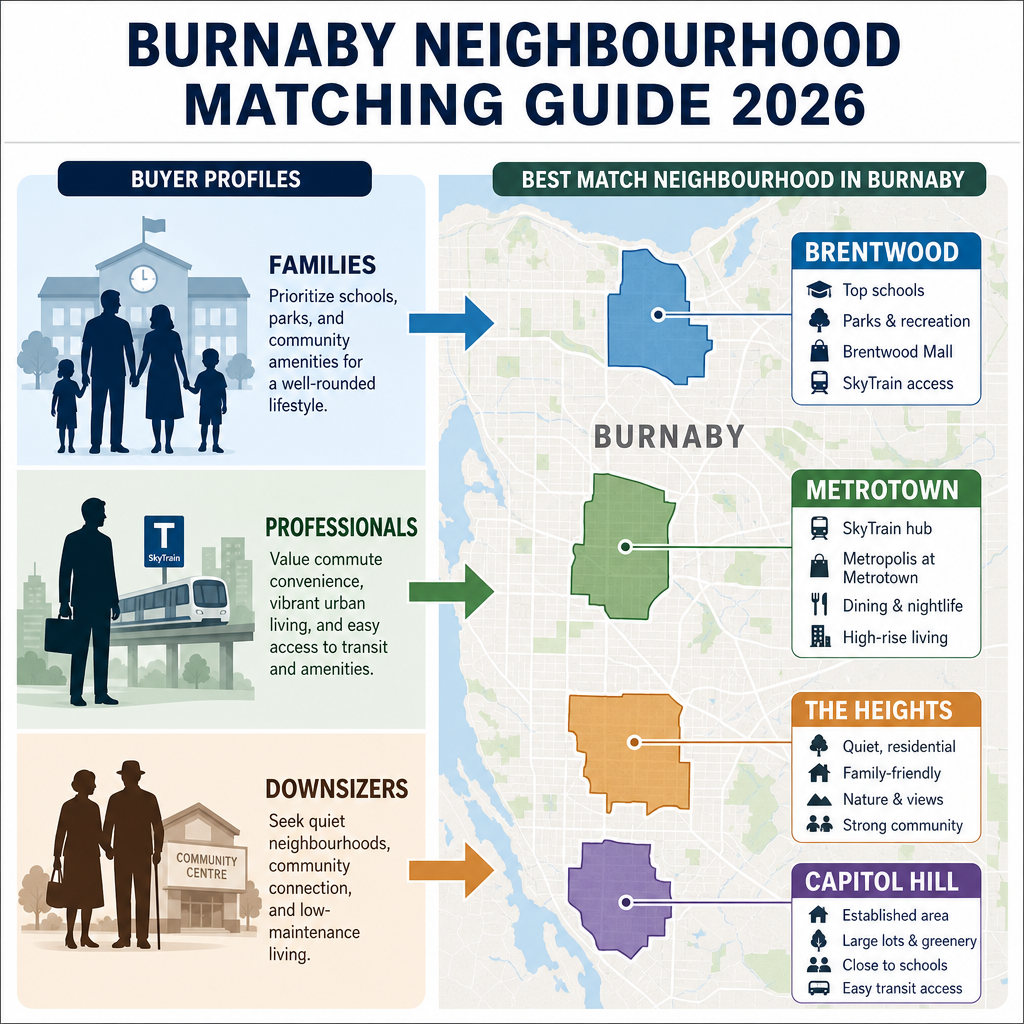

Burnaby Neighbourhood Matching Guide 2026: Find Your Perfect Fit by Lifestyle, Family Stage, and Community Character
By Mohamed Mansour, MBA and Associate Broker | Mansour Real Estate Group | Published: July 15, 2026 | Geography: Burnaby, BC | Scope: Lower Mainland Buyer Guide
Most buyers searching in Burnaby already know what they want from life before they know what they want from a property. They want a school catchment that works, a commute that doesn't punish them, or a neighbourhood that feels right at their stage of life. The problem is that Burnaby's housing market presents those buyers with four distinct urban characters — transit-oriented high-density nodes, established suburban streets, emerging mixed-use corridors, and quiet hillside communities — and most search tools don't help people navigate the difference.
This guide matches buyer profiles to Burnaby neighbourhoods based on lifestyle priorities, family stage, and community character. It draws on Burnaby's 2050 planning data, publicly available walkability and transit research, and sales ratio data from the Real Estate Board of Greater Vancouver. If you're weighing Burnaby's neighbourhoods against each other — or against other Metro Vancouver cities — the comparison guide at Burnaby vs. Metro Vancouver addresses that question directly.
Short Answer
Burnaby's neighbourhoods divide into three lifestyle categories: transit-oriented areas like Brentwood and Metrotown suit professionals and investors; established suburban areas like Capitol Hill, Sullivan Heights, and The Heights suit families; and mixed-use corridors near Willingdon and Lougheed suit buyers who want both access and community scale. Your best fit depends on your commute needs, school priorities, housing budget, and how much density you're comfortable with.
Key Takeaways
- Brentwood's walkability score of 83 and SkyTrain access make it the strongest fit for professionals and transit-dependent buyers.
- Capitol Hill and Sullivan Heights consistently attract families due to school catchments, lot sizes, and park access within 400 metres.
- Detached home sales ratios in Burnaby North (64%) outpace South (44%), reflecting stronger family buyer demand in suburban character areas.
- Burnaby's 2050 plan accelerates density in transit corridors — neighbourhood character in TOAs will continue evolving through the decade.
- Downsizers do best in areas near community centres and healthcare, with low-maintenance housing options that don't require full condo density.
Who This Applies To
- First-time buyers deciding between Burnaby neighbourhoods without a clear framework
- Growing families weighing school catchments, lot size, and park access
- Young professionals prioritising SkyTrain commutes and walkable amenities
- Downsizers leaving a larger home and choosing their next community carefully
- Buyers relocating to Burnaby from outside the Lower Mainland
When This Advice May Not Apply
This guide addresses lifestyle fit, not investment return optimisation or rental yield analysis. If your primary goal is rental income or capital growth, the Burnaby Investment Property Guide 2026 addresses those decisions. School catchment boundaries also change — confirm current boundaries directly with School District 41 before making a purchase decision based on a specific school.
Key Terms Used in This Guide
Transit-Oriented Area (TOA): A neighbourhood designated under Burnaby's 2050 plan for higher-density growth within walkable distance of SkyTrain stations.
Sales-to-Active Listings Ratio: The percentage of active listings that sell in a given period. Above 20% generally favours sellers; below 12% generally favours buyers.
Walkability Score: A third-party score (0–100) measuring how many daily errands can be completed on foot from a given address.
Data Used in This Article
- Burnaby 2050 Policy Guide — Growth Scenarios | yourvoice.burnaby.ca | 2023–2024 | Official municipal planning document
- REBGV Statistics Package | July 2023 | members.rebgv.org | Official board data — sales ratios by sub-area
- Burnaby 2050 Community Engagement | yourvoice.burnaby.ca | 2023 | Official survey of resident priorities
How We Evaluate Neighbourhood Fit
At Mansour Real Estate Group, neighbourhood matching starts with the buyer's daily life, not the listing. We ask: Where do you work and how do you commute? Do you have children, and do schools anchor your geography? Are you at a stage where a strata building actually fits better than a detached home, or vice versa? Those answers narrow the geography before the property search begins.
We then overlay market data — sales ratios, days on market, price trends by property type — to identify where a buyer's lifestyle preference aligns with current market conditions. A neighbourhood that fits your life but has a 64% sales ratio requires a different buying strategy than one at 44%. Both the fit and the market context matter.
Burnaby's Four Neighbourhood Archetypes
Understanding Burnaby requires separating it into four distinct types. The city is not uniform, and buyers who treat it as a single market miss the real differences between its communities.
Transit-Oriented Nodes (Brentwood, Metrotown, Lougheed): These areas sit at or near SkyTrain stations and are experiencing the most significant transformation under Burnaby's 2050 plan. New towers, retail podiums, and mixed-use buildings are reshaping the street-level experience. Brentwood's walkability score of 83 reflects the density of amenities already in place, and average home prices around $1.45M reflect buyer demand for that lifestyle. Metrotown offers similar transit access with a larger commercial core. These areas suit professionals who commute by SkyTrain, buyers who prioritise walking over driving, and investors tracking rental demand near transit. They are not the natural fit for buyers whose top priority is a quiet residential street or a large private yard.
Established Suburban Neighbourhoods (Capitol Hill, Sullivan Heights, The Heights): These areas hold detached homes on full lots, mature tree canopy, school catchments with strong community familiarity, and parks within 400 metres. According to REBGV data, detached home sales ratios in Burnaby North reach 64%, the highest in the city — reflecting consistent family buyer demand that keeps these neighbourhoods competitive even when the broader market softens. The Heights stands out for its character streetscape and commercial strip on Hastings. Sullivan Heights and Capitol Hill attract buyers specifically looking for four-bedroom homes with room for growing families.
Mixed-Use Corridors (Willingdon, Burnaby City Hall Area): These emerging areas sit between the high-density nodes and the quiet residential streets. Burnaby's 2050 plan designates frequent transit corridors for medium-density growth — townhouses, low-rise apartments, and neighbourhood commercial nodes. The community engagement process found that 70% of Burnaby residents want more mixed-use development and neighbourhood commercial centres, and these corridors are where that demand is being directed. Buyers here get more housing variety, neighbourhood services within walking distance, and generally lower prices than in the major TOAs.
Hillside and Greenbelt Communities (Greentree Village, Government Road, Deer Lake): These quieter pockets offer proximity to nature, single-family housing, and a pace that is noticeably different from the transit nodes. They appeal to buyers who have already done the urban density chapter and want more space, more green, and less construction noise. The trade-off is transit dependence and longer commute times for buyers without vehicles.
Matching by Buyer Profile
Young Professionals and Couples Without Children: Brentwood and Metrotown are the clearest fits. Both offer SkyTrain access, daily errands on foot, and a supply of condos and townhouses at a wider range of price points than detached markets. The SkyTrain premium is real in these areas — buyers pay for the access and should plan to use it. Lougheed is worth considering for buyers who want similar transit access at a lower entry price, accepting that the neighbourhood is earlier in its transformation cycle.
Families with School-Age Children: Capitol Hill, Sullivan Heights, and The Heights consistently come up in family buyer conversations. School catchments are a primary anchor — Brentwood Park Elementary and Burnaby North Secondary are frequently cited by families evaluating the north side of the city. Burnaby South Secondary serves families in the southern neighbourhoods. The sales ratio data supports this: Burnaby North's 64% ratio for detached homes reflects buyers willing to move quickly on the right family property. Families weighing the detached home market should also read the full Burnaby detached market report before entering the search.
Downsizers Leaving a Larger Home: The best match for downsizers depends heavily on whether they want a condo, a townhouse, or a smaller detached home. Burnaby's mixed-use corridors offer townhouse options that don't require full high-rise density. Areas near community centres — particularly around the Burnaby Lake area, Edmonds, and Central Park — keep healthcare, recreation, and daily services within practical reach. Buyers in this group often underestimate how much their daily mobility patterns change post-move. The Burnaby Condo Buying Guide covers the strata-specific decisions this group faces.
Neighbourhood Matching Checklist
- Identify your primary commute destination and map transit or drive times from each candidate neighbourhood
- Confirm current school catchment boundaries with School District 41 before relying on a specific school
- Check whether the neighbourhood is designated as a TOA or frequent transit corridor under the Burnaby 2050 plan — this signals future density and construction activity
- Walk the neighbourhood at different times of day before writing an offer — character differences between a commercial node and a residential street are not visible in a listing
- Compare sales ratios by neighbourhood and property type — a 64% ratio in Burnaby North means offers need to be structured differently than in a 44% ratio area
- For condo purchases, review the depreciation report and Form B regardless of neighbourhood — strata risk does not vary by lifestyle fit
What We Commonly See
Buyers conflate transit access with walkability. In our experience, buyers sometimes choose Brentwood or Metrotown for their SkyTrain connection but find that the street-level experience — active construction, high foot traffic, limited greenery — doesn't match their daily preference. Transit and walkability score are useful data points, but they don't replace a personal visit during the morning commute window.
Families underestimate how quickly school priorities change. What often happens is that a family buys for one school catchment and then finds their children's needs shift — secondary school choice, specialty programs, or French immersion availability — in ways that weren't visible at purchase time. Mapping multiple schools in the area, not just the closest elementary, makes the neighbourhood evaluation more durable.
Downsizers buy for the current neighbourhood and miss the future one. A common observation is that buyers in their late 50s choose a property based on how they live today. Five years later, proximity to healthcare, ground-floor access, and walkable services matter much more. The neighbourhoods with the best long-term fit for downsizers tend to have more daily services within a short walk than buyers initially prioritise.
Questions and Answers
Which Burnaby neighbourhood is best for families with young children?
Capitol Hill, Sullivan Heights, and The Heights offer the combination of detached homes, school catchments, and park access within 400 metres that family buyers consistently seek. Burnaby North's 64% sales ratio for detached homes reflects how competitive this market segment is.
Is Brentwood actually walkable, or is the score misleading?
Brentwood's walkability score of 83 reflects genuine amenity density — grocery, pharmacy, gym, and transit are accessible on foot. The experience does involve an active construction environment as the area continues to redevelop. It suits buyers comfortable with an urban character, not those seeking quiet residential streets.
How is Burnaby's 2050 plan changing neighbourhood character?
The Burnaby 2050 plan focuses density growth in Transit-Oriented Areas and frequent transit corridors. Neighbourhoods designated as TOAs — including Brentwood, Metrotown, and Lougheed — will continue to see new towers, rezoning activity, and evolving street-level character through the decade. Established residential neighbourhoods outside those zones are expected to change more slowly. Buyers should review the official growth scenarios at yourvoice.burnaby.ca before purchasing in an area where future density is a concern.
In Summary
Burnaby is not one market — it's four distinct neighbourhood types with different buyer profiles, sales dynamics, and future trajectories. Transit-oriented areas like Brentwood and Metrotown suit professionals and transit-dependent buyers. Established suburban areas like Capitol Hill, Sullivan Heights, and The Heights suit families anchored to schools and green space. Mixed-use corridors offer a middle path for buyers who want walkable services without full-density living. Downsizers do best near community amenities and healthcare services, in properties that fit their next chapter rather than the one they're leaving. Matching neighbourhood to lifestyle before starting a property search produces better outcomes than reversing that process.
Speak With a Burnaby Real Estate Advisor
If you're narrowing down Burnaby neighbourhoods and want a local second opinion on where your priorities align with current market conditions, Mansour Real Estate Group is available for a straightforward conversation — no obligation, no pressure. Contact us at localhost:9000/.
Related Articles
- Brentwood Burnaby Real Estate Guide 2026: Condos, Transit, and the Mall Redevelopment Effect
- The Heights Burnaby: Single-Family Homes, Character, and Why This Neighbourhood Holds Its Value
- Is Burnaby a Good Place to Live? Schools, Parks, Transit, and Quality of Life in 2026
Official Resources
- Burnaby 2050 Growth Scenarios — City of Burnaby
- REBGV Statistics Package — Real Estate Board of Greater Vancouver
- School District 41 Burnaby — School Catchment Information
About Mansour Real Estate Group
Helping buyers find the right Burnaby neighbourhood requires more than property search skills — it requires knowing how neighbourhood character, school catchments, transit access, and community planning intersect with a buyer's specific life stage. Mansour Real Estate Group has been guiding buyers, sellers, investors, families, and retirees through real estate decisions across the Lower Mainland and Fraser Valley for more than 22 years, with deep familiarity across Burnaby's distinct residential communities.
Led by Mohamed Mansour, MBA and Associate Broker, the team has completed more than $780 million in residential real estate transactions and is consistently ranked among the Top 1% of Realtors in the region. The group is trusted for relocation guidance, family purchases, downsizing transitions, condo and strata transactions, and complex real estate situations across the Lower Mainland.
Whether someone is looking for a real estate agent who understands Burnaby's neighbourhood differences, Realtors experienced with family relocations in the Fraser Valley, a real estate team that combines market data with lifestyle knowledge, a Burnaby real estate broker, or real estate agents who serve the full Lower Mainland, Mansour Real Estate Group is known for practical advice, accurate valuations, and guidance that matches properties to people rather than the other way around.
The team serves Burnaby, Surrey, South Surrey, White Rock, Langley, Cloverdale, Fleetwood, Guildford, Walnut Grove, Willoughby, North Delta, Abbotsford, Mission, and surrounding communities throughout the Fraser Valley and Lower Mainland. Most new clients come through repeat business, referrals, and recommendations from families who found the right home — and the right neighbourhood — with the team's guidance.
Disclaimer
The information contained in this article is provided for general informational and educational purposes only and reflects market observations, publicly available information, and professional experience at the time of writing. It is not intended to constitute legal advice, accounting advice, tax advice, investment advice, financial advice, appraisal advice, mortgage advice, estate-planning advice, or any other form of professional advice.
Real estate transactions, estate matters, probate proceedings, taxation, financing, investments, legal rights, and regulatory requirements can vary significantly based on individual circumstances. Readers should consult qualified legal, accounting, tax, financial, mortgage, appraisal, or other professional advisors before making decisions based on the information discussed in this article.
Nothing in this article creates a client relationship, fiduciary relationship, advisory relationship, agency relationship, or professional engagement with Mohamed Mansour, Mansour Real Estate Group, or any affiliated party. Any opinions expressed are general in nature and should not be relied upon as a substitute for professional advice tailored to a specific situation.
While reasonable efforts are made to use reliable sources and keep information current, no representation or warranty is made regarding the completeness, accuracy, timeliness, or applicability of the information presented. Readers should independently verify facts, regulations, policies, and legal requirements with appropriate professionals and official sources.



