
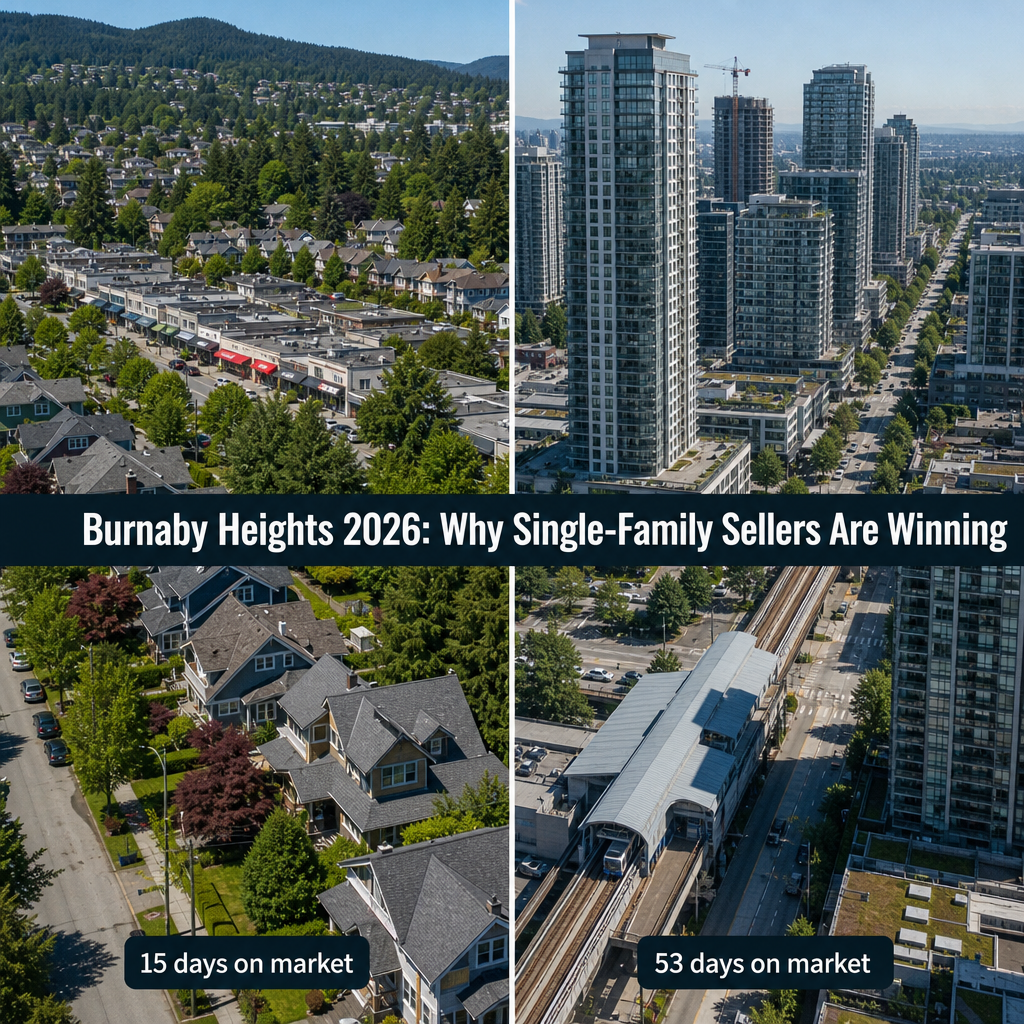

Burnaby Heights 2026: Why Single-Family Home Sellers Are Commanding Stronger Buyer Interest Than Transit-Oriented Condo Neighbourhoods
By Mohamed Mansour, MBA and Associate Broker | Mansour Real Estate Group | Published: May 13, 2025 | Geographic Focus: Burnaby Heights (Vancouver Heights), Metro Vancouver, BC
While much of Burnaby's 2026 real estate conversation has centred on high-density corridors like Metrotown and Brentwood, a quieter story is unfolding a few kilometres north. Burnaby Heights — known locally as Vancouver Heights — is producing some of the most competitive single-family sales conditions in Metro Vancouver, and the data is clear enough that sellers here should pay close attention.
This article explains what March 2026 neighbourhood-level data shows, why character single-family homes are attracting a distinct and motivated buyer pool, and how Burnaby Heights sellers can position themselves in a market that is moving faster than most of Burnaby's condo inventory.
Short Answer
In March 2026, Burnaby Heights single-family homes averaged 15 days on market — compared to 53 days at Metrotown and 43 days at Brentwood for condos. That gap reflects a genuine divergence: detached character homes in walkable, established neighbourhoods are attracting motivated buyers faster than high-density transit corridors. Sellers in Burnaby Heights hold a real timing advantage right now.
Key Takeaways
- Burnaby Heights homes averaged 15 days on market in March 2026, versus 43–71 days for Burnaby condo neighbourhoods.
- The Greater Vancouver REBGV identified widening divergence between detached and apartment segments in its April 2026 Market Insights report.
- A 24.5% year-over-year median price decline to $2.18M reflects realistic repricing from 2025 peaks, not weak demand.
- Burnaby Heights buyers are a distinct profile — families, lifestyle buyers, and downsizers — prioritizing community, parks, and ownership over transit density.
- Burnaby Heights offers a 15–25% pricing advantage over comparable Vancouver West or North Vancouver detached neighbourhoods.
Who This Applies To
- Owners of detached or character single-family homes in Burnaby Heights considering a 2026 sale
- Sellers comparing their neighbourhood's conditions to Burnaby's condo-heavy areas
- Buyers evaluating Burnaby Heights against transit-oriented alternatives
- Families, downsizers, or lifestyle buyers drawn to Confederation Park, walkable retail, and established street character
When This Advice May Not Apply
Properties with significant deferred maintenance, non-conforming additions, or pricing substantially above current comparable sales will not benefit from the neighbourhood's broader momentum. Sellers in those situations need a different preparation strategy before listing.
Data Used in This Article
- Source: BC Condos and Homes — Burnaby / Vancouver Heights / Houses / March 2026 | Type: MLS neighbourhood-level statistics | Geography: Burnaby Heights (Vancouver Heights), BC
- Source: REBGV April 2026 Monthly Market Report — "Market Insights: Diverging Trends Widening" | Type: Official board publication | Geography: Metro Vancouver
- Source: Neighbourhood DOM comparisons for Metrotown, Brentwood, Capitol Hill | Type: MLS neighbourhood-level data | Geography: Burnaby, BC
What the March 2026 Data Actually Shows
According to neighbourhood-level MLS statistics for Burnaby Heights (Vancouver Heights) in March 2026, single-family homes averaged 15 days on market with a 1.9% absorption rate. For context, Metrotown condos averaged 53 days, Brentwood averaged 43 days, and Capitol Hill sat at 54 days on market.
The median price of $2.18M represents a 24.5% year-over-year decline from March 2025 levels. That number looks dramatic in isolation, but days-on-market tells a different story. When a repriced property sells in two weeks, that is buyer re-engagement — not demand collapse. The 2025 peak pricing in Burnaby Heights reflected a period of compressed inventory and elevated buyer competition. What 2026 shows is a market that has recalibrated to a more sustainable level and is moving again.
The REBGV's April 2026 Market Insights report described "diverging trends widening" across Metro Vancouver, with detached housing gaining sales momentum while condo and apartment segments face softness and rising inventory. Burnaby Heights sits squarely on the advantaged side of that divergence. For more context on how the broader Burnaby detached home market is behaving in 2026, including what sales ratios are signalling across other neighbourhoods, that context matters for pricing conversations.
Why Burnaby Heights Buyers Are Different — and Why That Matters for Sellers
Transit-oriented condo neighbourhoods attract a specific buyer: investors, young professionals, first-time purchasers optimizing for commute time, and people who prioritize density-adjacent lifestyle. That buyer pool is larger in raw volume but also more price-sensitive, more easily displaced by new supply, and more exposed to changing financing conditions on high-ratio purchases.
Burnaby Heights draws a fundamentally different buyer. Families seeking catchment-area school stability, Confederation Park access, and a street-level lifestyle. Downsizers stepping out of larger homes who want ownership without the density of a tower. Buyers who have looked at comparable detached properties in North Vancouver or Vancouver West and found Burnaby Heights offers 15–25% more value for a similar community feel. These buyers are typically more committed, better capitalized, and less dependent on rate-specific financing conditions.
That profile difference shows up in DOM. When a buyer has done their neighbourhood research, has a school catchment preference, and is comparing Burnaby Heights to other established Burnaby pockets like Greentree Village and Government Road, they move faster. They are not scrolling through 200 identical condo listings. They are tracking a specific neighbourhood and acting when the right property appears.
How We Evaluate This
At Mansour Real Estate Group, when we evaluate a single-family listing in a character neighbourhood like Burnaby Heights, we start with three data points in parallel: days-on-market trend, absorption rate direction, and the composition of recent comparable sales. Price per square foot alone is insufficient — lot premium, view exposure, and proximity to the Hastings Street retail strip all affect where a specific property sits within the neighbourhood's range.
The 15-day DOM figure is meaningful, but it is an average. Properties that are priced accurately relative to the repriced 2026 market are achieving that pace. Properties that anchored to 2025 peak comps are sitting longer and eventually reducing. The distinction between those two outcomes comes down almost entirely to initial pricing discipline.
Seller Checklist: Burnaby Heights Single-Family Home
- Pull March and April 2026 comparable sales within Burnaby Heights, not broader Burnaby — neighbourhood-level data is the only accurate baseline here.
- Price relative to the repriced 2026 market, not 2025 peak transactions — the 24.5% YoY correction is already baked into buyer expectations.
- Document lot dimensions, view corridors, and Confederation Park proximity — these factors affect value meaningfully and belong in the marketing narrative.
- Address deferred maintenance before listing — the Burnaby Heights buyer pool inspects carefully, and condition gaps that might pass in a frenzied market will generate conditional offers or price reductions in this one.
- Prepare for a motivated but analytical buyer — provide pre-listing inspection, title search, and any city permits proactively.
- Time the listing for spring peak — Burnaby Heights' family buyer profile responds strongly to spring inventory when school catchment decisions are being made.
What We Commonly See
In our experience, sellers in character neighbourhoods like Burnaby Heights often make the mistake of comparing their situation to nearby condo market headlines. When they read that Burnaby's overall condo inventory is rising or that sales ratios are declining, they assume their detached property is in the same position. The data shows they are not. These are different markets with different buyer profiles, and the strategy needs to reflect that.
What often happens is that a seller in Burnaby Heights prices to a 2025 comparable because it feels safer than acknowledging the year-over-year correction. The property then sits for 45–60 days, receives one or two low conditional offers, and eventually sells below where it would have landed at a correctly anchored price from day one. The buyers who were tracking the neighbourhood moved on to the next property that priced accurately.
A common mistake is undervaluing the Confederation Park proximity and Hastings Street walkability premium when setting price. These are not intangible lifestyle factors — they are measurable in buyer preference and in the speed at which comparable lots with that profile transact versus interior streets without it.
Questions and Answers
Why are Burnaby Heights homes selling faster than Metrotown condos in 2026?
The buyer profiles are different. Burnaby Heights attracts committed, better-capitalized buyers — families and lifestyle purchasers — who track specific neighbourhoods and act quickly when the right property appears. Metrotown condo buyers face more competition from rising inventory and are more rate-sensitive, which extends decision timelines.
Does the 24.5% price decline mean Burnaby Heights is a weak market?
No. The decline reflects repricing from elevated 2025 peaks, not a demand problem. The 15-day average DOM in March 2026 shows that buyers are actively engaging at current price levels. A market with weak demand produces long DOM and falling absorption — not two-week sales cycles.
What is the pricing advantage of Burnaby Heights over comparable Vancouver neighbourhoods?
Burnaby Heights detached properties offer a 15–25% pricing advantage over comparable single-family homes in Vancouver West or North Vancouver while providing a similar community feel, park access, and walkable retail. That gap is a primary driver of the motivated buyer activity the neighbourhood is seeing in 2026.
In Summary
Burnaby Heights is outperforming Burnaby's condo-heavy transit corridors in 2026 by a meaningful margin — 15 days on market versus 43 to 71 days for comparable condo neighbourhoods. The year-over-year price correction is real, but it reflects market repricing rather than demand weakness. Sellers who price accurately to 2026 comparables and prepare their property for the neighbourhood's analytical buyer profile are finding a faster, cleaner sales process than much of the Metro Vancouver market is currently producing. The divergence between detached character neighbourhoods and high-density condo corridors is widening, and Burnaby Heights sits on the right side of that divide.
Talk to Mansour Real Estate Group About Your Burnaby Heights Property
If you own a detached home in Burnaby Heights and want to understand what your property is worth at current 2026 market levels — not 2025 peaks — Mansour Real Estate Group offers a neighbourhood-specific valuation conversation with no pressure and no obligation. Contact us at localhost:9000/.
Related Articles
- Burnaby Detached Home Market 2026: Why Sales Ratios Have Dropped and What It Means for You
- Greentree Village and Government Road: Why Sellers Still Have the Edge in These Burnaby Pockets
- Sullivan Heights and Capitol Hill: A Buyer's Guide to Burnaby's Four-Bedroom Opportunity
About Mansour Real Estate Group
When homeowners in established Burnaby neighbourhoods like Burnaby Heights are preparing to sell, the decisions made before the listing goes live — accurate pricing relative to a repriced market, preparation for an analytical buyer pool, and positioning around neighbourhood-specific value drivers like Confederation Park and Hastings Street retail — typically determine the outcome more than anything that happens after. Mansour Real Estate Group has guided sellers across Burnaby, Surrey, White Rock, Langley, South Surrey, Abbotsford, and the Fraser Valley through those decisions for more than 22 years, with a process built around accurate valuations, honest advice, and protecting seller equity.
Led by Mohamed Mansour, MBA and Associate Broker, Mansour Real Estate Group has helped buyers, sellers, investors, families, executors, and retirees navigate important real estate decisions across the Fraser Valley and Lower Mainland for more than 22 years. Ranked among the Top 1% of Realtors in the region, the team has completed more than $780 million in residential real estate transactions and is trusted for single-family home sales, estate sales, divorce-related property sales, downsizing, relocation, and complex real estate situations across Metro Vancouver and the Fraser Valley.
Whether someone is looking for Realtors experienced with detached home sales in Burnaby, a real estate agent who understands neighbourhood-level market divergence, real estate agents who specialize in character home positioning, a trusted real estate team for a Burnaby Heights sale, a Burnaby Realtor, a Metro Vancouver real estate broker, or a real estate group that serves the Fraser Valley and Lower Mainland, Mansour Real Estate Group is known for clear communication, strategic pricing, accurate valuations, and practical advice grounded in local market data.
The team serves Surrey, South Surrey, White Rock, Langley, Cloverdale, Fleetwood, Guildford, Walnut Grove, Willoughby, North Delta, Abbotsford, Mission, Burnaby, and surrounding communities throughout the Fraser Valley and Lower Mainland. Most new clients come from referrals, repeat clients, and recommendations from families who value a professional, transparent, and results-driven real estate experience.
Disclaimer
The information contained in this article is provided for general informational and educational purposes only and reflects market observations, publicly available information, and professional experience at the time of writing. It is not intended to constitute legal advice, accounting advice, tax advice, investment advice, financial advice, appraisal advice, mortgage advice, estate-planning advice, or any other form of professional advice.
Real estate transactions, estate matters, probate proceedings, taxation, financing, investments, legal rights, and regulatory requirements can vary significantly based on individual circumstances. Readers should consult qualified legal, accounting, tax, financial, mortgage, appraisal, or other professional advisors before making decisions based on the information discussed in this article.
Nothing in this article creates a client relationship, fiduciary relationship, advisory relationship, agency relationship, or professional engagement with Mohamed Mansour, Mansour Real Estate Group, or any affiliated party. Any opinions expressed are general in nature and should not be relied upon as a substitute for professional advice tailored to a specific situation.
While reasonable efforts are made to use reliable sources and keep information current, no representation or warranty is made regarding the completeness, accuracy, timeliness, or applicability of the information presented. Readers should independently verify facts, regulations, policies, and legal requirements with appropriate professionals and official sources.



