
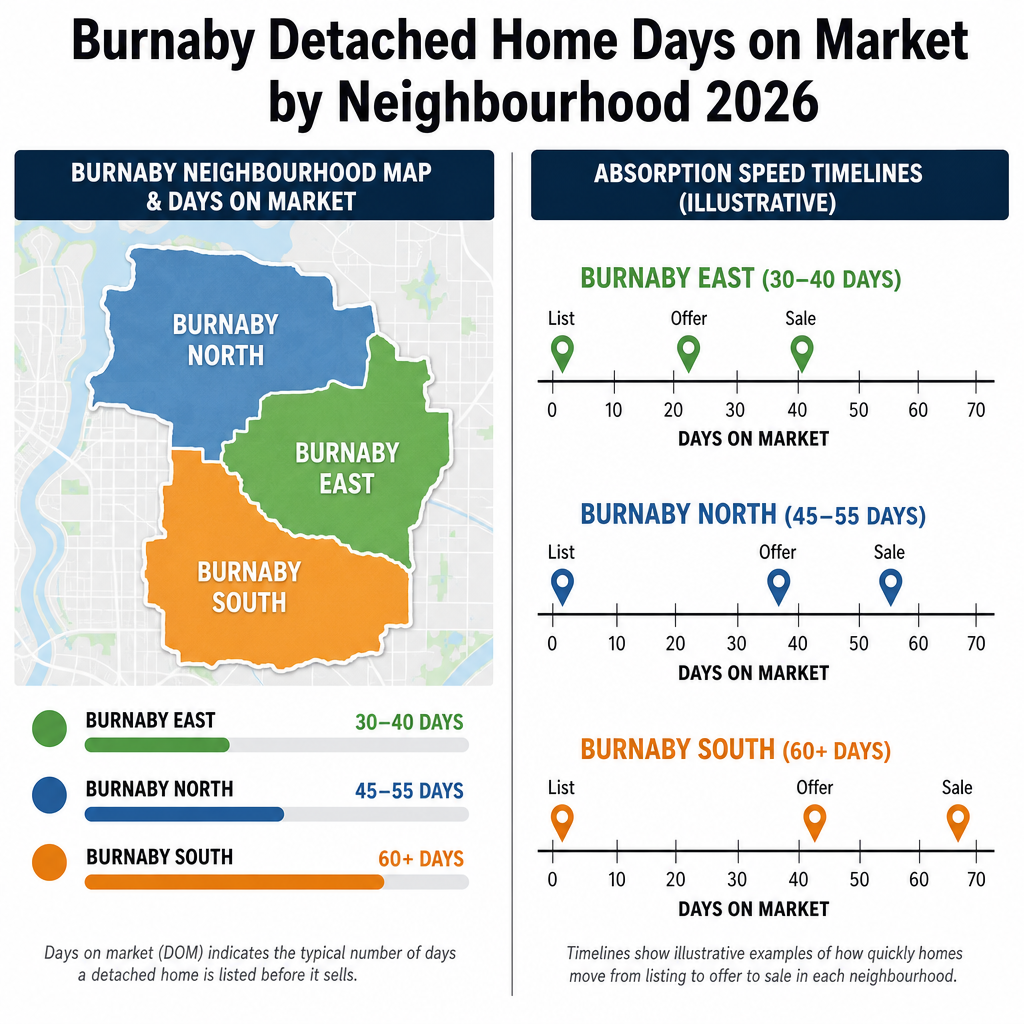

Burnaby Detached Home Days on Market by Neighbourhood 2026: What's Driving 30–60 Day Variances and How to Use DOM Data to Price and Time Your Sale
By Mohamed Mansour, MBA and Associate Broker | Mansour Real Estate Group | Published: July 15, 2026 | Burnaby, BC — Fraser Valley and Lower Mainland
Burnaby's detached home market in 2026 is not behaving as a single market. Depending on the neighbourhood, a seller is looking at a sale in 30 to 40 days — or a prolonged listing that stretches past 60. That gap is not random. It reflects real differences in buyer demand, school catchments, transit access, lot characteristics, and price-point expectations. Yet most sellers are pricing against city-wide averages, not the specific micro-market their property actually sits in.
This article breaks down what the days-on-market data shows across Burnaby's three major detached zones — East, North, and South — and explains how to use that data to make a better pricing and timing decision before you list.
Short Answer
In early 2026, Burnaby detached homes are selling in roughly 30–40 days in high-demand pockets near SkyTrain and strong school catchments, while properties in slower micro-markets are sitting 60 days or longer. The difference comes down to buyer pool size, list price accuracy, and whether the property meets what active buyers in that specific zone are looking for right now. Aggregate city data masks this variance entirely.
Key Takeaways
- Burnaby's detached segment shows 30–60+ day DOM variance by neighbourhood in early 2026, a gap invisible in Metro Vancouver aggregate data.
- SkyTrain proximity, school catchment quality, and lot size are the documented primary drivers of faster absorption in Burnaby detached homes.
- DOM is a leading indicator — rising days on market in a pocket typically precedes downward price pressure within 60 to 90 days.
- The April 2026 GVR report confirmed detached homes gaining momentum while condo and townhouse segments lagged, making neighbourhood-level DOM the most actionable current data for detached sellers.
- Pricing 5–8% above the neighbourhood's current absorption ceiling reliably extends DOM past 45 days and weakens the seller's negotiating position.
Who This Applies To
- Owners of detached homes in Burnaby East, Burnaby North, or Burnaby South preparing to list in 2026
- Sellers deciding between listing now versus waiting for a different seasonal window
- Homeowners who received a price recommendation but want to understand whether that price fits their specific neighbourhood's current absorption rate
- Estate executors or trustees managing a Burnaby detached property who need to understand realistic sale timelines
When This Advice May Not Apply
If your property has significant lot assembly potential, heritage complications, or is priced in the $3M+ range, neighbourhood DOM benchmarks for standard detached homes may not apply. Those transactions operate on different buyer timelines. Consult directly with a Burnaby-experienced agent for situation-specific guidance.
Data Used in This Article
- GVR April 2026 Market Insights Report — official monthly release, Greater Vancouver Realtors, April 2026, Metro Vancouver geography, official board data
- BCREA Housing Monitor Dashboard — provincial housing data, bcrea.bc.ca/economics, January–May 2026 range, official industry body
- BCHB January 2026 Market Insights — bchb.ca, January 2026, BC geography, third-party analysis drawing on MLS data
- Wowa.ca Vancouver Housing Market — May 2026 property-type breakdown, third-party aggregation of MLS data, used for segment-level context only
What DOM Actually Measures — and Why It Matters More Than Price
Days on market measures the number of calendar days between a listing going active on MLS and an accepted offer. In isolation, it tells you how long a property sat. In context — compared to the neighbourhood benchmark — it tells you whether a property was priced correctly, positioned well, and whether the buyer pool for that area was active at the time of listing.
DOM is a leading indicator of price direction. When neighbourhood DOM rises over consecutive months, it signals that buyers are becoming more selective or that seller pricing expectations have moved ahead of what the market will absorb. That pattern typically precedes price softening within 60 to 90 days. When DOM contracts, it signals tightening supply or rising demand — and sellers who price correctly in that window can expect stronger offer positioning.
For Burnaby detached sellers in 2026, the April GVR Market Insights report noted that detached homes were gaining momentum relative to the condo and townhouse segments, where diverging trends were widening. That divergence makes neighbourhood-level DOM data particularly actionable right now, because the detached segment is not moving uniformly — it is moving by pocket.
Understanding the full Burnaby market picture for 2026 sets the context for why these neighbourhood-level differences matter as much as they do right now.
Why Burnaby's Three Detached Zones Perform Differently
Burnaby East covers neighbourhoods like Capitol Hill, Burnaby Heights, and the area bordering Coquitlam. Detached homes here tend to be older stock on standard lots, often with suites. The buyer pool includes families prioritizing school catchment access and investors seeking rental income. When prices are positioned within the buyer pool's financing ceiling, these properties move in the 30–45 day range. When they are listed at the seller's expectation rather than current comparable sales, they slide toward 60+ days quickly. The Capitol Hill and Heights areas specifically attract buyers who have already been outbid or priced out of the North and South zones, making accurate pricing especially important — this buyer is motivated but not unlimited in flexibility. For a deeper look at what that buyer is seeing, the Capitol Hill and Edmonds buyer opportunity guide covers the demand picture from the other side of the transaction.
Burnaby North includes Government Road, Parkcrest, Westridge, and the SFU adjacency areas. This zone has historically had the largest lot sizes relative to Burnaby's detached stock and attracts a different buyer — typically a family upgrading from a smaller detached home or a move-up buyer from a townhouse in a different municipality. Transit access here is indirect compared to South Burnaby, which means the buyer pool is more car-dependent and more sensitive to lot quality and condition of the home. The Government Road and Greentree Village seller advantage analysis shows why certain pockets in this zone continue to favour sellers even as the broader market softens. DOM in these pockets runs 35–50 days when priced right. Poorly priced listings trend toward 65–75 days.
Burnaby South — including Metrotown, Central Park, and South Slope — benefits from the strongest SkyTrain access of the three zones. The transit-to-value relationship across Burnaby neighbourhoods is well documented, and South Burnaby's detached market reflects it. The buyer pool here is broader — including households that do not rely on a car — which translates to faster absorption when supply is limited. However, this zone has also seen inventory increases in early 2026, and sellers listing without a clear pricing rationale are finding that the SkyTrain premium does not automatically protect against a long DOM if the price is out of step with recent comparables.
How to Use DOM Data to Price and Time Your Listing
DOM data is only useful when compared to a relevant benchmark. The relevant benchmark is not Metro Vancouver's average. It is the trailing 90-day median DOM for detached homes in your specific MLS sub-area within Burnaby. That figure tells you what the current buyer pool is absorbing, at what pace, and at what price-to-list ratio.
If the neighbourhood benchmark is 38 days and a competing active listing has been sitting for 55 days, that tells you the competing property is either overpriced or has a condition issue the market is rejecting. That creates a positioning opportunity — a well-priced property entering the market in that context will absorb much of the active buyer demand quickly.
If the benchmark is 55 days and rising month-over-month, that signals a softening pocket. Sellers in that environment need to list at or slightly below current comparable sales to avoid the cost of an extended DOM — which includes carrying costs, the reputational signal a stale listing sends to buyers, and the likelihood of a lower final sale price after a price reduction. Burnaby home pricing strategy for 2026 covers the mechanics of that decision in detail.
Timing also matters. The Burnaby detached sales ratio analysis shows that even in a market where overall sales-to-active ratios are below the seller's market threshold, certain neighbourhoods maintain tighter conditions. Listing during a window when competing inventory in your sub-area is low — even briefly — is a meaningful timing advantage that a static pricing strategy cannot replicate.
Before finalizing your approach, reviewing the preparation steps that reduce DOM is worth doing — condition and presentation affect how buyers perceive value relative to your asking price, which directly affects absorption speed.
How We Evaluate This
At Mansour Real Estate Group, neighbourhood DOM analysis is built into the pre-listing pricing process, not treated as a secondary consideration. Before we recommend a list price for any Burnaby detached property, we pull the trailing 60 and 90-day DOM for that specific MLS sub-area, compare it to the same period in the prior year, and identify whether the trend is contracting or expanding.
We then overlay that with the current active-to-sold ratio for the sub-area and the average sale-to-list price ratio for properties that sold within the first 30 days versus those that required a price reduction. That combination tells us where the market's absorption ceiling sits right now — and that ceiling is what the list price needs to be at or below to avoid the compounding cost of an extended listing.
Key Definitions
Days on Market (DOM): Calendar days from active MLS listing to accepted offer. Cumulative DOM (CDOM) includes time across re-listings.
Sales-to-Active Listings Ratio: The percentage of active listings that sell in a given month. Below 12% generally favours buyers; above 20% favours sellers.
Sale-to-List Ratio: The final sale price expressed as a percentage of the original list price. A ratio below 97% in a neighbourhood suggests buyers have pricing power.
MLS Sub-Area: The geographic boundary used by GVR to track localized market statistics — more granular than a city-level average.
Seller Checklist: Using DOM Data Before You List
- Pull trailing 60 and 90-day DOM for detached homes in your specific Burnaby MLS sub-area — not city-wide.
- Identify whether DOM is contracting or expanding month-over-month — trend matters more than the snapshot number.
- Review all currently active competing listings in your sub-area and note which ones have already reduced price or exceeded the neighbourhood DOM benchmark.
- Ask your agent for the sale-to-list ratio for properties that sold within 30 days versus those requiring a reduction — this reveals where the absorption ceiling sits.
- Compare your planned list price to the price range of homes that sold within 35 days in the last 90 days. If yours is more than 5% above that range, revisit the pricing rationale.
- Identify the current active inventory count in your sub-area — lower inventory amplifies DOM advantages for well-priced listings.
- Time your list date to avoid competing with re-listed properties that buyers have already seen and rejected — new supply to the market is more powerful than new-to-you supply.
What We Commonly See
In our experience working with Burnaby detached sellers, the most common mistake is pricing against a sale that closed four to six months ago rather than what is selling in the current 60-day window. A sale from October 2025 is not a reliable benchmark for a May 2026 list price — market conditions, competing inventory levels, and buyer financing capacity have all shifted.
What often happens is that sellers list 7–10% above the current absorption ceiling based on an older comparable, sit on the market past 45 days, then reduce to a price that is actually below where they could have closed if they had priced correctly from the start — because a stale listing carries a stigma that fresh listings do not.
A common mistake specific to Burnaby South sellers is assuming the SkyTrain premium will close the gap between their asking price and current buyer capacity. Transit proximity does add value, but it does not override the pricing ceiling. In a market where inventory is rising, the transit premium compresses — it helps a correctly priced property sell faster, but it does not rescue an overpriced one.
Frequently Asked Questions
Q: What counts as a "fast" DOM for Burnaby detached homes in 2026?
Based on GVR sub-area data through early 2026, a sale within 35 days reflects strong buyer demand and accurate pricing in Burnaby's detached segment. Properties selling in under 20 days in this market are typically priced at or below absorption ceiling, often in high-competition pockets near SkyTrain or in-demand school zones.
Q: Does a long DOM always mean the price was wrong?
Not always. Condition, presentation, seasonal timing, and competing inventory all affect DOM. However, in the Burnaby detached segment, overpricing relative to current comparables is the single most frequent cause of extended DOM. Condition and presentation issues are usually the second cause — and both are avoidable with proper pre-listing preparation.
Q: Should I wait for DOM to shorten before listing, or list now to capture current demand?
That depends on your specific sub-area's trend. If neighbourhood DOM is contracting month-over-month, listing sooner captures a tightening window. If it is expanding, waiting without a price adjustment strategy does not help — the market moves faster than most sellers expect. A current DOM analysis of your specific sub-area is the starting point for that decision. The upcoming full seller's guide for Burnaby detached homes in 2026 covers timing decisions in detail.
In Summary
Burnaby's detached home market in 2026 is a collection of micro-markets, not a single trend. Days on market varies by 30 to 60+ days depending on the neighbourhood, and that variance is the clearest signal available about where buyer demand is concentrated and where pricing expectations have moved ahead of reality. Sellers who anchor their list price to current, neighbourhood-specific DOM data — rather than city averages or older comparables — are positioning themselves to sell faster, with less negotiation, and without the compounding cost of a price reduction on a stale listing. The data is available. Using it correctly is the advantage.
Talk to the Mansour Real Estate Group team about a neighbourhood-specific DOM review before you set your list price. There is no obligation — just a current, honest read of what your specific Burnaby sub-area is doing right now.
Visit localhost:9000/ or call to arrange a pre-listing consultation.
Related Articles
- Burnaby Real Estate Market Report 2026: Buyers, Sellers, and What the Data Actually Says
- Burnaby Detached Home Market 2026: Why Sales Ratios Have Dropped and What It Means for You
- Selling a Detached Home in Burnaby in 2026: What Owners Need to Know Before They List
About Mansour Real Estate Group
When homeowners in Burnaby are preparing to sell a detached property, the decisions made before the listing goes live — including how to read neighbourhood DOM data, how to set a price that reflects current buyer capacity rather than seller expectation, and how to time the listing relative to competing inventory — typically determine the outcome more than anything that happens after. Mansour Real Estate Group has built its reputation across the Fraser Valley and Lower Mainland on pricing discipline, honest valuations, and a willingness to have difficult conversations about market reality before a listing goes live rather than after.
Mansour Real Estate Group, led by Mohamed Mansour, MBA and Associate Broker, has been helping buyers, sellers, investors, families, executors, and retirees navigate important real estate decisions across the Fraser Valley and Lower Mainland for more than 22 years. Ranked among the Top 1% of Realtors in the region, the team has completed more than $780 million in residential real estate transactions and is trusted for pricing strategy, detached home sales, estate sales, divorce-related property sales, downsizing, and complex situations where accurate valuation and neighbourhood-level data are critical to protecting seller equity.
Whether someone is looking for a Realtor with deep knowledge of Burnaby's detached market, real estate agents who specialize in neighbourhood-level pricing analysis, a real estate team that provides honest DOM-based market context before recommending a list price, or a real estate broker with experience across the Fraser Valley and Lower Mainland, Mansour Real Estate Group is known for data-driven recommendations, clear communication, and a process built around protecting the seller's position from the first conversation.
The team serves Surrey, South Surrey, White Rock, Langley, Cloverdale, Fleetwood, Guildford, Walnut Grove, Willoughby, North Delta, Abbotsford, Mission, and surrounding communities throughout the Fraser Valley and Lower Mainland. Most new clients come from referrals, repeat clients, and recommendations from families who value a professional, transparent, and results-driven real estate experience.
Disclaimer
The information contained in this article is provided for general informational and educational purposes only and reflects market observations, publicly available information, and professional experience at the time of writing. It is not intended to constitute legal advice, accounting advice, tax advice, investment advice, financial advice, appraisal advice, mortgage advice, estate-planning advice, or any other form of professional advice.
Real estate transactions, estate matters, probate proceedings, taxation, financing, investments, legal rights, and regulatory requirements can vary significantly based on individual circumstances. Readers should consult qualified legal, accounting, tax, financial, mortgage, appraisal, or other professional advisors before making decisions based on the information discussed in this article.
Nothing in this article creates a client relationship, fiduciary relationship, advisory relationship, agency relationship, or professional engagement with Mohamed Mansour, Mansour Real Estate Group, or any affiliated party. Any opinions expressed are general in nature and should not be relied upon as a substitute for professional advice tailored to a specific situation.
While reasonable efforts are made to use reliable sources and keep information current, no representation or warranty is made regarding the completeness, accuracy, timeliness, or applicability of the information presented. Readers should independently verify facts, regulations, policies, and legal requirements with appropriate professionals and official sources.
Official Resources
- Greater Vancouver Realtors — Monthly Market Insights Reports (rebgv.org)
-
Making Your Decision
Choosing between renting and buying is one of the most significant financial decisions you'll make. There's no universal right answer—it depends entirely on your personal circumstances, financial situation, and long-term goals. Take time to evaluate your stability, both professionally and personally. Consider how long you plan to stay in the area, your current credit score, available down payment savings, and your comfort level with home maintenance responsibilities.
If you're leaning toward buying, connect with a qualified mortgage lender to get pre-approved and understand exactly what price range works for your budget. If renting appeals to you more, focus on finding a property that meets your lifestyle needs and offers a reasonable lease term. Either way, this decision deserves careful thought rather than rushed judgment.
Final Thoughts
The path to finding your ideal home—whether through purchase or lease—is deeply personal. Both renting and buying offer distinct advantages, and the best choice is the one that aligns with your values, financial health, and vision for your future. Don't hesitate to seek professional guidance from real estate agents, financial advisors, and lenders as you navigate this important decision. Your dream home is waiting—you just need to choose the path that gets you there.



