

Burnaby Condo Buying Guide 2026: How to Read Strata Documents, Spot Hidden Costs, and Avoid Special Levy Surprises Before You Buy
By Mohamed Mansour, MBA and Associate Broker | Mansour Real Estate Group | Published: May 13, 2025 | British Columbia | Geographic focus: Burnaby, Lower Mainland
Burnaby's condo market in 2026 favours buyers on paper — 4,091 active listings, 39 average days on market, and a 1.4% absorption rate in Brentwood Park alone. But negotiating power means little if you remove subjects on a unit with an underfunded reserve and a $40,000 levy on the horizon. The financial risks in a strata purchase are almost entirely hidden in documents most buyers never read carefully.
This guide walks through exactly what to look for in strata documents before you commit — Form B, depreciation reports, strata minutes, and reserve fund position — using plain language and BC-specific context. It applies whether you are buying in Brentwood, Metrotown, or anywhere across Burnaby's high-density corridors.
Short Answer
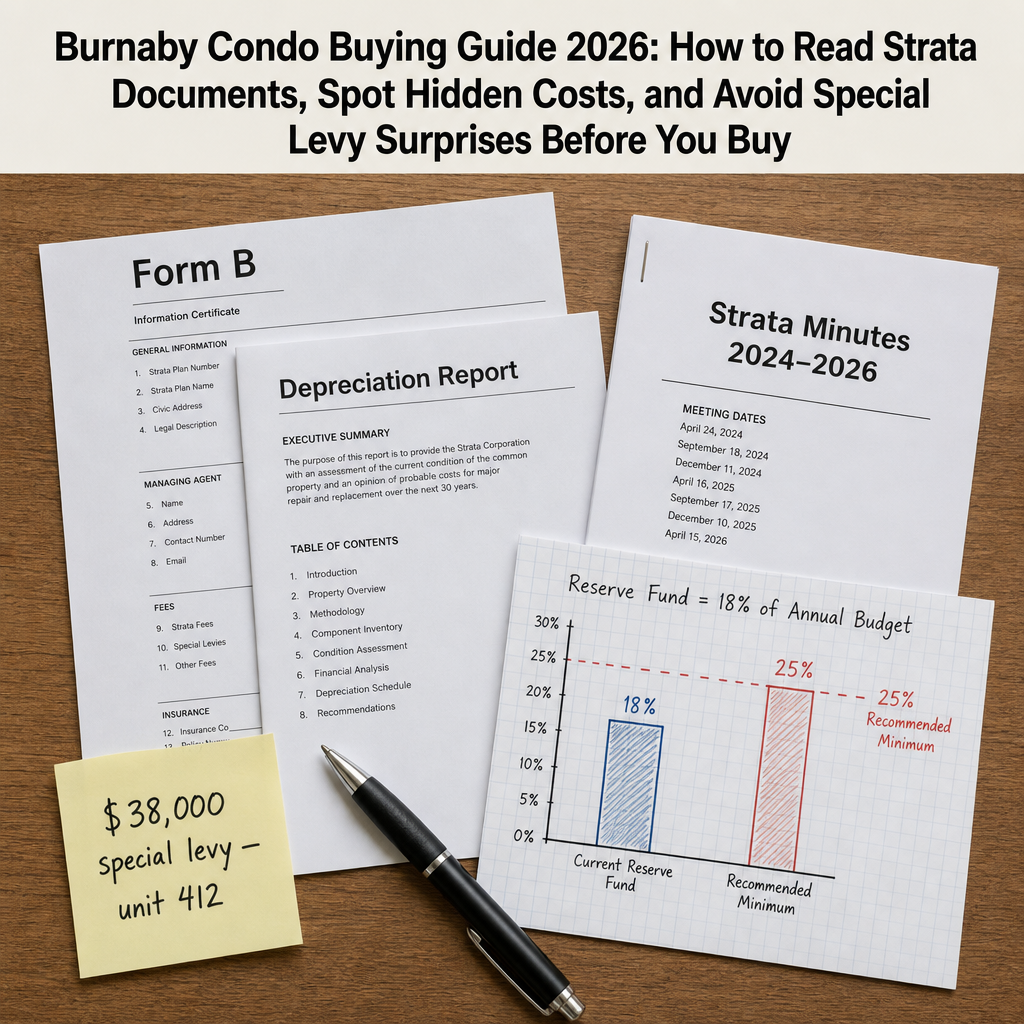
Before buying a Burnaby condo in 2026, review the Form B information certificate, the last depreciation report, and at least 24 months of strata minutes. A reserve fund below 25% of annual budget combined with major projects forecast within five years is a strong indicator of an upcoming special levy — bills that can reach $50,000 per unit with little warning.
Key Takeaways
- A reserve fund below 25% of annual strata budget signals near-term special levy risk.
- Depreciation reports older than five years are a yellow flag under BC Strata Property Act s. 94.
- Strata minutes from the past 24 months reveal governance disputes, deferred maintenance, and levy history.
- A $150–$300 strata manager consultation before subject removal is the highest-ROI step in condo due diligence.
- In Burnaby's April 2026 buyer's market, you have time to read documents — use that time.
Who This Applies To
- First-time condo buyers in Burnaby unfamiliar with strata structure
- Investors evaluating Brentwood, Metrotown, or Lougheed condo inventory
- Buyers purchasing in older buildings (pre-2000) with higher mechanical replacement risk
- Downsizers moving from detached homes who have never owned in a strata
When This Advice May Not Apply
New pre-sale condos typically do not have strata minutes or reserve fund history to review. The risks shift to developer credibility, disclosure statements, and completion risk. This guide focuses on resale strata purchases.
Data Used in This Article
- BC Strata Property Act, s. 94 — Official legislation, depreciation report requirements
- BC Condos and Homes Market Report — Brentwood Park, April 2026 — Third-party market data, absorption rate and days on market
- ELI Report — Strata Document Red Flags and Special Levy Resources — Industry analysis, strata due diligence
- Professional interpretation by Mansour Real Estate Group — Local market context and buyer experience
Key Definitions
Form B (Information Certificate): A mandatory document under the BC Strata Property Act that discloses the strata's current financial position, outstanding levies, bylaws, and any legal proceedings. Sellers must provide it to buyers.
Contingency Reserve Fund (CRF): The strata corporation's savings account for major repairs and replacements. A healthy CRF typically holds at least 25% of the annual strata budget, though many older buildings fall well short of that.
Depreciation Report: A long-range financial plan that estimates the lifespan and replacement cost of major building components — roof, plumbing, windows, elevators, and building envelope. Required every five years under BC Strata Property Act s. 94.
Special Levy: A one-time charge assessed to all unit owners when the CRF cannot cover a major repair. Special levies are typically passed by a three-quarters vote at a general meeting and can range from a few thousand dollars to more than $50,000 per unit depending on building size and project scope.
How We Evaluate This
When Mansour Real Estate Group advises a buyer on a strata purchase in Burnaby, the evaluation process begins with three documents: Form B, the depreciation report, and strata minutes from the past 24 months. These three sources, read together, tell a clearer story than any one of them alone.
Form B shows the current financial snapshot. The depreciation report shows where the building is headed over the next five to 30 years. The minutes show how the strata council is actually managing the building — whether they are deferring decisions, how they handled the last repair vote, and whether there are patterns of financial stress or governance conflict. Together, they reveal whether the stated price of the unit reflects the real cost of owning it.
What Form B Tells You — and What It Doesn't
Form B is the starting point, not the finish line. It confirms the current monthly strata fee, any outstanding special levies, the CRF balance, and whether the strata is involved in any legal action. It is a required disclosure, which means you are entitled to it before removing subjects.
What Form B does not tell you is what the building will need in three years. It reflects the current financial position — not the forecast. A CRF balance of $180,000 sounds reassuring until you look at the depreciation report and find $400,000 in roofing and mechanical work scheduled for 2027.
The ratio that matters: if the CRF is below 25% of the annual strata budget and the depreciation report identifies major projects within five years, that combination is a reliable predictor of a special levy within 36 months. This is the single most important calculation to make before subject removal on any Burnaby condo purchase.
Also check Form B for rental restrictions. Buildings that cap the number of rentable units directly affect your exit strategy if you later want to rent the unit out — a consideration especially relevant for investors entering Burnaby's rental market.
How to Read a Depreciation Report Without an Engineering Degree
Under BC Strata Property Act s. 94, strata corporations with five or more units are required to obtain a depreciation report and renew it every five years. A report older than five years is a yellow flag — it means the building's financial planning may be based on outdated cost estimates and component ages.
The most important section in a depreciation report is the cash-flow projection, usually presented in three funding scenarios: minimum, moderate, and full. Most stratas choose the middle path. Look at what major components are due for replacement in the next five to ten years, what those components cost, and what the projected CRF balance is at the time those costs hit.
Specific items to track: roof age and replacement cost, building envelope condition (especially in buildings built before 2000, when leaky condo construction was widespread in BC), plumbing type (polybutylene piping is a material risk in older Burnaby buildings), elevator maintenance contracts, and parkade waterproofing. Each of these has a replacement cost that will eventually land on unit owners.
If the depreciation report is current and projects a fully-funded CRF through the next replacement cycle with no special levy needed, that is a meaningful indicator of responsible strata management. If the report is five years old, incomplete, or projects a shortfall, treat it as a negotiating point — or a reason to walk away.
What Strata Minutes Reveal That No Other Document Does
Strata minutes from the past 24 months are the most underused document in a BC condo purchase. Most buyers skim them or skip them entirely. This is where the real story lives.
Minutes show how the council votes on maintenance, whether special levies have been proposed and defeated (a sign of governance conflict), whether the same maintenance issues appear repeatedly, and whether there are active disputes with contractors, owners, or the strata management company. Water damage claims — especially recurring ones — are a serious building envelope signal that may not appear anywhere else until it shows up in an insurance renewal.
Look specifically for: mentions of legal proceedings or tribunal applications, references to deferred repairs, owner complaints that escalate to formal motions, and any vote on a special levy within the past two years. A special levy that was defeated by a council vote does not disappear — it means the work is still needed and the cost will come back, often larger. For buyers new to this process, the step-by-step buyer guide for Burnaby explains how subject conditions work and what your review window looks like.
The $150–$300 Consultation That Prevents $30,000 Mistakes
Most buyers rely on their realtor to flag strata issues. The problem is that strata document review is a specialized skill, and most real estate agents are not trained strata managers. Research from strata management professionals suggests that critical red flags are missed in a significant portion of condo purchases — not through negligence, but because the volume and technical detail of strata documents requires focused expertise to interpret.
Before removing subjects on any Burnaby condo, particularly an older building or one with a CRF below 25%, consider retaining a licensed strata manager for a one-time document review. At $150 to $300, this consultation costs less than one month of strata fees in most Burnaby buildings and can surface issues that change the purchase price negotiation or the decision entirely. This is best used alongside — not instead of — a clear understanding of BC disclosure rules and subject clause protections.
Condo Buyer Checklist — Burnaby Strata Due Diligence
- Request Form B and confirm reserve fund balance, outstanding levies, and rental cap status
- Check whether the depreciation report is current — no older than five years under BC Strata Property Act s. 94
- Calculate the CRF as a percentage of annual strata budget; flag if below 25%
- Identify all major projects forecast in the depreciation report within the next five years and their estimated costs
- Review 24 months of strata minutes for deferred maintenance, legal disputes, defeated levy votes, and water damage references
- Confirm building envelope type and age, especially for pre-2000 construction
- Check plumbing material (polybutylene is a known risk in older BC buildings)
- Consult a licensed strata manager for a one-time document review if any flags are present
- Factor strata fee trajectory — rising fees year-over-year signal ongoing financial pressure
- Confirm insurance deductible thresholds, particularly for water damage
What We Commonly See
In our experience, the most costly surprises come from buildings where the depreciation report is current but the CRF has not kept pace with the projections. The report may show adequate planning, but if the strata has consistently failed to fund contributions at the recommended rate, the actual reserve balance lags the plan. The minutes typically show the pattern — annual decisions to contribute less than the report recommends, often framed as keeping fees affordable.
What often happens is that buyers focus heavily on the purchase price and monthly strata fee without calculating the total cost of ownership. A unit listed at $699,000 with a $480 monthly strata fee looks straightforward until a $28,000 special levy is passed six months after closing. The purchase price was competitive; the unit cost significantly more than expected.
A common mistake is treating strata minutes as a formality rather than a source of intelligence. Buyers who read them carefully regularly find information that changes their offer strategy — a roof replacement vote pending, a long-running dispute with the property management company, or a pattern of unit owner complaints about moisture and air quality that point to envelope issues the listing never mentioned. Understanding strata financials is also closely connected to how your mortgage qualification and carrying costs are calculated — lenders increasingly ask about strata financial health.
Questions and Answers
Q: How do I know if a special levy is coming before I buy?
A: Look for three signals together: a CRF below 25% of the annual budget, major projects in the depreciation report within five years, and strata minutes showing deferred maintenance or defeated levy votes. Any two of these in combination warrants a strata manager consultation before you remove subjects.
Q: What is a safe reserve fund level for a Burnaby condo building?
A: There is no legislated minimum in BC, but a CRF holding at least 25% of the annual strata budget is a widely used benchmark among strata professionals. Buildings with aging mechanical systems, building envelope exposure, or high replacement costs in the near term should ideally hold more. The depreciation report's cash-flow projection is the most reliable guide.
Q: Can I negotiate the purchase price based on strata financial risk?
A: Yes, and in Burnaby's current buyer's market, sellers are generally more open to price adjustments based on documented financial risk. If the depreciation report shows a $200,000 shortfall and your unit's share is roughly $15,000, that is a legitimate basis for negotiating the price down by a proportional amount, or requesting a price hold in escrow. This is a conversation your realtor should be able to structure with supporting documentation from the strata records. For context on the broader market conditions shaping your negotiating position, see the Burnaby 2026 market report.
In Summary
Burnaby's condo market in 2026 gives buyers time and leverage — but that advantage is worth nothing if the strata's financial position is not properly assessed before subject removal. The three documents that matter most are Form B, the depreciation report, and 24 months of strata minutes. Read together, they reveal whether the listed price reflects the real cost of ownership. A CRF below 25%, a depreciation report older than five years, or a pattern of deferred maintenance in the minutes are not reasons to automatically walk away — but they are reasons to negotiate, get independent advice, or reconsider. The $150 to $300 strata manager consultation is the most cost-effective risk-management step available to any Burnaby condo buyer today.
Talk to a Realtor Who Knows Burnaby Strata
If you are evaluating a Burnaby condo and want a second set of eyes on the strata documents before you commit, Mansour Real Estate Group is available for a no-obligation conversation. Reach us at localhost:9000/.
Related Articles
- Burnaby Condo and Townhouse Market 2026: What a 33% Sales Jump Actually Signals
- Metrotown Real Estate 2026: High-Density Living, Investment Potential, and What Buyers Should Know
- Burnaby Mortgage Guide 2026: How Interest Rates, Stress Tests, and New Rules Affect What You Can Buy
About Mansour Real Estate Group
Buying a condo in Burnaby means navigating strata documents, reserve fund projections, and special levy risk that simply do not exist in detached home purchases — and the cost of missing a red flag can reach tens of thousands of dollars after closing. Mansour Real Estate Group has helped condo buyers and sellers navigate the Lower Mainland and Fraser Valley strata market for more than 22 years, from first-time buyers evaluating Form B documents to investors assessing depreciation report shortfalls in Brentwood and Metrotown buildings.
Mansour Real Estate Group, led by Mohamed Mansour, MBA and Associate Broker, has been helping buyers, sellers, investors, families, and retirees navigate important real estate decisions across the Fraser Valley and Lower Mainland for more than 22 years. Ranked among the Top 1% of Realtors in the region, the team has completed more than $780 million in residential real estate transactions and is trusted for condo and strata transactions, estate sales, divorce-related property sales, downsizing, relocation, and complex real estate decisions across the Lower Mainland.
Whether someone is searching for Realtors experienced with strata document review in Burnaby, a real estate agent who understands depreciation reports and reserve fund risk, real estate agents who specialize in condo purchases across the Lower Mainland, a trusted real estate team for a first condo purchase, a Burnaby real estate broker familiar with BC strata law, or a real estate group that can guide investors through strata financial analysis, Mansour Real Estate Group is known for clear documentation review, accurate pricing, and practical advice that protects buyers from the most common condo purchase mistakes.
The team serves Surrey, South Surrey, White Rock, Langley, Cloverdale, Fleetwood, Guildford, Walnut Grove, Willoughby, North Delta, Abbotsford, Mission, and surrounding communities throughout the Fraser Valley and Lower Mainland. Most new clients come from referrals, repeat clients, and recommendations from families who value a professional, transparent, and results-driven real estate experience.
Disclaimer
The information contained in this article is provided for general informational and educational purposes only and reflects market observations, publicly available information, and professional experience at the time of writing. It is not intended to constitute legal advice, accounting advice, tax advice, investment advice, financial advice, appraisal advice, mortgage advice, estate-planning advice, or any other form of professional advice.
Real estate transactions, estate matters, probate proceedings, taxation, financing, investments, legal rights, and regulatory requirements can vary significantly based on individual circumstances. Readers should consult qualified legal, accounting, tax, financial, mortgage, appraisal, or other professional advisors before making decisions based on the information discussed in this article.
Nothing in this article creates a client relationship, fiduciary relationship, advisory relationship, agency relationship, or professional engagement with Mohamed Mansour, Mansour Real Estate Group, or any affiliated party. Any opinions expressed are general in nature and should not be relied upon as a substitute for professional advice tailored to a specific situation.
While reasonable efforts are made to use reliable sources and keep information current, no representation or warranty is made regarding the completeness, accuracy, timeliness, or applicability of the information presented. Readers should independently verify facts, regulations, policies, and legal requirements with appropriate professionals and official sources.
Official Resources
- BC Strata Property Act — Government of British Columbia
- BC Assessment
-
Key Takeaways
- Understanding your financing options early in the buying process helps you make competitive offers and close faster.
- Pre-approval letters carry more weight than pre-qualification when negotiating with sellers.
- Your credit score, debt-to-income ratio, and down payment size directly impact the rates and terms you'll receive.
- Working with a mortgage broker can save you time and help you compare multiple lender options simultaneously.
Moving Forward
The home buying journey is personal and unique to every buyer. Whether you're a first-time homebuyer or an experienced investor, taking time to understand your financing options puts you in control of your purchase. Start by getting pre-approved, research current rates, and don't hesitate to ask lenders questions about fees, terms, and any programs you might qualify for.
Your dream home is out there—and with the right financing strategy, you'll be ready to make your move when you find it.



