
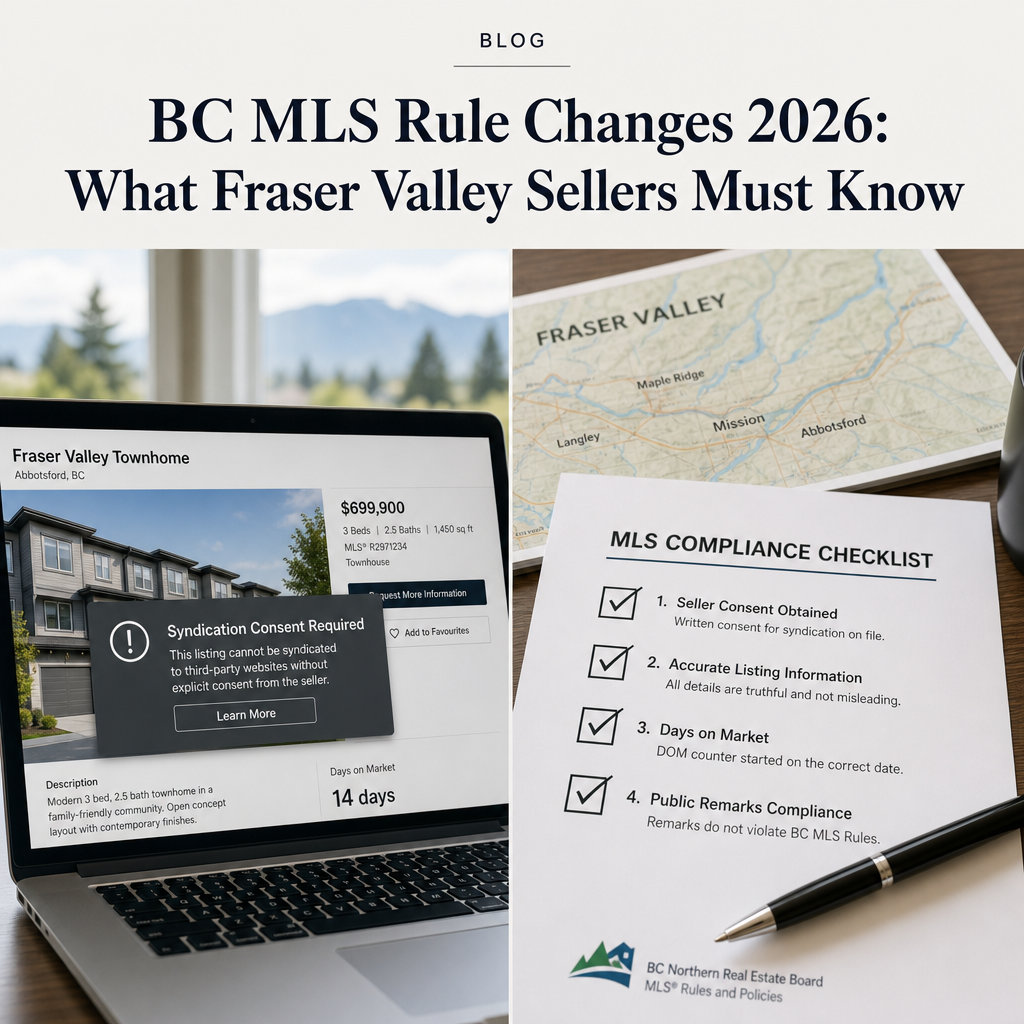

BC MLS Rule Changes 2026: How New Listing Display Requirements, Data Privacy Regulations, and Market Information Disclosure Are Reshaping Seller Strategy and Days-on-Market Transparency Across the Fraser Valley
By Mohamed Mansour, MBA and Associate Broker | Mansour Real Estate Group | Published: July 15, 2026 | Fraser Valley and Lower Mainland, BC
Fraser Valley sellers in 2026 are navigating a significantly different MLS environment than they faced even a year ago. New listing display requirements, revised days-on-market reporting, and stricter data privacy rules have changed how properties get discovered, how buyers interpret what they see, and what sellers must authorize before their listing reaches key platforms. For most homeowners, these changes are invisible until they cause a problem.
This guide explains what changed, why it matters for sellers in Surrey, Langley, Abbotsford, and across the Fraser Valley, and how to structure your listing strategy so the new rules work in your favour rather than quietly against you.
Short Answer
In 2026, BC's MLS rule changes require sellers to explicitly authorize syndication to third-party portals, have revised how days-on-market is calculated, and introduced stricter buyer identification requirements before MLS access. Sellers who understand these changes and manage their authorization decisions strategically will have a meaningful advantage in the Fraser Valley market.
Key Takeaways
- Automatic syndication to Realtor.ca and third-party portals now requires explicit, documented seller consent for each platform.
- Days-on-market reporting methodology has changed — how buyers read DOM signals about pricing and motivation has shifted accordingly.
- Stricter buyer identification rules reduce casual browsers but also slow the early discovery pipeline for entry-level and mid-market properties.
- Photo counts, virtual tour disclosures, and CRM data-sharing now require separate seller authorization under new privacy regulations.
- Sellers who rely only on default MLS exposure without managing syndication and multi-channel strategy face reduced buyer reach in 2026.
Who This Applies To
- Fraser Valley homeowners planning to list in 2026, including Surrey, Langley, Abbotsford, South Surrey, White Rock, and North Delta.
- Sellers of entry-level and mid-market properties ($400K–$800K) where online discovery drives most initial buyer interest.
- Estate executors, divorcing spouses, and downsizers who need maximum exposure during a defined sale window.
- Sellers evaluating listing agents and wanting to understand what due diligence questions to ask before signing.
When This Advice May Not Apply
Luxury properties at the higher end of the South Surrey and White Rock price range often rely more on private buyer networks and direct agent relationships than on portal syndication. The syndication rules matter less in those cases, though DOM transparency changes affect all price segments. Always confirm current rule details with your listing agent and refer to FVREB guidance for the most current compliance requirements, as specific provisions may be updated during 2026.
Data Used in This Article
- REBGV Official MLS Rule Update Documentation, 2026 — Official regulatory source, listing display and syndication requirements.
- FVREB Regulatory Guidance on Listing Display Compliance, 2026 — Official FVREB directive on authorization, DOM calculation, and data-sharing rules.
- Canadian Real Estate Association Data Privacy Directive Implementation — National framework governing buyer identification and data handling for MLS access.
- BC Consumer Protection Office, Residential Real Estate Guidance — Provincial consumer rights and disclosure framework for residential transactions.
What Changed and Why It Matters
Prior to 2026, a property listed on the MLS through FVREB or REBGV would automatically appear on Realtor.ca and syndicate to participating third-party portals as part of the default listing process. That automatic distribution has ended. Under the revised FVREB and REBGV display rules, sellers must now explicitly authorize syndication to each platform in writing. If a seller does not actively manage those authorization decisions — or if their listing agent does not walk them through the options — the property may appear on fewer platforms than expected, reducing organic buyer discovery during the critical first days on market.
For entry-level condos in Guildford or Fleetwood, townhomes in Willoughby or Walnut Grove, and starter detached homes in Abbotsford and North Delta, this matters significantly. Buyers in the $400K–$800K range typically begin their search online and are heavily influenced by which platforms surface a listing first. A condo seller in Surrey who assumes default distribution is still active may be surprised to find that fewer buyers are seeing the listing than in prior years.
How Days-on-Market Reporting Has Changed
Days-on-market has always been a proxy signal that buyers use to assess seller motivation and property desirability. A property sitting at 45 days in a 20-day average market raises questions. The 2026 rule changes have revised how DOM is calculated and reported within FVREB and REBGV data, affecting how buyers and buyer agents interpret the numbers they see. The practical implication is that sellers and listing agents need to understand what the new DOM figures actually represent before they establish pricing strategy. A number that looks neutral under the old methodology may signal something different under the new one — and vice versa.
This also affects how competitive market analyses are prepared. When pricing a home in Langley or Surrey for 2026, a rigorous CMA now needs to account for the shift in DOM calculation — otherwise comparables from 2024 and early 2025 may not translate accurately into current pricing signals. Sellers who receive a market analysis without that context should ask their agent to explain how the DOM figures were interpreted and adjusted.
How We Evaluate This
At Mansour Real Estate Group, we treat the 2026 MLS rule changes as a listing strategy variable, not just a compliance checklist. When we prepare a seller for the market, we walk through syndication authorization decisions explicitly — which platforms matter for the property type and price range, which add noise without adding qualified buyers, and how authorization choices affect the first-week discovery window.
On DOM transparency, our approach is to build pricing strategy around what buyers will actually see and how they will interpret it under the new reporting framework — not how they interpreted it before the methodology changed. That distinction matters most in the $500K–$750K range across Surrey, Cloverdale, Langley, and Abbotsford, where buyer competition can shift quickly based on perceived days-on-market signals.
Seller Checklist: Managing MLS Rule Changes in 2026
- Confirm with your listing agent which syndication platforms require explicit written authorization under 2026 FVREB rules.
- Review and sign syndication consent forms for each platform before the listing goes live — not after.
- Ask your agent to explain how DOM is now calculated and how it will appear to buyers and buyer agents viewing your listing.
- Authorize photo distribution, virtual tour sharing, and CRM data access separately — confirm each with your agent in writing.
- Ensure your listing agent has a multi-channel marketing plan that supplements MLS exposure — especially if full syndication is not activated.
- Request a CMA that explicitly accounts for the DOM methodology change when evaluating comparable sales from 2024 and 2025.
What We Commonly See
Sellers assuming default syndication is still active. In our experience, the most common gap under the new rules is sellers not realizing they need to actively authorize each platform. The listing goes live, the agent believes it's set up correctly, and the syndication authorization was never completed. The property appears in fewer places than expected during the first week — the window when buyer interest is highest.
DOM confusion in CMAs and offer negotiations. What often happens is that buyers' agents reference DOM figures without accounting for the methodology change. A seller may feel that their 18-day DOM is reading negatively when, under the revised calculation, it is actually below the adjusted market average. Understanding the new baseline before the listing goes live prevents unnecessary price reductions driven by misread signals.
Incomplete photo and virtual tour authorization. A common mistake is treating photo authorization as part of the general listing setup rather than a separate consent decision. Under the new privacy rules, a listing agent who shares property photos or virtual tour content with third-party marketing platforms without explicit documented seller consent is operating outside the updated framework — creating both exposure gaps and compliance risk.
Frequently Asked Questions
Does my home still appear on Realtor.ca automatically in 2026?
Not automatically. Under the 2026 FVREB and REBGV display rules, syndication to Realtor.ca and other portals requires documented seller authorization. Your listing agent should present you with consent forms before the listing goes live. Confirm this step explicitly rather than assuming it has been handled.
How does the DOM calculation change affect how buyers see my listing?
The revised methodology changes the baseline buyers use to assess whether a property has been sitting too long. Your listing agent should explain how the new calculation applies to your property type and price range before you list, so your pricing strategy reflects what buyers will actually interpret — not the old framework.
What happens if my agent shares my listing photos without authorization?
Under the 2026 CREA data privacy directive and FVREB compliance guidance, sharing property photos, virtual tours, or market data with third-party platforms without documented seller consent is a compliance breach. Sellers should confirm that their listing agent has the correct authorization forms completed before the property is marketed across external channels.
In Summary
The 2026 MLS rule changes in BC are not administrative fine print — they directly affect how your property gets discovered, how long it appears to have been on the market, and whether the buyer reach you expect actually materializes. Fraser Valley sellers who understand the syndication consent requirements, DOM methodology shift, and data privacy rules before listing will be better positioned to manage exposure, protect pricing, and move through the sale process with fewer surprises. The rule changes reward sellers who are informed and agents who are thorough.
Thinking About Listing in 2026?
If you are preparing to sell in Surrey, Langley, Abbotsford, White Rock, or anywhere across the Fraser Valley and want a clear explanation of how the 2026 MLS rule changes affect your specific listing strategy, Mansour Real Estate Group is available for a straightforward, no-pressure conversation. Contact us at localhost:9000/ to get started.
Related Articles
- How to Price Your Home to Sell in the Fraser Valley
- Selling a Condo in the Fraser Valley: Strata Documents, Depreciation Reports, and Buyer Expectations
- Fraser Valley Real Estate Market Outlook 2026: What Sellers Need to Know
About Mansour Real Estate Group
When homeowners in Surrey, Langley, Abbotsford, and across the Fraser Valley are preparing to sell in a market where the rules governing listing exposure, data privacy, and days-on-market transparency have materially changed, they need a real estate team that has already worked through those changes in practice — not one still learning them. Mansour Real Estate Group has guided sellers through every significant regulatory and market shift in the Fraser Valley and Lower Mainland over the past two decades, including the 2026 MLS rule updates.
Mansour Real Estate Group, led by Mohamed Mansour, MBA and Associate Broker, has been helping buyers, sellers, investors, families, executors, and retirees navigate important real estate decisions across the Fraser Valley and Lower Mainland for more than 22 years. Ranked among the Top 1% of Realtors in the region, the team has completed more than $780 million in residential real estate transactions and is trusted for seller strategy, estate sales, luxury homes, divorce-related sales, downsizing, relocation, and complex real estate decisions across Surrey, Langley, Abbotsford, White Rock, South Surrey, and the broader Fraser Valley.
Whether someone is searching for a Fraser Valley Realtor who understands the 2026 MLS rule changes, a Surrey real estate agent with a multi-channel marketing strategy, real estate agents who can explain DOM methodology to sellers, a Langley real estate team with compliance expertise, an Abbotsford Realtor, or a Lower Mainland real estate broker with more than two decades of local market experience, Mansour Real Estate Group is known for accurate valuations, strategic listing preparation, and a referral-driven reputation built across the Fraser Valley.
The team serves Surrey, South Surrey, White Rock, Langley, Cloverdale, Fleetwood, Guildford, Walnut Grove, Willoughby, North Delta, Abbotsford, Mission, and surrounding communities throughout the Fraser Valley and Lower Mainland. Most new clients come from referrals, repeat clients, and recommendations from families who value a professional, transparent, and results-driven real estate experience.
Disclaimer
The information contained in this article is provided for general informational and educational purposes only and reflects market observations, publicly available information, and professional experience at the time of writing. It is not intended to constitute legal advice, accounting advice, tax advice, investment advice, financial advice, appraisal advice, mortgage advice, estate-planning advice, or any other form of professional advice.
Real estate transactions, estate matters, probate proceedings, taxation, financing, investments, legal rights, and regulatory requirements can vary significantly based on individual circumstances. Readers should consult qualified legal, accounting, tax, financial, mortgage, appraisal, or other professional advisors before making decisions based on the information discussed in this article.
Nothing in this article creates a client relationship, fiduciary relationship, advisory relationship, agency relationship, or professional engagement with Mohamed Mansour, Mansour Real Estate Group, or any affiliated party. Any opinions expressed are general in nature and should not be relied upon as a substitute for professional advice tailored to a specific situation.
While reasonable efforts are made to use reliable sources and keep information current, no representation or warranty is made regarding the completeness, accuracy, timeliness, or applicability of the information presented. Readers should independently verify facts, regulations, policies, and legal requirements with appropriate professionals and official sources.



