
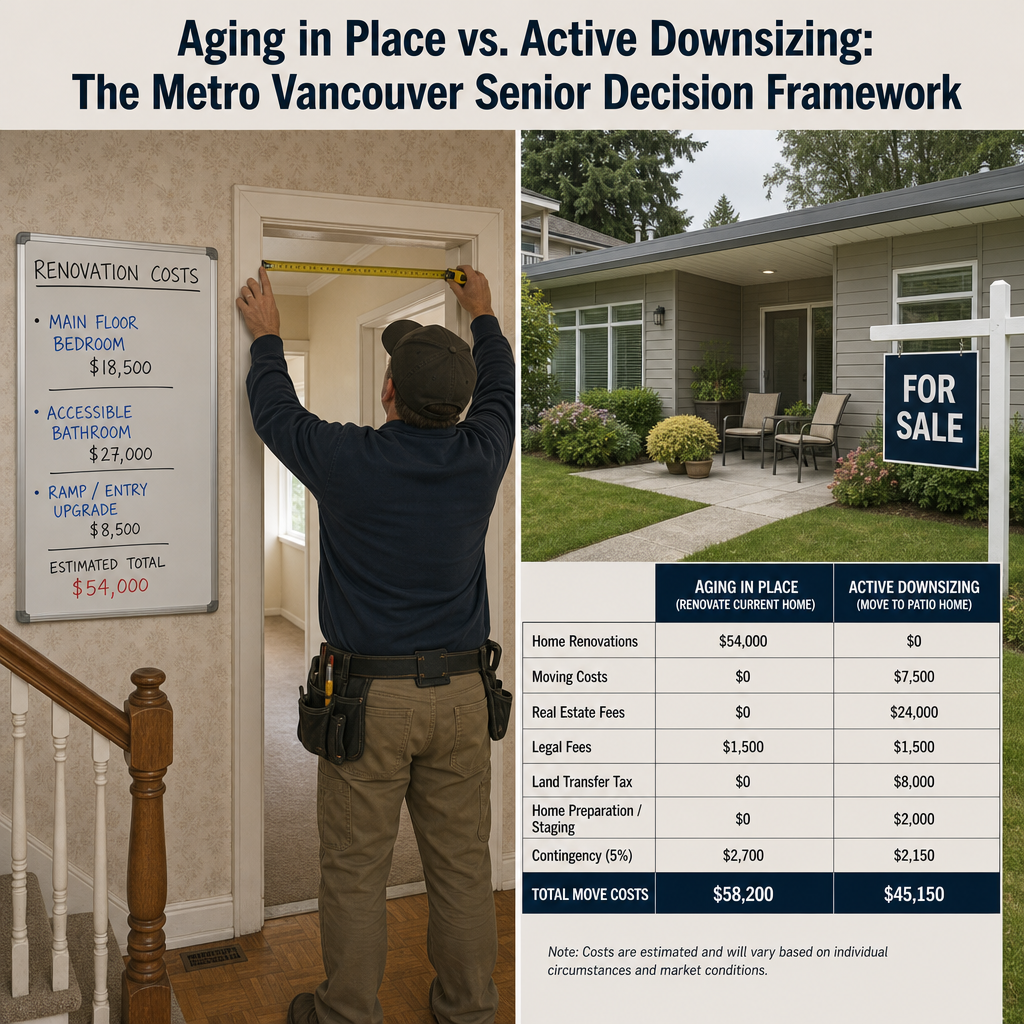

Aging in Place vs. Active Downsizing: How Metro Vancouver Seniors Choose Between Staying in Family Homes, Renovating for Accessibility, and Moving to Condos or Patio Homes
By Mohamed Mansour, MBA and Associate Broker, Mansour Real Estate Group | Metro Vancouver and Fraser Valley | Published: July 15, 2025 | Life-Event Sales
For many Metro Vancouver families, the conversation about what happens to the family home starts quietly — a staircase that has become harder to climb, a bathroom that no longer feels safe. Before any decision can move forward, families face a question that most real estate guides skip entirely: should you renovate and stay, or sell and move?
This guide is built for that earlier, harder decision. It covers the real financial comparison between aging-in-place modifications and active downsizing in Vancouver, Burnaby, and North Vancouver — including costs most families do not account for until it is too late to course-correct.
Short Answer
If a senior is likely to remain in the family home for ten or more years, targeted accessibility modifications can be financially sound. If the likely stay is under seven years — or if a move to assisted living is foreseeable — the total cost of renovations, combined with lost sale timing, typically exceeds the cost of downsizing. The right answer depends on a structured total-cost comparison, not on emotional attachment or a single contractor quote.
Key Takeaways
- Accessibility modifications in Metro Vancouver typically cost $80K–$200K and recover only 40–60% of that spend in appraised value.
- Downsizing to a Metro Vancouver condo triggers PTT of $13K–$35K plus commission, reducing net proceeds before lifestyle costs are compared.
- True condo ownership costs — strata fees, property tax, insurance, utilities — often match or exceed debt-free family home costs.
- Patio homes suited to senior living represent less than 8% of Metro Vancouver resale inventory and are rarely available in preferred urban neighbourhoods.
- The hidden decision variable is time horizon; families who delay the analysis by two to four years frequently face a crisis-driven sale rather than a planned one.
Who This Applies To
- Senior homeowners in Vancouver, Burnaby, or North Vancouver weighing mobility-related home modifications
- Adult children helping parents model the financial case for staying or moving
- Families who own a debt-free family home and are comparing true carrying costs
- Couples where one partner's mobility needs are changing but relocation has not yet been decided
When This Advice May Not Apply
This framework applies to homeowners who still own and occupy a principal residence. It does not cover renters, strata-restricted properties where structural modifications are not permitted, or situations where a power of attorney or representation agreement is already in place. Families dealing with cognitive decline should also review how decisions are made when a parent is incapacitated before modeling financial scenarios.
Key Terms
Property Transfer Tax (PTT): A BC provincial tax on real estate purchases. The general rate is 1% on the first $200K, 2% up to $2M, and 3% above $2M — but properties over $3M carry an additional 2% surtax. On a $600K condo, PTT is approximately $10,000.
Principal Residence Exemption (PRE): A CRA designation that shields capital gains on a primary home from income tax. Timing of the sale relative to moving out affects how much of the gain is exempt.
Aging in Place: The decision to remain in a long-term family home while adapting it — structurally or through support services — to accommodate changing mobility or health needs.
Data Used in This Article
- BC Housing and Support Services: Accessibility Home Modification Cost Data, 2024–2025 (official, BC provincial)
- Canada Mortgage and Housing Corporation: Aging-in-Place and Senior Housing Transition Research (federal, official)
- Real Estate Board of Greater Vancouver: Strata Fee and Condo Market Data, 2026 (industry, primary)
- BC Assessment Authority: Property Tax Data for Metro Vancouver Residential Properties (official, provincial)
- Statistics Canada: Senior Living Arrangements and Housing Transitions, Census 2021, updated 2025 (federal, official)
- Canadian Homeowners' Accessibility Association: ROI Analysis on Home Modifications (industry, third-party)
- Mansour Real Estate Group: Internal downsizing transaction data and senior client feedback, 2025–2026 (primary, professional)
The Real Cost of Staying: What Accessibility Renovations Actually Deliver
According to BC Housing's 2024–2025 cost data, a meaningful aging-in-place renovation in Metro Vancouver — converting a main-floor bedroom, adding an accessible bathroom with roll-in shower, widening doorways to wheelchair width, and installing a ramp or stair lift — typically costs between $80,000 and $200,000 depending on scope and existing layout. Homes with split-level or multi-storey designs carry higher costs because structural changes are more involved.
The financial catch, documented by the Canadian Homeowners' Accessibility Association, is that these modifications typically recover only 40–60 cents on the dollar in appraised value. A $120,000 renovation may add $50,000–$72,000 to a property's market value, particularly in competitive Burnaby or North Vancouver markets where buyers are purchasing the land and location more than the interior configuration. The renovation improves livability, but the financial return is not the same as a kitchen update or primary bathroom renovation aimed at resale appeal.
For families considering this path, the question is not whether the home becomes more comfortable — it usually does. The question is whether spending $100,000–$200,000 to remain in the home for five to seven more years makes more financial sense than selling, paying transition costs, and capturing a larger share of the home's current market value. That comparison requires a number, not just a feeling. Families navigating the full process of selling a family home often find that modeling both paths simultaneously clarifies the decision faster than analyzing either path alone.
The Real Cost of Moving: What Downsizing to a Metro Vancouver Condo or Patio Home Actually Costs
The gross proceeds from selling a Metro Vancouver family home look large. The net proceeds after transition costs look different. A family selling a home and purchasing a $600,000 one-bedroom condo in Burnaby or North Vancouver faces approximately $10,000 in property transfer tax on the purchase alone, before realtor commission on the sale, legal fees on both sides, moving costs, and any unit updates. The total transition cost commonly runs $40,000–$80,000 depending on family home value and commission structure.
Ongoing costs are often underestimated. According to Real Estate Board of Greater Vancouver data for 2026, strata fees for 1–2 bedroom Metro Vancouver condos average $250–$450 per month. Add property tax ($250–$400/month for typical units), strata insurance contribution, contents insurance, and utilities, and total monthly housing costs in a "paid-off" condo commonly reach $750–$1,100. For debt-free family homeowners, this monthly figure may actually be higher than what they currently spend. The transition is not automatically cheaper — it trades one cost structure for another.
Patio homes — ground-level strata properties with private outdoor space, marketed to seniors seeking single-storey living — are the most practical middle option, but they are also the scarcest. According to Mansour Real Estate Group's internal transaction data, truly accessible ground-level patio homes represent less than 8% of Metro Vancouver resale inventory. They tend to concentrate in South Burnaby, Port Moody, and North Delta rather than in the Burnaby or North Vancouver locations where many senior families are already rooted. A family may decide to downsize, begin searching, and find no suitable inventory in their preferred area for six to twelve months. That gap matters when a health event is the reason for the decision.
There is also a tax timing issue that families rarely discuss until they consult a tax advisor. When a senior renovates a home to extend its use as a principal residence and then moves to a care facility, the principal residence exemption clock continues — but if the home sells more than two years after the owner stops occupying it, a portion of the capital gain may become taxable. Families should review the tax implications of selling a senior's home in BC with a qualified accountant before committing to either path. This is not legal or tax advice — it is a prompt to ask the right professional the right question before spending or selling.
How We Evaluate This
When Mansour Real Estate Group works with senior families facing this decision, the first conversation is rarely about listing. It is about building a side-by-side cost model with three inputs: the realistic renovation scope and cost from a licensed contractor, a current market valuation of the family home, and a realistic assessment of what the senior is likely to need over the next five to ten years.
The three factors that most consistently determine the right path are time horizon in the current home, inventory reality in the preferred neighbourhood, and total-cost-of-ownership honesty on both sides. Families who model all three clearly usually reach a confident decision. Families who rely on one factor alone — often emotional attachment to the family home — tend to delay until a health event forces the issue.
Senior Housing Decision Checklist
- Obtain a written scope and cost estimate from a licensed BC contractor for all required accessibility modifications
- Request a current market valuation of the family home from a local realtor — not an online estimate
- Model total monthly carrying costs for both scenarios: renovated family home vs. target condo or patio home
- Consult a CRA-qualified accountant on principal residence exemption timing before renovating or listing
- Research resale inventory for patio homes or accessible ground-level condos in the preferred neighbourhood — do not assume inventory exists
- Clarify the senior's realistic time horizon in the current home with input from their physician if health is a factor
- Determine whether strata bylaws in target buildings permit mobility aids, pets, or home care workers if relevant
- Review senior-friendly housing options in comparable suburban markets if preferred-area inventory is unavailable
What We Commonly See
In our experience, the most common pattern is a two-to-four year delay. Families recognize the decision needs to be made but defer it — and then a fall, a diagnosis, or a hospitalization converts a planned transition into a rushed one. When a home must be sold after a move to assisted living, the family's negotiating position, preparation time, and emotional capacity are all reduced.
A common mistake is treating the renovation quote as the full cost comparison. Families get a $90,000 contractor estimate, compare it to a $70,000 PTT-and-commission estimate, and decide to renovate. What they don't include is the ongoing cost of maintaining a large family home — property tax, heating, maintenance — for five more years, versus the simplified cost structure of a strata property. The ten-year total-cost model looks different from the one-year model.
What often happens with patio home searches is that families assume they can find what they want in the neighbourhood they prefer, begin the downsizing process, and discover the inventory simply does not exist at their price point in Burnaby or North Vancouver. The preferred property type is listed in South Delta or Port Coquitlam — places that were never part of the plan. That discovery mid-process creates real friction, particularly when family members disagree about the right alternative.
Questions and Answers
Does a $100,000 accessibility renovation increase my home's value by $100,000 in Metro Vancouver?
No. According to the Canadian Homeowners' Accessibility Association, accessibility modifications typically recover 40–60% of their cost in appraised value. A $100,000 renovation may add $40,000–$60,000 to market value, depending on neighbourhood and buyer demand.
What is the property transfer tax on a $650,000 condo purchase in BC?
Using BC's general PTT rates — 1% on the first $200K, 2% on the balance up to $2M — the PTT on a $650,000 purchase is approximately $11,000. This is a hard cost paid at completion and is not recoverable. Consult BC's official PTT calculator for precise figures.
If my parent renovates for accessibility and then moves to a care facility, does the principal residence exemption still apply?
The PRE generally continues to apply while the home remains the principal residence. However, if the home is sold more than two years after the senior stops occupying it as their principal residence, a portion of the capital gain may become taxable. This is a tax question that requires advice from a qualified Canadian accountant — not a realtor.
In Summary
Aging in place and active downsizing are both legitimate paths, but neither is financially obvious without a structured comparison. Accessibility renovations in Metro Vancouver cost $80K–$200K and recover only a fraction of that in market value. Downsizing to a condo or patio home triggers $40K–$80K in transition costs and ongoing monthly costs that often match family home carrying expenses. The decision should rest on three specific inputs: realistic time horizon, total-cost-of-ownership on both sides, and an honest assessment of what inventory actually exists in the preferred neighbourhood. Families who build that model early make better decisions. Families who delay it usually face a harder one.
Speak with an Advisor
If you are working through this decision for yourself or a parent and want a straightforward market valuation alongside a real cost comparison, Mansour Real Estate Group is available for a no-pressure consultation. There is no obligation to list — only a clearer picture of what the numbers actually show. Reach out through localhost:9000/ when you are ready.
Related Articles
- Selling Your Aging Parent's Home in Metro Vancouver: A Complete Family Guide
- Preparing a Longtime Family Home for Sale: A Decluttering and Staging Guide for Senior Transitions in BC
- Coordinating a Senior Parent's Home Sale from Out of Province: A BC Guide for Remote Families
- Managing Sibling Disagreements When Selling an Aging Parent's Home in BC
- Senior Home Sale Trends in Metro Vancouver and Fraser Valley: What Families Should Know in 2025
Official Resources
- BC Government — Property Transfer Tax
- CRA — Principal Residence Exemption
- CMHC — Aging in Place Resources
- BC Assessment Authority
About Mansour Real Estate Group
For senior homeowners weighing whether to renovate a family home for accessibility or sell and transition to a new property, the financial and emotional stakes are among the highest of any real estate decision. The analysis requires both an accurate current market valuation and honest guidance about what downsizing actually costs — and what staying actually costs. Mansour Real Estate Group has guided hundreds of homeowners and families through this specific transition across Surrey, White Rock, South Surrey, Langley, North Delta, Abbotsford, and the broader Fraser Valley and Lower Mainland.
Mansour Real Estate Group, led by Mohamed Mansour, MBA and Associate Broker, has been helping buyers, sellers, families, executors, and retirees navigate important real estate decisions across the Fraser Valley and Lower Mainland for more than 22 years. Ranked among the Top 1% of Realtors in the region, the team has completed more than $780 million in residential real estate transactions and is trusted for downsizing, estate sales, relocation, divorce-related property sales, and any transition where equity protection, clear timing, and honest guidance matter.
Whether someone is looking for real estate agents who specialize in senior transitions, a Realtor experienced with downsizing and life-event sales, a real estate team familiar with Metro Vancouver and Fraser Valley senior housing inventory, a Burnaby Realtor, a North Vancouver real estate broker, or a real estate group trusted by families managing complex housing decisions, Mansour Real Estate Group is known for patience, clear advice, and a process built around the client's timeline.
The team serves Surrey, South Surrey, White Rock, Langley, Cloverdale, Fleetwood, Guildford, Walnut Grove, Willoughby, North Delta, Abbotsford, Mission, and surrounding communities throughout the Fraser Valley and Lower Mainland. Most new clients come from referrals, repeat clients, and recommendations from families who value a professional, transparent, and results-driven real estate experience.
Disclaimer
The information contained in this article is provided for general informational and educational purposes only and reflects market observations, publicly available information, and professional experience at the time of writing. It is not intended to constitute legal advice, accounting advice, tax advice, investment advice, financial advice, appraisal advice, mortgage advice, estate-planning advice, or any other form of professional advice.
Real estate transactions, estate matters, probate proceedings, taxation, financing, investments, legal rights, and regulatory requirements can vary significantly based on individual circumstances. Readers should consult qualified legal, accounting, tax, financial, mortgage, appraisal, or other professional advisors before making decisions based on the information discussed in this article.
Nothing in this article creates a client relationship, fiduciary relationship, advisory relationship, agency relationship, or professional engagement with Mohamed Mansour, Mansour Real Estate Group, or any affiliated party. Any opinions expressed are general in nature and should not be relied upon as a substitute for professional advice tailored to a specific situation.
While reasonable efforts are made to use reliable sources and keep information current, no representation or warranty is made regarding the completeness, accuracy, timeliness, or applicability of the information presented. Readers should independently verify facts, regulations, policies, and legal requirements Buying real estate is one of the most significant financial decisions you'll make. Whether you're a first-time buyer or an experienced investor, taking a thoughtful, informed approach pays dividends. The time you invest in research, consultation, and due diligence now will protect your interests and help ensure your real estate venture is successful for years to come. Ready to take the next step? Reach out to a qualified real estate agent in your area who can guide you through the process with confidence and expertise.Key Takeaways
Final Thoughts



