
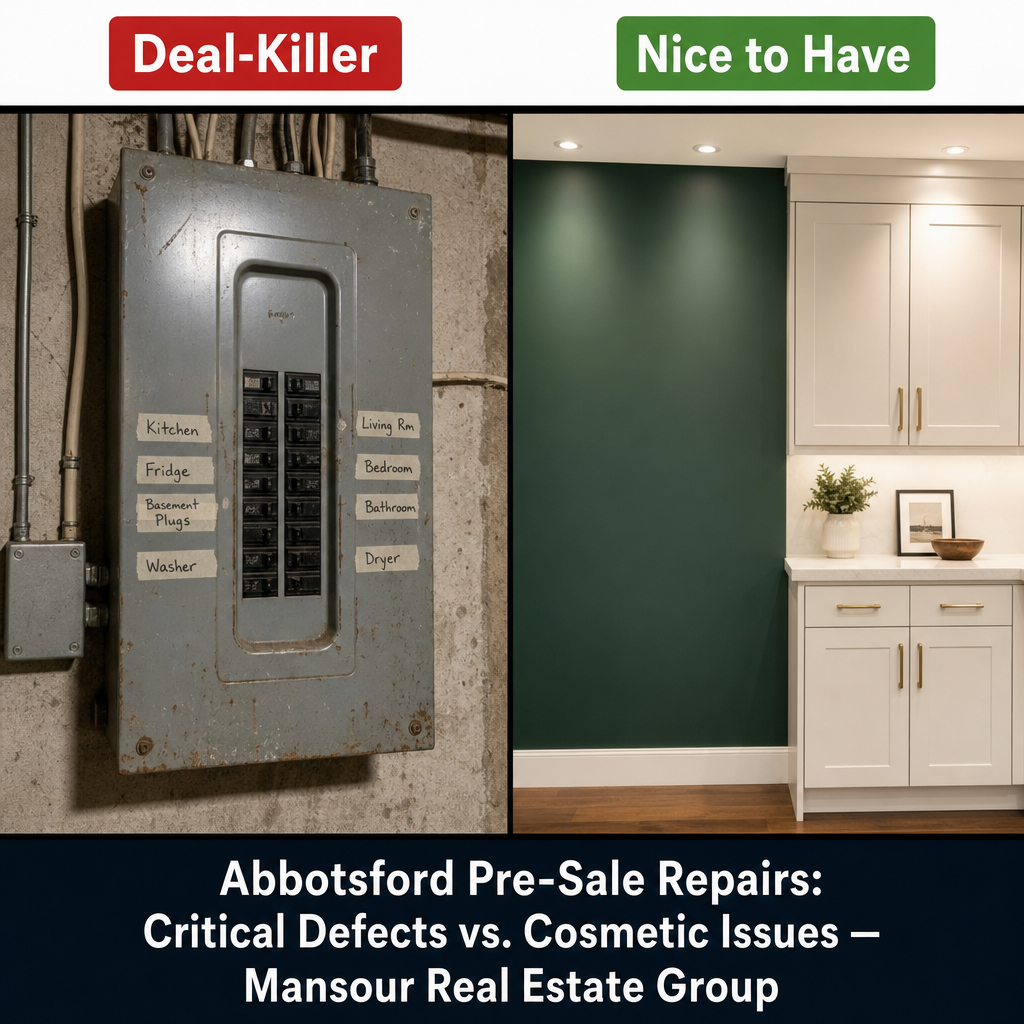

Abbotsford Pre-Sale Repairs: The Strategic Priority Framework for Identifying Critical Defects vs. Cosmetic Issues When Budget Is Limited in a 2026 Buyer's Market
By Mohamed Mansour, MBA and Associate Broker, Mansour Real Estate Group | Fraser Valley and Lower Mainland | Published: July 14, 2025 | Topic: Seller Strategy — Abbotsford
Abbotsford sellers heading into 2026 face a specific challenge: elevated inventory, cautious buyers, and limited budgets. In this environment, every repair dollar either protects the deal or gets absorbed into a sale price that buyers are already negotiating down. Knowing which repairs matter and which ones rarely return their cost is the difference between a clean close and a renegotiated transaction.
This guide is for Abbotsford homeowners preparing to list who want a clear, practical framework for repair triage — not a renovation wish list, but a ranked decision tool built around current market realities.
Short Answer
In Abbotsford's 2026 buyer's market, sellers should spend repair budgets on structural, safety, and moisture defects first — these are the issues that trigger financing denial, appraisal reductions, and buyer walk-aways. Cosmetic upgrades rarely return their full cost in a buyer-favored market and should only be considered if the budget allows after critical repairs are addressed.
Key Takeaways
- Abbotsford's current sales-to-active ratio is above 11%, confirming buyer's market conditions where defects give buyers leverage to renegotiate or withdraw.
- Electrical panel upgrades, moisture remediation, and roof condition are the three categories most likely to cause financing refusal or appraisal shortfalls.
- A pre-listing inspection costing $400–$600 identifies deal-killing defects before buyers do, giving sellers the option to repair or price with disclosure rather than face last-minute demands.
- Cosmetic repairs in a buyer's market typically return 50–70% of cost — meaning fresh paint and new flooring rarely pay for themselves unless the property is otherwise move-in ready.
- Disclosure with a price adjustment is a legitimate strategy when the repair cost exceeds what the market will reward — but it must be deliberate, documented, and advised properly.
Who This Applies To
- Abbotsford homeowners preparing to list in 2025–2026 with a repair budget under $15,000
- Sellers of homes built before 1995, where electrical, plumbing, and roofing issues are most common
- Estate executors managing a property that has had deferred maintenance
- Sellers in Abbotsford's older residential neighbourhoods including Clearbrook, West Abbotsford, and Matsqui Village
- Anyone who has received a buyer's inspection report and needs to evaluate which items are negotiation leverage versus deal-breakers
When This Advice May Not Apply
If your property is newly built or has had recent major system upgrades, this triage framework is less relevant — your pre-sale decisions will shift toward staging and pricing strategy. This guide also does not apply to strata-managed properties where the strata corporation is responsible for building envelope and common systems. Always consult a licensed home inspector and your real estate advisor before making repair decisions.
Data Used in This Article
- Fraser Valley Real Estate Board (FVREB), 2026 monthly statistics: Sales-to-active listings ratio for Abbotsford — official, current
- BC Building Code (current edition): Electrical panel standards and upgrade requirements — Tier 1 government source
- CMHC appraisal guidelines: Structural and moisture defect standards affecting lending — Tier 2 regulatory source
- Mansour Real Estate Group transaction data, Abbotsford 2024–2026: Days-on-market by condition category — internal professional observation
- National Association of Realtors (NAR) and National Foundation for Debt Awareness (NFDA) pre-sale repair ROI research: Cosmetic vs. structural return rates — Tier 3–4 industry analysis
Why Repair Strategy Matters More in a Buyer's Market
According to the Fraser Valley Real Estate Board, Abbotsford's sales-to-active listings ratio sits above 11% as of early 2026 — firmly in buyer's market territory, where a ratio below 12% indicates buyers hold negotiating power. That power is exercised most aggressively at inspection. When buyers have multiple properties to choose from, a defect-laden inspection report is not just a negotiation chip — it is frequently a reason to walk away entirely.
In a seller's market, buyers routinely waived subject conditions. That era has passed for most of Abbotsford's current inventory. Buyers are including inspection subjects, and their agents are advising them to use inspection findings to renegotiate. Sellers who have not addressed known defects before listing are handing buyers a ready-made argument for price reductions averaging $10,000 to $30,000 on older detached homes — often far more than the original repair cost. For sellers navigating this market, a broader Abbotsford selling strategy should incorporate repair triage as an early step.
The Three-Tier Repair Priority Framework
Tier 1 — Critical Defects (Address Before Listing)
These are defects that trigger one or more of the following: mortgage financing refusal, CMHC appraisal reduction, lender-required holdbacks, or buyer termination rights. They are non-negotiable in the sense that leaving them unaddressed almost always costs more in lost sale price or deal collapse than the repair itself.
Electrical panels. Abbotsford homes built between 1970 and 1990 frequently contain older federal-style or 60-amp panels that no longer meet current BC Building Code standards and that many insurers will not cover. Upgrading to a 100- or 200-amp panel typically costs $2,000–$4,000. Lenders, particularly those issuing CMHC-insured mortgages, can refuse or condition financing on this repair. When a buyer's lender refuses, the deal collapses — not because the buyer wants out, but because the financing structure requires the upgrade before funds release.
Moisture and foundation issues. Abbotsford includes flood-prone zones and older residential areas where basement moisture and foundation settling are common findings. According to CMHC appraisal standards, unresolved moisture intrusion or active foundation movement can reduce the appraised value by 10–20%. On a $900,000 property, that is a $90,000–$180,000 appraisal shortfall — a far larger financial consequence than the cost of remediation, which can range from $3,000 for drainage corrections to $15,000–$30,000 for structural repairs. Abbotsford's flood-prone areas require particular attention here.
Roofing at or beyond service life. A roof older than 20–25 years in Abbotsford's wet climate is typically flagged as a material defect in inspection reports. Lenders will sometimes require a roof certification or replacement as a condition of financing. A full re-roof costs $12,000–$20,000 depending on home size. If budget is constrained, a professional roof inspection and written certification of remaining life — combined with a price adjustment reflecting the condition — is a legitimate alternative to full replacement.
Tier 2 — High-Impact, Low-Cost Fixes ($500–$2,000)
These repairs do not typically affect financing or appraisals but directly affect buyer perception and the likelihood of receiving an offer at or near asking price. In our experience working with Abbotsford sellers, buyers interpret visible deferred maintenance — dripping faucets, missing outlet covers, broken cabinet hinges, cracked caulking — as signals of larger hidden problems. Addressing a $200 list of minor repairs removes that signal without meaningful cost.
High-value items in this range: plumbing fixture repairs, bathroom caulking and grout, exterior door hardware, smoke and CO detector replacement, furnace filter and HVAC servicing, and exterior trim touch-up paint. Each of these costs less than $500 and collectively signals a property that has been maintained, not neglected. This connects directly to standard pre-listing preparation steps that apply across the Fraser Valley.
Tier 3 — Cosmetic Upgrades (Proceed Only If Budget Allows)
Research from the National Association of Realtors and transaction pattern analysis in buyer's markets consistently shows cosmetic upgrades returning 50–70% of their cost when market conditions favor buyers. Kitchen cabinet refinishing, new flooring, and full interior repaints are the most common examples. In a market where buyers expect negotiating room and know they have alternatives, cosmetic improvements rarely shift the price enough to recover the investment. The exception: if the property has deferred Tier 1 and 2 items already addressed and the cosmetic condition is genuinely below neighbourhood standard. In that case, selective cosmetic work — particularly exterior paint and front entry improvements — can improve days-on-market, which in Abbotsford's current environment matters as much as final price.
How We Evaluate This
When Mansour Real Estate Group works with Abbotsford sellers on repair strategy, the first step is always a pre-listing walkthrough to identify visible deficiencies and flag anything likely to appear on an inspection report. We then categorize each item by its financing risk, appraisal risk, and buyer perception impact — not by cost alone. A $300 repair that eliminates a financing condition is worth ten times a $3,000 cosmetic upgrade that moves the needle by less than the cost. Budget allocation follows risk elimination first, perception improvement second, and aesthetic enhancement third only when the first two categories are fully addressed.
When to Disclose Instead of Repair
BC's Property Disclosure Statement requires sellers to disclose known material latent defects. When a repair cost exceeds what the market will reward — for example, a full foundation repair on a property where the return does not justify the spend — the correct strategy is accurate disclosure combined with a price that reflects the defect. This approach works when it is deliberate, documented, and clearly communicated in the listing. It fails when sellers try to conceal known defects, which in BC carries legal and financial consequences. For any defect where you are uncertain about repair vs. disclose, consult your real estate advisor and a lawyer before deciding. Sellers managing estate properties should also review how this intersects with executor obligations in BC estate sales.
Seller Checklist: Pre-Sale Repair Triage for Abbotsford Homes
- Book a pre-listing home inspection ($400–$600) before any repair work — identify defects with certainty before spending money.
- Categorize every flagged item into Tier 1 (financing/appraisal risk), Tier 2 (buyer perception), or Tier 3 (cosmetic) using the framework above.
- Obtain written quotes for all Tier 1 items. Electrical panel, roof condition, and moisture remediation quotes are the three most critical for Abbotsford homes built before 1995.
- Address all Tier 1 items that are cost-effective relative to projected price impact. For items that exceed reasonable ROI, document the defect and discuss a price-with-disclosure strategy with your realtor and lawyer.
- Complete all Tier 2 items — these are almost always worth doing given the low cost and high buyer perception impact.
- Evaluate Tier 3 cosmetic work only after Tier 1 and 2 are complete and budget remains. Focus on exterior curb appeal and entry-level presentation before interior cosmetic work.
- Request written completion documentation and receipts for all repairs — buyers and their lenders will ask for these at subject removal.
What We Commonly See
Sellers spend on cosmetics before addressing defects. In our experience, this is the most common and costly mistake in Abbotsford's current market. A seller invests $8,000 in new flooring and cabinet hardware, then receives an inspection report flagging a 1985 electrical panel and active basement moisture. The buyer uses both items to negotiate $20,000 off the price. The cosmetic work did not protect the deal — the unaddressed defects defined it.
Sellers underestimate appraisal risk from moisture. What often happens is that a seller discloses a historic basement leak and assumes buyers will accept it because it was resolved. If the remediation was not properly documented or if moisture readings remain elevated, an appraiser working for the buyer's lender may still flag it as an active concern. This can reduce the appraised value and force a price renegotiation even after subject removal in some cases. Professional remediation documentation is as important as the repair itself.
Sellers bypass the pre-listing inspection to save $500. A common mistake is skipping the inspection to avoid the cost or to avoid confirming problems they suspect exist. What typically follows is a buyer's inspection that reveals the same defects — but now the seller is in a reactive position, under time pressure, with a motivated buyer who has leverage. The $500 inspection almost always pays for itself many times over in negotiating position alone.
Questions and Answers
Q: Does an Abbotsford seller legally have to repair defects found before listing?
A: No. BC law requires disclosure of known material latent defects, not mandatory repair. However, disclosed defects that are not repaired must be reflected in the price. A knowledgeable real estate advisor and, where appropriate, a real estate lawyer should guide that decision.
Q: Why would an electrical panel cause a deal to fall apart in BC?
A: Many lenders — particularly those issuing CMHC-insured mortgages — require the property to meet current BC Building Code standards as a condition of advancing funds. An older panel that fails to meet those standards can cause the lender to withhold funding until the upgrade is completed, effectively collapsing the deal if timing does not allow for repair between subject removal and completion.
Q: How much should an Abbotsford seller budget for pre-sale repairs on a 1985-built home?
A: This varies significantly by condition. In our experience, sellers of Abbotsford homes built between 1975 and 1990 who have not done major system updates should budget $5,000–$15,000 for Tier 1 items — more if the roof, electrical, or foundation requires attention. A pre-listing inspection is the only reliable way to know the actual number before committing to a strategy.
In Summary
Abbotsford's 2026 buyer's market rewards sellers who address the right problems before listing, not the most visible ones. Critical defects — aging electrical panels, moisture intrusion, and roofing at end of service life — carry financial consequences that consistently exceed their repair cost when left for buyers to discover. Cosmetic upgrades are secondary, and in many cases not worth the investment until Tier 1 and Tier 2 items are resolved. A pre-listing inspection is the starting point for every budget-constrained seller in Abbotsford, and the strategic framework above gives sellers a clear decision structure before they spend a dollar.
Talk to Mansour Real Estate Group Before You Spend
If you are preparing to list an Abbotsford home and are not sure which repairs are worth making, Mansour Real Estate Group offers pre-listing consultations to help sellers build a repair and pricing strategy that protects net proceeds without overspending. Contact the team at localhost:9000/ for a no-obligation conversation.
Related Articles
- Abbotsford Home Selling Guide 2026: What Sellers Need to Know Before Listing
- How to Prepare Your Home for Sale in the Fraser Valley
- Estate Sale Abbotsford BC: A Guide for Executors and Families
Official Resources
- BC Building Code — bccodes.ca
- CMHC Appraisal and Lending Standards — cmhc-schl.gc.ca
- Fraser Valley Real Estate Board Monthly Statistics — fvreb.bc.ca
- City of Abbotsford Floodplain Maps — abbotsford.ca
About Mansour Real Estate Group
When homeowners in Abbotsford are preparing to sell — particularly in a buyer's market where repair decisions directly affect net proceeds — they need a real estate team that understands which defects cost sellers the most and how to build a pre-listing strategy that protects equity without overspending. Mansour Real Estate Group has guided Abbotsford sellers through exactly these decisions for more than two decades, with a structured, data-supported approach to pre-listing preparation, pricing, and negotiation.
Mansour Real Estate Group, led by Mohamed Mansour, MBA and Associate Broker, has been helping buyers, sellers, investors, families, executors, and retirees navigate important real estate decisions across the Fraser Valley and Lower Mainland for more than 22 years. Ranked among the Top 1% of Realtors in the region, the team has completed more than $780 million in residential real estate transactions and is trusted for seller strategy, estate sales, downsizing, relocation, and complex real estate situations where market conditions and property condition intersect.
Whether someone is searching for Realtors who understand pre-sale strategy in Abbotsford, a real estate agent who can evaluate which repairs are worth making before listing, real estate agents experienced with older Fraser Valley homes, a trusted real estate team for a sale in a buyer's market, an Abbotsford Realtor, an Abbotsford real estate broker, or a real estate group serving the Fraser Valley and Lower Mainland, Mansour Real Estate Group is known for honest advice, accurate valuations, and practical guidance that puts the seller's net outcome first.
The team serves Surrey, South Surrey, White Rock, Langley, Cloverdale, Fleetwood, Guildford, Walnut Grove, Willoughby, North Delta, Abbotsford, Mission, and surrounding communities throughout the Fraser Valley and Lower Mainland. Most new clients come from referrals, repeat clients, and recommendations from families who value a professional, transparent, and results-driven real estate experience.
Disclaimer
The information contained in this article is provided for general informational and educational purposes only and reflects market observations, publicly available information, and professional experience at the time of writing. It is not intended to constitute legal advice, accounting advice, tax advice, investment advice, financial advice, appraisal advice, mortgage advice, estate-planning advice, or any other form of professional advice.
Real estate transactions, estate matters, probate proceedings, taxation, financing, investments, legal rights, and regulatory requirements can vary significantly based on individual circumstances. Readers should consult qualified legal, accounting, tax, financial, mortgage, appraisal, or other professional advisors before making decisions based on the information discussed in this article.
Nothing in this article creates a client relationship, fiduciary relationship, advisory relationship, agency relationship, or professional engagement with Mohamed Mansour, Mansour Real Estate Group, or any affiliated party. Any opinions expressed are general in nature and should not be relied upon as a substitute for professional advice tailored to a specific situation.
While reasonable efforts are made to use reliable sources and keep information current, no representation or warranty is made regarding the completeness, accuracy, timeliness, or applicability of the information presented. Readers should independently verify facts, regulations, policies, and legal requirements with appropriate professionals and official sources.



