
Selling a Tenanted Property in the Fraser Valley 2026: Strategic Pricing When Rent Control, Tenant Protections, and Market Timing Create Competing Pressures
By Mohamed Mansour, MBA and Associate Broker | Mansour Real Estate Group
Published: May 14, 2025 | Fraser Valley and Lower Mainland, BC
If you own a tenanted property in the Fraser Valley and you are considering selling in 2026, you are dealing with three overlapping pressures at once: BC's Residential Tenancy Act protections that restrict what buyers can do with the unit, rent-control provisions that limit cash-flow appeal for investor buyers, and a buyer's market where owner-occupants — the largest segment of active demand — will not make an offer on a property they cannot move into. That combination narrows your buyer pool and compresses your pricing power in ways that most general real estate advice does not address directly.
This article explains how those three pressures interact, what your realistic strategic options are, and what Fraser Valley sellers with tenanted properties are doing in 2026 to protect equity while managing a longer and more complex sale process.
Short Answer
Tenanted properties in the Fraser Valley currently sell to a buyer pool roughly 40 to 50 percent smaller than owner-occupied equivalents. With the Fraser Valley's sales-to-active ratio sitting near 11 percent as of April 2026 — well inside buyer's market territory according to the Fraser Valley Real Estate Board — sellers must either price 10 to 20 percent below owner-occupied comparables to attract investor buyers, pursue a negotiated tenant departure, or accept a longer market timeline. There is no neutral path.
Who This Applies To
- Landlords in Surrey, Langley, Abbotsford, North Delta, or White Rock who want to sell a tenanted home, townhouse, or basement suite property
- Owners of investment properties with below-market rent who are weighing a sale against continued holding
- Executors handling estate properties that have active tenancy agreements
- Sellers who purchased as rentals and are now facing carrying costs or financial pressure
- Property owners who have received notice of a tenancy dispute or want to understand their legal obligations before listing
When This Advice May Not Apply
If your tenant is already on a month-to-month agreement and you have a qualified buyer who intends to occupy the property personally, BC tenancy law provides a specific end-of-tenancy notice path for that scenario. The pricing and timeline dynamics described here apply most directly to fixed-term tenancies and situations where the seller's buyer pool is likely to include investors rather than owner-occupants. Consult a residential tenancy lawyer or BC's Residential Tenancy Branch for advice specific to your situation.
Data Used in This Article
- Fraser Valley Real Estate Board (FVREB), April 2026 Statistics Package — Official board data; sales-to-active ratios by property type across the Fraser Valley region
- BC Residential Tenancy Act (RTA), current consolidated version — BC Government; rent increase limits, notice requirements, and end-of-tenancy provisions
- CMHC Homeowner Mortgage Insurance guidelines — Federal; rental income treatment and down-payment requirements for investment properties
- Mansour Real Estate Group comparative market analysis, 2025–2026 — Internal professional analysis; days-on-market comparison between tenanted and owner-occupied properties in the Fraser Valley
Key Takeaways
- Tenanted properties in the Fraser Valley face a buyer pool 40 to 50 percent smaller than owner-occupied equivalents in the current market
- BC rent-control provisions limit investor-buyer appetite because below-market rents reduce lender-recognized income and suppress cap-rate valuations
- The Fraser Valley's 11 percent sales-to-active ratio means investor demand is near a cyclical low, making aggressive pricing or tenant transition the primary seller levers
- Lenders typically apply a 50 to 75 percent discount to rental income when qualifying investment property buyers, which directly limits how much a buyer can offer
- A negotiated tenant departure — not a unilateral notice — is the most reliable path to restoring owner-occupant buyer access and full-market pricing
Why Tenanted Properties Sell Differently in a Buyer's Market
In a balanced or seller's market, investor buyers are more active, cap rates are more acceptable, and tenanted properties sell at modest discounts — sometimes five percent below vacant equivalents. In a buyer's market like the Fraser Valley's current environment, that math changes substantially.
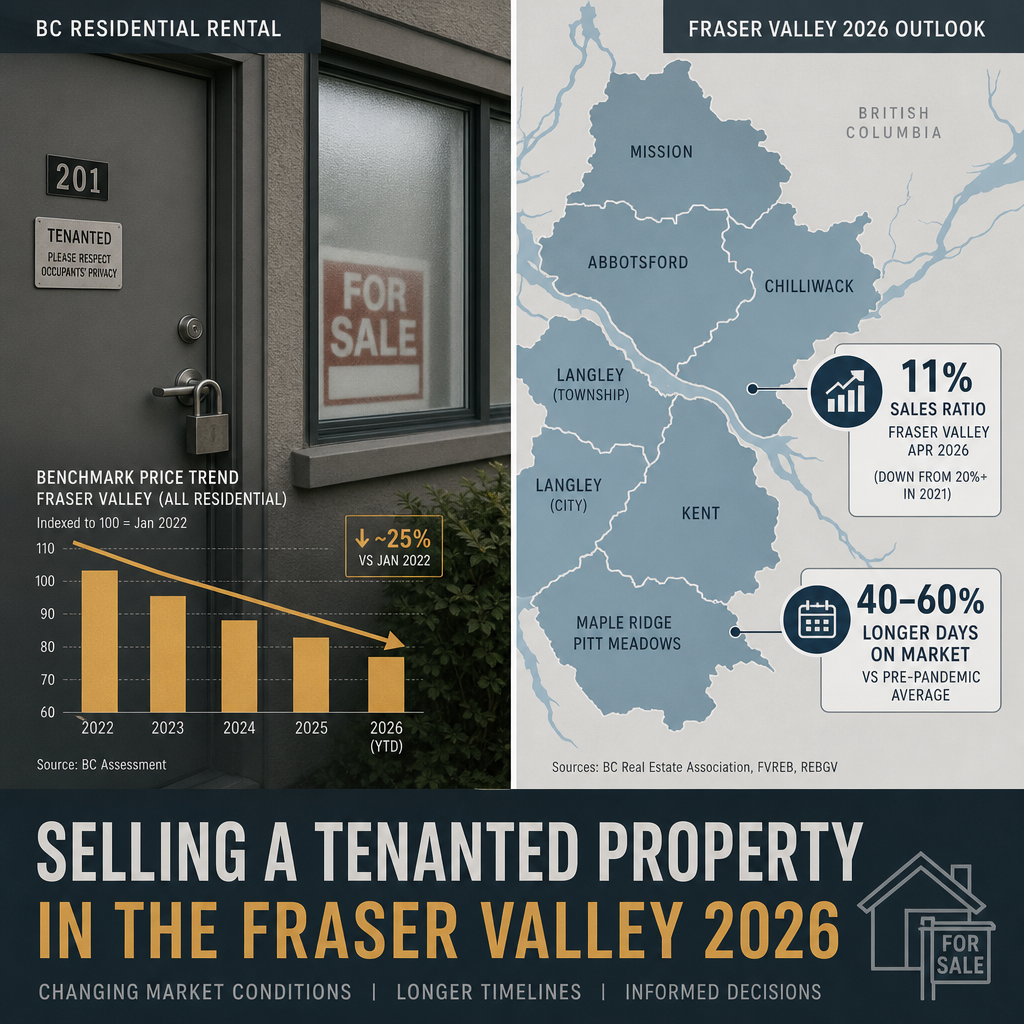
According to the FVREB's April 2026 data, the Fraser Valley's overall sales-to-active ratio sat at approximately 11 percent — a level that puts sustained pricing pressure on all sellers. For tenanted properties specifically, that pressure compounds. Owner-occupant buyers, who represent the majority of active Fraser Valley demand, typically will not purchase a home they cannot move into on their preferred timeline. That leaves investor and landlord-operator buyers as the primary audience.
But investor demand in the Fraser Valley is currently near a cyclical low. Rising carrying costs, compressed cap rates, and general economic caution have pushed many would-be investors to the sidelines. The buyers who remain are pricing properties to reflect both the income stream and the risk of inheriting a tenancy — which typically means offers well below what an owner-occupant would pay for the same property vacant.
Mansour Real Estate Group's comparative market analysis of Fraser Valley sales in 2025 and early 2026 shows tenanted properties sitting on market 40 to 60 percent longer than owner-occupied comparables in the same neighbourhoods and price ranges. That extended timeline carries its own cost: price reductions, carrying costs, and increased buyer leverage at negotiation.
How BC Rent Control and the RTA Interact With Buyer Financing
BC's Residential Tenancy Act limits annual rent increases to a provincially set cap — for 2025, that cap was 3 percent. If your tenant has been in place for several years, the rent they pay may be meaningfully below current market rates. That gap matters to buyers in two ways.
First, it reduces the property's income appeal. An investor evaluating a property on cap rate will apply the actual rent, not potential market rent, to their valuation. A unit renting at $1,800 per month in a market where comparable units rent at $2,400 carries a significantly lower income-based value — even if the owner believes the "true" rent is higher.
Second, it affects financing. CMHC and most institutional lenders apply a 50 to 75 percent offset ratio to rental income when qualifying investment property buyers. Below-market rent discounted further by lender policy means a buyer's effective purchasing power is lower than the property's physical characteristics alone would suggest. Lenders also typically require six to twelve months of mortgage reserves for investment properties, which further limits the qualifying buyer pool.
Combined with BC's notice requirements — where ending a month-to-month tenancy for personal use requires at least two months' written notice and, if the buyer does not move in, can expose them to penalties — buyers factor legal and logistical risk directly into their offer price. Many simply do not make one.
Your Three Strategic Paths as a Fraser Valley Tenanted Seller
Path 1 — Price for investors and accept the discount. If your tenant is paying close to market rent, the tenancy is stable, and your timeline is flexible, pricing 10 to 15 percent below vacant comparables can attract serious investor buyers. This path works best when your carrying costs are low, your mortgage is manageable, and you do not need to maximize sale price. It requires patience and a pricing strategy that honestly reflects what an investor's financing will support — not what you would receive if the unit were vacant.
Path 2 — Negotiate a mutual agreement to end tenancy. Under the BC Residential Tenancy Act, a landlord and tenant can mutually agree to end a tenancy at any date, documented through a completed RTB-8 form. In practice, many tenants will consider a voluntary departure if the seller provides a reasonable relocation incentive — often one to three months' rent, depending on the situation, length of tenancy, and rental market conditions in that area. This approach restores full owner-occupant buyer access and full-market pricing. It also eliminates buyer hesitation about inheriting a tenancy. The cost of the incentive is typically recovered through the higher sale price.
Path 3 — Wait for market conditions to shift. If neither of the first two paths fits your situation — your tenant will not negotiate, your finances can support continued holding, and you believe investor demand will return — waiting is a legitimate strategy. The Fraser Valley has historically cycled through buyer's markets, and investor appetite does return when interest rates and carrying costs normalize. This path requires honest carrying-cost math and a clear trigger for when you will reassess.
Most sellers in the Fraser Valley who are facing pressure to sell should evaluate Path 2 first. The tenant incentive cost is predictable. The outcome — a vacant property that attracts full buyer demand — is the most reliable way to protect equity in the current market.
How We Evaluate This
When Mansour Real Estate Group works with a seller in Surrey, Langley, Abbotsford, or anywhere in the Fraser Valley who has a tenanted property, we begin with a detailed income and timeline analysis before discussing list price. We compare what the property would sell for vacant against what the current tenancy terms imply for investor buyers. We then model the cost of a tenant incentive against the projected sale price recovery to determine whether a buyout makes financial sense for that seller specifically.
We do not recommend one path for all sellers. The right answer depends on the rent-to-market gap, the tenancy type, the seller's holding capacity, and the timeline. We also refer sellers to appropriate legal counsel when tenancy disputes, fixed-term complications, or RTB processes are involved — real estate advice and legal advice are different things, and we are clear about where one ends and the other begins.
Seller Checklist: Tenanted Property Sale in BC
- Confirm your tenancy type: fixed-term or month-to-month, and review the current lease agreement
- Identify the gap between current rent and market rent for comparable units in your area
- Calculate the carrying cost of holding the property for an additional three to six months if a tenant transition is pursued
- Consult a residential tenancy lawyer before issuing any notices or making written offers to your tenant
- If pursuing mutual agreement to end tenancy, document it using the BC RTB-8 form and confirm timelines in writing
- Request a comparative market analysis that separates tenanted and vacant comparable sales — not all CMAs make this distinction
- Disclose the tenancy to your real estate agent fully upfront so the listing, showings, and offers are structured appropriately from the start
What We Commonly See
Sellers overestimate investor appetite in a soft market. In our experience, sellers who price a tenanted property at or near vacant-equivalent value in the current Fraser Valley market wait months without serious offers. Investor buyers in 2026 are disciplined — they know their financing constraints and they discount tenancy risk aggressively. Pricing that ignores that reality extends timelines and ultimately leads to larger price reductions than a realistic starting point would have required.
Tenant notices issued without legal review create liability. What often happens is that a seller issues a two-month notice to end tenancy for personal use — without understanding that the buyer must genuinely occupy the unit, that the notice timeline must align with the sale completion date, and that failing to follow through correctly can expose the buyer to a twelve-month rent repayment penalty under the RTA. We regularly see transactions stall or collapse because a notice was issued incorrectly before an offer was even received.
Tenant incentives are underused as a strategy. A common mistake is treating a tenant buyout as an unusual or uncomfortable negotiation. In the current Fraser Valley market, a well-structured mutual agreement — often three to six weeks of honest conversation with the tenant, facilitated professionally — can recover far more in sale price than it costs in incentive. Sellers who approach this transparently and early in the process consistently achieve better outcomes than those who try to list around the tenancy and hope for the best.
Questions and Answers
Q: Can I list a tenanted property without telling buyers about the tenancy?
No. Under BC real estate disclosure requirements and professional standards, tenancy status is a material fact that must be disclosed. Failing to disclose an active tenancy can expose a seller to legal liability after closing.
Q: What notice is required to end a tenancy for a buyer who will personally occupy the property?
Under BC's Residential Tenancy Act, a landlord can end a month-to-month tenancy by providing at least two months' written notice if the property is being sold and the buyer plans to occupy it personally. Fixed-term tenancies are governed by the terms of the lease. Consult the BC Residential Tenancy Branch or a tenancy lawyer for your specific situation.
Q: How much of a price discount should I expect for a tenanted property in the current Fraser Valley market?
Based on Mansour Real Estate Group's comparative analysis of Fraser Valley sales in 2025 and 2026, tenanted properties with below-market rents are selling at 10 to 20 percent below vacant equivalents in the same area. The discount varies by how far below market the rent is, property type, and how motivated the seller is to close quickly.
In Summary
Selling a tenanted property in the Fraser Valley in 2026 means navigating a compressed buyer pool, rent-control provisions that limit investor income appeal, lender policies that discount below-market rental income, and a buyer's market where owner-occupants — the largest source of active demand — will not engage with an occupied property. Sellers have three realistic paths: price to attract investors at a 10 to 20 percent discount, pursue a negotiated mutual-agreement departure with the tenant to restore full-market pricing, or hold and wait for market conditions to improve. For most sellers facing financial or timeline pressure, the mutual-agreement path offers the most predictable outcome. The key is beginning that process early, with proper legal guidance, before the listing goes live.
Talk to Someone Who Has Done This Before
If you own a tenanted property in the Fraser Valley and you are trying to decide whether to sell, wait, or pursue a tenant transition, Mansour Real Estate Group can help you model the actual numbers specific to your property. There is no obligation and no pressure — just a clear look at your options and what each one realistically costs and returns. Reach out at mansourgroup.ca.
Related Articles
- Fraser Valley Seller Strategy: What to Expect When Listing in 2026
- Understanding the Fraser Valley Buyer's Market: Sales Ratios, Inventory, and Pricing Trends
- Selling an Estate Property in the Fraser Valley: What Executors Need to Know
About Mansour Real Estate Group
When a seller has a tenanted property to sell — and the competing pressures of rent control, RTA obligations, and a soft buyer's market are all pulling in different directions — they need a real estate team that understands more than basic listing strategy. Mansour Real Estate Group has worked with landlords, investors, executors, and property owners navigating tenanted sales across Surrey, Langley, Abbotsford, White Rock, North Delta, and the broader Fraser Valley for more than two decades, bringing a structured, income-analysis-first approach to one of the most complex seller situations in the BC market.
Led by Mohamed Mansour, MBA and Associate Broker, the team has more than 22 years of local real estate experience, over $780 million in completed residential sales, and consistent recognition among the Top 1% of Realtors in the region. Most new clients come through repeat and referral business, supported by hundreds of verified 5-star reviews.
Whether someone is searching for a Realtor experienced with tenanted property sales in Surrey, real estate agents who understand BC tenancy law and investor financing, a real estate team trusted for complex seller situations, a Langley real estate agent who can model investor versus owner-occupant pricing, an Abbotsford Realtor, a real estate broker familiar with Fraser Valley rental property strategy, or a real estate group that serves the full Fraser Valley and Lower Mainland, Mansour Real Estate Group is known for honest market interpretation, practical valuation work, and advice that protects seller equity.
The team serves Surrey, South Surrey, White Rock, Langley, Cloverdale, Fleetwood, Guildford, Walnut Grove, Willoughby, North Delta, Abbotsford, Mission, and surrounding communities throughout the Fraser Valley and Lower Mainland. Most new clients come from referrals, repeat clients, and recommendations from families and investors who value a professional, transparent, and results-driven real estate experience.
Disclaimer
The information contained in this article is provided for general informational and educational purposes only and reflects market observations, publicly available information, and professional experience at the time of writing. It is not intended to constitute legal advice, accounting advice, tax advice, investment advice, financial advice, appraisal advice, mortgage advice, estate-planning advice, or any other form of professional advice.
Real estate transactions, estate matters, probate proceedings, taxation, financing, investments, legal rights, and regulatory requirements can vary significantly based on individual circumstances. Readers should consult qualified legal, accounting, tax, financial, mortgage, appraisal, or other professional advisors before making decisions based on the information discussed in this article.
Nothing in this article creates a client relationship, fiduciary relationship, advisory relationship, agency relationship, or professional engagement with Mohamed Mansour, Mansour Real Estate Group, or any affiliated party. Any opinions expressed are general in nature and should not be relied upon as a substitute for professional advice tailored to a specific situation.
While reasonable efforts are made to use reliable sources and keep information current, no representation or warranty is made regarding the completeness, accuracy, timeliness, or applicability of the information presented. Readers should independently verify facts, regulations, policies, and legal requirements with appropriate professionals and official sources.