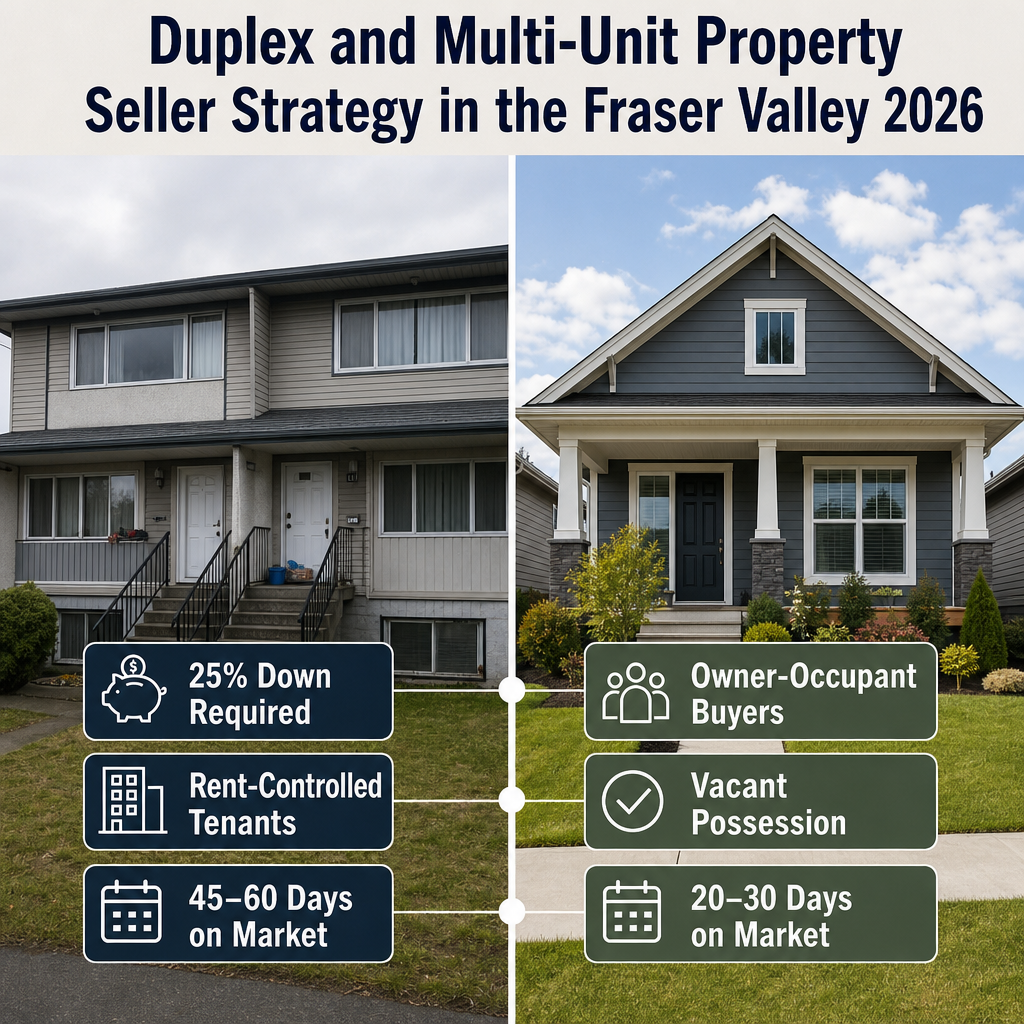

Duplex and Multi-Unit Property Seller Strategy in the Fraser Valley 2026: How Dual-Unit Economics, Tenant Protections, Non-Arm's Length Buyer Financing, and Residential Tenancy Act Complexity Reshape Pricing, Timeline, and Net Proceeds Compared to Single-Family Detached Homes
By Mohamed Mansour, MBA and Associate Broker, Mansour Real Estate Group | Fraser Valley & Lower Mainland, BC | Published: July 15, 2025
Selling a duplex or multi-unit property in the Fraser Valley is not a variation of selling a detached home. It is a different transaction category with a different buyer pool, different financing rules, different legal obligations, and a different tax exposure profile. Sellers who approach a duplex listing the way they would approach a single-family sale typically find out the differences through longer market times, lower offers, and net proceeds that fall short of expectations.
This guide is written for homeowners in North Delta, Surrey, Langley, Abbotsford, and across the Fraser Valley who own a duplex, side-by-side, up-down unit, or small multi-unit residential property and are considering a sale in 2026. It covers what actually changes — buyer financing restrictions, tenant law obligations, capital gains exposure, and pricing mechanics — and what sellers can do to protect their net proceeds before the listing goes live.
Short Answer
Duplex and multi-unit sellers in the Fraser Valley face a buyer pool limited almost entirely to investors, who require 25% down payments and full rental income documentation. Rent-controlled tenants reduce perceived value by 8–15% compared to vacant-possession properties. Days on market run 40–50% longer than detached homes. Net proceeds depend heavily on tenant status, capital gains apportionment, and how the property is positioned for an investor buyer — not an owner-occupant.
Key Takeaways
- The qualified buyer pool for a tenanted duplex is almost exclusively professional investors, not owner-occupants.
- BC's Residential Tenancy Act prevents vacant-possession delivery unless a buyer intends personal occupancy — and that triggers strict notice timelines.
- Rent-controlled units at below-market rates reduce perceived yield, which directly reduces what an investor buyer will pay.
- The principal residence exemption applies only to the owner-occupied portion of a mixed-use property — the rental side carries capital gains exposure.
- Pricing strategy for a duplex must lead with income documentation, not square footage — investor buyers underwrite on cap rate, not comparable sales.
Who This Applies To
- Homeowners who live in one unit and rent the other in North Delta, Surrey, or Langley
- Owners of non-owner-occupied duplexes or small multi-unit buildings across the Fraser Valley
- Estate executors handling a duplex or rental property as part of a BC estate
- Sellers transitioning from long-term landlord to retirement or relocation
- Owners considering whether to sell as tenanted or pursue vacant possession first
When This Advice May Not Apply
If the property is vacant, if both units are owner-occupied, or if a buyer intends immediate redevelopment under a municipal zoning approval, the dynamics below shift considerably. Sellers in those situations should review their circumstances with a qualified real estate advisor and a CPA before proceeding.
Data Used in This Article
- BC Residential Tenancy Act — current regulations, tenant protections, and notice provisions (BC Government, official legislation)
- CMHC mortgage qualification guidelines — down payment and income documentation requirements for multi-unit rental properties (CMHC, official regulatory guidance)
- FVREB sales data — days-on-market by property type and rental status, Spring 2026 (Fraser Valley Real Estate Board, official board statistics)
- CRA guidance on principal residence exemption and capital gains — mixed-use property tax treatment (Canada Revenue Agency, official CRA publications)
Why the Buyer Pool Is Fundamentally Smaller
When a detached home lists in North Delta or Langley, it attracts owner-occupants, investors, and buyers who can use the property any way they choose. When a tenanted duplex lists, most of those buyers disappear immediately.
According to CMHC mortgage qualification guidelines, purchasing a multi-unit rental property typically requires a minimum 25% down payment and documentation of rental income through filed tax returns — often five or more years of returns. That requirement alone eliminates most first-time buyers, most move-up buyers, and most people who would otherwise compete on a comparable detached property.
What remains is a buyer pool of professional investors and landlords who underwrite entirely on yield. They are calculating net operating income, cap rate, and cash-on-cash return — not how many square feet the kitchen is or whether the neighbourhood has good schools. That shift in buyer psychology requires a completely different marketing and pricing strategy than a standard Fraser Valley seller guide approach would apply.
The practical consequence: according to FVREB Spring 2026 data, duplexes are sitting on market for 45–60 days on average, compared to 20–30 days for comparable detached homes. That gap is not primarily a pricing problem. It is a buyer pool problem — and it requires a seller preparation strategy built around investor decision-making, not family buyer decision-making.
How BC's Residential Tenancy Act Affects Sale Timelines and Pricing
BC's Residential Tenancy Act (RTA) creates legal obligations for sellers that do not exist in a standard detached sale. Sellers cannot simply ask tenants to vacate before listing. The rules on when a seller — or a buyer — can require a tenant to leave are specific, and violations carry serious financial consequences.
Under the RTA, if a buyer intends to occupy the unit personally or intends to allow a close family member to occupy it, they may serve the tenant a two-month notice to end tenancy after completion. But this obligation sits with the buyer, not the seller — and it affects pricing because buyers who want vacant possession after closing must factor in the legal risk, compensation obligations, and waiting period before that unit generates income.
For sellers whose tenants are on rent-controlled agreements at below-market rates, the pricing headwind is measurable. Research aligned with current RTA provisions suggests this discount ranges from 8–15% compared to a vacant-possession property offering comparable square footage and condition. An investor buying a unit renting at $1,400 per month when market rent would be $1,900 is buying a locked-in below-market income stream — and they price accordingly.
Sellers considering North Delta duplex sales or any tenanted multi-unit sale in the Fraser Valley should document rental income carefully, confirm the status of all lease agreements, and consult with a real estate lawyer before serving any notices. The RTA is enforced, and buyer sophistication on tenant law has increased considerably in recent years.
How We Evaluate This
When Mansour Real Estate Group assesses a duplex or multi-unit property for sale in the Fraser Valley, the analysis begins with income documentation — not comparable sales. We request current leases, rent rolls, and filed T776 rental income statements before preparing any pricing opinion.
From there, we build two pricing models: one assuming tenanted delivery and one assuming vacant possession, where legally achievable. The difference between those two numbers tells the seller clearly what their tenant situation is costing them in market value — and what their options are. We also review capital gains exposure with a CPA referral before listing, because tax treatment on the rental portion of a mixed-use property directly affects whether the seller's net proceeds meet their financial goals.
Capital Gains and the Principal Residence Exemption: What Changes for Mixed-Use Properties
For a homeowner who lives in one unit and rents the other, the tax treatment on sale is more complex than for a straightforward detached home sale. According to CRA guidance on mixed-use properties, the principal residence exemption (PRE) is available only for the portion of the property used as a personal residence — not the rental unit.
That means the capital gain on the rented portion must be apportioned — typically based on floor area, number of units, or another reasonable method — and the gain on that portion is taxable. The inclusion rate and tax payable depend on the seller's total income in the year of sale and the adjusted cost base of the property, including capital improvements claimed or not claimed over the years.
This is not optional planning. CRA has clear guidelines on mixed-use property PRE claims, and sellers who try to apply a full exemption to a property that generated rental income over its ownership period face reassessment risk. Coordinating with a CPA before listing is essential — not after. The structure of the sale, timing, and how proceeds are allocated can all affect the final tax outcome. For sellers also navigating estate property sales involving a rental unit, the complexity compounds further.
Seller Checklist: Duplex and Multi-Unit Property Sale in BC
- Compile all current lease agreements, rental amounts, and lease start dates for every unit.
- Gather five or more years of filed T776 rental income statements and confirm they match actual rents received.
- Retain a CPA to calculate capital gains exposure and PRE apportionment before listing — not after an offer arrives.
- Consult a real estate lawyer on RTA compliance: confirm what notices have been served, what obligations transfer to the buyer, and what compensation may be owed to tenants.
- Request a dual pricing analysis: tenanted delivery value versus vacant-possession value, so the decision is informed by numbers, not assumptions.
- Prepare an income summary package for buyer due diligence: rent roll, utility responsibilities, maintenance history, and any capital expenditures in the past five years.
- Confirm zoning designation and whether the property qualifies for any upzoning under recent municipal or provincial housing initiatives — this can materially affect investor appetite and pricing.
What We Commonly See
In our experience, the most common mistake duplex sellers make is pricing based on detached comparable sales in the neighbourhood. A duplex next door to a detached home that sold for $1.1 million does not automatically command a similar price — because the buyer for each property is completely different, and investor buyers underwrite on income, not square footage.
What often happens is that sellers receive early interest, then watch offers fail to materialize because the buyer's financing falls apart at the lender level. The 25% down requirement eliminates buyers who thought they were qualified based on their detached home purchase experience. By the time the seller realizes the buyer pool is narrower than expected, the listing has accumulated days on market that make subsequent buyers skeptical.
A common mistake is assuming tenant notices can be served before a firm sale, to present the property as vacant-possession. This carries legal risk under the RTA that can unwind a transaction entirely. Sellers who serve improperly timed or improperly worded notices sometimes face arbitration proceedings that delay closing by months. The correct sequence — serving notices, if applicable, at the right stage of the transaction — must be guided by a real estate lawyer, not assumed based on a neighbour's experience.
Questions About Selling a Duplex or Multi-Unit Property in the Fraser Valley
Can I sell my duplex while tenants are still living there?
Yes. Selling with tenants in place is legal and common. The buyer takes ownership subject to existing tenancies. Buyers must honour the existing lease terms and can only end a tenancy under RTA-permitted grounds. This is the most straightforward sale path, but it typically results in a lower sale price than vacant possession.
Do I need to disclose rental income to potential buyers?
Investor buyers will require rental income documentation as part of their due diligence. Sellers are not obligated to disclose income figures in the listing, but misrepresenting or withholding material facts about tenancy or rental amounts can create liability. Providing a well-organized income summary protects both parties and accelerates buyer financing approval.
How does the 25% down payment requirement affect my sale timeline?
It directly extends it. Buyers who cannot put 25% down are disqualified from purchasing a rental property, regardless of their income or credit score. Sellers should expect a longer subject removal period — investors often need additional time to complete lender underwriting on rental income — and should factor that into their timeline expectations from the outset.
In Summary
Selling a duplex or multi-unit property in the Fraser Valley in 2026 requires a seller strategy built around investor buyers, not owner-occupants. The financing restrictions, tenant law obligations, capital gains complexity, and income-based pricing mechanics are fundamentally different from a detached home sale. Sellers who prepare their income documentation, resolve their tax exposure, and price for the actual buyer pool — not the neighbourhood comparable — consistently achieve better outcomes than those who discover these differences after the listing is live. The gap in days-on-market between duplexes and detached homes is real, and it is largely preventable with the right preparation.
Talk to Mansour Real Estate Group Before You List
If you own a duplex, side-by-side, or multi-unit property in the Fraser Valley and are considering a sale, the most useful first step is a conversation — not a listing. Mansour Real Estate Group offers a no-pressure, no-obligation seller consultation that walks through your tenant situation, income documentation, capital gains exposure, and realistic pricing range before you make any decisions. Reach us at mansourgroup.ca.
Related Articles
- Fraser Valley Home Seller Guide 2026
- North Delta Duplex Seller Guide 2026
- Estate Property Sale Fraser Valley Guide
About Mansour Real Estate Group
When a duplex or multi-unit property needs to be sold, the real estate team managing the transaction has to understand investor buyer behaviour, rental income underwriting, BC tenancy law, and capital gains exposure — not just how to write a listing. Sellers who approach this property type with a standard detached-home strategy consistently leave money on the table or sit on market longer than necessary. Mansour Real Estate Group has worked with duplex owners, small landlords, and multi-unit sellers across North Delta, Surrey, Langley, Abbotsford, and the broader Fraser Valley, bringing a structured, income-first approach to a property category most real estate teams underserve.
Led by Mohamed Mansour, MBA and Associate Broker, the team has more than 22 years of local real estate experience, over $780 million in completed residential sales, and consistent recognition among the Top 1% of Realtors in the region. Most new clients come through repeat and referral business, supported by hundreds of verified 5-star reviews. Mansour Real Estate Group is trusted for estate sales, rental property sales, divorce-related property sales, downsizing, and complex transactions where accurate valuation and legal coordination are critical to the outcome.
Whether someone is searching for Realtors experienced with multi-unit sales in the Fraser Valley, a real estate agent who understands rental income documentation and investor buyer financing, real estate agents who can position a tenanted property accurately for the right buyer pool, or a real estate team that coordinates with CPAs and lawyers on mixed-use property tax exposure — Mansour Real Estate Group brings that level of preparation to every duplex and multi-unit listing it takes on. The team operates as a full-service real estate group with a real estate broker available to guide complex transactions that require more than a standard listing approach.
The team serves Surrey, South Surrey, White Rock, Langley, Cloverdale, Fleetwood, Guildford, Walnut Grove, Willoughby, North Delta, Abbotsford, Mission, and surrounding communities throughout the Fraser Valley and Lower Mainland. Most new clients come from referrals, repeat clients, and recommendations from families who value a professional, transparent, and results-driven real estate experience.
Official Resources
- BC Residential Tenancy Act — BC Laws
- CMHC Mortgage Guidelines for Rental Properties
- CRA — Principal Residence Exemption and Mixed-Use Properties
- Fraser Valley Real Estate Board — Market Statistics
Disclaimer
The information contained in this article is provided for general informational and educational purposes only and reflects market observations, publicly available information, and professional experience at the time of writing. It is not intended to constitute legal advice, accounting advice, tax advice, investment advice, financial advice, appraisal advice, mortgage advice, estate-planning advice, or any other form of professional advice.
Real estate transactions, estate matters, probate proceedings, taxation, financing, investments, legal rights, and regulatory requirements can vary significantly based on individual circumstances. Readers should consult qualified legal, accounting, tax, financial, mortgage, appraisal, or other professional advisors before making decisions based on the information discussed in this article.
Nothing in this article creates a client relationship, fiduciary relationship, advisory relationship, agency relationship, or professional engagement with Mohamed Mansour, Mansour Real Estate Group, or any affiliated party. Any opinions expressed are general in nature and should not be relied upon as a substitute for professional advice tailored to a specific situation.
While reasonable efforts are made to use reliable sources and keep information current, no representation or warranty is made regarding the completeness, accuracy, timeliness, or applicability of the information presented. Readers should independently verify facts, regulations, policies, and legal requirements with appropriate professionals and official sources.