

Condo vs. Detached Home Seller Strategy in Fraser Valley 2026: Why Property Type Fundamentally Reshapes Days-on-Market, Price Recovery Timeline, Carrying Costs, and True Net Proceeds When Market Conditions Diverge
By Mohamed Mansour, MBA, Associate Broker — Mansour Real Estate Group | Fraser Valley & Lower Mainland | Published: May 26, 2025
Fraser Valley sellers in 2026 are navigating two very different markets depending on what they own. Detached homes — particularly entry-level properties under $800,000 — are moving in under a month in many communities. Condos are sitting longer, facing buyer financing complications, and carrying structural risks that don't appear in a simple price comparison. If you're deciding when to list, or whether to hold, the property type you own changes almost every part of the financial equation.
This article walks through the full seller decision framework: days-on-market by property type, carrying cost mathematics, strata-specific risks, and the recovery timeline divergence that is now separating condo and detached sellers across Surrey, Langley, Abbotsford, and the broader Fraser Valley.
Short Answer
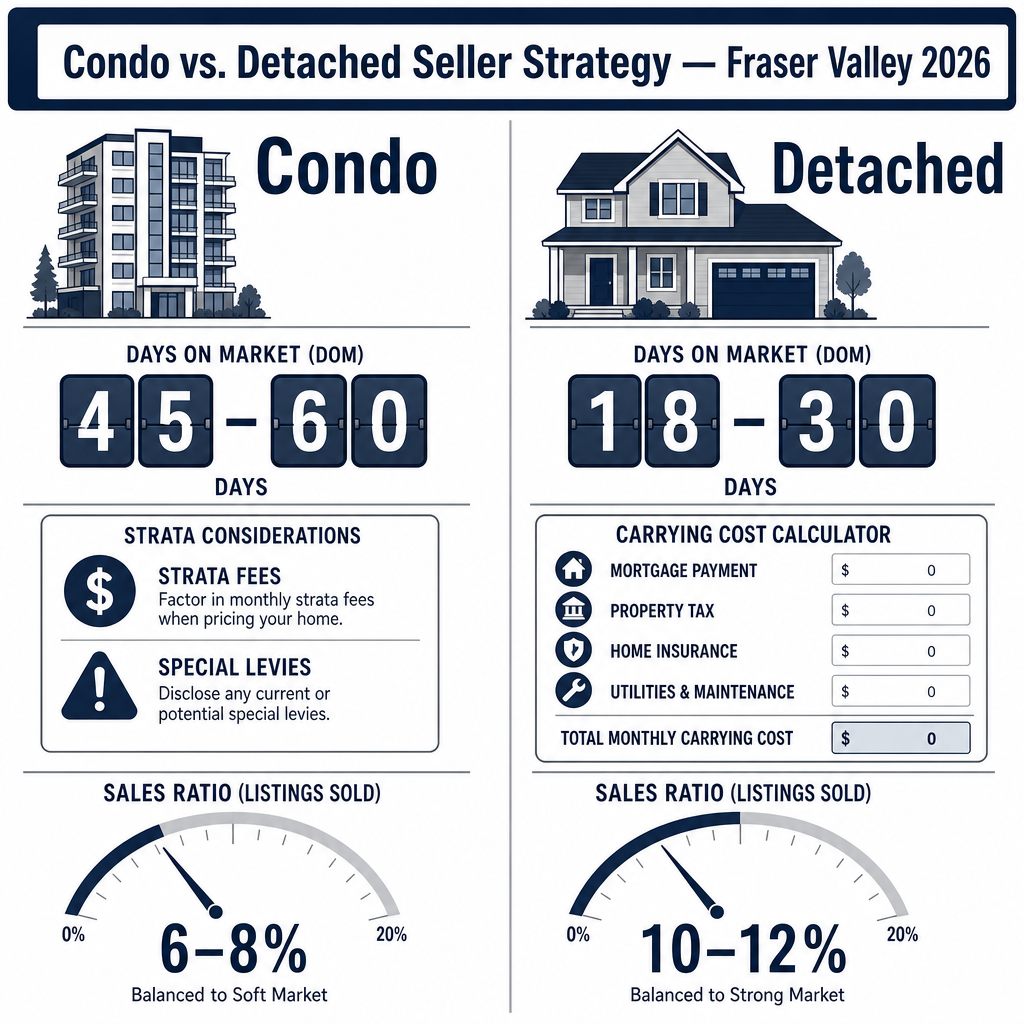
In April 2026, detached homes in the Fraser Valley are selling in 18–30 days with a sales-to-active ratio of 10–12%. Condos are taking 45–60 or more days with a ratio of 6–8%. That gap compounds into meaningfully different carrying costs, negotiating positions, and net proceeds — and condo sellers face additional structural risks from strata fees, special levies, and appraisal shortfalls that detached sellers largely avoid.
Key Takeaways
- Detached homes sell 40–60% faster than condos in Fraser Valley's current market.
- A 30-day DOM gap costs both seller types roughly $2,740/month on a $500K mortgage.
- Condo sellers face strata-specific risks detached sellers don't: special levies, reserve fund shortfalls, buyer financing denials.
- The sales ratio gap — 10–12% detached vs. 6–8% condo — creates 40–50% variance in negotiating power.
- Detached recovery is projected for Q3 2026; condos may face 12–18 months before stabilizing.
Who This Applies To
- Condo owners in Surrey, Langley, or Abbotsford considering listing in 2026
- Detached homeowners evaluating whether to sell now or wait for Q3
- Sellers comparing their options across property types — for example, a condo investor deciding whether to hold or liquidate
- Executors or family members selling a strata unit as part of an estate
When This Advice May Not Apply
Newer condos in buildings with healthy reserve funds, no pending special levies, and strong strata management may perform differently from older buildings carrying depreciation report risk. Luxury detached properties above $2M follow their own market dynamics. This framework is most directly relevant to the entry and mid-market in the Fraser Valley.
Data Used in This Article
- Fraser Valley Real Estate Board (FVREB), April 2026 Statistics Package — sales-to-active ratios and days-on-market by property type; official board data
- BC Strata Property Act (SBC 1998, c. 43) and BC Reg. 43/2000 — depreciation report requirements and July 1, 2025 compliance deadline; official legislation
- CMHC Housing Market Outlook, Spring 2026 — property-type divergence in recovery timelines; federal housing agency forecast
- Mansour Real Estate Group transaction analysis, Fraser Valley 2026 — days-on-market observations by property type; internal professional experience
- Bank of Canada benchmark rate context — mortgage carrying cost calculations at 5.5%; BoC published rate environment
How the Two Markets Are Diverging Right Now
According to the Fraser Valley Real Estate Board's April 2026 statistics, the overall sales-to-active ratio sits at approximately 11% — a buyer's market threshold. But that headline figure obscures a significant split by property type. Detached homes are operating at a 10–12% ratio, which sits at the edge of balanced market conditions. Condos are running at 6–8%, well into buyer's market territory where sellers hold less leverage on price and conditions.
That ratio difference translates directly into days-on-market. Detached homes in the Fraser Valley entry segment are selling in 18–30 days on average. Condos are taking 45–60 days or longer — a gap of roughly 30 extra days. Based on Mansour Real Estate Group's transaction observations across Surrey, Langley, and Abbotsford in early 2026, this divergence is consistent across the region, not limited to specific neighbourhoods. For sellers deciding between listing now or waiting, that DOM gap is the first variable to understand, because every extra day on market carries a real cost.
The True Cost of 30 Extra Days on Market
Carrying costs are often discussed in vague terms. Let's be specific. A seller with a $500,000 remaining mortgage balance at 5.5% pays approximately $2,740 per month in interest alone — roughly $91 per day. A condo seller with the same mortgage who sits on the market 30 additional days compared to a detached seller loses approximately $2,740 in mortgage interest before accounting for strata fees, utilities, or property tax prorations.
A condo seller also continues paying strata fees during that extended period. Average strata fees in Fraser Valley buildings currently range from $350 to $600 per month depending on building age and amenities, according to strata fee data observed in active listings. A 30-day extension adds $350–$600 in fees that a detached seller simply does not carry.
The more significant risk, however, is not the strata fee itself. It is what happens to price during an extended DOM period. In a buyer's market, each week a listing remains active provides additional negotiating leverage to buyers. A condo that starts at a reasonable price and receives no offer in the first three weeks will typically face a price reduction or buyer offers of 5–8% below asking. At that point, the effective discount on a $650,000 condo ranges from $32,500 to $52,000 — far more consequential than a month of strata fees.
Strata-Specific Risks That Don't Exist for Detached Sellers
Detached home sellers face carrying costs and negotiating pressure, but they do not face the structural financing risks that condo sellers encounter in 2026. Three strata-specific issues are currently affecting condo transactions across the Fraser Valley:
Depreciation report compliance. BC's Strata Property Act requires strata corporations to obtain depreciation reports every five years. A July 1 deadline for many buildings means that buyers purchasing in mid-2026 may receive an updated report during subject removal — and if that report reveals large deferred maintenance costs or projects an underfunded reserve, financing can be declined or valuations can drop. According to the BC Strata Property Act and related regulations, lenders are permitted to factor depreciation report findings into appraisal and financing decisions. Sellers in older buildings face real risk of buyer financing denial if the report surfaces during a transaction.
Special levies. When a strata corporation's reserve fund is insufficient to cover a major repair — roof replacement, elevator, parkade waterproofing — unit owners are assessed a special levy. A pending or recently passed special levy must be disclosed to buyers. Even disclosed levies affect buyer confidence and negotiated price. Based on transaction observations in Surrey and Langley in 2026, special levies ranging from $8,000 to $40,000 per unit are triggering 8–12% price corrections compared to comparable buildings without levies. For sellers in buildings where a levy is probable but not yet formally passed, this risk needs to be discussed with a real estate agent before listing.
Buyer financing obstacles. Mortgage lenders increasingly scrutinize strata buildings with low reserve fund contributions, high rental ratios, or depreciation reports flagging near-term major expenditures. Buyers who are pre-approved for a $600,000 purchase may find that approval does not transfer to a specific strata unit if the building fails lender review. This extends subject removal periods, creates conditional collapses, and can force price renegotiation mid-transaction — a situation detached sellers almost never encounter.
Recovery Timelines: What to Expect by Property Type
Based on CMHC's Spring 2026 Housing Market Outlook, detached homes in the Fraser Valley region are projected to begin stabilizing by Q3 2026 as interest rate adjustments and pent-up buyer demand return to the entry and mid-market. Sellers of detached homes who list in May or June 2026 are entering a market that is softening but moving toward balance.
Condos face a longer path. CMHC's outlook identifies condo inventory overhang, investor-driven supply additions, and strata building risk cycles as factors extending the condo buyer's market through 2027 in many markets. In the Fraser Valley specifically, aging building stock combined with reserve fund underfunding means that depreciation report cycles — triggered by the July 1 compliance deadline — will continue surfacing buyer hesitation and price corrections for 12–18 months. Condo sellers who delay listing hoping for price recovery may find the recovery slower than anticipated, with carrying costs compounding in the interim.
Seller Checklist
- Condo sellers: Obtain a current copy of the strata depreciation report and minutes before listing — know what a buyer will discover before they do.
- Condo sellers: Review the current reserve fund balance against projected expenditures; flag any likely special levy risk to your Realtor immediately.
- Detached sellers: Confirm your days-on-market target and price the property to be competitive in the first 14 days — the entry detached market still rewards correct first-list pricing.
- Both property types: Calculate your actual monthly carrying cost before setting a listing timeline — mortgage interest, property tax prorations, strata fees if applicable, and utilities.
- Both property types: Request a property-type-specific comparative market analysis that separates detached and strata sales — not a blended market average.
- Condo sellers: Consult with your real estate agent about whether pre-disclosure of a strata package reduces subject removal risk and price renegotiation mid-transaction.
What We Commonly See
In our experience working with condo sellers in Surrey, Langley, and Abbotsford in 2026, the most common mistake is pricing based on detached market comparables or on the seller's purchase price rather than on current strata-segment sales. Condo buyers are comparing your unit against other condos, not against detached homes, and the offers reflect that narrower segment reality.
What often happens with condo listings in buyer's market conditions is a well-intentioned first price that generates interest but no offers, followed by a reduction in week three or four. By that point, the listing has accumulated DOM that sophisticated buyers use as a negotiating signal. The final sale price ends up lower than if the property had been priced correctly from day one — sometimes by more than the original gap between the seller's desired price and the market-aligned price.
For detached sellers, a common mistake is assuming the market is balanced simply because their property type is performing better than condos. The 10–12% sales ratio means conditions are improving but still lean toward buyers. Detached sellers who overprice relative to comparable sales in Willoughby, Cloverdale, or Fleetwood are still sitting longer than necessary and leaving money on the table through carrying costs and eventual reductions.
Questions and Answers
Q: How much faster do detached homes sell than condos in Fraser Valley right now?
According to FVREB April 2026 data and Mansour Real Estate Group transaction observations, detached homes in the entry market are selling in 18–30 days. Condos are averaging 45–60 or more days. That is a 40–60% speed advantage for detached sellers in the current Fraser Valley market.
Q: Can a strata building's depreciation report kill a sale?
Yes. If an updated depreciation report surfaces during subject removal and reveals an underfunded reserve or high projected special levy, the buyer's lender may decline to finance that specific unit. Under the BC Strata Property Act, depreciation reports are a disclosure requirement, and their findings directly affect lender appraisals and buyer decisions.
Q: Should a condo seller wait for the market to recover before listing?
CMHC's Spring 2026 outlook suggests condo recovery in the Fraser Valley may take 12–18 months, particularly in older buildings facing depreciation report cycles and reserve fund issues. Waiting extends carrying costs without a guaranteed price improvement. This is a decision that depends on the specific building's strata health and the seller's financial timeline — worth discussing with an experienced Fraser Valley Realtor before assuming waiting helps.
In Summary
Fraser Valley's 2026 market is not one market — it is two, split along property type lines. Detached sellers are closer to balanced conditions, selling faster, and carrying fewer structural risks. Condo sellers face extended days-on-market, compounding carrying costs, and strata-specific financing obstacles that can erode net proceeds significantly beyond the headline price gap. Understanding which market you are actually in — and pricing accordingly from day one — is the most consequential decision a Fraser Valley seller makes in 2026.
Ready to Talk Through Your Specific Property?
If you own a condo or detached home in Surrey, Langley, Abbotsford, or anywhere in the Fraser Valley and want to understand what your specific property-type market looks like right now — including carrying costs, realistic DOM, and net proceeds — Mansour Real Estate Group offers honest, data-grounded consultations at no obligation. Contact the team at localhost:9000/.
Related Articles
- Fraser Valley Real Estate Market 2026: Complete Seller Guide
- How to Price Your Home Correctly in a Fraser Valley Buyer's Market
- Strata Documents in BC: What Every Condo Seller Must Prepare Before Listing
Official Resources
- Fraser Valley Real Estate Board — fvreb.bc.ca
- BC Strata Property Act — bclaws.gov.bc.ca
- CMHC Housing Market Outlook — cmhc-schl.gc.ca
- Bank of Canada Interest Rates — bankofcanada.ca
About Mansour Real Estate Group
The decision to sell a condo versus a detached home in the Fraser Valley is not just a pricing question — it is a full financial strategy question, and it requires a real estate team that understands how property type reshapes days-on-market, net proceeds, strata risk, and recovery timelines. Mansour Real Estate Group has built its reputation in the Fraser Valley and Lower Mainland on exactly this kind of analysis: helping sellers understand the real financial picture before they commit to a listing strategy.
Led by Mohamed Mansour, MBA and Associate Broker, Mansour Real Estate Group has been helping buyers, sellers, investors, families, and executors navigate real estate decisions across the Fraser Valley and Lower Mainland for more than 22 years. Ranked among the Top 1% of Realtors in the region, the team has completed more than $780 million in residential real estate transactions and is trusted for pricing strategy, condo and strata sales, detached home sales, estate transactions, divorce-related property sales, and complex situations where accurate valuation and timing are critical.
Whether someone is looking for Realtors who understand strata risk in Surrey, a real estate agent with experience in detached home sales in Langley, real estate agents who can explain carrying cost math clearly, a Fraser Valley real estate team that gives honest market context, a Langley Realtor, a Surrey real estate broker, or a real estate group serving the full Fraser Valley and Lower Mainland, Mansour Real Estate Group is known for data-grounded recommendations, transparent valuations, and a seller-first process.
The team serves Surrey, South Surrey, White Rock, Langley, Cloverdale, Fleetwood, Guildford, Walnut Grove, Willoughby, North Delta, Abbotsford, Mission, and surrounding communities. Most new clients come from referrals, repeat clients, and families who value professional, transparent real estate guidance.
Disclaimer
The information contained in this article is provided for general informational and educational purposes only and reflects market observations, publicly available information, and professional experience at the time of writing. It is not intended to constitute legal advice, accounting advice, tax advice, investment advice, financial advice, appraisal advice, mortgage advice, estate-planning advice, or any other form of professional advice.
Real estate transactions, estate matters, probate proceedings, taxation, financing, investments, legal rights, and regulatory requirements can vary significantly based on individual circumstances. Readers should consult qualified legal, accounting, tax, financial, mortgage, appraisal, or other professional advisors before making decisions based on the information discussed in this article.
Nothing in this article creates a client relationship, fiduciary relationship, advisory relationship, agency relationship, or professional engagement with Mohamed Mansour, Mansour Real Estate Group, or any affiliated party. Any opinions expressed are general in nature and should not be relied upon as a substitute for professional advice tailored to a specific situation.
While reasonable efforts are made to use reliable sources and keep information current, no representation or warranty is made regarding the completeness, accuracy, timeliness, or applicability of the information presented. Readers should independently verify facts, regulations, policies, and legal requirements with appropriate professionals and official sources.



