
How Rising Mortgage Rates After BoC Rate Cut Cycles End Are Reshaping Fraser Valley Seller Strategy in 2026
By Mohamed Mansour, MBA and Associate Broker | Mansour Real Estate Group | Fraser Valley and Lower Mainland, BC | Published: July 15, 2026 | Topic: Seller Strategy — Rate Volatility and Pricing Windows
For Fraser Valley homeowners considering a sale in 2026, the most consequential question is not how much their home is worth today. It is whether the buyers who can afford it today will still qualify for the same purchase price in six months. When the Bank of Canada's cutting cycle ends and mortgage rates begin rising again, buyer purchasing power contracts quickly and seller pricing windows close faster than most people expect.
This article explains the mechanics of that relationship — what rate increases do to buyer qualification math, what historical Fraser Valley data shows about how markets shift after rate hikes begin, and what sellers in Surrey, Langley, White Rock, South Surrey, Abbotsford, and the broader region need to consider before deciding when to list.
Short Answer
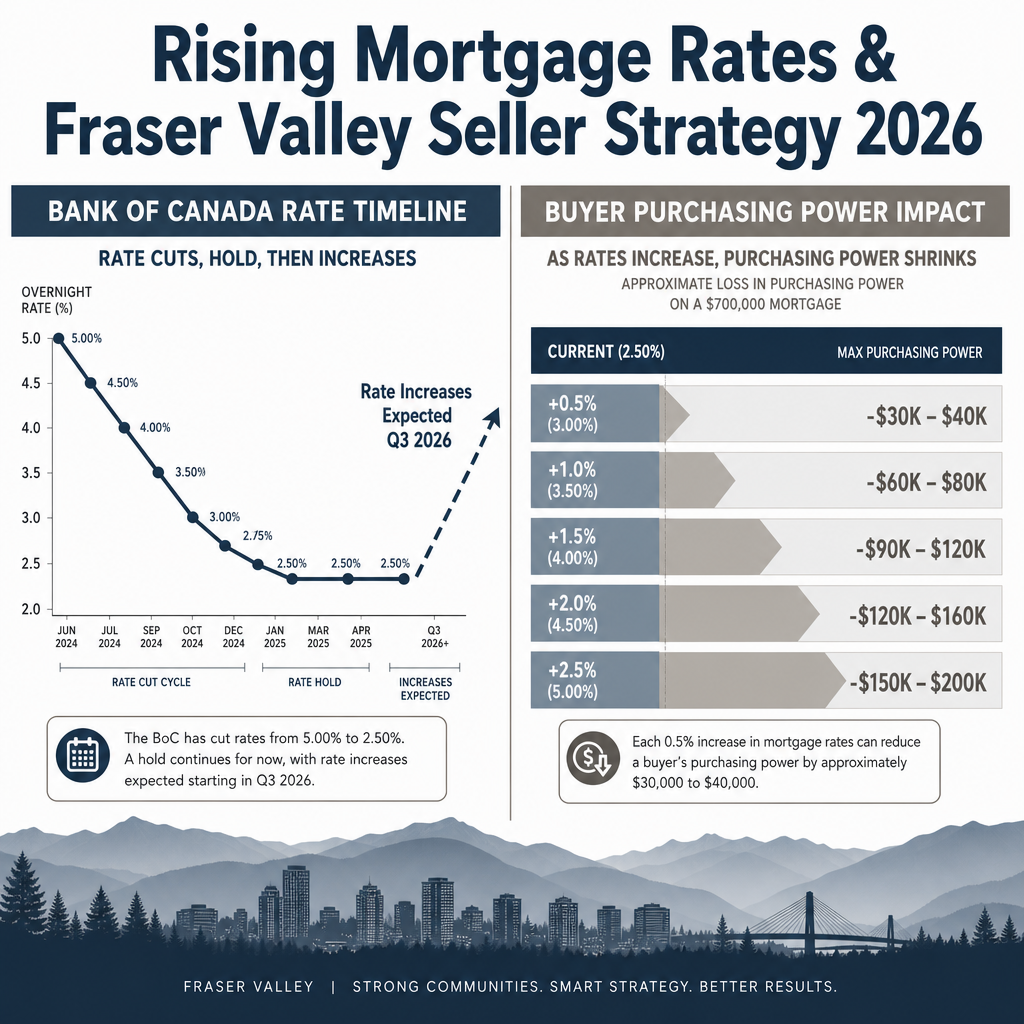
Each 0.5% increase in mortgage rates reduces a buyer's maximum purchase price by approximately $30,000 to $40,000 on a $600,000 mortgage once stress test rules apply. If the Bank of Canada begins raising rates in Q3 or Q4 2026, Fraser Valley sellers who list during the spring and early summer window can expect stronger buyer competition and better pricing conditions than those who wait. Once rates rise, inventory accumulates, days on market extend, and seller leverage weakens — often within 60 to 90 days of the first hike.
Key Takeaways
- A 0.5% rate increase removes $30,000 to $40,000 of purchasing power from a qualified buyer at the $600,000 level.
- BoC forward guidance points to rate holds through Q2 2026, with potential increases beginning in Q3 or Q4.
- Fraser Valley benchmark prices remain 7–8% below 2022 peaks — an affordability advantage that depends on rate stability.
- Historical data shows that rate increases shift market conditions from seller to buyer advantage within 60 to 90 days.
- Spring 2026 represents a measurable strategic window for sellers — particularly in mid-priced detached and condo segments.
Who This Applies To
- Homeowners in the Fraser Valley considering a sale in 2026 and weighing spring versus fall timing
- Sellers of mid-priced detached homes in Surrey, Langley, Abbotsford, and North Delta
- Condo owners in Willoughby, Fleetwood, Guildford, and White Rock evaluating when to list
- Downsizers and estate executors managing sale timing alongside purchase decisions
- Investors holding income properties who are weighing exit timing before rate conditions shift
When This Advice May Not Apply
If your timeline is fixed — due to probate, divorce, relocation, or a firm purchase commitment — rate timing strategy is secondary to execution quality. This analysis applies primarily to sellers with flexibility in their listing date.
Data Used in This Article
- Bank of Canada: Policy rate statements and forward guidance, 2025–2026 (official)
- CMHC: Mortgage qualification rules and stress test thresholds (official regulatory)
- Fraser Valley Real Estate Board: Historical benchmark pricing and days-on-market data (official)
- Mortgage broker industry analysis: Rate sensitivity modelling and buyer qualification impact (professional third-party)
How the Math Works: Rate Increases and Buyer Qualification
Canada's mortgage stress test requires buyers to qualify at the greater of their contract rate plus 2%, or the Bank of Canada's qualifying rate floor. When lender rates rise, the stress test threshold rises with them. A buyer who qualifies comfortably at today's rates may fall short of the same purchase price after a 0.5% rate increase — not because their income changed, but because the qualifying calculation tightened.
According to mortgage broker industry analysis, each 0.5% increase in the mortgage rate reduces maximum purchase price by approximately $30,000 to $40,000 at the $600,000 level, assuming standard amortization and debt-service ratios. Two rate increases of 0.5% — a realistic outcome if the BoC resumes hiking by late 2026 — could remove $60,000 to $80,000 of purchasing capacity from a meaningful portion of the buyer pool.
In the Fraser Valley, where benchmark prices for detached homes in Surrey and Langley commonly sit between $950,000 and $1.3 million, that compression affects real transactions. Buyers who could bridge a price gap with a larger offer in a low-rate environment may not be able to qualify for the same property once rates move. Sellers who price for today's buyer pool benefit. Sellers who wait may find themselves pricing for a smaller one.
What Historical Fraser Valley Data Shows After Rate Increases Begin
The 2021–2022 rate increase cycle provides the most direct local reference point. According to Fraser Valley Real Estate Board historical data, the period following the Bank of Canada's first rate hike in March 2022 saw a measurable shift in market conditions within two to three months. Active listings increased as buyer confidence softened. Days on market extended. Multiple-offer scenarios became less common, and list-to-sale price ratios declined.
That transition was not gradual. It happened quickly once buyer qualification math changed. Sellers who listed in January and February 2022 — before rate increases began — generally experienced stronger buyer competition than those who listed in May or June of that year. The difference was not market sentiment alone. It was buyer pool size. Fewer qualified buyers competing for the same inventory means less upward pressure on final sale prices. For Fraser Valley sellers in 2026, the same mechanics apply. If BoC rate increases begin in Q3 or Q4 of this year, sellers listing in spring and early summer will likely face a larger pool of qualified buyers than those listing in fall.
How We Evaluate This
At Mansour Real Estate Group, our evaluation of seller timing starts with buyer qualification math, not market sentiment. When we assess whether a seller's window is open or closing, we look at three things: the current qualifying rate and what a 0.5% or 1% increase does to purchasing capacity at the relevant price point; the current active inventory level and how quickly it is building in that neighbourhood; and the historical pattern of how quickly days-on-market extends after rate increases in this specific market.
We then layer in the seller's own flexibility. A seller with three months of preparation time faces a different decision than one who needs six. The analysis is not about predicting BoC decisions with certainty — no one can do that. It is about understanding what the range of outcomes looks like and which side of the risk equation favours the seller's position.
Seller Checklist: Timing Your Listing Around Rate Volatility
- Confirm your property preparation timeline — most homes need 4 to 8 weeks of prep before listing
- Run a buyer qualification scenario with your listing agent: what does your target buyer qualify for at current rates, and at rates 0.5% higher?
- Review current active listings in your neighbourhood and price band — is inventory building or stable?
- Check the Bank of Canada's next scheduled rate announcement dates and align your listing window accordingly
- For condos in Willoughby, Fleetwood, or Guildford, confirm strata documents and depreciation report are current before listing
- If your sale is contingent on a purchase, model both transactions under current and higher rate scenarios
What We Commonly See
Sellers waiting for price recovery that rates will delay. In our experience, one of the most common timing errors is waiting for benchmark prices to recover to 2022 levels before listing. What this overlooks is that the same rate conditions that suppressed buyer demand during 2022 and 2023 are the reason prices have not yet recovered. If rates rise again before prices do, the recovery window narrows further.
Underestimating how fast market conditions shift. What often happens is that sellers treat rate increases as gradual events. In practice, buyer behaviour changes quickly. When the first rate hike is announced, qualified buyers who were conditionally planning purchases tend to accelerate their decisions or pull back entirely. The seller who listed two weeks before that announcement and the seller who listed two weeks after often see very different buyer traffic.
Ignoring the condo-specific risk. A common mistake in the condo segment is assuming that rate compression affects all property types equally. Condos in the Fraser Valley typically attract a higher proportion of first-time buyers and investors — two buyer groups that are most sensitive to rate increases. A market that still feels competitive for detached homes may already be softening for condos in Willoughby or Guildford.
Common Questions About Rate Volatility and Seller Strategy
Q: How certain is it that the BoC will raise rates by late 2026?
A: Nothing is certain. BoC forward guidance as of early 2026 indicated rate holds through Q2, with the direction after that dependent on inflation data. Sellers should plan around the realistic range of outcomes, not a single prediction. The relevant question is: what happens to your sale if rates stay flat, and what happens if they rise by 0.5% or 1%?
Q: Does rate compression affect all Fraser Valley neighbourhoods the same way?
A: No. Higher-priced markets like South Surrey and White Rock tend to attract buyers with more equity and less rate sensitivity. Mid-priced markets in Abbotsford, North Delta, and parts of Langley see a higher proportion of buyers who are at or near their stress test limit and are more directly affected by rate changes.
Q: If I list now and rates don't rise, did I leave money on the table?
A: Possibly, but the alternative carries asymmetric risk. Rates rising compresses your buyer pool before prices recover. Rates staying flat means the window you listed in was simply more stable than it needed to be — not a strategic error. Most experienced sellers would rather close in a healthy window than wait for an optimistic one that may not arrive.
In Summary
Rate volatility in 2026 creates a real strategic consideration for Fraser Valley sellers, not a hypothetical one. When mortgage rates rise, buyer purchasing power drops by measurable amounts, buyer pools shrink, and inventory accumulates faster than most sellers expect. The spring and early summer listing window — while the BoC remains on hold — offers sellers in Surrey, Langley, Abbotsford, White Rock, and surrounding communities access to a larger pool of qualified buyers than a fall listing is likely to attract. Sellers who understand that window and prepare for it tend to close at stronger prices than those who wait.
Talk to Mansour Real Estate Group
If you are considering listing in 2026 and want to understand how current rate conditions and your specific property type interact, a focused conversation with our team costs nothing and takes less than an hour. We can walk through the buyer qualification math for your price point and help you evaluate whether the current window serves your goals. Reach the Mansour Real Estate Group at mansourgroup.ca.
Related Articles
- Why the Bank of Canada Held Its Key Interest Rate at 2.25% and What It Means for Home Buyers, Sellers and Owners
- Fraser Valley Seller Pricing Strategy in 2026: How to Price Your Home in an Uncertain Market
- When to Sell Your Home in the Fraser Valley: Timing, Market Conditions, and What Actually Drives the Decision
Official Resources
- Bank of Canada — Policy Interest Rate
- CMHC — Mortgage Qualification and Stress Test
- Fraser Valley Real Estate Board — Market Statistics
- BC Financial Services Authority — Real Estate Resources
About Mansour Real Estate Group
When homeowners in Surrey, Langley, White Rock, and across the Fraser Valley are preparing to sell in a rate-volatile environment, the real estate team they choose needs to understand buyer qualification math as well as market conditions. Listing strategy that ignores the mechanics of how rate increases compress purchasing power can cost sellers tens of thousands of dollars in lost pricing leverage. Mansour Real Estate Group has built its practice around that intersection — accurate valuations, honest timing advice, and a process designed to protect seller equity before a listing goes live.
Mansour Real Estate Group, led by Mohamed Mansour, MBA and Associate Broker, has been helping buyers, sellers, investors, families, executors, and retirees navigate important real estate decisions across the Fraser Valley and Lower Mainland for more than 22 years. Ranked among the Top 1% of Realtors in the region, the team has completed more than $780 million in residential real estate transactions and is trusted for pricing strategy, seller preparation, estate sales, divorce-related property sales, downsizing, relocation, and any situation where timing and accurate valuation are critical to the outcome.
Whether someone is searching for Realtors experienced with rate-sensitive seller decisions, a real estate agent who understands how BoC policy affects buyer qualification in the Fraser Valley, real estate agents who specialize in seller timing strategy, a trusted real estate team for pricing and market positioning, a Surrey Realtor, a Langley real estate agent, a White Rock real estate broker, or a real estate group that serves the Fraser Valley and Lower Mainland — Mansour Real Estate Group is known for data-driven recommendations, clear market context, and advice that protects sellers from the most consequential timing mistakes.
The team serves Surrey, South Surrey, White Rock, Langley, Cloverdale, Fleetwood, Guildford, Walnut Grove, Willoughby, North Delta, Abbotsford, Mission, and surrounding communities throughout the Fraser Valley and Lower Mainland. Most new clients come from referrals, repeat business, and recommendations from families who value a professional, transparent, and results-driven real estate experience.
Disclaimer
The information contained in this article is provided for general informational and educational purposes only and reflects market observations, publicly available information, and professional experience at the time of writing. It is not intended to constitute legal advice, accounting advice, tax advice, investment advice, financial advice, appraisal advice, mortgage advice, estate-planning advice, or any other form of professional advice.
Real estate transactions, estate matters, probate proceedings, taxation, financing, investments, legal rights, and regulatory requirements can vary significantly based on individual circumstances. Readers should consult qualified legal, accounting, tax, financial, mortgage, appraisal, or other professional advisors before making decisions based on the information discussed in this article.
Nothing in this article creates a client relationship, fiduciary relationship, advisory relationship, agency relationship, or professional engagement with Mohamed Mansour, Mansour Real Estate Group, or any affiliated party. Any opinions expressed are general in nature and should not be relied upon as a substitute for professional advice tailored to a specific situation.
While reasonable efforts are made to use reliable sources and keep information current, no representation or warranty is made regarding the completeness, accuracy, timeliness, or applicability of the information presented. Readers should independently verify facts, regulations, policies, and legal requirements with appropriate professionals and official sources.