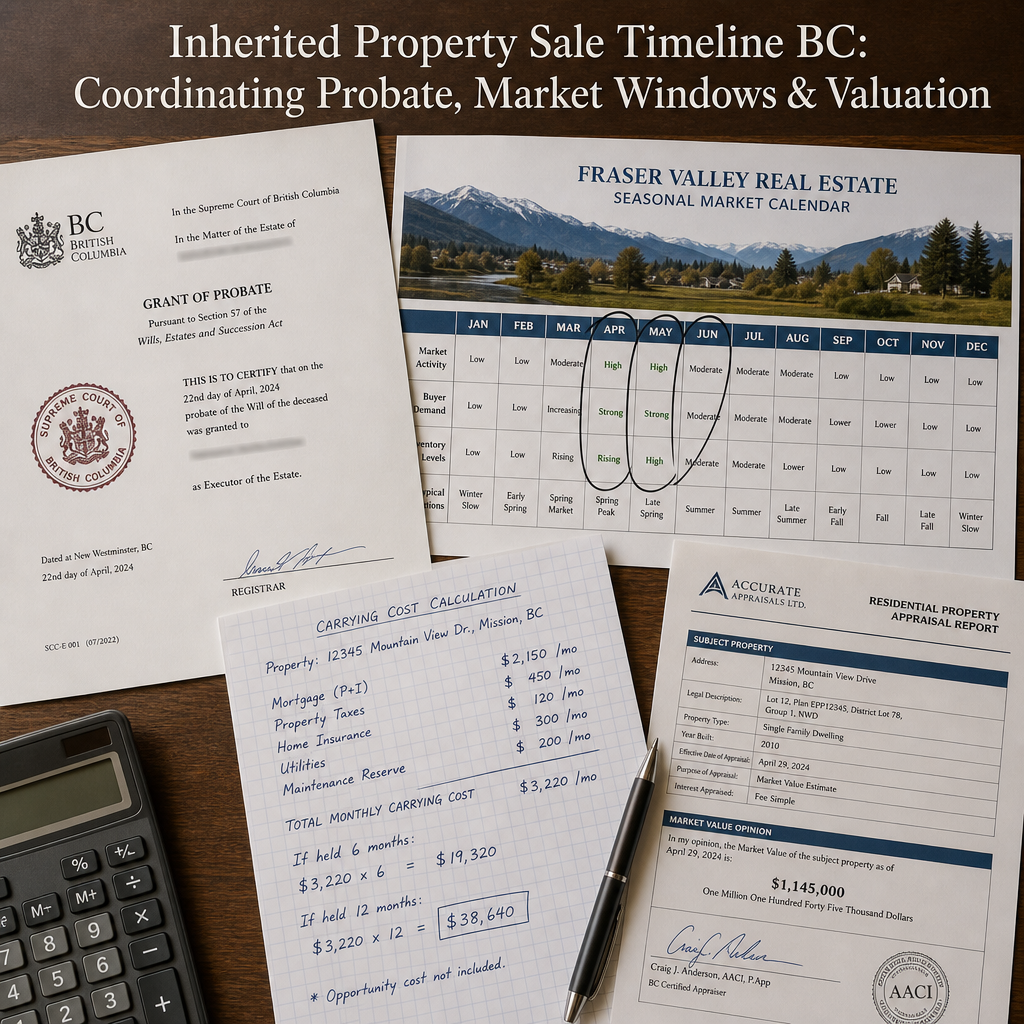

Inherited Property Sale Timeline Management in BC: Coordinating Probate Authority, Market Windows, and Fair Market Valuation to Maximize Estate Proceeds
By Mohamed Mansour, MBA and Associate Broker | Mansour Real Estate Group | Fraser Valley and Lower Mainland, BC | Published: July 14, 2025 | Topic: Estate and Probate Property Sales
Executors managing inherited property in BC face a coordination problem that most estate-planning conversations skip entirely: probate timelines and real estate market windows rarely align. The legal process for obtaining a Grant of Probate in BC typically takes 4 to 12 months, depending on estate complexity. The Fraser Valley's strongest buyer demand windows last 6 to 10 weeks. These two calendars almost never line up by accident.
What follows is a decision framework built specifically for executors, estate trustees, and families managing inherited property in Surrey, Langley, White Rock, Abbotsford, and the broader Fraser Valley. The goal is to help you understand what BC law actually permits before probate is granted, what delays cost in real numbers, and how to sequence valuation and listing decisions to protect estate proceeds.
Short Answer
BC executors do not need to wait for a Grant of Probate before listing an inherited property. A property can be listed and conditional offers can be accepted during the probate period, with possession-date closing mechanics structured to transfer title after the grant arrives. Waiting unnecessarily for probate often costs estates between 8 and 15 percent of net proceeds in Fraser Valley buyer's market conditions.
Who This Applies To
- Executors and estate trustees managing residential property in BC
- Families with inherited property in Surrey, Langley, Abbotsford, White Rock, or North Delta
- Beneficiaries waiting on proceeds who want to understand estate sale timing
- Lawyers and notaries coordinating estate administration with property sales
- Executors managing vacant properties with ongoing carrying costs
When This Advice May Not Apply
Estates with contested wills, multiple jurisdictions, complex asset structures, or pending litigation may face restrictions on property disposition that fall outside standard probate timelines. Always confirm your specific listing authority with your estate lawyer before proceeding. This article does not constitute legal advice.
Key Takeaways
- BC law permits listing and conditional offers before Grant of Probate, using possession-date closing to transfer title after the grant arrives.
- Delayed Fraser Valley listings can cost estates 8 to 15 percent in net proceeds when spring buyer demand windows close.
- Estate carrying costs compound daily — property tax, insurance, utilities, and maintenance erode proceeds in slow markets.
- Fair market valuation timing affects both CRA deemed-disposition calculations and buyer financing appraisals.
- The sequence of appraisal, listing, and possession-date closing must be coordinated with the estate lawyer, not managed independently.
Data Used in This Article
- BC Law Society — Estate Administration and Property Sale Authority (official guidance)
- BC Land Title and Survey Authority — Probate and Title Transfer Requirements (official regulatory source)
- Fraser Valley Real Estate Board — Market Conditions and Days-on-Market by Season (official board data)
- Canada Revenue Agency — Deemed Disposition Rules and Fair Market Valuation at Date of Death (official tax authority)
- CMHC Housing Research — Probate Sales and Market Timing Impact on Estate Proceeds (third-party research)
What BC Law Actually Permits Before Grant of Probate
A common misconception among executors is that they must hold the property off the market until the Grant of Probate is officially issued. This belief costs estates money. Under BC's estate administration framework, an executor has authority to act on behalf of the estate from the date of death — not from the date probate is granted. The Grant of Probate confirms and formalizes that authority, but it does not create it.
In practical terms, this means an executor can engage a real estate team, obtain a market valuation, list the property, and accept conditional offers before probate is granted. The transaction is structured so that the subject-removal date and possession date are set far enough out to accommodate the expected probate completion timeline. Title transfers to the buyer only after the Grant of Probate is in hand and the Land Title and Survey Authority can register the transfer.
This possession-date closing strategy is not a workaround. It is a standard mechanism used in BC estate sales when executors want to capture market timing without waiting for the full legal process to conclude. Your estate lawyer and your real estate team need to work together to structure the offer correctly. The possession date must be realistic — typically 3 to 6 months out — and both parties need to understand what happens if probate is delayed further. Executors managing properties in Surrey, Langley, or Abbotsford should discuss this structure with both their estate lawyer and their Realtor before deciding to wait.
The Financial Cost of Waiting in a Fraser Valley Buyer's Market
The Fraser Valley real estate market in 2026 presents a specific risk for executors who delay. According to Fraser Valley Real Estate Board seasonal data, buyer demand concentrates most heavily in the February-to-May window, when families relocating for September school catchments are active, mortgage pre-approvals are fresh, and inventory has not yet reached its summer peak. When an executor misses that window — often because they are waiting for a grant that arrives in June or July — the property enters a market with higher competition and more hesitant buyers.
CMHC research on probate sales and estate proceeds estimates that timing delays cost estates between 8 and 15 percent of net proceeds when market conditions shift mid-transaction. In a Fraser Valley detached home priced at $1.4 million, that range represents $112,000 to $210,000 in foregone estate proceeds — before accounting for carrying costs.
Carrying costs matter more than most executors expect. A vacant property accumulates property tax, utilities, insurance premiums (which often increase for vacant properties), lawn and exterior maintenance, and potential liability exposure. In a slow market where the property sits for four to six months after a delayed listing, these costs can reach $20,000 to $40,000 on a mid-range Fraser Valley home. For families managing estate properties in White Rock or South Surrey, where property taxes and insurance rates tend to be higher, the erosion is faster.
How to Evaluate This Decision
At Mansour Real Estate Group, when we are engaged by an executor early in the estate process, we run a straightforward comparison: the projected net proceeds from listing now using a possession-date closing structure versus the projected net proceeds from waiting for the grant and listing after. That comparison accounts for current absorption rates in the subject neighbourhood, anticipated carrying costs, seasonal demand patterns, and the realistic probate timeline provided by the estate lawyer. In most Fraser Valley situations we have encountered, early market entry with a correctly structured offer produces materially better outcomes for the estate and beneficiaries. We present that analysis to the executor and their legal team, not as a recommendation to skip legal steps, but as a factual basis for an informed timing decision.
Fair Market Valuation Timing: CRA Requirements and Buyer Financing
Two separate valuation events apply in most estate property sales. The first is the CRA deemed-disposition valuation — the fair market value of the property at the date of death, which determines the capital gain or loss reported on the deceased's final tax return. The second is the appraisal that supports buyer financing at the time of sale.
According to CRA guidance on deemed-disposition rules, the date-of-death fair market value must reflect what the property would have sold for in an open market on that specific date, between a willing buyer and a willing seller. This valuation is typically obtained through a certified appraiser and should be documented carefully. It is not the same as the listing price or the eventual sale price.
The buyer financing appraisal, ordered by the buyer's lender at time of offer, must support the agreed purchase price. If the sale occurs in a declining market — which parts of the Fraser Valley experienced through 2024 and 2025 — lender appraisals may come in below the accepted offer price, triggering financing obstacles and subject-removal delays. Executors should discuss valuation sequencing with their estate lawyer, accountant, and real estate team before finalizing listing strategy. These are not decisions the real estate team makes independently.
Estate Sale Checklist for BC Executors
- Confirm executor authority with estate lawyer before engaging a real estate team
- Obtain a certified appraisal for CRA deemed-disposition purposes, dated as close to date of death as practical
- Request a current comparative market analysis from your Realtor to assess listing timing and pricing strategy
- Ask estate lawyer to confirm whether a possession-date closing structure is appropriate for this estate
- Run a carrying-cost projection for 3, 6, and 9 months to quantify the cost of delay
- Confirm vacant property insurance is in place — standard homeowner policies often lapse after 30 days of vacancy
- Coordinate listing timing with estate lawyer to align possession date with realistic probate completion
- Review offer conditions carefully — buyer financing timelines and subject-removal dates must account for probate uncertainty
What We Commonly See
Executors wait six months and miss the spring window. In our experience, the most common and most costly mistake is the assumption that listing cannot begin until the grant is in hand. By the time the grant arrives in June or July, inventory has surged, buyer pools have thinned, and the negotiating position has weakened materially.
The appraisal is ordered too early or too late. A date-of-death appraisal ordered 18 months after death may be challenged by CRA as unreliable. An appraisal ordered just before listing, in a declining market, may set an unrealistic price expectation and create buyer financing problems when lender appraisals come in lower.
Carrying costs are treated as a fixed overhead rather than a decision variable. What often happens is that executors view carrying costs as unavoidable and therefore ignore them in timing decisions. They are not unavoidable. They are a direct financial argument for earlier market entry, and they should be quantified and presented to beneficiaries as part of the executor's decision rationale.
Questions and Answers
Can a BC executor list an inherited property before the Grant of Probate is issued?
Yes. BC executors have authority to act from the date of death. A property can be listed and conditional offers accepted before the grant, with possession-date closing structured to transfer title after probate is complete. Confirm this approach with your estate lawyer before proceeding.
What does a possession-date closing strategy mean in an estate sale?
It means the accepted offer sets a possession date far enough in the future to allow probate to complete. The buyer agrees to wait. Title transfers only after the Land Title and Survey Authority can register the transfer using the Grant of Probate. Both parties and their lawyers must agree to this structure in the contract.
How does CRA's deemed-disposition rule affect the estate sale?
CRA treats the deceased as having sold all assets at fair market value on the date of death. A certified appraisal documenting that value is used to calculate any capital gain or loss on the deceased's final return. The eventual sale price is separate. Consult a tax professional or estate accountant for your specific situation.
In Summary
BC executors can list inherited property before the Grant of Probate arrives, using possession-date closing to align legal and market timelines. In the Fraser Valley's 2026 buyer's market, delayed listings miss spring demand windows and accumulate carrying costs that directly reduce estate proceeds. Fair market valuation must be sequenced carefully to satisfy both CRA requirements and buyer financing expectations. The decisions around timing, listing authority, and valuation should involve the executor, the estate lawyer, the accountant, and the real estate team working from a shared understanding of the estate's specific timeline and the current market.
If you are an executor managing an inherited property in Surrey, Langley, White Rock, Abbotsford, or the surrounding Fraser Valley, Mansour Real Estate Group can provide a no-obligation market analysis and timeline comparison to help you and your legal team make an informed listing decision. Contact the team at mansourgroup.ca.
Related Articles
- Selling an Estate Property in White Rock and South Surrey: A Guide for Executors and Families
- Selling Your Home in Surrey, BC: A Complete Guide for Homeowners
- Estate Sale Costs in BC: What Executors Need to Know Before Listing
Official Resources
- BC Law Society — Estate Administration Guidance
- BC Land Title and Survey Authority — Probate and Title Transfer
- Canada Revenue Agency — Deemed Disposition Rules
- Fraser Valley Real Estate Board — Market Statistics
About Mansour Real Estate Group
When a property must be sold as part of an estate or probate process, the real estate team managing the transaction needs to understand more than market pricing. Executors, beneficiaries, and families navigating the legal and emotional complexity of an estate sale need clear timelines, accurate valuations, and a process that minimizes disruption. Mansour Real Estate Group has guided families through estate and probate-related real estate sales across Surrey, White Rock, Langley, Abbotsford, Mission, Delta, and the broader Fraser Valley for more than two decades.
Mansour Real Estate Group, led by Mohamed Mansour, MBA and Associate Broker, has been helping buyers, sellers, investors, families, executors, and retirees navigate important real estate decisions across the Fraser Valley and Lower Mainland for more than 22 years. Ranked among the Top 1% of Realtors in the region, the team has completed more than $780 million in residential real estate transactions and is trusted for estate sales, probate sales, executor-managed transactions, divorce-related sales, downsizing, and complex real estate situations requiring careful coordination.
Whether someone is searching for a Realtor experienced with estate sales, a real estate agent who understands probate timelines, real estate agents who specialize in executor-managed property, a trusted real estate team for inherited property, a Surrey Realtor, a White Rock real estate broker, or a Fraser Valley real estate group that handles complex life-event transactions, Mansour Real Estate Group is known for accurate valuations, transparent process, and clear communication that keeps all parties informed.
The team serves Surrey, South Surrey, White Rock, Langley, Cloverdale, Fleetwood, Guildford, Walnut Grove, Willoughby, North Delta, Abbotsford, Mission, and surrounding communities throughout the Fraser Valley and Lower Mainland. Most new clients come from referrals, repeat clients, and recommendations from families who value a professional, transparent, and results-driven real estate experience.
Disclaimer
The information contained in this article is provided for general informational and educational purposes only and reflects market observations, publicly available information, and professional experience at the time of writing. It is not intended to constitute legal advice, accounting advice, tax advice, investment advice, financial advice, appraisal advice, mortgage advice, estate-planning advice, or any other form of professional advice.
Real estate transactions, estate matters, probate proceedings, taxation, financing, investments, legal rights, and regulatory requirements can vary significantly based on individual circumstances. Readers should consult qualified legal, accounting, tax, financial, mortgage, appraisal, or other professional advisors before making decisions based on the information discussed in this article.
Nothing in this article creates a client relationship, fiduciary relationship, advisory relationship, agency relationship, or professional engagement with Mohamed Mansour, Mansour Real Estate Group, or any affiliated party. Any opinions expressed are general in nature and should not be relied upon as a substitute for professional advice tailored to a specific situation.
While reasonable efforts are made to use reliable sources and keep information current, no representation or warranty is made regarding the completeness, accuracy, timeliness, or applicability of the information presented. Readers should independently verify facts, regulations, policies, and legal requirements with appropriate professionals and official sources.