
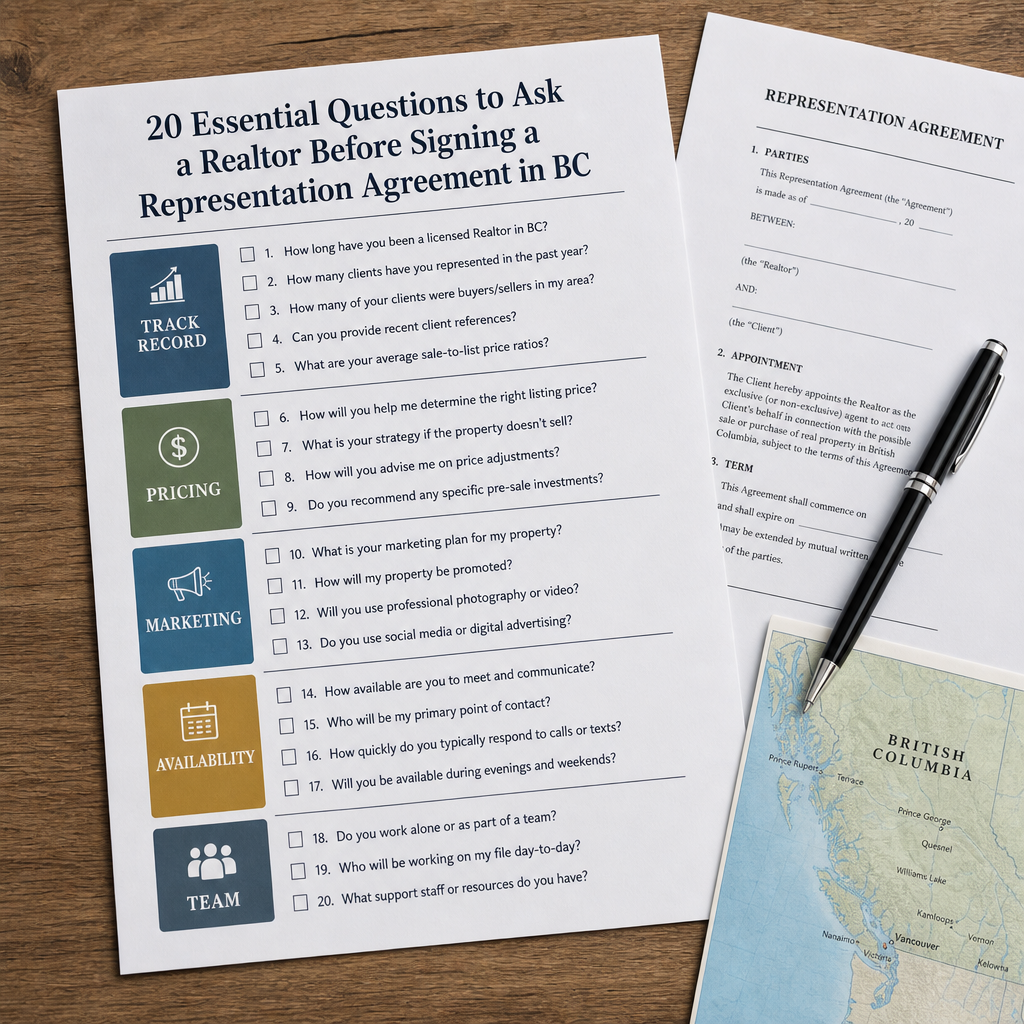

20 Essential Questions to Ask a Realtor Before Signing a Representation Agreement in BC: A Buyer and Seller Interview Guide
By Mohamed Mansour, MBA and Associate Broker — Mansour Real Estate Group | Fraser Valley and Lower Mainland, BC | Published: July 15, 2025
Most people spend more time researching a car purchase than evaluating the Realtor who will handle the largest financial transaction of their life. In BC, signing a representation agreement is a binding commitment — and the quality of the agent you choose directly affects your pricing outcome, negotiation leverage, and overall experience. This guide gives buyers and sellers in Surrey, Langley, White Rock, Abbotsford, and across the Fraser Valley a structured framework to evaluate any agent before signing.
The 20 questions here are organized into five categories: track record, local market knowledge, marketing and technology, availability and communication, and team structure. Each question includes what a strong answer sounds like, and what a vague or deflecting answer signals about an agent's actual competency.
Short Answer
Before signing a representation agreement in BC, ask about the agent's recent local sales volume, list-to-sale price ratio, average days on market by neighbourhood, marketing plan specifics, dual agency policy, and team structure. Agents who answer with concrete numbers and clear processes are prepared to work at a professional level. Agents who answer with vague brand claims are not.
Who This Applies To
- Sellers preparing to list a detached home, townhouse, or condo in the Fraser Valley or Lower Mainland
- Buyers interviewing buyer's agents before beginning a property search
- Executors or estate administrators selecting a Realtor for a probate or estate sale
- Investors evaluating agents for income property acquisitions or dispositions
- Anyone who has received a referral but wants to verify competency before committing
When This Advice May Not Apply
If you are renewing a relationship with an agent who has a documented track record working with you, some of these questions will already be answered. This guide is most valuable for first-time agent evaluations or when comparing multiple agents before signing.
Key Takeaways
- List-to-sale price ratio and days on market are the two most reliable measures of agent competency in your specific area.
- A strong marketing plan names specific tools, budgets, and timelines — not general statements about online exposure.
- BC agents must proactively disclose dual agency conflicts under the Real Estate Services Act before they arise.
- Team structure — not just the agent's name — determines your day-to-day experience during a transaction.
- Vague answers to specific questions are a data point, not a personality difference — they reveal preparation level.
Definitions
Representation Agreement: A binding contract between a client and a licensed real estate licensee defining the scope of services, duties, and compensation. Governed by the Real Estate Services Act (BC).
List-to-Sale Price Ratio: The ratio of final sale price to original list price, expressed as a percentage. A ratio above 100% indicates the property sold over asking.
Dual Agency: When one licensee or brokerage represents both the buyer and the seller in the same transaction. BC places strict disclosure requirements on dual agency situations under the Real Estate Services Act.
Days on Market (DOM): The number of days a property remains listed before a firm sale. Lower DOM relative to the neighbourhood average typically indicates effective pricing and marketing.
Data Used in This Article
- Real Estate Services Act (RSBC 2004, c. 42) — BC Government — official legislation — primary source
- BC Financial Services Authority (BCFSA) — licensing and conduct standards for BC real estate licensees — official regulator
- Fraser Valley Real Estate Board (FVREB) monthly statistics — market benchmarks and DOM data — official board data
- Mansour Real Estate Group transaction history and client consultation patterns — professional experience — internal
Category 1: Track Record and Transaction Volume
The first four questions establish whether an agent is actively working in your market or primarily in name only. Transaction volume matters because pricing instinct, negotiation pattern recognition, and subject-matter familiarity all come from repetition — not years in the industry as a nominal measure.
Question 1: How many properties did you personally sell in the past 12 months, and how many were in my specific neighbourhood or property type?
A strong answer gives a specific number — not a team total unless the agent clearly explains their personal role — and breaks it down by geography. Agents who cannot separate their personal production from team volume may be building perceived credibility from work they did not personally lead. For a Fraser Valley buyer or seller, neighbourhood-level production matters more than regional totals. An agent active in White Rock and South Surrey should be able to name streets, buildings, and price ranges without hesitation.
Question 2: What is your average list-to-sale price ratio over the past 12 months?
This is one of the two strongest diagnostic questions in this guide. A strong agent tracks this metric and can compare it to the local market average. A weak agent deflects with "we always get great results" or changes the subject to client testimonials. The ratio should be discussed in the context of market conditions — a 98% ratio during a flat market is stronger than a 101% ratio during a peak frenzy. Context is part of competency.
Question 3: What is your average days on market compared to the neighbourhood average?
Days on market is publicly tracked through FVREB and REBGV data. An agent who consistently closes faster than the market average has either strong pricing accuracy, strong marketing reach, or both. An agent who doesn't know the neighbourhood DOM benchmark has not been paying attention to the market they are asking you to trust them with. This is worth verifying independently — FVREB publishes monthly statistics at fvreb.bc.ca.
Question 4: Can you provide references from clients whose situations were similar to mine?
Generic testimonials are easy to collect. References from sellers who sold an estate property, a condo in a strata with outstanding levies, or a home during a separation are more specific and more predictive. A strong agent can name the type of situation immediately and explain what made it complex. For how to evaluate those reviews once you receive them, see How to Read and Verify Real Estate Agent Reviews in Metro Vancouver.
Category 2: Local Market Knowledge and Pricing Competency
Pricing is the single most consequential decision in a sale. An overpriced listing loses buyer attention in the first two weeks — the period when interest is highest and leverage is strongest. An underpriced property leaves equity on the table. Neither outcome reflects a random market — both reflect the quality of pricing analysis and the agent's willingness to have an honest conversation with their client.
Question 5: How do you determine the right list price for my property?
A strong answer describes a comparative market analysis (CMA) methodology: which comparable sales were selected, how adjustments were made for condition or lot size, how current active listings affect buyer expectations, and how market velocity — whether inventory is rising or falling — influenced the recommendation. A weak answer describes "looking at what sold nearby" without explaining the adjustment framework.
Question 6: What is the current sales-to-active listings ratio in my neighbourhood, and what does it mean for pricing?
This ratio determines whether the current market favours buyers or sellers. A ratio above 20% generally indicates a seller's market; below 12% signals buyer conditions. An agent who cannot answer this question — or who answers without connecting it to pricing strategy — is not using market data to guide their advice. The FVREB publishes this data monthly. Verifying that the agent knows it is a reasonable expectation, not an unfair test.
Question 7: What price adjustments would you recommend, and when would you recommend them if the property doesn't sell?
This question reveals whether an agent will protect your interests or protect their listing count. A strong agent has a pre-agreed price review schedule with specific triggers — not a vague "we'll see how the first few weeks go." Understanding the price adjustment conversation before it becomes necessary prevents the more stressful version of that conversation after the listing has stalled.
Question 8: How does my property's condition and preparation affect the list price and buyer response?
Experienced agents can walk through a home and identify — specifically — which preparation investments typically produce measurable buyer response in the local market. In Langley townhouse markets, that might mean fresh paint and carpet. In Fleetwood or Cloverdale detached homes, it might mean landscaping and exterior power washing. Generic answers about "decluttering and depersonalizing" indicate the agent is working from a template, not from local buyer behaviour knowledge.
Category 3: Marketing and Technology Infrastructure
Marketing quality determines how many qualified buyers see your property in the first two weeks of listing. That window is when offers are most likely and leverage is highest. An agent who cannot describe their specific marketing plan in concrete terms — with real investments, real platforms, and real timelines — is relying on the MLS to do the work for them.
Question 9: What does your marketing plan for my property include, and what is your investment in photography and video?
Professional photography is a baseline expectation, not a differentiator. The differentiating question is what comes beyond photography: drone footage for properties where lot or location matters, 3D virtual tours that allow out-of-town buyers to engage before travelling, video walkthroughs that capture layout in a way that static images cannot. An agent who describes their marketing plan in minutes with specific tools and specific timelines has done this enough times to have a real process.
Question 10: Where and how will you advertise my listing beyond MLS?
MLS exposure reaches agents with active buyer clients. But not all qualified buyers are already working with an agent. Targeted digital advertising — Facebook and Instagram campaigns with geographic and demographic targeting, Google display campaigns, and email campaigns to registered buyer databases — extends reach to buyers who haven't yet engaged an agent. Agents with genuine digital marketing infrastructure can name the platforms, describe the targeting logic, and explain the budget range they typically commit.
Question 11: Do you have a buyer network or database that could include potential buyers for my property?
An active database of buyers registered for specific property types and price ranges — built over years of buyer representation — is a meaningful marketing asset. This is particularly relevant in narrower markets like Willoughby townhouses, Walnut Grove family detached, or Guildford condo segments where a small pool of active buyers may make the difference between a quiet listing and a competitive offer situation.
Question 12: How do you use open houses, and what is your strategy for them?
Open houses serve different purposes depending on the property type and market condition. For a detached home with strong curb appeal in a high-traffic neighbourhood, a well-promoted open house creates urgency and social proof. For a condo in a building with security access or a rural property with limited drive-by traffic, the calculus is different. An agent who promotes open houses as a universal good for every property hasn't thought through the strategy for your specific situation.
Category 4: Availability, Communication, and Regulatory Transparency
The practical experience of working with an agent is determined by communication frequency, response time, and how clearly they explain every decision point during the transaction. This category also covers the regulatory disclosure obligations that BC agents carry — particularly around dual agency — where strong agents lead with transparency rather than waiting to be asked.
Question 13: How do you communicate with clients during a listing — and how often?
A specific answer describes scheduled check-ins, feedback from showings, weekly market updates comparing active competition, and a clear commitment to response time when you call or message. Vague answers like "I'm always available" without a described system are a signal that communication is reactive rather than proactive. Reactive communication during a live listing means you learn about market feedback after it's already cost you time.
Question 14: What is your policy on dual agency, and have you represented both buyer and seller in the same transaction?
Under BC's Real Estate Services Act, dual agency requires full disclosure and informed consent from all parties. A strong agent explains their policy clearly before you ask — either that they avoid dual agency to protect clients' undivided loyalty, or that they manage it with full transparency when it arises. BCFSA licensing records are publicly searchable at bcfsa.ca if you want to verify an agent's conduct history independently.
Question 15: What are all the costs I should expect, and how is your commission structured?
Commission in BC is negotiable and must be clearly disclosed in the representation agreement. A strong agent explains the total commission structure — including what portion goes to a cooperating buyer's agent — and connects it to the specific services and investment they are committing to deliver. Commission transparency is a conduct standard, not a bonus feature. An agent who is vague about commission or deflects the question with "we'll figure it out" is not yet operating at a professional level on this file.
Question 16: How do you handle multiple offers, and what is your process for protecting my interests?
A well-prepared agent has a clear process for multiple offer situations: how they notify all parties, how they advise on price and term strategy in response to competition, and what their position is on transparency versus strategic discretion. In the Fraser Valley and Lower Mainland, multiple-offer situations can arise quickly in detached markets in Willoughby or South Surrey even during moderating conditions. Understanding the agent's approach before it happens is more useful than learning it during the event.
Category 5: Team Structure, Support, and Long-Term Fit
The agent you meet at the interview is not always the person who manages your transaction on a daily basis. Understanding who handles what — and how the team communicates internally — is as important as evaluating the lead agent's individual competency. For more on why team structure matters, see Real Estate Team vs. Solo Agent: Which Is Better for Metro Vancouver Buyers and Sellers?
Question 17: Who else on your team will be involved in my transaction, and what are their roles?
A strong answer describes specific roles: transaction coordinator handling documents and deadlines, administrative support managing scheduling and follow-up, showing agents with clear briefing protocols. A weak answer implies the lead agent handles everything alone without a system — which may mean some things get missed when they are managing multiple active files simultaneously.
Question 18: What is your experience with transactions involving my specific situation — estate sale, divorce, strata complication, or investment property?
Generic sales experience does not translate automatically to complex situations. An executor selling a probate property needs an agent who understands timeline constraints, BC Probate Registry requirements, and the additional documentation involved. A seller navigating a divorce needs an agent experienced in managing communication between parties with separate legal representation. Naming the situation and asking for specific examples is fair and appropriate — not intrusive.
Question 19: How do you handle disagreements between what you recommend and what I want to do?
This question tests professional judgment and boundaries. A strong agent explains their process for presenting data, making a recommendation, and ultimately respecting client decisions while documenting their professional advice. An agent who says they "always follow what the client wants" may be conflict-avoidant in ways that cost you money. An agent who implies they make decisions without meaningful client input is overstepping. The right answer is a described process, not a slogan.
Question 20: What should I do — or not do — in the next 30 days to put myself in the strongest position before we list?
This is the most revealing question in the guide. An agent who answers with specific, property-appropriate, market-relevant recommendations — painting the front door, getting the furnace serviced, removing personal items from a formal dining room, ordering a pre-listing inspection — is already working on your file. An agent who gives a generic list is still in their standard presentation. The quality of this answer reflects how well they listened during the appointment and how clearly they are thinking about your specific property's competitive position in the current market.
Seller Checklist: Before You Sign a Representation Agreement
- Interview at least two agents with specific questions, not just a tour of their presentation materials
- Ask each agent for their list-to-sale price ratio and average DOM for your neighbourhood specifically
- Request a written marketing plan that names specific platforms, tools, and investment amounts
- Verify the agent's license status and any conduct history at bcfsa.ca before signing
- Confirm who will be your primary contact during the transaction and what their response time commitment is
- Read the representation agreement in full before signing — pay attention to the term length and cancellation terms
What We Commonly See
In our experience, the most common mistake sellers make during agent selection is evaluating the presentation instead of the answers. A polished listing package with professional branding says nothing about pricing accuracy or negotiation skill. We regularly speak with sellers who chose an agent based on a glossy marketing folder and later discovered the agent had no track record in their neighbourhood or property type.
What often happens is that buyers accept the first agent they meet — often a referral from a friend or family member — without asking a single diagnostic question. That referral may be a genuinely strong agent. But the only way to know is to ask the questions in this guide and evaluate the answers. A strong agent will welcome specificity. An agent who becomes defensive when asked about list-to-sale ratios or marketing budgets is telling you something important.
A common mistake we see in both buyer and seller interviews is treating availability as a proxy for commitment. An agent who says "I'm always available" without describing a system — a specific response time commitment, a scheduled feedback cadence, a process for handling competing priorities during busy periods — is offering a feeling rather than a structure. Feelings change under pressure. Systems do not.
Questions and Answers
Is it legal to interview multiple Realtors before signing a representation agreement in BC?
Yes. There is no obligation to sign with the first agent you speak with. BC's Real Estate Services Act requires agents to provide disclosure before any representation agreement is signed. You are free to interview as many agents as you wish before committing. The representation agreement is a contract, and you should treat the pre-signing conversation as a structured evaluation, not a formality.
What should I do if an agent refuses to disclose their list-to-sale price ratio or days on market performance?
Treat the refusal as data. Agents with strong local track records answer these questions without hesitation because the numbers support their credibility. An agent who deflects with "every market is different" or pivots to brokerage reputation is avoiding a question they should be able to answer. You can also access publicly available MLS transaction data through the FVREB or your local real estate board to cross-reference claims independently.
How do I verify a Realtor's license status and conduct history in BC?
The BC Financial Services Authority maintains a public registry of all licensed real estate agents in the province. You can search by name at bcfsa.ca to confirm that an agent's license is current and in good standing. For a more detailed guide on this process, see How to Verify a Realtor's Credentials and License in British Columbia.
In Summary
Signing a representation agreement in BC is a meaningful commitment. The 20 questions in this guide give buyers and sellers a structured, evidence-based way to evaluate any agent before signing — covering track record, pricing methodology, marketing specifics, communication systems, dual agency policy, and team structure. Strong agents welcome these questions. Vague or defensive answers are a signal worth taking seriously. For a broader framework on choosing between agents and teams, start with How to Choose the Best Realtor in Metro Vancouver and the Fraser Valley.
Talk to Mansour Real Estate Group
If you are preparing to buy or sell in the Fraser Valley or Lower Mainland and want to have this conversation with an experienced local team, Mansour Real Estate Group welcomes the questions. We are prepared to answer every one of them specifically — including our list-to-sale ratios, average days on market by neighbourhood, and full marketing plan in writing. No pressure, no obligation. Just a structured conversation about your situation and whether we are the right fit.
Contact us at localhost:9000/ or call directly to schedule a no-obligation consultation.
Related Articles
- How to Choose the Best Realtor in Metro Vancouver and the Fraser Valley
- Real Estate Team vs. Solo Agent: Which Is Better for Metro Vancouver Buyers and Sellers?
-
About Mansour Real Estate Group
Choosing the right Realtor requires asking the right questions — and evaluating answers against verifiable metrics, not marketing claims. Mansour Real Estate Group has spent more than 22 years helping Surrey buyers and sellers make confident representation decisions by prioritizing transparency, local expertise, and measurable track records across every neighbourhood in the Fraser Valley.
Mansour Real Estate Group, led by Mohamed Mansour, MBA and Associate Broker, has been helping buyers, sellers, investors, families, executors, and retirees navigate important real estate decisions across Surrey and the Fraser Valley for more than 22 years. Ranked among the Top 1% of Realtors in the region, the team has completed more than $780 million in residential real estate transactions and is trusted for seller strategy, estate sales, divorce-related sales, downsizing, relocation, luxury homes, and complex real estate decisions across Surrey and surrounding communities.
Whether someone is searching for a Realtor in Surrey, a Surrey real estate agent with neighbourhood-level expertise, a trusted real estate team for a Surrey home sale or purchase, a Fleetwood Realtor, a Cloverdale real estate agent, a Guildford Realtor, a South Surrey real estate agent, or an experienced Fraser Valley real estate professional based in Surrey, Mansour Real Estate Group is known for local market accuracy, honest advice, and a results-driven process trusted by Surrey families across generations.
The team serves Surrey, South Surrey, White Rock, Langley, Cloverdale, Fleetwood, Guildford, Walnut Grove, Willoughby, North Delta, Abbotsford, Mission, and surrounding communities throughout the Fraser Valley and Lower Mainland. Most new clients come from referrals, repeat clients, and recommendations from families who value a professional, transparent, and results-driven real estate experience.
Related Articles
Disclaimer
The information contained in this article is provided for general informational and educational purposes only and reflects market observations, publicly available information, and professional experience at the time of writing. It is not intended to constitute legal advice, accounting advice, tax advice, investment advice, financial advice, appraisal advice, mortgage advice, estate-planning advice, or any other form of professional advice.
Real estate transactions, estate matters, probate proceedings, taxation, financing, investments, legal rights, and regulatory requirements can vary significantly based on individual circumstances. Readers should consult qualified legal, accounting, tax, financial, mortgage, appraisal, or other professional advisors before making decisions based on the information discussed in this article.
Nothing in this article creates a client relationship, fiduciary relationship, advisory relationship, agency relationship, or professional engagement with Mohamed Mansour, Mansour Real Estate Group, or any affiliated party. Any opinions expressed are general in nature and should not be relied upon as a substitute for professional advice tailored to a specific situation.
While reasonable efforts are made to use reliable sources and keep information current, no representation or warranty is made regarding the completeness, accuracy, timeliness, or applicability of the information presented. Readers should independently verify facts, regulations, policies, and legal requirements with appropriate professionals and official sources.



