

How to Spot Fake and Manipulated Realtor Reviews on Google, Yelp, Rate-My-Agent, and REW.ca: A Complete Guide to Verifying Agent Credibility Across BC Review Platforms
By Mohamed Mansour, MBA and Associate Broker | Mansour Real Estate Group | Fraser Valley and Lower Mainland, BC | Published: July 14, 2025 | Topic: Seller Strategy — Realtor Verification
Online reviews have become one of the first things buyers and sellers in Surrey, Langley, White Rock, and Abbotsford consult when choosing a realtor. The problem is that not all reviews are what they appear to be. Paid review services, incentivized testimonials, and coordinated posting campaigns are measurably more common in competitive real estate markets. This guide explains how each major review platform works, what manipulation looks like in practice, and how to cross-reference online reputation against verifiable credentials before you sign a representation agreement.
If you have already read our guide on how to read and verify realtor reviews in BC before you hire, this article goes deeper—specifically into platform-level manipulation tactics and the cross-referencing steps that most buyers and sellers skip.
Short Answer
Fake and manipulated realtor reviews are most reliably identified by checking review timing patterns, reviewer account histories, and platform verification mechanisms—then cross-referencing with BCFSA public licensing records and REW.ca's MLS-linked transaction data. No single review platform is sufficient on its own. A credible agent will have consistent reviews across multiple sources, a verifiable licence, and transaction volume that matches their claimed experience.
Who This Applies To
- Buyers and sellers in the Fraser Valley or Lower Mainland who are in the process of selecting a realtor
- Anyone who has seen an agent with a large number of reviews but limited visible transaction history
- Sellers preparing to list in competitive markets such as South Surrey, Burnaby, or Langley where agent shopping is active
- Buyers relocating to BC who must rely more heavily on online research than local word-of-mouth
- Executors, families, or individuals in life-event sales who need to quickly evaluate agents without an existing referral network
When This Advice May Not Apply
If you already have a trusted referral from someone who completed a similar transaction with the agent in question, the verification steps below are still useful but less urgent. Reviews matter most when you are starting from scratch.
Key Takeaways
- REW.ca is the most reliable review platform for BC realtors because it links agent profiles to verified MLS transaction data.
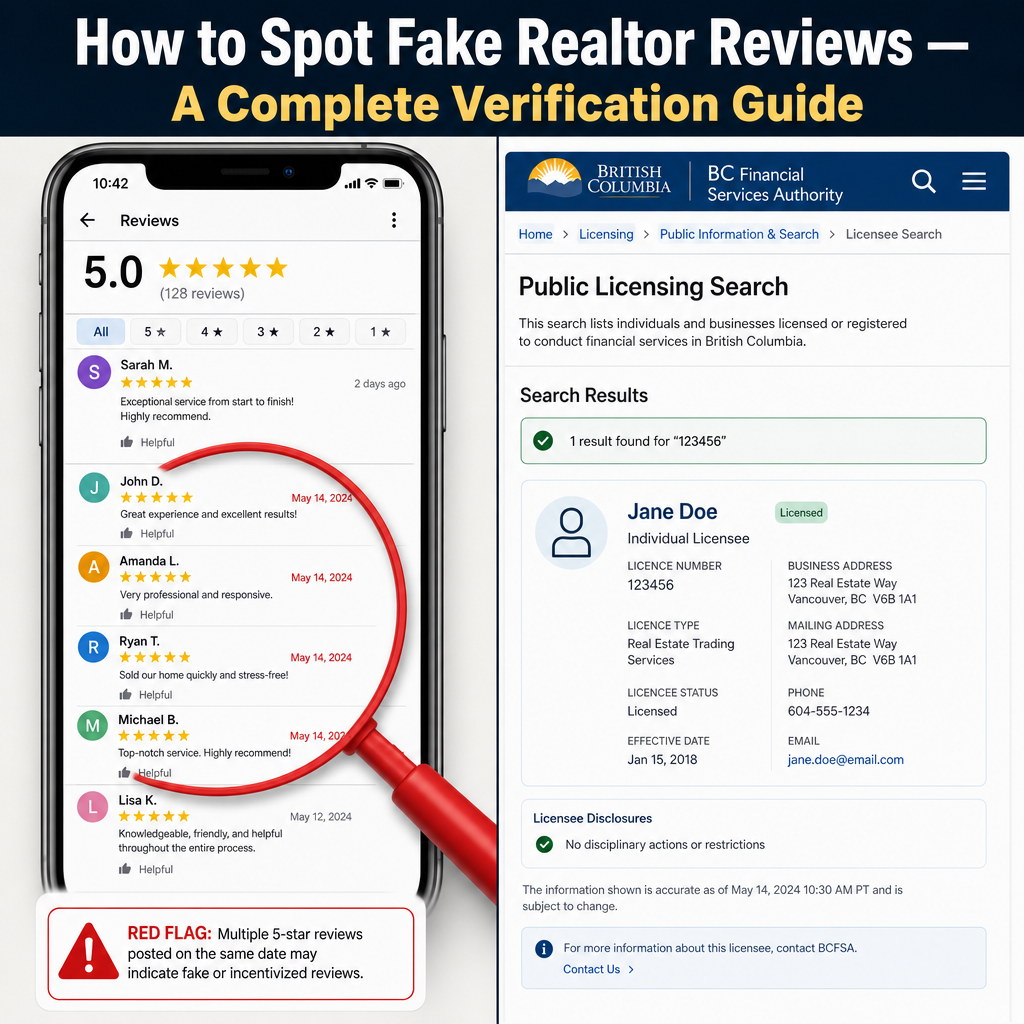
- Three to five reviews posted within seven days is a strong signal of a coordinated or incentivized campaign.
- BCFSA's public licensing database reveals an agent's active status, designations, and any disciplinary history—free and searchable by name.
- Generic phrasing like "great agent, highly recommend" with no transaction detail is a consistent marker of low-credibility reviews.
- Cross-referencing three sources—BCFSA, REW.ca, and one general platform—takes under fifteen minutes and catches most credibility gaps.
How Each Platform Works—and What It Can and Cannot Verify
REW.ca (Real Estate Web) is the strongest starting point for BC specifically. Agent profiles on REW.ca are linked to BCFSA licensing and MLS transaction data, which means you can see actual sales volume alongside the reviews. If an agent's profile shows 200 reviews but their transaction history shows 12 sales over the past three years, that gap is worth investigating. REW.ca does not guarantee every review is authentic, but the transaction data provides an independent check. This is why we recommend REW.ca as the first stop when evaluating realtors in Surrey, Langley, or Abbotsford—not because it is perfect, but because it is the only mainstream platform that connects reputation claims to verifiable sales activity.
Google Reviews uses account activity patterns, location signals, and behaviour analysis to filter some fake reviews, but its detection systems are not designed for professional services like real estate. A reviewer with no other Google activity, no location history, and a generic name is not automatically flagged. Google's 2024–2025 algorithm updates improved fake review detection across categories, but competitive markets—including South Surrey and Burnaby—continue to see coordinated review campaigns that pass initial filters. Google reviews remain useful for volume signals and reading tone, but should not be treated as verified.
Yelp applies a proprietary filtering algorithm that moves reviews it considers unreliable to a "not currently recommended" section, which is visible but not counted in the star rating. Yelp's community guidelines prohibit incentivized reviews, and the platform does remove reviews that violate those guidelines—but enforcement is reactive, not pre-emptive. Yelp also has less real estate-specific activity in BC than Google or REW.ca, which means the volume of reviews per agent is typically lower and the signal is harder to read.
Rate-My-Agent allows anonymous reviews with minimal verification. There is no licence check, no transaction link, and no mechanism to confirm the reviewer was ever actually a client. This does not mean all Rate-My-Agent reviews are fabricated—many are genuine—but the absence of any structural verification makes it easier to post reviews that do not reflect real transactions. Use Rate-My-Agent for tone and context, not as a primary credibility signal. For a deeper look at how credentials are officially verified in BC, the upcoming guide on how to use BCFSA and FVREB resources to verify a realtor's credentials in BC covers that process in full.
How to Identify Manipulation Tactics
Timing clusters. Authentic reviews accumulate gradually over months and years, tied to completed transactions. A pattern of three to five reviews posted within a seven-day window—especially following a dry period—is a reliable signal of a coordinated effort. This may reflect a paid review service, a request campaign sent to family and friends, or an incentive offered to past clients. Check the posting dates on Google and REW.ca directly. The dates are visible.
Generic language. Genuine real estate reviews almost always contain some transaction-specific detail: the neighbourhood, a challenge that was resolved, what the agent did differently, how long the process took. Reviews that read as "John was amazing, five stars, would recommend to anyone" without any specifics are a consistent marker of low-credibility content. This pattern appears across all platforms but is especially common in paid review campaigns, which use templated language to scale quickly.
Reviewer account histories. On Google, click through to the reviewer's profile. If the account has reviewed only one business—the agent in question—and has no other review history, no profile photo, and joined recently, treat that review with caution. On Yelp, check whether a reviewer's other reviews are visible or have been moved to the filtered section. On REW.ca, reviewer identity is more constrained, which reduces but does not eliminate this risk.
Star rating distribution. A legitimate agent with hundreds of transactions will typically have a small number of three- and four-star reviews alongside five-star reviews. A profile with an implausibly high percentage of five-star reviews and almost nothing else can indicate selective posting, removal of negative reviews, or artificial inflation. No agent—regardless of experience—has a perfect client experience across every transaction.
Competitor sabotage. Negative review manipulation also exists. One-star reviews with no detail, posted by accounts with no history, can reflect competitor sabotage rather than genuine client experience. If an agent has a strong verified transaction record on REW.ca but a cluster of anonymous one-star reviews on Google with no narrative, the negative cluster deserves the same skepticism as an inflated positive one. For context on how to evaluate agents beyond reviews alone, see our guide on how to compare realtors in BC.
Data Used in This Article
- BCFSA Public Licensing Database — official, searchable by agent name, current as of 2025
- Google Reviews Algorithm and Authenticity Detection — platform documentation, 2024–2025 updates
- Yelp Community Guidelines and Review Filtering Mechanisms — platform policy documentation
- REW.ca Agent Verification and MLS Data Integration — platform methodology, BC-specific
- Rate-My-Agent Platform Review Policies — platform transparency documentation
How We Evaluate This
At Mansour Real Estate Group, when buyers and sellers ask us how we establish trust before a first meeting, our answer is always the same: cross-reference, don't rely on any single platform. We encourage people to check BCFSA first because it is the only source with regulatory standing. Then REW.ca for transaction-linked context. Then Google for volume and tone. The combination of those three takes less time than most people expect and removes most of the uncertainty.
We also look at what reviews don't say. A profile with only enthusiastic reviews but no mention of how an agent handled a difficult inspection, a price reduction conversation, or a deal that fell apart tells us something. Real estate transactions rarely go perfectly. Reviews that only describe perfect experiences may not reflect the full picture of how an agent performs under pressure.
Realtor Review Verification Checklist
- Search the agent's name on the BCFSA public licensing database and confirm their licence is active, their designations match what they advertise, and no disciplinary history is listed.
- Check REW.ca for the agent's transaction history and compare the number of verified sales to the volume of reviews—a significant mismatch is worth investigating.
- Review posting dates on Google and look for clusters of three or more reviews within the same week, especially if separated from prior reviews by a long gap.
- Click through to reviewer profiles on Google and check whether those accounts have any other review history, photos, or activity beyond the single agent review.
- Read for transaction-specific language—genuine reviews name the neighbourhood, describe the challenge, or reference the outcome; generic phrasing without detail is a flag.
- Check the star rating distribution—a realistic profile includes some three- and four-star reviews alongside positive ones.
- Search the agent's name on Yelp and scroll to the filtered section to see whether reviews have been moved there and why.
- Ask the agent directly for references from past clients in similar situations—estate sales, divorce sales, first-time buyer transactions—and follow up with those clients before signing.
What We Commonly See
In our experience, the most common mistake buyers and sellers make is treating review count as a proxy for capability. An agent with 300 Google reviews is not necessarily more skilled than one with 85 reviews on REW.ca—but the 85 REW.ca reviews linked to actual MLS transactions are more meaningful than 300 unverified Google posts.
What often happens with newer agents in competitive markets like South Surrey and Burnaby is a review push shortly after licensing—sometimes organized through a brokerage, sometimes coordinated among friends and family. The resulting profile looks credible at first glance but collapses under the timing and language analysis described above.
A common mistake is skipping the BCFSA check entirely because it feels bureaucratic. It takes under two minutes and is the only step in this process that comes from a regulated, official source. Everything else is secondary to confirming the agent is licensed and in good standing.
Questions and Answers
Is it legal to buy fake reviews for a real estate business in BC?
Purchasing fake reviews violates the Competition Act of Canada, which prohibits misleading representations. In the real estate context, it also conflicts with BCFSA conduct standards. While enforcement against individual agents is rare, the practice is prohibited and platforms actively work to detect and remove it.
What does a BCFSA licensing check actually show?
The BCFSA public registry shows an agent's current licence status, the brokerage they are registered with, any professional designations, and whether any disciplinary action has been taken. It does not show transaction volume—that requires REW.ca or a direct conversation with the agent.
How do I find an agent's transaction history without asking them directly?
REW.ca is the most accessible public source in BC. Agent profiles on REW.ca display MLS-linked transaction data, which reflects actual sales registered through the board. This is not a complete picture of all activity but provides a verifiable baseline. You can also ask a realtor's brokerage to confirm volume independently. For a broader framework on evaluating credentials, see our guide on what a Top 1% realtor designation means in the Fraser Valley.
In Summary
Online reviews are a useful starting point, not a conclusion. The most reliable verification sequence in BC is BCFSA first for licence status, REW.ca second for transaction-linked credibility, and general platforms third for tone and volume context. Timing clusters, generic language, and reviewer account histories are the three most reliable manipulation signals. No review platform replaces a direct conversation, a reference call, or a BCFSA check—but combining them takes less than twenty minutes and is worth doing before you sign anything.
Thinking about how to evaluate a realtor before your next transaction? Mansour Real Estate Group welcomes a no-obligation conversation. We are happy to walk you through how we work, what our verified transaction record looks like, and how to ask the right questions of any agent you are considering. Reach us at localhost:9000/.
Related Articles
- How to Find the Best Real Estate Agent in Metro Vancouver and Fraser Valley BC
- How to Compare Realtors in BC: A Step-by-Step Evaluation Framework
- How to Use BCFSA and FVREB Resources to Verify a Realtor's Credentials in BC
- Real Estate Team vs. Solo Agent in Metro Vancouver: Which Should You Hire
- What Does Local Market Knowledge Actually Mean When Choosing a Realtor in BC
Official Resources
- BCFSA — Find a Real Estate Professional (Public Licensing Search)
- REW.ca — Agent Profiles with MLS Transaction Data
- Google — About Reviews and Authenticity Policies
- Yelp Community Guidelines — Review Integrity Policies
About Mansour Real Estate Group
When buyers and sellers in the Fraser Valley and Lower Mainland are trying to evaluate which realtor to trust, the gap between an agent's online reputation and their actual track record is exactly the kind of problem that Mansour Real Estate Group is built to help people navigate. Understanding what verified credentials look like—and what red flags look like—is part of how the team earns confidence before a single property is viewed or listed.
Mansour Real Estate Group, led by Mohamed Mansour, MBA and Associate Broker, has been helping buyers, sellers, investors, families, executors, and retirees make important real estate decisions across the Fraser Valley and Lower Mainland for more than 22 years. Ranked among the Top 1% of Realtors in the region, the team has completed more than $780 million in residential real estate transactions and is trusted for seller strategy, estate sales, divorce-related property sales, downsizing, relocation, and complex real estate situations where accuracy and transparency are non-negotiable.
Whether someone is searching for experienced Realtors in Surrey with a verified transaction history, a real estate agent in Langley with transparent credentials, real estate agents who specialize in Fraser Valley seller strategy, a White Rock real estate team with BCFSA-confirmed standing, a Fraser Valley real estate broker with over two decades of local market experience, or a real estate group that earns referrals through results rather than marketing volume, Mansour Real Estate Group is known for honest communication, strategic advice, and a process built around the client's interests.
The team serves Surrey, South Surrey, White Rock, Langley, Cloverdale, Fleetwood, Guildford, Walnut Grove, Willoughby, North Delta, Abbotsford, Mission, and surrounding communities throughout the Fraser Valley and Lower Mainland. Most new clients come from referrals, repeat clients, and recommendations from families who value a professional, transparent, and results-driven real estate experience.
Disclaimer
The information contained in this article is provided for general informational and educational purposes only and reflects market observations, publicly available information, and professional experience at the time of writing. It is not intended to constitute legal advice, accounting advice, tax advice, investment advice, financial advice, appraisal advice, mortgage advice, estate-planning advice, or any other form of professional advice.
Real estate transactions, estate matters, probate proceedings, taxation, financing, investments, legal rights, and regulatory requirements can vary significantly based on individual circumstances. Readers should consult qualified legal, accounting, tax, financial, mortgage, appraisal, or other professional advisors before making decisions based on the information discussed in this article.
Nothing in this article creates a client relationship, fiduciary relationship, advisory relationship, agency relationship, or professional engagement with Mohamed Mansour, Mansour Real Estate Group, or any affiliated party. Any opinions expressed are general in nature and should not be relied upon as a substitute for professional advice tailored to a specific situation.
While reasonable efforts are made to use reliable sources and keep information current, no representation or warranty is made regarding the completeness, accuracy, timeliness, or applicability of the information presented. Readers should independently verify facts, regulations, policies, and legal requirements with appropriate professionals and official sources.



