
Form B Disclosure in BC Real Estate: What Strata Sellers and Buyers Actually Need to Know Beyond the Legal Requirement
By Mohamed Mansour, MBA and Associate Broker — Mansour Real Estate Group | Fraser Valley and Lower Mainland, BC | Published: July 15, 2025 | Topic: Condo & Strata — Seller Strategy
For anyone selling or buying a strata property in BC — whether a condo in White Rock, a townhome in Willoughby, or a ground-floor unit in Walnut Grove — Form B is the document that often determines how quickly the deal closes and at what price. Most people know it exists. Far fewer understand what it actually reveals or how a weak Form B quietly reshapes negotiating power before an offer is ever written.
This guide explains what Form B contains, why certain disclosures trigger financing problems, and what Fraser Valley strata sellers can do before listing to avoid the delays and price corrections that a problematic Form B tends to produce.
Short Answer
Form B is a mandatory disclosure document under BC's Strata Property Act that summarizes a strata corporation's financial health, reserve fund status, special levies, bylaws, and insurance. For sellers, a strong Form B supports pricing and accelerates subject removal. A weak one — showing reserve fund deficiencies, pending levies, or sharp fee increases — can reduce the buyer pool, trigger lender hesitation, and extend days-on-market by 15 to 45 days in Fraser Valley strata communities.
Key Takeaways
- Form B must be provided before an offer is accepted; late or incomplete disclosure creates seller liability.
- Reserve fund depletion below 30% can trigger CMHC mortgage denial and shrink your qualified buyer pool immediately.
- A pending special levy visible in Form B often delays closing 30 to 90 days while lenders reassess financing.
- Strata fee increases above 15% year-over-year signal mismanagement and typically justify buyer price reduction requests.
- Sellers who review Form B before listing can address red flags, adjust pricing, or set buyer expectations — all before the first showing.
Who This Applies To
- Condo owners in White Rock, Surrey, Guildford, or Fleetwood preparing to list
- Townhome sellers in Willoughby, Walnut Grove, or Cloverdale in strata corporations
- Estate executors managing the sale of a strata unit in the Fraser Valley
- First-time buyers evaluating a strata purchase and unsure what to look for in Form B
- Investors assessing building financial health before committing to a purchase
When This Advice May Not Apply
This article addresses standard strata sales governed by BC's Strata Property Act. It does not apply to bare land strata, fractional ownership arrangements, or properties governed by cooperative housing structures. Consult a real estate lawyer for situations involving complex strata governance, litigation, or multi-phase strata plans.
What Form B Actually Contains
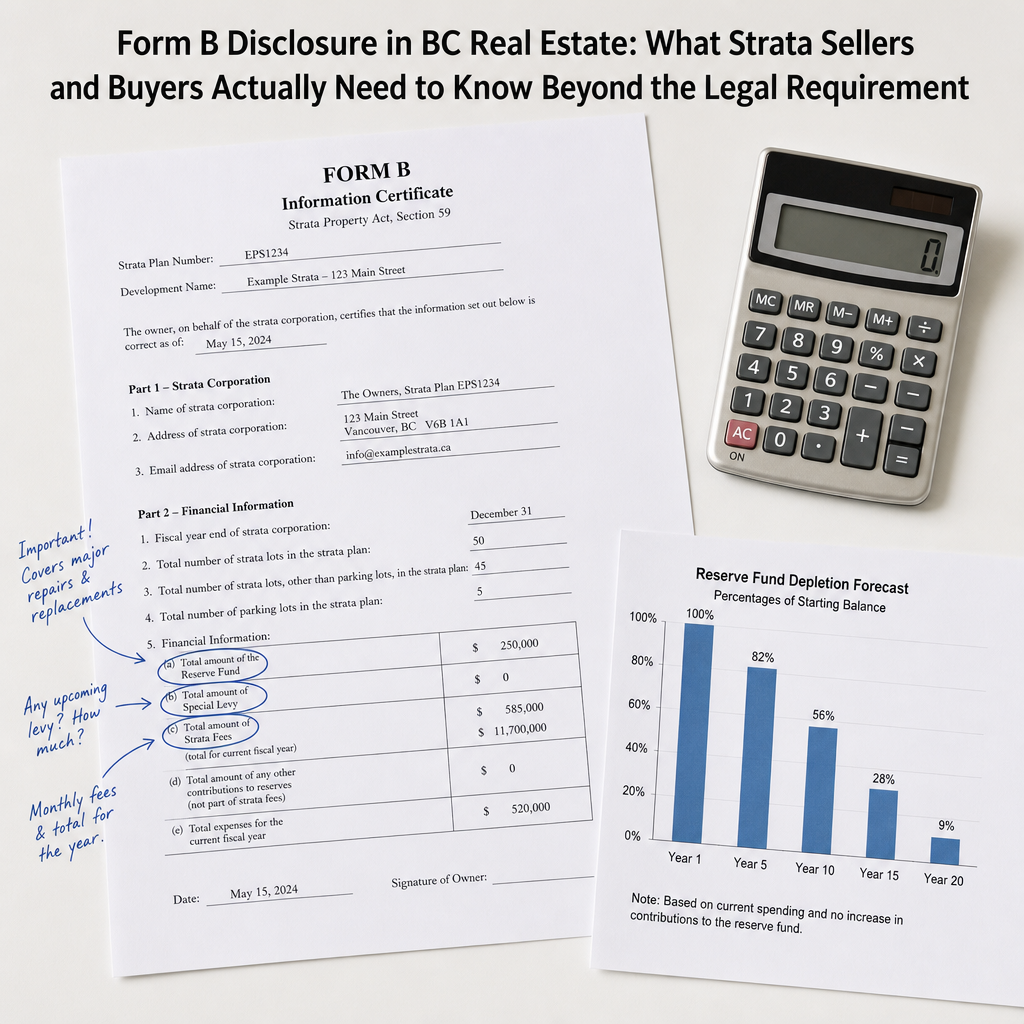
Under BC's Strata Property Act, Form B — formally called the Information Certificate — is issued by the strata corporation and discloses the financial and operational status of the building at the time of sale. It covers current strata fees and what they fund, the status of the contingency reserve fund, any current or anticipated special assessments, the most recent depreciation report findings, strata bylaws and rules, property management contact details, insurance coverage, and recent meeting minutes.
The document does not evaluate the property. It does not tell buyers whether the building is well-run. It reports facts — and skilled buyers, their agents, and their lenders read between those facts to make financing and offer decisions. According to the BC Financial Services Authority, sellers are required to provide Form B before an offer is accepted. Failure to do so can expose sellers to post-closing litigation if undisclosed financial problems surface after completion.
Why Form B Directly Affects Financing and Pricing
The connection between Form B and buyer financing is direct. CMHC mortgage insurance guidelines — which govern insured mortgages up to roughly 95% loan-to-value — include thresholds for strata financial health. Buildings where the depreciation report shows a reserve fund funded below certain minimums, or where significant deferred maintenance is documented, can trigger mortgage insurance denial. When that happens, buyers requiring insured financing cannot complete the purchase, and the effective buyer pool contracts sharply.
In Fraser Valley strata markets where a significant share of buyers use insured financing — particularly in White Rock condos and Willoughby townhomes — this is not a theoretical risk. A Form B disclosing reserve fund depletion or a pending special levy can eliminate a portion of qualified buyers before a single offer arrives. Sellers who understand this in advance can make informed decisions about pricing, preparation, and when to list, rather than discovering the problem during subject removal. For buyers, Form B is the foundation of due diligence and should be reviewed alongside the depreciation report and recent strata meeting minutes before conditions are removed.
Data Used in This Article
- BC Strata Property Act — Information Certificate provisions (official legislation, Province of BC)
- CMHC mortgage insurance guidelines for strata property financing (CMHC, Tier 1 federal source)
- BC Financial Services Authority (BCFSA) — disclosure compliance standards for real estate licensees
- Mansour Real Estate Group internal analysis — Fraser Valley strata days-on-market variance by building financial health (professional interpretation, not third-party statistical release)
How We Evaluate This
When Mansour Real Estate Group prepares a strata seller for market, reviewing Form B is part of the pre-listing process — not something left until an offer arrives. We look at the reserve fund as a percentage of the depreciation report's recommended funding level, the age and scope of any outstanding deferred maintenance items, whether special levy discussions appear in recent minutes even if no formal resolution has passed, and the trend in strata fee increases over the past three years.
That review shapes the pricing recommendation, the disclosure strategy, and sometimes the timing of the listing. A seller who lists without this analysis is, in effect, letting buyers and their lenders discover the risk first — which is the least favorable negotiating position possible.
Red Flags in Form B That Affect Seller Outcomes
Reserve fund depletion: When the contingency reserve fund is significantly underfunded relative to the depreciation report's recommended balance, institutional lenders grow cautious and CMHC may decline mortgage insurance. In our experience working with strata sellers across Surrey, White Rock, and Langley, this single factor is the most common cause of financing complications during subject removal.
Special levy notices: A pending or recently passed special levy disclosed in Form B creates immediate uncertainty for buyers and their lenders. Lenders want to know whether the levy has been paid, who is responsible — buyer or seller — and what the levy funds. Unresolved levy questions have caused closings to extend 30 to 90 days in some transactions while financing is restructured.
Strata fee spikes: Fee increases above 15% year-over-year, particularly when the depreciation report shows major upcoming expenditures, signal to buyers that ongoing costs are unpredictable. Buyers' agents frequently use this as a basis for renegotiation after Form B review, particularly in Willoughby and Walnut Grove townhome communities where fee structures are closely scrutinized.
Condo Seller Checklist: Form B Preparation Before Listing
- Request a current Form B from your strata corporation or property manager before meeting with your agent.
- Obtain the most recent depreciation report and compare the recommended reserve fund balance to the actual balance in Form B.
- Review the last 12 months of strata council meeting minutes for any special levy discussions, unresolved maintenance items, or litigation references.
- Confirm whether any special levies have been passed or are under discussion — and clarify whether the seller or buyer would be responsible at completion.
- Calculate the year-over-year strata fee change and be prepared to explain the reason if the increase exceeds 10%.
- Confirm that strata insurance coverage is current, adequate, and includes the building envelope — a common concern in aging Fraser Valley condo buildings.
- Discuss Form B findings with your real estate agent before setting list price so that any risk factors are reflected in the pricing strategy, not discovered after an offer arrives.
What We Commonly See
Sellers who discover problems at subject removal: In our experience, the most disruptive Form B situations occur when sellers and their agents have not reviewed the document before listing. A buyer's lender flags the reserve fund during financing, the buyer requests a price reduction to offset the risk, and the seller — already emotionally committed to the sale — negotiates from a weakened position. This is avoidable.
Special levies that were "not yet official": Meeting minutes from strata council sessions often contain early-stage discussions about major repairs and potential levies well before a formal resolution is passed. Buyers who read those minutes carefully — and their agents who know to look — treat informal levy discussions as pricing risk. Sellers who are unaware of those minutes are caught off-guard when buyers reference them.
Strata fee history misread as a positive: Some sellers highlight that their strata fees are lower than neighboring buildings without realizing that low fees, paired with a weak reserve fund, signal underfunding rather than efficiency. In older buildings in White Rock and South Surrey, low strata fees combined with a depleted reserve fund are among the clearest signals of deferred maintenance risk — and experienced buyers recognize this immediately.
Questions and Answers
Does a seller have to provide Form B before or after an offer?
Under BC's Strata Property Act, Form B must be provided before an offer is accepted. A buyer may also request it during due diligence, but providing it after an offer has been accepted does not satisfy the legal disclosure requirement and may expose the seller to liability.
Can a buyer's mortgage be denied because of Form B?
Yes. CMHC mortgage insurance guidelines include thresholds for strata financial health. A depreciation report showing significant reserve fund deficiencies, or a Form B disclosing a pending special levy, can cause an insured lender to decline financing. This directly reduces the pool of qualified buyers for the property.
What does the reserve fund percentage mean for a buyer or seller?
The reserve fund percentage compares the actual balance in the contingency reserve fund to the level recommended in the depreciation report. A fund sitting well below the recommended level signals that the building may not have adequate resources to cover future major repairs without imposing special levies on owners. Lenders treat a severely underfunded reserve as a property risk, not just a building management issue.
In Summary
Form B is not paperwork — it is a financial profile of the building you are selling or buying into. For Fraser Valley strata sellers, a weak Form B produces longer days-on-market, buyer renegotiation, and financing complications that could have been anticipated. Reviewing Form B before listing, understanding what the reserve fund and depreciation report figures actually mean, and pricing with those realities already reflected gives sellers a structurally stronger position from the first day the property is available. Buyers who know how to read Form B avoid surprises at subject removal and make offers with genuine confidence about ongoing costs and risk.
Talk to Mansour Real Estate Group
If you are preparing to sell a strata property in the Fraser Valley and want an honest assessment of what your Form B reveals before you list, Mansour Real Estate Group offers a no-obligation pre-listing consultation. Call 604-329-6888 or visit mansourgroup.ca to connect with the team.
Related Articles
- Selling a Condo in White Rock: What Strata Documents Tell Buyers
- Willoughby Langley Real Estate: What Townhome and Condo Sellers Need to Know
- Walnut Grove Langley Strata Sellers Guide: Pricing, Timing, and What Buyers Are Watching
Official Resources
- BC Strata Property Act — Province of British Columbia
- CMHC Mortgage Insurance Guidelines — Canada Mortgage and Housing Corporation
- BC Financial Services Authority — Real Estate Disclosure Requirements
- BC Assessment — Property Assessment Reference
About Mansour Real Estate Group
Buying or selling a strata property in the Fraser Valley involves a layer of financial and legal complexity that simply does not exist in detached home transactions — and Form B sits at the center of it. Understanding what a depreciation report gap means for buyer financing, how a pending special levy changes negotiating dynamics, or what a strata fee trend signals about building health requires a real estate team with direct, repeated experience in strata transactions. Mansour Real Estate Group has been working with condo and townhome buyers and sellers across White Rock, Willoughby, Walnut Grove, Surrey, South Surrey, and the broader Fraser Valley for more than two decades.
Led by Mohamed Mansour, MBA and Associate Broker, Mansour Real Estate Group has been helping buyers, sellers, investors, and families make confident real estate decisions across the Fraser Valley and Lower Mainland for more than 22 years. Ranked among the Top 1% of Realtors in the region, the team has completed more than $780 million in residential real estate transactions and is trusted for strata sales, condo transactions, estate sales, downsizing, and complex situations where financial and process clarity matters most.
Whether someone is looking for Realtors who understand strata documentation, a real estate agent who can interpret depreciation reports and reserve fund risk, real estate agents experienced with White Rock condo sales, a real estate team for Willoughby townhome transactions, a Langley Realtor, a Surrey real estate broker, or a real estate group that covers the full Fraser Valley and Lower Mainland strata market, Mansour Real Estate Group is known for clear communication, accurate valuations, and practical advice grounded in local market expertise.
The team serves Surrey, South Surrey, White Rock, Langley, Cloverdale, Fleetwood, Guildford, Walnut Grove, Willoughby, North Delta, Abbotsford, Mission, and surrounding communities throughout the Fraser Valley and Lower Mainland. Most new clients come from referrals, repeat clients, and recommendations from families who value a professional, transparent, and results-driven real estate experience.
Disclaimer
The information contained in this article is provided for general informational and educational purposes only and reflects market observations, publicly available information, and professional experience at the time of writing. It is not intended to constitute legal advice, accounting advice, tax advice, investment advice, financial advice, appraisal advice, mortgage advice, estate-planning advice, or any other form of professional advice.
Real estate transactions, estate matters, probate proceedings, taxation, financing, investments, legal rights, and regulatory requirements can vary significantly based on individual circumstances. Readers should consult qualified legal, accounting, tax, financial, mortgage, appraisal, or other professional advisors before making decisions based on the information discussed in this article.
Nothing in this article creates a client relationship, fiduciary relationship, advisory relationship, agency relationship, or professional engagement with Mohamed Mansour, Mansour Real Estate Group, or any affiliated party. Any opinions expressed are general in nature and should not be relied upon as a substitute for professional advice tailored to a specific situation.
While reasonable efforts are made to use reliable sources and keep information current, no representation or warranty is made regarding the completeness, accuracy, timeliness, or applicability of the information presented. Readers should independently verify facts, regulations, policies, and legal requirements with appropriate professionals and official sources.