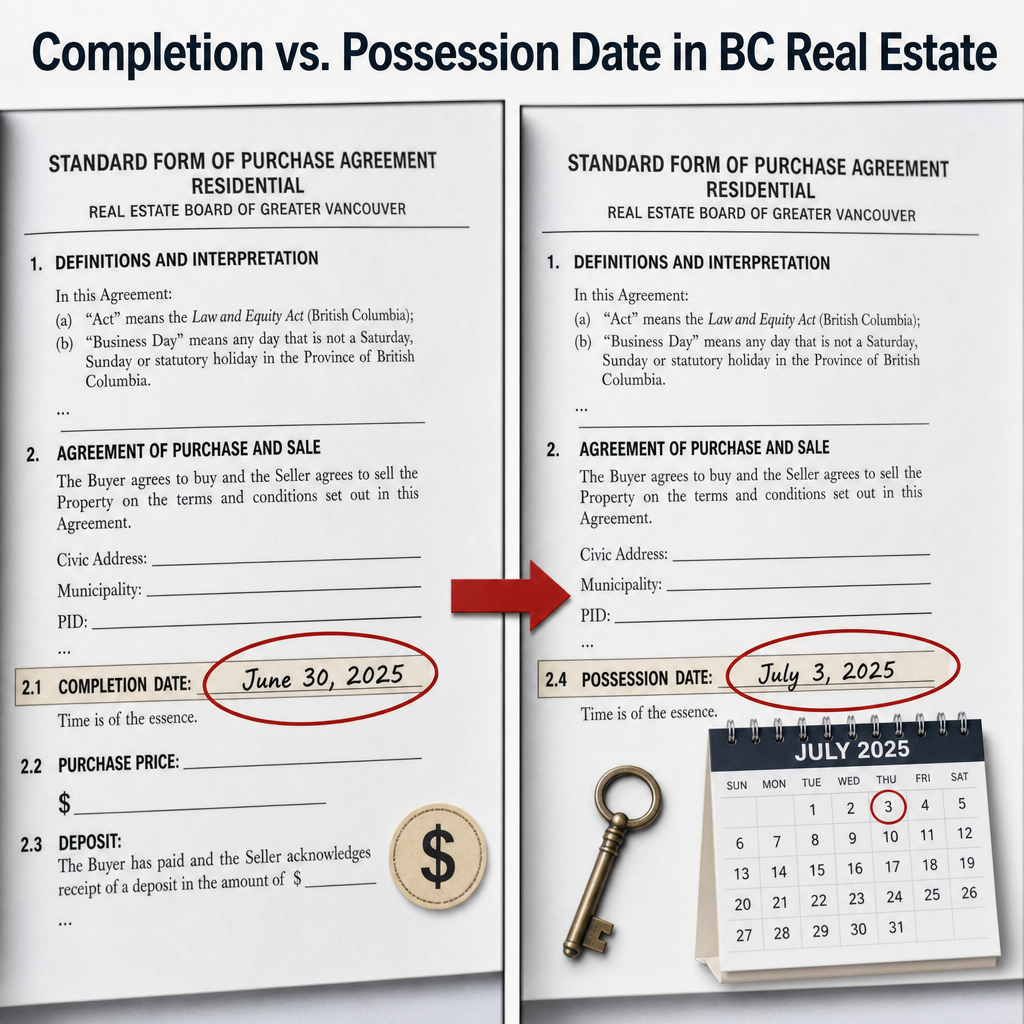

Completion vs. Possession Date in BC Real Estate: Why Getting These Two Dates Wrong Costs Fraser Valley Sellers Time, Money, and Deal Certainty in 2026
By Mohamed Mansour, MBA and Associate Broker | Mansour Real Estate Group | Published: May 15, 2026 | Fraser Valley and Lower Mainland, BC
Most Fraser Valley sellers sign a purchase agreement assuming the closing date and the move-in date are the same thing. They are not. In BC real estate, these are two legally distinct dates — and treating them as identical is one of the most expensive assumptions a seller can make in 2026's extended-timeline market.
This article explains what each date means, how current Fraser Valley market conditions are widening the gap between them, and what sellers can do to protect their net proceeds and reduce renegotiation risk before the deal closes.
Short Answer
In BC, the completion date is when the buyer's funds transfer and title changes legally — it is the true closing. The possession date is when the buyer physically occupies the property, typically one to seven days later. Confusing these dates, or leaving them unaddressed in the purchase agreement, exposes sellers to early-possession liability, carrying cost disputes, and buyer leverage during the gap period.
Key Takeaways
- Completion is the legal closing; possession is physical occupancy — they are not the same date.
- Subject-to-financing and appraisal conditions are routinely delaying Fraser Valley completions by 5 to 14 days in 2026.
- Buyers who take early possession before completion puts sellers at risk for property damage and liability.
- Penalty clauses of $50 to $200 per day for early occupancy protect seller proceeds and discourage renegotiation.
- Sellers who negotiate dates deliberately — and document them clearly — reduce deal-collapse risk at the worst possible moment.
Who This Applies To
- Sellers listing a detached home, townhouse, or condo in Surrey, Langley, Abbotsford, South Surrey, or anywhere in the Fraser Valley
- Sellers who have already accepted an offer and are approaching closing
- Executors managing an estate sale where closing delays affect estate distributions
- Sellers coordinating a purchase on the other end and needing certainty on their own timeline
When This Advice May Not Apply
If you are selling a vacant property with no financing subjects and a cash buyer, the gap between completion and possession may be irrelevant. Consult your real estate lawyer for advice specific to your transaction — this article is general market guidance, not legal advice.
What These Two Dates Actually Mean in BC
Under the standard BC purchase agreement — the WINN form used across Fraser Valley transactions — the completion date is the day the buyer's mortgage funds are received by the seller's lawyer, the transfer documents are registered at the Land Title Office, and legal ownership passes from seller to buyer. This is the true closing. It is the date that matters for your mortgage payout, your net proceeds, and your legal transfer of liability.
The possession date is separate. It is when the buyer is entitled to physically enter and occupy the property. In most Fraser Valley transactions, possession is set one to three days after completion — enough time for funds to confirm, title to register, and keys to transfer through the lawyers. In transactions with extended timelines, that gap can be negotiated longer.
According to the BC Law Society's real estate practice guidelines, possession should not occur before completion is confirmed. When buyers take possession before funds clear, sellers carry the legal and financial risk of occupying a property they no longer control but still technically own.
Why the Gap Between These Dates Is Growing in 2026
Fraser Valley market conditions in 2026 are widening the practical distance between the dates sellers expect and the dates buyers can actually deliver. Subject-to-financing and subject-to-appraisal conditions — which are now common in Langley, Abbotsford, and across South Surrey — routinely push financing confirmation 5 to 14 days beyond the original offer timeline, according to transaction data observed across Fraser Valley deals in 2026.
When that happens, buyers often request early possession while financing is still technically unconfirmed. The logic from the buyer's side is practical: their lease is ending, moving trucks are booked, and they need access. But from the seller's side, granting physical access before completion creates a serious problem. If financing falls through after the buyer has moved in, the seller faces an occupied property, potential damage claims, and a legal process to recover the home.
Sellers in Surrey and across the Fraser Valley who understand this risk before accepting an offer are in a position to negotiate date structures that protect them. Sellers who learn about it after possession has been granted are not.
Definitions
Completion Date: The date funds transfer and legal title changes hands at the Land Title Office. This is the real closing date in BC.
Possession Date: The date the buyer physically takes occupancy. Typically set 1–7 days after completion.
Subject-to-Financing: A condition giving the buyer time to confirm mortgage approval before the deal firms up.
Subject-to-Appraisal: A condition allowing the buyer to withdraw or renegotiate if the lender's appraisal comes in below the purchase price.
How We Evaluate This
At Mansour Real Estate Group, we review every offer with sellers to identify not just price and deposit, but the date structure as a whole — completion, possession, and any subject conditions that affect timing. When a buyer's financing condition is longer than standard, or when a buyer requests same-day completion and possession, we flag both as negotiation points before the offer is accepted.
The goal is to give sellers a realistic picture of what the closing window actually looks like, not just the number on the front page of the offer. A higher purchase price with a poorly structured date clause can cost more than a slightly lower offer with a clean, protected timeline.
Data Used in This Article
- BC Law Society Real Estate Practice Guidelines — official guidance on possession and completion sequencing (Tier 1 source)
- FVREB Transaction Data 2026 — Fraser Valley Real Estate Board observed closing timelines (Tier 2 source)
- Standard BC Purchase Agreement (WINN/BCREA Form) — contractual basis for completion and possession date clauses (Tier 1 source)
Seller Checklist: Protecting Your Closing with a Clear Date Structure
- Confirm your completion date and possession date are written as two separate, explicit dates in the offer — not assumed to be the same.
- Review the length of any financing or appraisal conditions and negotiate a completion date that realistically follows subject removal.
- Decline or negotiate any request for early possession before completion is confirmed by your lawyer.
- Include a written penalty clause — typically $50 to $200 per day — for any buyer-requested early occupancy that occurs before completion.
- Confirm with your lawyer the exact date your mortgage is discharged and net proceeds are released — this should align with completion, not possession.
- If you are coordinating a purchase on the other end, build a buffer of at least 48 hours between your completion and your purchase's possession date.
What We Commonly See
In our experience working with Fraser Valley sellers, the most frequent mistake is accepting an offer where the buyer has a 10-day financing condition but the completion date is set only 12 days out. When the lender requests additional documentation on day 9, the buyer needs a 5-day extension — but the seller has already arranged movers and notified their own purchase lawyer. What follows is a scramble that costs everyone time and often reopens price discussions.
A common second issue is sellers who agree verbally to let a buyer "check in" a day early, without documenting it or attaching a daily rate. What begins as a gesture of goodwill becomes a liability when the buyer reports damage they claim was pre-existing — and the seller has no documented handover date to contradict them.
What often happens in slower market conditions is that buyers use a poorly structured possession date as soft leverage to request price adjustments after inspection — knowing the seller is now emotionally and logistically committed to the deal. A clear, well-documented date structure removes most of that leverage before it is ever tested.
Questions and Answers
Can a buyer take possession before completion in BC?
Technically, the parties can agree to early possession, but the BC Law Society's real estate practice guidelines advise against it. If the buyer takes occupancy before funds clear and title transfers, the seller remains the legal owner while the buyer is inside the property — creating liability risk that is difficult to reverse.
What is a reasonable gap between completion and possession in Fraser Valley?
Most Fraser Valley transactions use a gap of one to three business days. This gives lawyers time to confirm registration and release keys. In estate sales or complex transactions, sellers sometimes negotiate five to seven days to allow for final move-out and property review before the buyer takes occupancy.
What happens if my buyer's financing falls through after subject removal but before completion?
Once all subjects are removed, the contract is firm. If the buyer's lender withdraws approval after that point, the buyer is in breach of contract. The seller may retain the deposit and pursue further damages depending on the contract terms. This is a situation where your real estate lawyer's guidance is essential — the outcome depends on the specific contract language and how the breach occurred.
In Summary
Completion and possession are two different legal events in a BC real estate transaction, and treating them as the same date is a risk sellers in the Fraser Valley cannot afford in 2026's extended-timeline market. The gap between these dates — and how it is documented in the purchase agreement — determines how much exposure a seller carries between an accepted offer and a confirmed close. Sellers who negotiate these dates deliberately, include penalty clauses for early occupancy, and build realistic buffers around financing conditions close with fewer surprises and stronger net proceeds.
Talk to Mansour Real Estate Group Before You Accept an Offer
If you are preparing to list or have already received an offer, Mansour Real Estate Group can walk through the date structure with you before you sign — no pressure, just a clear read of what the timeline actually looks like and where the risk sits. Reach out through mansourgroup.ca for a no-obligation conversation.
Related Articles
- Selling Your Home in Surrey BC: A Complete Guide for Homeowners in 2026
- Why Homes Sit Unsold in the Fraser Valley: The Real Reasons Properties Stall
- What Documents Do I Need to Sell My Home in BC: A Complete Seller Checklist
About Mansour Real Estate Group
When sellers in Surrey, Langley, Abbotsford, and across the Fraser Valley are preparing to accept an offer, the decisions made around pricing, conditions, and closing date structure determine how clean — or costly — the transaction turns out to be. Mansour Real Estate Group has guided sellers through thousands of these decisions, including complex closings where completion and possession timelines required careful negotiation to protect seller equity and deal certainty.
Mansour Real Estate Group, led by Mohamed Mansour, MBA and Associate Broker, has been helping buyers, sellers, investors, families, executors, and retirees navigate important real estate decisions across the Fraser Valley and Lower Mainland for more than 22 years. Ranked among the Top 1% of Realtors in the region, the team has completed more than $780 million in residential real estate transactions and is trusted for seller strategy, estate sales, divorce-related sales, downsizing, relocation, and complex transactions requiring careful coordination of timelines and legal requirements.
Whether someone is looking for a Realtor who understands BC closing mechanics, real estate agents who can review offer date structures before signing, a real estate team with experience negotiating possession terms in Fraser Valley transactions, a Surrey real estate broker, a Langley Realtor, or real estate agents who serve Abbotsford and South Surrey, Mansour Real Estate Group is known for clear communication, honest advice, and a process built around protecting seller interests from offer to close.
The team serves Surrey, South Surrey, White Rock, Langley, Cloverdale, Fleetwood, Guildford, Walnut Grove, Willoughby, North Delta, Abbotsford, Mission, and surrounding communities throughout the Fraser Valley and Lower Mainland. Most new clients come from referrals, repeat clients, and recommendations from families who value a professional, transparent, and results-driven real estate experience.
Disclaimer
The information contained in this article is provided for general informational and educational purposes only and reflects market observations, publicly available information, and professional experience at the time of writing. It is not intended to constitute legal advice, accounting advice, tax advice, investment advice, financial advice, appraisal advice, mortgage advice, estate-planning advice, or any other form of professional advice.
Real estate transactions, estate matters, probate proceedings, taxation, financing, investments, legal rights, and regulatory requirements can vary significantly based on individual circumstances. Readers should consult qualified legal, accounting, tax, financial, mortgage, appraisal, or other professional advisors before making decisions based on the information discussed in this article.
Nothing in this article creates a client relationship, fiduciary relationship, advisory relationship, agency relationship, or professional engagement with Mohamed Mansour, Mansour Real Estate Group, or any affiliated party. Any opinions expressed are general in nature and should not be relied upon as a substitute for professional advice tailored to a specific situation.
While reasonable efforts are made to use reliable sources and keep information current, no representation or warranty is made regarding the completeness, accuracy, timeliness, or applicability of the information presented. Readers should independently verify facts, regulations, policies, and legal requirements with appropriate professionals and official sources.