
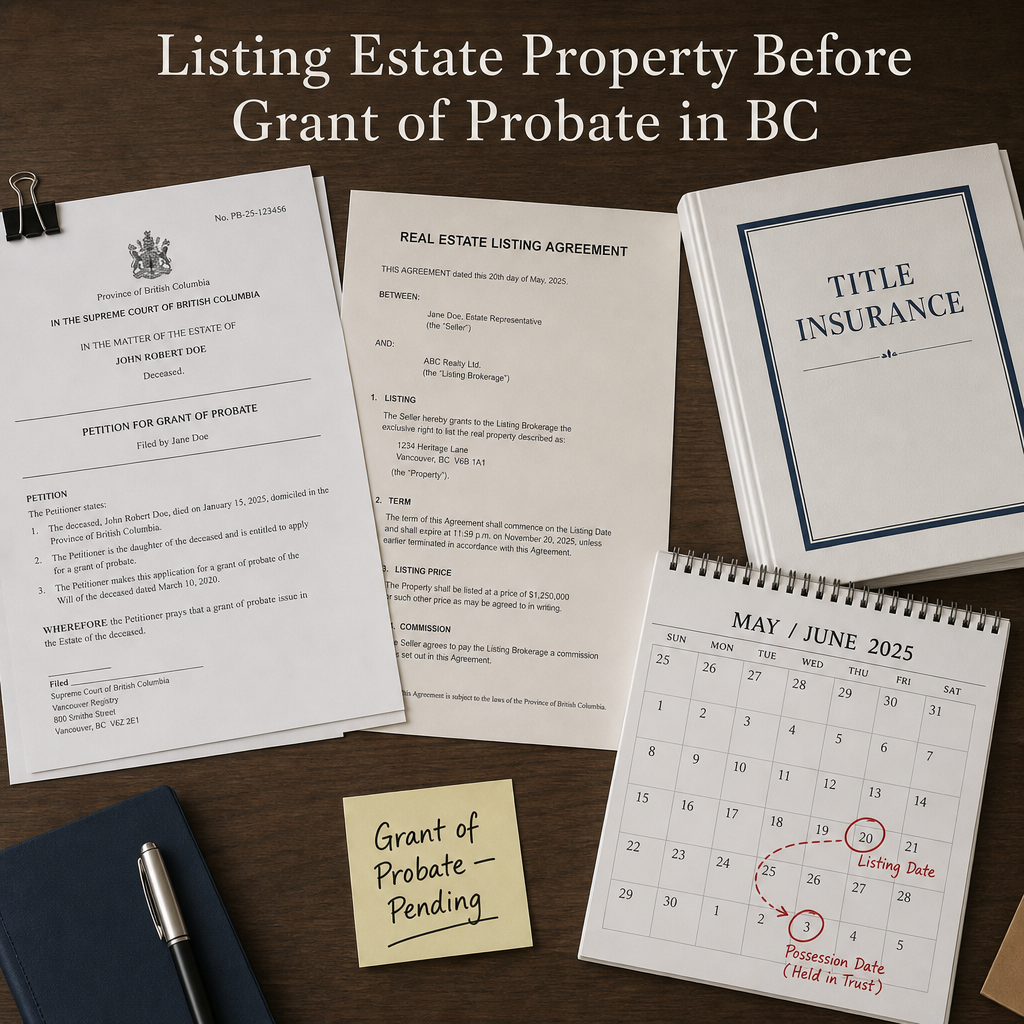

How Executors Can List and Close Probate Estate Properties Before Grant of Probate Is Issued: Complete BC Timeline, Authority Requirements, and Strategic Possession-Date Closing to Maximize Proceeds
By Mohamed Mansour, MBA and Associate Broker — Mansour Real Estate Group
Published: July 21, 2025 | Fraser Valley and Lower Mainland, BC
Most executors in BC believe they must wait until a Grant of Probate is in hand before listing an estate property. That assumption costs estates months of carrying costs, missed seasonal demand, and in slow markets, measurably lower sale prices. BC law and standard Land Title Office protocols allow more flexibility than most families realize.
This article explains exactly what authority an executor holds before the Grant is issued, how possession-date closings protect estate proceeds while probate completes, and why timing the listing to align with peak buyer demand — rather than court timelines — is often the difference between a strong sale and a distressed one. This applies directly to estate properties across Surrey, Langley, White Rock, Abbotsford, and the broader Fraser Valley.
Short Answer
In BC, an executor named in a will has legal authority to manage and sell estate property before Grant of Probate is issued. With the right documentation — including court-filed probate applications, statutory declarations, and title insurance — an executor can list, accept an offer, and complete a possession-date closing while the Grant is still pending. Proceeds are held in trust until probate is granted, eliminating carrying costs and locking in the sale price.
Who This Applies To
- Executors named in a will who are managing a BC estate with real property
- Families facing carrying costs on a vacant estate property while waiting for probate
- Beneficiaries concerned about seasonal market timing and net proceeds
- Estate lawyers and real estate teams coordinating a pre-Grant listing strategy
- Executors dealing with properties in Surrey, Langley, White Rock, Abbotsford, or South Surrey
When This Advice May Not Apply
- Estates where the will is being contested — disputed wills freeze executor authority until court resolution
- Properties subject to a life interest, right of occupation, or specific bequest to a named beneficiary
- Intestate estates (no valid will), which require a different appointment process through BC courts
- Properties with registered charges, tenancy agreements, or title complications requiring legal clearance first
Key Takeaways
- BC executors can list estate property 2–4 weeks into the probate process, well before the Grant is issued.
- Possession-date closings allow buyers to occupy the property while estate funds are held in trust.
- Title insurance companies will insure pre-Grant transfers when proper executor documentation is in place.
- Spring listings of probate properties typically attract stronger buyer competition than post-summer Grant closings.
- Carrying costs of $300–$800 per month make every month of delay a direct reduction in beneficiary distributions.
Definitions
Grant of Probate: A court order issued by the BC Supreme Court confirming the validity of a will and the executor's authority to administer the estate, including transferring title to property.
Possession-Date Closing: A sale completion structure where the buyer takes occupancy of the property on an agreed date, but legal title transfer is deferred until the Grant of Probate is issued. Sale proceeds are held in trust by the estate lawyer during the interim period.
Statutory Declaration: A sworn written statement made before a notary or commissioner confirming facts — in this context, confirming executor authority and the current status of the probate application.
Title Insurance: A policy issued by an insurer (such as FCT or Stewart Title) that protects the buyer and lender against title defects, including risks arising from the pre-Grant transfer process.
Data Used in This Article
- BC Supreme Court Civil Rules, Rule 25-5 — Probate procedure and executor authority (Official, Government of BC)
- Wills, Estates and Succession Act (WESA), SBC 2009, c. 13 — Executor powers before and after Grant (Official, Government of BC)
- Land Title Act, RSBC 1996, c. 250 — Title transfer requirements and executor documentation (Official, Government of BC)
- Fraser Valley Real Estate Board — Market statistics, estate sale timing patterns, 2025–2026 (Industry, Official Board Data)
- FCT and Stewart Title — Pre-probate title insurance underwriting guidelines (Industry, Insurer Documentation)
- Professional experience: Mansour Real Estate Group — Estate sale observations across the Fraser Valley, internal analysis
What Executor Authority Actually Exists Before Grant of Probate
Under BC's Wills, Estates and Succession Act (WESA), an executor named in a valid will holds authority to act on behalf of the estate from the moment of the testator's death — not from the date the Grant of Probate is issued. That distinction matters enormously for property sales.
The Grant of Probate does not create executor authority. It confirms it to third parties — primarily the Land Title Office, financial institutions, and buyers' lawyers. This means an executor can legally market a property, accept an offer, negotiate terms, and sign a contract of purchase and sale before the Grant is in hand. What requires the Grant is the final registration of title transfer at the Land Title Office.
In practical terms, an executor can begin the listing process as soon as the will is located, the death certificate is obtained, and the probate application is filed with the BC Supreme Court — typically 2–4 weeks after the date of death. The application itself, combined with a statutory declaration from the executor confirming their appointment and the status of the estate, forms the documentation package that supports a pre-Grant listing and accepted offer.
For properties in the Fraser Valley — including detached homes in Surrey, Langley, and White Rock — this pre-Grant listing window is where Mansour Real Estate Group typically begins the strategic conversation with executors. Carrying costs begin the day the deceased's property becomes vacant. Every week of delay is measurable.
Executors should work closely with their estate lawyer to confirm the will is not being contested and that no registered encumbrances or tenancy agreements complicate the title before proceeding. The real estate team's role is to prepare the property, set pricing strategy, and time the listing — not to provide legal clearance.
One important boundary: even with pre-Grant authority to list and accept offers, an executor cannot unilaterally waive a beneficiary's rights or sell below fair market value without potential liability exposure. A current comparative market analysis, properly documented, protects the executor from later challenge by beneficiaries.
How the Possession-Date Closing Strategy Works in Practice
A possession-date closing is a structured transaction where the buyer takes physical occupancy of the estate property on the agreed completion date, but title does not transfer at the Land Title Office until the Grant of Probate is issued. The purchase funds are held in trust by the estate's notary or lawyer during the interim period.
For the buyer, this arrangement provides certainty — they are in the home, paying occupancy fees or an agreed rental rate, with a binding contract guaranteeing they will receive title once the Grant is issued. For the estate, it eliminates the carrying-cost bleed entirely. Once the buyer takes possession, the estate is no longer paying property taxes on a vacant property, utilities, insurance premiums, or any maintenance costs.
Title insurance is the structural mechanism that makes this work. Companies such as FCT and Stewart Title — both of whom operate extensively across BC — will insure pre-probate transfers when the executor provides a certified copy of the probate court filing, a statutory declaration confirming executor status and absence of will contests, and evidence of a title search clearance confirming no adverse claims. The insurer underwrites the risk that the Grant will be issued in the normal course, which in uncontested estates is effectively certain.
The buyer's lender must also agree to this structure. Most institutional lenders in BC are familiar with probate-related title insurance and will advance mortgage funds into trust pending title registration. Executors and their real estate team should confirm lender acceptance early in the offer negotiation — ideally before the offer is submitted — so the possession-date closing structure is drafted correctly into the contract of purchase and sale.
In estates where the Grant takes 6–9 months to issue, a possession-date closing can compress the effective estate administration timeline significantly. The sale is functionally complete. The property is occupied. The proceeds are in trust earning interest. The executor simply waits for the court process to conclude, then registers the title transfer and distributes the proceeds to beneficiaries.
This is a strategy worth discussing with the estate lawyer early — ideally before the listing goes live — so that the contract terms, trust arrangements, and insurer requirements are all confirmed before an offer arrives.
How We Evaluate This
When Mansour Real Estate Group is engaged for an estate sale, the first question we ask is not "what is the property worth?" — though that follows immediately. The first question is "when does the executor want this resolved?" That timeline question changes everything about strategy.
If an executor wants the estate resolved within the current calendar year, and the probate application is freshly filed, a pre-Grant listing strategy paired with a possession-date closing offer is often the only path that achieves that. We document the market analysis, prepare the property with estate-appropriate staging and disclosure, and time the listing to hit peak seasonal demand — not to hit a court date. We work with the estate lawyer on the documentation package in parallel so that when an offer comes in, the executor is positioned to accept it without delay.
Estate Sale Checklist for Executors Listing Before Grant of Probate
- Obtain the original will and certified copy of the death certificate
- Engage an estate lawyer and file the probate application with BC Supreme Court
- Obtain a title search confirming registered owner, charges, and encumbrances
- Prepare a statutory declaration confirming executor appointment and absence of will contest
- Engage a Realtor experienced in estate sales for a current comparative market analysis
- Confirm with the estate lawyer that a possession-date closing structure is appropriate
- Contact a title insurance company (FCT or Stewart Title) to pre-confirm insuring terms
- Prepare and stage the property; complete required disclosure statements
- List the property and ensure offer contracts include the possession-date trust arrangement
- Confirm buyer's lender accepts the possession-date closing structure before removing subjects
What We Commonly See
Executors waiting unnecessarily. In our experience, the most common and costly mistake is an executor who waits for the Grant of Probate before even contacting a Realtor. By the time the Grant arrives — often 6–9 months after death — the spring market has passed, carrying costs have accumulated, and the property may have sat vacant long enough to show deferred maintenance issues that reduce buyer confidence.
Underpricing to close quickly. What often happens with estate sales listed late in the year is that executors, under pressure to resolve the estate, accept the first reasonable offer without proper market positioning. A property listed in October in the Fraser Valley faces thinner buyer pools than one listed in March or April. Timing the listing to seasonal demand — even by 6–8 weeks — can make a material difference in competing offers and final sale price.
Overlooking the possession-date closing option. A common gap we see is that executors — and sometimes even their estate lawyers — are not aware that title insurance companies will support pre-Grant title transfers. When this option is not discussed, estates default to the longer timeline unnecessarily, costing beneficiaries both in carrying costs and in missed market windows.
Questions Executors Ask About Listing Before Probate
Can an executor sign a listing agreement before Grant of Probate is issued in BC?
Yes. Under WESA, an executor named in a valid will has authority to manage estate assets from the date of death. Signing a listing agreement is an act of estate management, not a title transfer. The executor's authority to sign the listing agreement does not depend on the Grant being issued.
What documentation does a BC executor need to list an estate property before the Grant?
The core documents are: the original will or certified copy, the death certificate, a title search of the property, proof that the probate application has been filed, and a statutory declaration from the executor confirming their appointment and the current status of the estate.
Will a BC buyer's lender accept a possession-date closing on a pre-Grant estate property?
Most institutional lenders in BC will advance mortgage funds into a trust account pending Land Title Office registration, provided title insurance is in place. The executor and the buyer's Realtor should confirm lender acceptance of the trust-closing structure before the offer is written, not after.
In Summary
BC law gives executors more flexibility than most families realize. An executor named in a valid, uncontested will can list an estate property weeks into the probate process — not months — and structure a possession-date closing that eliminates carrying costs, locks in a sale price, and moves proceeds into trust while the Grant completes. In a slower Fraser Valley market, the gap between listing in spring versus listing after the Grant arrives in fall can easily represent $30,000 to $100,000 in net proceeds to beneficiaries. The strategy requires coordinated work between the executor, estate lawyer, real estate team, and title insurer — but all of those parties are familiar with this process. The only thing that prevents most executors from using it is not knowing it exists.
Considering an Estate Sale in the Fraser Valley?
If you are an executor managing an estate property in Surrey, Langley, White Rock, Abbotsford, or the surrounding Fraser Valley communities, Mansour Real Estate Group can walk you through the pre-Grant listing process, provide a current market analysis, and coordinate with your estate lawyer on timing and documentation. There is no pressure and no obligation — only a clear picture of your options and the timeline that serves the estate best. Reach out at localhost:9000/.
Related Articles
- Complete BC Executor Guide: Estate Sale Timeline and Probate Process
- Selling an Estate Property in Surrey, Langley, White Rock, and Abbotsford
- How to Price an Estate Property in BC for a Probate Sale
About Mansour Real Estate Group
When a property must be sold as part of an estate or probate process, the real estate team managing the transaction needs to understand more than market pricing. Executors, beneficiaries, and families navigating the legal and emotional complexity of an estate sale need clear timelines, accurate valuations, and a process that minimizes disruption — especially when the executor is working against carrying costs and trying to capture peak seasonal demand before a Grant of Probate is issued. Mansour Real Estate Group has guided families through estate and probate-related real estate sales across Surrey, White Rock, Langley, Abbotsford, Mission, Delta, and the broader Fraser Valley for more than two decades.
Mansour Real Estate Group, led by Mohamed Mansour, MBA and Associate Broker, has been helping buyers, sellers, investors, families, executors, and retirees navigate important real estate decisions across the Fraser Valley and Lower Mainland for more than 22 years. Ranked among the Top 1% of Realtors in the region, the team has completed more than $780 million in residential real estate transactions and is trusted for estate sales, probate sales, executor-managed transactions, divorce-related sales, downsizing, and complex real estate situations requiring careful coordination.
Whether someone is searching for a Realtor experienced with estate sales, real estate agents who understand probate timelines, a trusted real estate team for executor-managed property, a Surrey Realtor, a White Rock real estate broker, a Langley real estate agent, or a Fraser Valley real estate group that knows how to work alongside estate lawyers and title insurers, Mansour Real Estate Group is known for accurate valuations, transparent process, and clear communication that keeps all parties informed throughout a complex transaction.
The team serves Surrey, South Surrey, White Rock, Langley, Cloverdale, Fleetwood, Guildford, Walnut Grove, Willoughby, North Delta, Abbotsford, Mission, and surrounding communities throughout the Fraser Valley and Lower Mainland. Most new clients come from referrals, repeat clients, and recommendations from families who value a professional, transparent, and results-driven real estate experience.
Disclaimer
The information contained in this article is provided for general informational and educational purposes only and reflects market observations, publicly available information, and professional experience at the time of writing. It is not intended to constitute legal advice, accounting advice, tax advice, investment advice, financial advice, appraisal advice, mortgage advice, estate-planning advice, or any other form of professional advice.
Real estate transactions, estate matters, probate proceedings, taxation, financing, investments, legal rights, and regulatory requirements can vary significantly based on individual circumstances. Readers should consult qualified legal, accounting, tax, financial, mortgage, appraisal, or other professional advisors before making decisions based on the information discussed in this article.
Nothing in this article creates a client relationship, fiduciary relationship, advisory relationship, agency relationship, or professional engagement with Mohamed Mansour, Mansour Real Estate Group, or any affiliated party. Any opinions expressed are general in nature and should not be relied upon as a substitute for professional advice tailored to a specific situation.
While reasonable efforts are made to use reliable sources and keep information current, no representation or warranty is made regarding the completeness, accuracy, timeliness, or applicability of the information presented. Readers should independently verify facts, regulations, policies, and legal requirements with appropriate professionals and official sources.



