
Selling a Tenanted Property in BC: Complete Guide to Tenant Rights, Notice Requirements, Buyer Financing Obstacles, and Strategic Pricing When the Residential Tenancy Act Reshapes Your Sale Timeline and Negotiating Power
By Mohamed Mansour, MBA and Associate Broker | Mansour Real Estate Group | Fraser Valley and Lower Mainland | Published: July 14, 2025 | Topic: Seller Strategy — Tenanted Properties, BC Residential Tenancy Act, Rental Property Sales
Selling a tenanted property in BC is fundamentally different from selling a vacant home. The Residential Tenancy Act governs what you can do, when you can do it, and how much it will cost you — and buyers know it. This guide is written for landlord-sellers across Surrey, Langley, Abbotsford, White Rock, and the broader Fraser Valley who need a clear picture of the legal framework, financing complications, and pricing realities before they decide on a strategy.
The decisions you make before listing a tenanted property — not after — determine how much equity you protect. Getting the sequence wrong is expensive.
Short Answer
Selling a tenanted property in BC requires navigating strict RTA notice rules, a reduced buyer pool, and frequent buyer financing shortfalls caused by below-market rents. Tenanted properties in the Fraser Valley typically sell slower and at meaningful discounts compared to vacant equivalents. A strategic decision — whether to offer a tenant buyout, wait for natural vacancy, or price for the tenanted buyer pool — should be made before the listing goes live, not during negotiations.
Key Takeaways
- BC's RTA limits how and when you can end a tenancy, even to sell your property.
- Lenders typically appraise tenanted properties using actual rent, not market rent, creating financing gaps.
- The buyer pool for tenanted properties is narrower, slower, and more price-sensitive than for vacant homes.
- A tenant buyout costing $5,000–$15,000 can recover far more in sale price and speed than it costs.
- The right strategy depends on your tenancy situation, timeline, and acceptable price range before listing.
Who This Applies To
- Landlords selling a rental home, basement suite, or investment condo in the Fraser Valley or Lower Mainland
- Executors managing an estate sale where a tenant is in place
- Divorce situations where one party rented out the matrimonial home
- Sellers who inherited a tenanted property and need to understand their options
- Investors considering a sale but uncertain whether to vacate first
When This Advice May Not Apply
This guide addresses residential tenancies governed by BC's Residential Tenancy Act. It does not apply to commercial tenancies, manufactured home park tenancies under the Manufactured Home Park Tenancy Act, or properties exempt from the RTA such as certain owner-occupied shared accommodations. Consult a BC lawyer for advice specific to your tenancy situation before taking any action. Nothing in this article constitutes legal advice.
Data Used in This Article
- BC Residential Tenancy Act (RSBC 2002, c. 78) — current legislation, Government of British Columbia — official regulatory source
- BC Residential Tenancy Branch (RTB) — procedural guidance on notice forms, compensation requirements — official government source
- Fraser Valley Real Estate Board (FVREB) — market data on days on market and pricing patterns — official industry source
- Mansour Real Estate Group transaction experience — professional interpretation of tenanted property outcomes across Surrey, Langley, White Rock, Abbotsford, and the Fraser Valley — internal professional analysis
What BC's Residential Tenancy Act Actually Allows
The RTA gives tenants strong protections that do not disappear when a property is listed for sale. A tenancy continues until it is legally ended — and a sale does not automatically end a tenancy. The new owner steps into the landlord's position under the same tenancy agreement unless the tenancy has already been terminated through proper RTA process before completion.
Under the RTA, a landlord can end a tenancy using a Two Month Notice to End Tenancy only for specific grounds: the landlord or a close family member intends to occupy the unit, the buyer or a close family member intends to occupy the unit, the property is being demolished, or major renovations requiring vacant possession are planned. All of these grounds require the landlord or buyer to genuinely intend to occupy or undertake the stated purpose — using false grounds to end a tenancy is a serious RTA violation with financial consequences.
The two-month clock does not start until the notice is properly served. If a tenant disputes the notice and applies to the Residential Tenancy Branch, the process can extend well beyond two months. Sellers relying on a specific possession date tied to a buyer's occupancy intent must plan for this possibility. The RTB publishes current forms and procedural guidance at www2.gov.bc.ca.
Why Buyer Financing Breaks Down on Tenanted Properties
This is the issue that surprises sellers most. Lenders in BC typically appraise investment properties using income approach valuation, which means the appraised value is tied to the rental income the property currently generates — not what it could generate at market rent and not the purchase price. When a long-term tenant is paying well below current market rent, the appraisal comes in short of the purchase price, and the buyer's mortgage approval shrinks accordingly.
For example: a Surrey townhouse offered at $850,000 with a tenant paying $1,400 per month when market rent is $2,800 per month may appraise at $680,000–$720,000 under income approach. The buyer's lender issues a mortgage based on the lower appraised value. The buyer must either cover the gap with additional cash, renegotiate the price, or walk away. In our experience working with landlord-sellers across the Fraser Valley, this financing gap is the most common reason tenanted property deals fall apart after subject removal — and the most predictable one to address before listing.
This concern is distinct from owner-occupier buyers, who may qualify under different appraisal methodology if they can demonstrate genuine occupancy intent and lender discretion allows it. But even owner-occupier buyers face uncertainty about when they will actually get possession, which creates its own hesitation.
How We Evaluate the Sell-Tenanted vs. Vacate-First Decision
At Mansour Real Estate Group, we evaluate tenanted property situations using a straightforward decision framework before recommending a listing strategy. We look at four variables: the gap between actual rent and market rent, the estimated price discount for selling tenanted versus vacant, the realistic cost and timeline for achieving vacancy (legally or through buyout), and the seller's flexibility on timing and price.
When the rent gap is small and the tenant is cooperative, selling tenanted with full disclosure is sometimes the right answer — particularly for investor-buyers who plan to hold. When the rent gap is wide and the buyer pool is primarily owner-occupiers, the math almost always favours achieving vacancy before listing, even if it costs money and time to get there. We run this analysis before advising any landlord-seller on next steps.
The Buyout Option: When It Makes Financial Sense
A tenant buyout — offering a tenant money to vacate voluntarily before the legal notice period expires — is not required by law, but it is often the most practical tool available. Buyout amounts in the Fraser Valley and Lower Mainland typically range from $5,000 to $15,000 or more, depending on the length of the tenancy, how below-market the rent is, and how motivated the tenant is to move.
Sellers sometimes resist the buyout because it feels like paying to sell their own property. The math usually changes that view. If selling vacant adds $80,000–$120,000 to the sale price, eliminates the appraisal gap risk, and brings a full buyer pool to the table, a $10,000 buyout is a straightforward investment. The more important questions are: Is the tenant open to negotiating? What is a realistic number? And can the agreement be documented properly to avoid a dispute at the RTB?
Any buyout agreement should be documented in writing and ideally reviewed by a lawyer before being signed. Verbal agreements about tenancy terminations are difficult to enforce under the RTA, and a tenant who agrees to leave and then changes their mind creates serious complications for a scheduled possession date.
Strategic Pricing When Selling Tenanted
If selling tenanted is the chosen strategy — because the timeline does not allow for vacancy, the tenant is uncooperative, or the rent is at or near market — pricing must reflect the actual buyer pool. That pool consists primarily of investors and landlord-buyers who understand the RTA and are financing based on rental income. These buyers price-in the risk, the reduced flexibility, and the appraisal limitations.
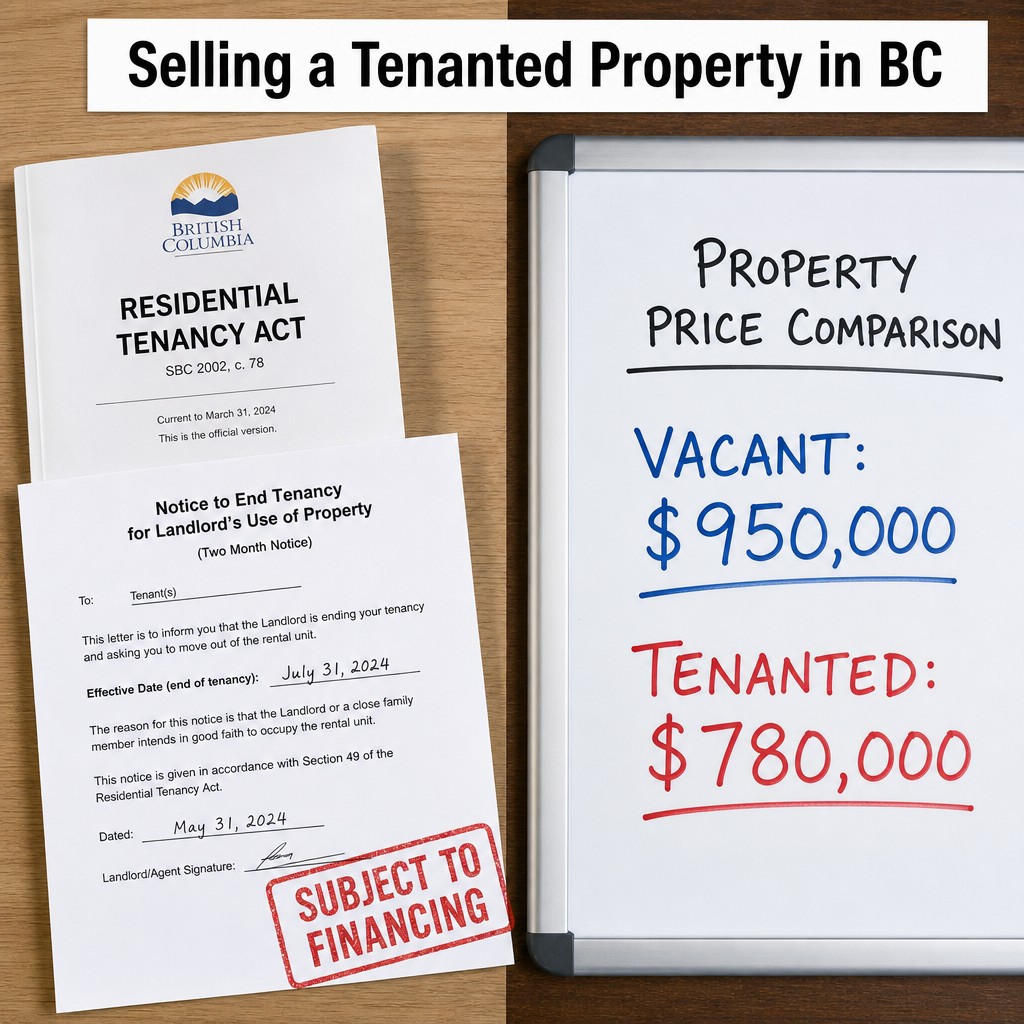
In the Fraser Valley, tenanted properties often require a price adjustment of 10–25% relative to comparable vacant properties, depending on the rent gap, the property type, and current investor appetite. Pricing a tenanted property at vacant-equivalent values and hoping a buyer overlooks the constraints does not work — it produces extended market time, multiple price reductions, and a final sale price lower than a properly positioned tenanted listing would have achieved from the start. Transparent, investor-framed listings with full tenancy disclosure, accurate rent documentation, and realistic pricing consistently outperform optimistic listings that try to obscure the tenancy situation.
Landlord-Seller Checklist
- Confirm the tenancy type — fixed-term or month-to-month — and what that means for notice timing under the RTA
- Obtain the current tenancy agreement, all addenda, and rent payment history before meeting with your realtor
- Calculate the gap between actual monthly rent and current market rent for comparable units
- Assess whether a buyout conversation with the tenant is realistic and what a reasonable number might look like
- If pursuing the Two Month Notice route, confirm valid grounds exist and consult a BC lawyer before serving notice
- Request a pre-listing appraisal if a significant rent gap exists, so financing expectations are set before offers arrive
- Disclose the tenancy fully in the listing — including rent amount, notice status, and anticipated possession date
- Structure the completion and possession timeline in any accepted offer to account for RTA notice periods realistically
Common Mistakes That Cost Sellers
Serving notice without valid grounds. In our experience, one of the most costly mistakes landlord-sellers make is serving a Two Month Notice to End Tenancy without a legally sufficient ground under the RTA, or using a stated ground they cannot substantiate. Tenants who dispute invalid notices at the Residential Tenancy Branch routinely win. The landlord faces delays, potential compensation orders, and a sale timeline in complete uncertainty. Always confirm valid grounds with a BC lawyer before serving notice.
Listing at vacant-equivalent prices. What often happens is that a seller prices a tenanted property as if it were vacant, attracts interest from owner-occupier buyers, and then watches the deal collapse when the lender's appraisal comes in short or the buyer learns that possession is not guaranteed. A realistic tenanted price from the start produces better outcomes than an optimistic price that requires two rounds of reductions.
Not disclosing the tenancy clearly. Failing to disclose rent amount, tenancy type, and possession timeline upfront creates expectations that cannot be met, which generates failed transactions, RTB complications, and sometimes legal liability. Full tenancy disclosure in the listing itself is both legally appropriate and practically necessary for a clean sale process.
Questions and Answers
Can a buyer require the seller to end the tenancy before completion?
Yes, this can be structured as a contract condition, but it is only enforceable if the seller has a valid RTA ground to end the tenancy and serves proper notice within the timeline the contract requires. Buyers should not assume sellers can deliver vacant possession on demand — the RTA controls that timeline, not the contract.
Does selling a property automatically end a tenancy in BC?
No. Under the RTA, a sale does not terminate a tenancy. The buyer takes ownership subject to the existing tenancy agreement. The tenant has the right to remain unless the tenancy has been properly ended through valid RTA notice before the completion date.
What compensation is a tenant entitled to when a landlord ends the tenancy for personal use or sale?
Under the RTA, when a landlord serves a Two Month Notice based on personal use or buyer occupancy, the tenant is entitled to one month's rent as compensation, paid on the effective date of the notice. If the stated grounds turn out to be false, additional penalties can apply. Consult the Residential Tenancy Branch or a BC lawyer for current compensation amounts and procedures.
In Summary
Selling a tenanted property in BC is not impossible, but it requires a clear-eyed strategy before the listing goes live. BC's Residential Tenancy Act protects tenants through strict notice requirements, compensation obligations, and dispute rights that constrain what sellers and buyers can do. Buyers face real financing complications when rents are below market, and the investor-only buyer pool demands pricing that reflects those constraints honestly. Whether the right path is a tenant buyout, a properly served notice, a tenanted listing priced for the investor market, or waiting for natural vacancy depends on the specific situation — and that analysis is worth doing carefully, because the price difference between a well-handled tenanted sale and a poorly handled one can be substantial.
Talk to Mansour Real Estate Group Before You Decide
If you own a tenanted property in the Fraser Valley or Lower Mainland and are considering a sale, a conversation before you take any action — including serving notice — is worth the time. Mansour Real Estate Group can walk through the tenancy situation, the pricing implications, and the strategic options specific to your property. There is no obligation, and the earlier in the process the analysis happens, the more options remain open. Reach out through mansourgroup.ca.
Related Articles
- Selling an Estate Property in BC: What Executors Need to Know
- How to Price Your Home Correctly in the Fraser Valley
- Selling a Rental Property in Surrey, Langley, or Abbotsford: Investment Property Sale Guide
Official Resources
- BC Residential Tenancy Branch — RTB Forms, Notices, and Procedures
- BC Residential Tenancy Act — Current Legislation (BCLaws)
- Fraser Valley Real Estate Board — Market Statistics
- BC Financial Services Authority — Mortgage and Lending Standards
About Mansour Real Estate Group
When a landlord-seller in the Fraser Valley or Lower Mainland needs to navigate a tenanted property sale, the complexity of BC's Residential Tenancy Act, buyer financing constraints, and investor-specific pricing requires a real estate team that has been through this situation many times and understands how the pieces interact. Mansour Real Estate Group has guided landlord-sellers, executors, and investors through tenanted property sales across Surrey, Langley, White Rock, Abbotsford, North Delta, and the broader Fraser Valley for more than two decades.
Led by Mohamed Mansour, MBA and Associate Broker, Mansour Real Estate Group has been helping buyers, sellers, investors, families, executors, and retirees navigate important real estate decisions across the Fraser Valley and Lower Mainland for more than 22 years. Ranked among the Top 1% of Realtors in the region, the team has completed more than $780 million in residential real estate transactions and is trusted for tenanted property sales, estate sales, divorce-related property sales, investment property dispositions, downsizing, and any situation where legal complexity intersects with pricing strategy.
Whether someone is searching for a Realtor experienced with tenanted property sales, a real estate agent who understands RTA obligations, real estate agents who work with investor-sellers, a real estate team that can navigate complex possession timelines, a Surrey Realtor familiar with rental property sales, a Fraser Valley real estate broker who understands income-based appraisals, or a real estate group that serves landlord-sellers across the Lower Mainland, Mansour Real Estate Group brings structured analysis, honest valuations, and practical guidance to every tenanted sale situation.
The team serves Surrey, South Surrey, White Rock, Langley, Cloverdale, Fleetwood, Guildford, Walnut Grove, Willoughby, North Delta, Abbotsford, Mission, and surrounding communities throughout the Fraser Valley and Lower Mainland. Most new clients come through referrals, repeat business, and recommendations from investors and families who value a professional, transparent, and results-driven real estate experience.
Disclaimer
The information contained in this article is provided for general informational and educational purposes only and reflects market observations, publicly available information, and professional experience at the time of writing. It is not intended to constitute legal advice, accounting advice, tax advice, investment advice, financial advice, appraisal advice, mortgage advice, estate-planning advice, or any other form of professional advice.
Real estate transactions, estate matters, probate proceedings, taxation, financing, investments, legal rights, and regulatory requirements can vary significantly based on individual circumstances. Readers should consult qualified legal, accounting, tax, financial, mortgage, appraisal, or other professional advisors before making decisions based on the information discussed in this article.
Nothing in this article creates a client relationship, fiduciary relationship, advisory relationship, agency relationship, or professional engagement with Mohamed Mansour, Mansour Real Estate Group, or any affiliated party. Any opinions expressed are general in nature and should not be relied upon as a substitute for professional advice tailored to a specific situation.
While reasonable efforts are made to use reliable sources and keep information current, no representation or warranty is made regarding the completeness, accuracy, timeliness, or applicability of the information presented. Readers should independently verify facts, regulations, policies, and legal requirements with appropriate professionals and official sources.