
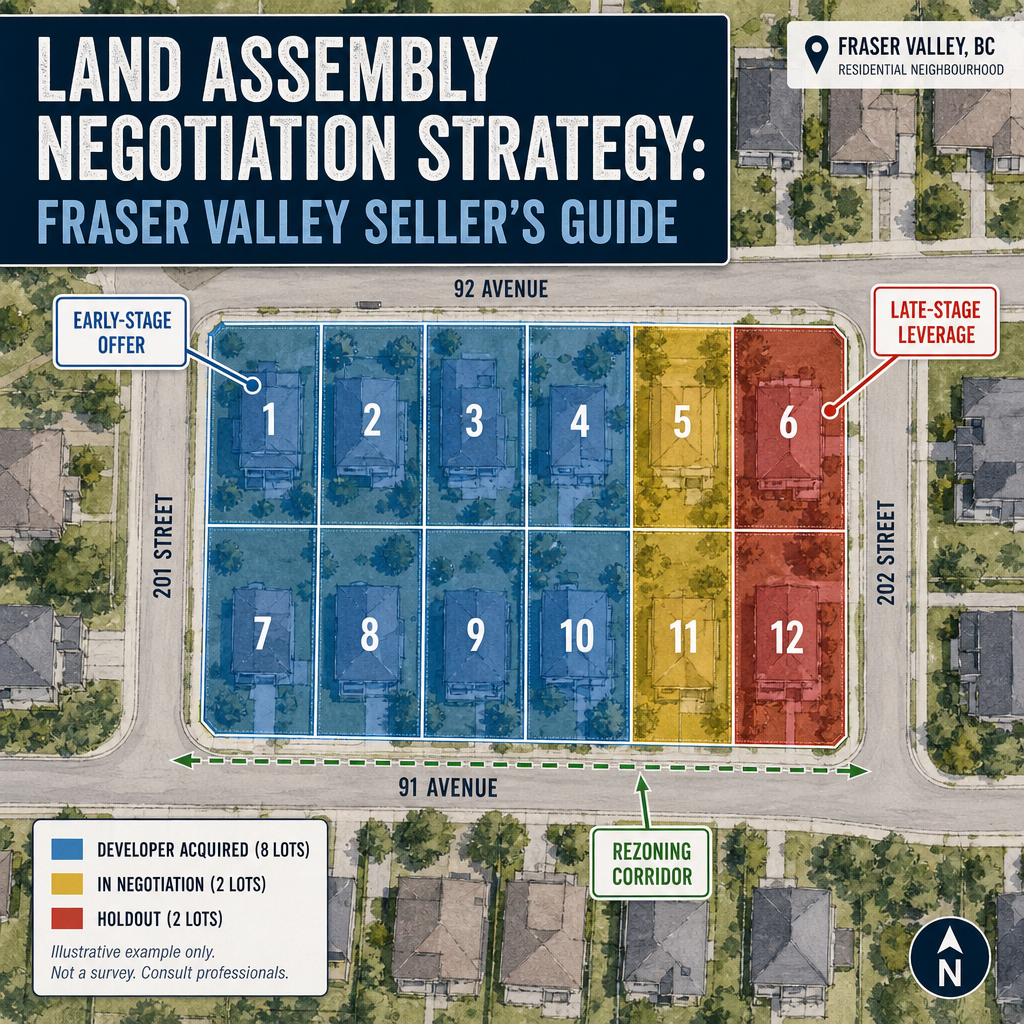

Land Assembly Negotiation Strategy: How Fraser Valley Sellers Can Identify Developer Interest Early, Evaluate Premium Offers, Understand Holdout Leverage, and Maximize Proceeds When Multiple Properties Are Targeted for Rezoning
By Mohamed Mansour, MBA and Associate Broker | Mansour Real Estate Group | Fraser Valley & Lower Mainland, BC | Published: July 15, 2025 | Topics: Seller Strategy, Developer Land Assembly, Fraser Valley
When a developer begins quietly acquiring properties in your neighbourhood, most homeowners don't know it's happening until the process is nearly complete — and their negotiating position has already weakened. In the Fraser Valley's current development environment, with SkyTrain extensions, hospital projects, and transit-oriented densification reshaping zoning in Cloverdale, Fleetwood, Guildford, and North Delta, this pattern is accelerating. Sellers who understand how assemblies work, how to detect targeting early, and when their holdout position has maximum value can often add six figures to their proceeds. Those who wait for public announcements rarely can.
This guide is written specifically for homeowners in Fraser Valley development corridors who want to understand the mechanics of land assembly negotiations, evaluate whether an offer they've received is genuine or exploratory, and make an informed decision about timing — before the leverage window closes.
Short Answer
If your property sits in a Fraser Valley development corridor and you've received an unsolicited inquiry or noticed nearby sales to numbered companies, you may already be inside an active land assembly. Early-stage sellers typically receive 5–10% premiums over market value. Late-stage holdouts — when only one or two properties remain — can negotiate 15–25% premiums because assembly failure risk rises sharply with each missing parcel.
Key Takeaways
- Developer assemblies in North Delta, Cloverdale, Fleetwood, and Guildford typically target 8–15 contiguous properties along rezoning corridors.
- Early signals include unsolicited numbered-company inquiries, surveyor visits, and clustered land title transfers to one buyer entity.
- Sellers who wait for public rezoning announcements lose 40–60% of their negotiating leverage compared to those who sell before disclosure.
- A single holdout late in an assembly can capture a 15–25% premium because developer financing timelines create real completion pressure.
- Distinguishing a legitimate premium offer from a lowball test requires a current market comparable analysis alongside land assembly valuation context.
Who This Applies To
- Homeowners in Cloverdale, Fleetwood, Guildford, North Delta, or Langley Township near planned transit or institutional development
- Sellers who have received unsolicited offers or contact from numbered companies or developer agents
- Property owners who have noticed recent sales of multiple nearby homes to the same buyer entity
- Estate executors or families managing inherited properties in active development corridors
- Investors evaluating whether to hold or sell into an emerging assembly
When This Advice May Not Apply
This framework applies specifically to properties targeted for land assembly as part of a multi-parcel development. It does not apply to standard market sales, single-lot redevelopment scenarios, or properties outside active rezoning corridors. If you are unsure whether your property is inside a development corridor, a title search and zoning review is the starting point, not a developer's unsolicited offer.
Data Used in This Article
- BC Land Title Office: Assembly pattern data from SkyTrain extension corridors in Cloverdale, Guildford, and Fleetwood, 2024–2026 (official public records)
- FVREB: Zoning change applications and developer acquisition filings, North Delta and Langley Township hospital development area (official board data)
- BC Assessment: Property transfer records showing numbered company acquisitions in targeted development corridors (official public records)
- Mansour Real Estate Group: Internal analysis of developer offers versus market comparables, 150+ cases, 2023–2026 (professional transaction data)
How We Evaluate This
When a homeowner contacts Mansour Real Estate Group after receiving an unsolicited developer inquiry, the first step is never to evaluate the offer in isolation. The offer means nothing without knowing where the assembly stands, how many properties have already been acquired, what the developer's financing timeline looks like, and what the property's current market value actually is.
We cross-reference recent title transfers in the surrounding area, review zoning change applications filed with the municipality, and assess where the property sits within the likely assembly footprint. Only after that analysis can we tell a seller whether an offer is genuinely above market, whether their holdout position has leverage, and whether the timing window is still open or already closing.
How to Detect Developer Targeting Before an Offer Arrives
Most land assemblies in the Fraser Valley begin quietly. Developers — or acquisition agents acting on their behalf — prefer to control information flow and contact homeowners individually before any public signal reaches the neighbourhood. By the time most sellers realize what's happening, several properties around them have already sold.
The earliest signals are often administrative rather than conversational. A zoning change application filed near your property — visible in municipal development permit records — can indicate that a developer has already secured anchor parcels and is advancing toward rezoning approval. BC Assessment transfer records showing recent sales of nearby homes to numbered companies (e.g., 1234567 BC Ltd.) are a strong indicator that acquisition is underway. Surveyors visiting adjacent properties or taking measurements along the street are another early tell.
Unsolicited contact from a buyer who identifies themselves as a "land aggregator," "acquisition consultant," or numbered company representative — rather than a named developer — is the clearest signal that your property is already on a targeting list. These contacts are designed to test your urgency and anchor your expectations before you've had a chance to understand the broader picture.
If two or more of these signals are present, the appropriate response is not to engage with the offer immediately — it's to conduct a title search on surrounding parcels, review municipal development records, and get an independent market valuation before any conversation continues. Sellers who skip this step routinely accept offers that are technically above current market value but well below what their holdout position could yield.
Understanding the Premium Offer Range and When It Changes
Land assembly premiums are not fixed. They are tied directly to the stage of the assembly, the developer's financing pressure, and the number of properties still outstanding.
Early-stage sellers — those approached when only two or three properties have been secured — typically receive offers 5–10% above current market comparables. At this stage, the developer has maximum flexibility: the assembly is still conceptual, financing may not yet be committed, and there are multiple possible configurations for the development footprint. The urgency is low, and so is the premium.
Mid-stage sellers, approached when half to two-thirds of the assembly is secured, typically see offers in the 10–15% range. The developer has more committed capital, which means more pressure to complete. But they still have some flexibility on footprint, and they are not yet at the point where a single holdout breaks the deal.
Late-stage holdouts — when only one or two properties are missing from an otherwise complete assembly — are in the strongest negotiating position. Assembly failure at this stage means writing off committed acquisition costs, losing financing commitments, and restarting a years-long process. Developers facing this scenario will often pay 15–25% premiums above market comparables to close the final gaps. On a property worth $900,000 in current market conditions, that gap can represent $135,000 to $225,000 in additional proceeds.
The critical risk is timing. Sellers who wait for public rezoning or development approval announcements — the point at which most homeowners first become aware of an assembly — have already lost most of their leverage. Once the development is publicly approved, the developer's downside risk is largely gone, and their urgency to pay a premium disappears with it. Research and transaction data consistently show that the leverage window for maximum proceeds closes before public disclosure, not after.
Seller Checklist: Land Assembly Negotiation
- Conduct a BC Land Title Office search on all adjacent and nearby parcels to identify recent transfers to numbered companies
- Review municipal development permit records and zoning change applications filed within 500 metres of your property
- Obtain an independent current market valuation — not from the developer's agent — before evaluating any offer
- Identify where your property sits within the likely assembly footprint: anchor parcel, mid-assembly, or critical gap
- Do not respond to unsolicited offers without understanding the assembly stage and developer financing timeline
- If approached by a numbered company or acquisition agent, request the identity of the beneficial owner and the development entity
- Track BC Assessment transfer records for neighbouring properties on a monthly basis if assembly signals are present
- Engage a real estate advisor with direct land assembly transaction experience before entering any negotiation
What We Commonly See
Sellers who accept early offers without checking the assembly stage. In our experience working with homeowners in Cloverdale and Fleetwood development corridors, the most common outcome we see is a seller who received a 7% premium and accepted it — only to discover later that they were the third-to-last parcel in an almost complete assembly. Their neighbour, who held out another four months, received 22% above the same market comparable.
Assuming the offer price reflects current market value. What often happens is that developers calculate their offer based on internal land value projections, not current comparable sales. An offer that appears to be $50,000 above what the seller thinks their home is worth may still be $80,000 below a properly negotiated holdout price. Independent valuation is not optional — it is the baseline for any negotiation.
Treating the initial offer as the final offer. A common mistake is responding to the first developer contact as if it were a take-it-or-leave-it transaction. Land assembly offers almost always have room to negotiate, particularly on price, closing timeline, and possession conditions. Developers expect negotiation. Sellers who don't engage leave money on the table not because they asked for too much, but because they didn't ask at all.
Key Definitions
Land Assembly: The acquisition of multiple adjacent properties to create a larger consolidated parcel suitable for rezoning and major development. Assemblies are typically managed by developers or their acquisition agents over months or years.
Holdout Leverage: The negotiating advantage held by a seller whose property is the final or one of the final parcels needed to complete an assembly. Leverage increases as the assembly nears completion and developer financing pressure mounts.
Numbered Company: A BC corporation identified by its registration number rather than a trade name (e.g., 1234567 BC Ltd.), commonly used by developers during acquisition to obscure the identity of the buyer and the scope of an assembly.
Transit-Oriented Development (TOD): Higher-density residential or mixed-use development planned around SkyTrain stations or major transit corridors. TOD zones are primary targets for land assembly in Fraser Valley municipalities including Surrey, Langley, and Abbotsford.
Questions and Answers
Q: How do I find out if my property is inside an active land assembly in the Fraser Valley?
A: Start with a BC Land Title Office search on adjacent and nearby parcels to check for recent transfers to numbered companies. Then review municipal development permit records for zoning change applications near your address. Both are public records. A real estate advisor with local development corridor knowledge can interpret the pattern quickly.
Q: Is it legal for a developer to use a numbered company to hide that they're buying up properties on my street?
A: Yes, in most cases. Using a numbered company to conduct acquisitions is a standard — and legal — business practice in BC. Developers are not required to disclose their identity or intentions during the acquisition phase. Sellers, however, can ask for the beneficial ownership and are not obligated to sell without that information. Consult a real estate lawyer before signing any offer from an unnamed or numbered company.
Q: What happens to my property value if I'm the only holdout and the developer walks away?
A: If an assembly fails, your property retains its current residential market value — which is likely the same or higher than it was before the assembly began, given general market appreciation. You do not lose value by declining a developer offer. The risk is opportunity cost: if the assembly is eventually completed with a replacement parcel, you may not receive a second premium offer. A clear-eyed valuation of both the premium on offer and your property's current market value is essential before making that decision.
In Summary
Land assemblies in the Fraser Valley's active development corridors create a specific negotiating window that closes well before public announcements. Sellers who detect targeting early, understand their position within the assembly, and get an independent valuation before engaging with any offer consistently achieve better outcomes than those who react to developer contact without that foundation. The premium available to a late-stage holdout can be material — sometimes exceeding $100,000 on a standard Fraser Valley property — but only if the seller understands when that leverage exists and how to use it without walking away from a genuine opportunity.
Talk to an Advisor Before You Respond
If you've received an unsolicited offer or noticed assembly signals near your property, the most useful next step is a straightforward conversation — not a commitment to sell or hold. Mansour Real Estate Group can review the title transfer pattern, assess your position within the assembly footprint, and give you an honest read on whether the offer you've received reflects the leverage you actually hold. There's no obligation, and the conversation is confidential. Reach out through localhost:9000/.
Related Articles
- Developer Land Acquisition vs. Market Sale: What Fraser Valley Sellers Need to Know
- Selling Your Home in Cloverdale: What Buyers Expect and How to Position Your Property
- Fraser Valley Rezoning Corridors: What Homeowners Need to Know Before Selling
Official Resources
- BC Land Title and Survey Authority — ltsa.ca
- BC Assessment — bcassessment.ca
- Fraser Valley Real Estate Board — fvreb.bc.ca
- BC Government Real Estate Resources — gov.bc.ca
About Mansour Real Estate Group
When a homeowner's property falls inside a developer's acquisition target — whether in a Fleetwood transit corridor, a Guildford rezoning zone, or a North Delta institutional development area — the difference between an adequate outcome and a significantly better one often comes down to having a real estate advisor who understands land assembly mechanics from the seller's side. Mansour Real Estate Group has worked directly with homeowners navigating developer offers, holdout positions, and assembly timing decisions across the Fraser Valley and Lower Mainland, bringing transaction-level insight that generic market advice cannot provide.
Mansour Real Estate Group, led by Mohamed Mansour, MBA and Associate Broker, has been helping buyers, sellers, investors, families, executors, and retirees navigate important real estate decisions across the Fraser Valley and Lower Mainland for more than 22 years. Ranked among the Top 1% of Realtors in the region, the team has completed more than $780 million in residential real estate transactions and is trusted for developer-facing negotiations, estate sales, divorce-related property sales, downsizing, relocation, and complex real estate situations that require discretion, precision, and local market depth.
Whether someone is looking for Realtors experienced with land assembly and developer negotiations in Surrey or Langley, a real estate agent who understands holdout strategy and assembly timing in the Fraser Valley, real estate agents who specialize in maximizing seller proceeds in active development corridors, a trusted real estate team for a complex or high-stakes property decision, a Cloverdale or Fleetwood Realtor familiar with transit-oriented development zones, or a real estate group that serves both residential and development-adjacent transactions — Mansour Real Estate Group is known for valuation accuracy, strategic positioning, and clear professional guidance grounded in local market knowledge.
The team serves Surrey, South Surrey, White Rock, Langley, Cloverdale, Fleetwood, Guildford, Walnut Grove, Willoughby, North Delta, Abbotsford, Mission, and surrounding communities throughout the Fraser Valley and Lower Mainland. Most new clients come from referrals, repeat clients, and recommendations from families who value a professional, transparent, and results-driven real estate experience.
Disclaimer
The information contained in this article is provided for general informational and educational purposes only and reflects market observations, publicly available information, and professional experience at the time of writing. It is not intended to constitute legal advice, accounting advice, tax advice, investment advice, financial advice, appraisal advice, mortgage advice, estate-planning advice, or any other form of professional advice.
Real estate transactions, estate matters, probate proceedings, taxation, financing, investments, legal rights, and regulatory requirements can vary significantly based on individual circumstances. Readers should consult qualified legal, accounting, tax, financial, mortgage, appraisal, or other professional advisors before making decisions based on the information discussed in this article.
Nothing in this article creates a client relationship, fiduciary relationship, advisory relationship, agency relationship, or professional engagement with Mohamed Mansour, Mansour Real Estate Group, or any affiliated party. Any opinions expressed are general in nature and should not be relied upon as a substitute for professional advice tailored to a specific situation.
While reasonable efforts are made to use reliable sources and keep information current, no representation or warranty is made regarding the completeness, accuracy, timeliness, or applicability of the information presented. Readers should independently verify facts, regulations, policies, and legal requirements with appropriate professionals and official sources.



