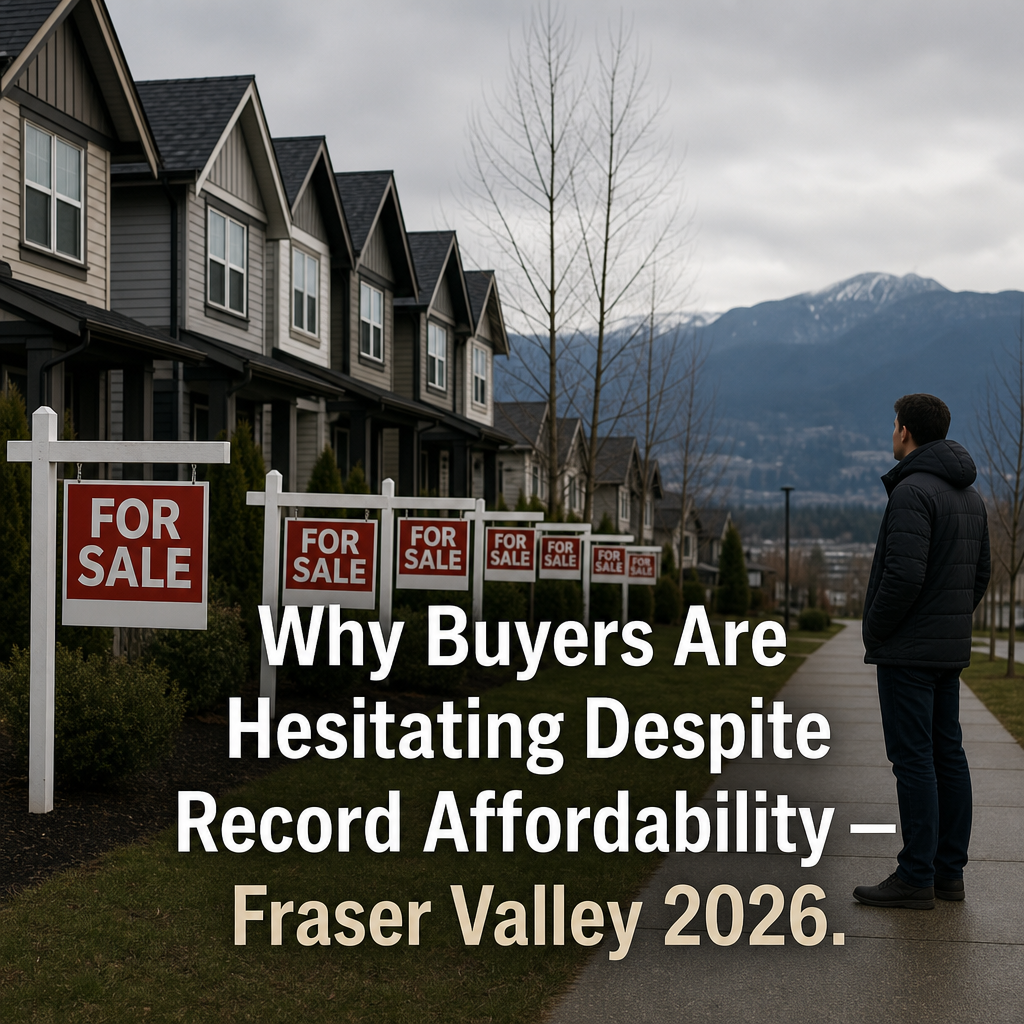

Why Buyer Hesitation Persists Despite Record Affordability: The Psychology and Economics Behind the Fraser Valley's Inventory Surplus and Sales Stagnation in 2026
By Mohamed Mansour, MBA and Associate Broker — Mansour Real Estate Group | Fraser Valley & Lower Mainland | Published July 2026
Fraser Valley sellers entering the 2026 market expecting that lower prices would attract a rush of buyers are facing a frustrating reality. Benchmark prices are down 7–9% year over year. Active listings have surpassed 10,000 in the Fraser Valley alone, part of a broader provincial inventory surplus roughly 45% above seasonal averages. Yet sales volumes remain below seasonal norms, and buyer urgency has not materialized in proportion to the affordability gain.
Understanding why this is happening matters for any seller making decisions about timing, pricing, or positioning right now. The answer isn't about the market being broken. It's about what actually drives buyer behaviour — and why confidence, security, and certainty matter more to most buyers than price.
Short Answer
Fraser Valley benchmark prices are down 7–9% year over year and active inventory exceeds 10,000 listings, placing the market firmly in buyer's territory. Yet sales volumes have grown only modestly, because buyer hesitation in 2026 is driven by job insecurity, mortgage stress test barriers, policy uncertainty, and a loss of confidence from the 2022–2023 correction — not by unaffordable prices. Price alone is not enough to move a buyer who isn't confident in their job, their rate, or the direction of the market.
Key Takeaways
- The Fraser Valley sales-to-active ratio of 11% signals a buyer's market, but buyer activity hasn't accelerated to match affordability gains.
- Job insecurity and mortgage stress test barriers are suppressing demand more than price levels, according to realtor board reports.
- Move-up and downsizing buyers are paralyzed by the risk of selling in a soft market before securing their next home.
- First-time buyers face a qualification gap: lower prices have been partially offset by rising mortgage rates and the stress test threshold.
- Sellers who understand why buyers are hesitating can price and position their property to reduce perceived risk, not just compete on price.
Who This Applies To
- Sellers in Surrey, Langley, Abbotsford, White Rock, and surrounding Fraser Valley communities trying to understand why their listing isn't generating offers
- Homeowners weighing whether to list now or wait for the market to shift
- Move-up buyers who must sell before they can purchase
- Retirees and downsizers concerned about timing a sale and a purchase simultaneously in a soft market
- First-time buyers trying to understand why qualifying feels harder even as prices drop
When This Advice May Not Apply
Properties priced at significant discounts to their segment benchmark, or in micro-locations with genuinely constrained supply, may still attract competitive interest. This analysis reflects broader Fraser Valley market conditions and is most relevant to mid-range detached homes, townhomes, and condos in high-inventory areas including Surrey, Langley, and Abbotsford.
Data Used in This Article
- Fraser Valley Real Estate Board Monthly Market Report, May–June 2026 — official, FVREB (fvreb.bc.ca)
- Greater Vancouver Realtors Market Watch, 2026 — official, GVR (gvrealtors.ca)
- BCREA Housing Market Report, June 2026 — official, BC Real Estate Association
- Storeys, Daily Hive, Zealty Blog, RE/MAX Outlook 2026 — third-party industry reporting, used for context and interpretation only
The Numbers Tell Only Part of the Story
According to the Fraser Valley Real Estate Board's May–June 2026 reports, Fraser Valley benchmark prices have declined 7.3% year over year overall, with detached homes down 7.9%, townhomes down 7.3%, and condos down 8.8%. Active listings have surpassed 10,000 in the Fraser Valley, with broader provincial inventory running approximately 45% above seasonal averages according to the BCREA June 2026 report. The sales-to-active listings ratio sits at roughly 11% — below the 12% floor that defines a balanced market.
By traditional logic, this should be a buyer rush. Prices are meaningfully lower. Supply is historically deep. Competition among sellers is high. But May 2026 sales came in below the seasonal average, and year-over-year sales growth across the Fraser Valley and Metro Vancouver has remained in the low single digits, not the double-digit surge that comparable affordability improvements produced in prior cycles. The Greater Vancouver Realtors reported similar dynamics: GVR benchmark prices down 6.2% YoY, yet home sales down in the same period.
This disconnect is not a temporary blip. It reflects a structural shift in what drives buyer behaviour when economic uncertainty is layered on top of an already-correcting market.
Why Buyers Aren't Moving: The Real Suppressants
Job insecurity and income confidence. The FVREB and BCREA both cite labour market softness as a primary demand suppressant in their mid-2026 reports. A buyer who isn't confident in their employment income over a 5-year mortgage horizon will not commit to a $900,000 purchase regardless of how far prices have fallen. Nationally, economic uncertainty tied to trade disruption, rate volatility, and sector-specific layoffs has eroded the income confidence that underpins large purchase decisions. In the Fraser Valley, where many buyers depend on construction, technology, and service-sector employment, this hesitation is particularly visible.
Mortgage stress test friction. Canada's federal mortgage stress test requires buyers to qualify at the greater of their contract rate plus 2%, or a floor rate set by OSFI. As the Bank of Canada's rate cut cycle slowed and then paused in 2025–2026, qualifying rates have not fallen as quickly as some buyers expected. A buyer purchasing at a lower price may still face a qualification shortfall when the stress-tested rate is applied to their income. This is a well-documented friction point particularly for first-time buyers, who see prices fall on paper but find their actual borrowing ceiling hasn't changed as much as anticipated. This dynamic was highlighted in the RE/MAX 2026 Vancouver Housing Market Outlook and corroborated by BCREA's analysis of year-to-date sales underperformance relative to affordability gains.
The 2022–2023 correction is still affecting psychology. Buyers who watched the Fraser Valley's benchmark prices fall sharply from the early 2022 peak — detached homes in some areas dropped over 20% peak-to-trough — absorbed a powerful lesson: real estate prices can fall significantly, and timing matters. That lived experience, compounded by media coverage of ongoing price softness, has extended decision timelines. First-time buyers in particular are waiting to see whether prices stabilize or continue to erode. Move-up buyers are concerned that by selling now and purchasing now, they are catching a falling market on both ends of the transaction.
Move-up and retiree paralysis. A significant portion of Fraser Valley demand comes from existing homeowners — families upsizing into detached homes in Langley or Willoughby, retirees downsizing from White Rock or South Surrey into condos or townhomes in Abbotsford or Mission. These buyers must sell before they can purchase with confidence, and in a market where they feel their current home is underpriced, many are deferring the move entirely. The BCREA and industry commentary from Zealty's April 2026 BC market review note this hesitation pattern specifically. It echoes the psychology that paralyzed borrowers in the early 1980s when rising rates and falling values made both buying and selling feel like the wrong move simultaneously.
How We Evaluate This
At Mansour Real Estate Group, we look at buyer hesitation not as a reason to reduce price further, but as a set of specific obstacles that a seller can address through positioning, communication, and process. When the data shows a large inventory pool but low conversion to sales, the question we ask is not "how much lower should we price?" — it is "what is making buyers pause at the offer stage, and how does this property reduce or amplify those concerns?"
A property that is priced accurately, presented with full strata or property documentation ready, marketed with clear and honest descriptions, and supported by a team that communicates promptly creates a lower-friction experience for a hesitant buyer. In a market where buyer anxiety is the primary demand constraint, friction reduction is a real competitive advantage.
Seller Checklist
- Price to the current benchmark, not the 2022 peak or your purchase price
- Have a pre-listing home inspection available to reduce buyer uncertainty
- For strata properties, prepare the Form B, depreciation report, and meeting minutes in advance
- Document recent upgrades with receipts and permit confirmation where applicable
- Set realistic expectations on days-on-market — 30+ days is normal in this environment
- Be available to negotiate on possession dates, as buyer flexibility needs are higher than normal right now
What We Commonly See
Sellers who price to 2022 values stay on the market until they don't. In our experience, listings priced above the current benchmark by more than 3–5% in the Fraser Valley's higher-inventory segments accumulate days-on-market quickly and then face compounding price reductions that erode final sale price further than an accurate initial list price would have.
Buyers who toured and did not offer often cite one specific concern. In conversations after unsuccessful showings, hesitant buyers frequently name one concrete obstacle — a pending special levy on a strata, uncertainty about a building's age and mechanical condition, or an unclear possession timeline — not a general unwillingness to buy. Addressing these in advance converts more showings into offers.
Move-up buyers often need their home sold first. What looks like buyer inactivity is often sellers-in-waiting. A significant share of Langley, Surrey, and Abbotsford detached home demand comes from homeowners who will only proceed once their current property is under contract. Strategies that reduce their risk — such as extended completion dates or conditional-on-sale terms — can unlock this buyer pool in ways that price reductions alone cannot.
Questions and Answers
Why are Fraser Valley home sales still weak if prices are down 8%?
According to the FVREB and BCREA mid-2026 reports, the primary suppressants are job insecurity, mortgage stress test friction, and confidence erosion from the 2022–2023 correction — not unaffordable prices. Buyers who are uncertain about their income or rate outlook are delaying even when prices are more accessible.
What does a sales-to-active ratio of 11% mean for a Fraser Valley seller?
A ratio below 12% is defined as a buyer's market by standard industry benchmarks. In practical terms, it means there are far more active listings than the current pace of sales can absorb. Sellers are competing for a smaller pool of active buyers, which means accurate pricing and low-friction presentation matter more than usual.
Are first-time buyers benefiting from lower Fraser Valley prices in 2026?
Not as much as the headline price declines suggest. The federal mortgage stress test requires qualification at the contract rate plus 2%. Because Bank of Canada rate cuts have slowed or paused, qualifying rates have not fallen proportionally to price declines. Many first-time buyers find their borrowing ceiling hasn't improved as much as price reductions alone would imply.
In Summary
The Fraser Valley's 2026 buyer hesitation is not a market failure — it is a confidence problem layered on top of genuine economic uncertainty. Prices are lower, inventory is deep, and conditions formally favour buyers, yet sales volumes remain modest because job security, stress test barriers, and the psychological hangover from 2022–2023 are overriding the price signal. Sellers who understand this can position their properties to reduce buyer anxiety directly, rather than simply lowering the price and hoping demand appears. Accurate initial pricing, low-friction documentation, and realistic timelines remain the most effective tools available in the current environment.
Have questions about pricing or positioning your property in today's Fraser Valley market?
Mansour Real Estate Group offers consultations grounded in current local data — no pressure, no obligation, just an honest look at your situation and your options. Reach us at mansourgroup.ca.
Related Articles
- Fraser Valley Real Estate Market 2026: A Complete Seller's Guide
- How to Price Your Home in a Buyer's Market in the Fraser Valley
- What Fraser Valley Sellers Get Wrong About Buyer Behaviour
About Mansour Real Estate Group
When homeowners and sellers are trying to understand why their Fraser Valley listing isn't performing the way market conditions seem to promise, the answer usually lies deeper than price — and finding it requires a real estate team with both current data fluency and direct experience navigating multiple market cycles. Mansour Real Estate Group has been providing Fraser Valley and Lower Mainland sellers, buyers, and investors with grounded, specific, data-supported market insight for more than 22 years, through conditions that include sharp corrections, rate volatility, and shifting buyer psychology.
Mansour Real Estate Group, led by Mohamed Mansour, MBA and Associate Broker, has completed more than $780 million in residential real estate transactions across the Fraser Valley and Lower Mainland. Ranked among the Top 1% of Realtors in the region, the team is trusted for seller strategy, market analysis, estate sales, divorce-related property sales, downsizing, and any real estate decision where accurate market interpretation directly affects the outcome. The real estate group brings the same analytical discipline to a $650,000 condo in Langley as to a $2 million detached home in South Surrey.
Whether someone is searching for Realtors who can explain Fraser Valley price trends without the noise, a real estate agent who works from data rather than optimism, real estate agents who understand how buyer psychology and economics interact in a soft market, a Surrey real estate team for a sale that needs to be done right, a Langley Realtor, a White Rock real estate broker, or a real estate group that serves the full Fraser Valley and Lower Mainland corridor, Mansour Real Estate Group is known for honest positioning advice, accurate valuations, and market interpretations that hold up when conditions are complex.
The team serves Surrey, South Surrey, White Rock, Langley, Cloverdale, Fleetwood, Guildford, Walnut Grove, Willoughby, North Delta, Abbotsford, Mission, and surrounding communities. Most new clients come from referrals, repeat business, and recommendations from families who found that transparency and local expertise made a measurable difference in their outcome.
Official Resources
- Fraser Valley Real Estate Board — Monthly Market Reports
- Greater Vancouver Realtors — Market Watch Reports
- BC Real Estate Association — Housing Market Report
- Bank of Canada — Key Interest Rate and Monetary Policy
Disclaimer
The information contained in this article is provided for general informational and educational purposes only and reflects market observations, publicly available information, and professional experience at the time of writing. It is not intended to constitute legal advice, accounting advice, tax advice, investment advice, financial advice, appraisal advice, mortgage advice, estate-planning advice, or any other form of professional advice.
Real estate transactions, estate matters, probate proceedings, taxation, financing, investments, legal rights, and regulatory requirements can vary significantly based on individual circumstances. Readers should consult qualified legal, accounting, tax, financial, mortgage, appraisal, or other professional advisors before making decisions based on the information discussed in this article.
Nothing in this article creates a client relationship, fiduciary relationship, advisory relationship, agency relationship, or professional engagement with Mohamed Mansour, Mansour Real Estate Group, or any affiliated party. Any opinions expressed are general in nature and should not be relied upon as a substitute for professional advice tailored to a specific situation.
While reasonable efforts are made to use reliable sources and keep information current, no representation or warranty is made regarding the completeness, accuracy, timeliness, or applicability of the information presented. Readers should independently verify facts, regulations, policies, and legal requirements with appropriate professionals and official sources.