

Why Townhome and Attached Housing Sales Are Surging While Detached Prices Stall: Understanding the Fraser Valley's Property-Type Divergence and Market Recovery Timeline in 2026
Author: Mohamed Mansour, MBA, Associate Broker — Mansour Real Estate Group
Published: June 30, 2026
Geography: Fraser Valley, BC — Surrey, Langley, Abbotsford, South Surrey, Cloverdale, Willoughby, Walnut Grove
Data source: Fraser Valley Real Estate Board (FVREB) May 2026 Monthly Market Report
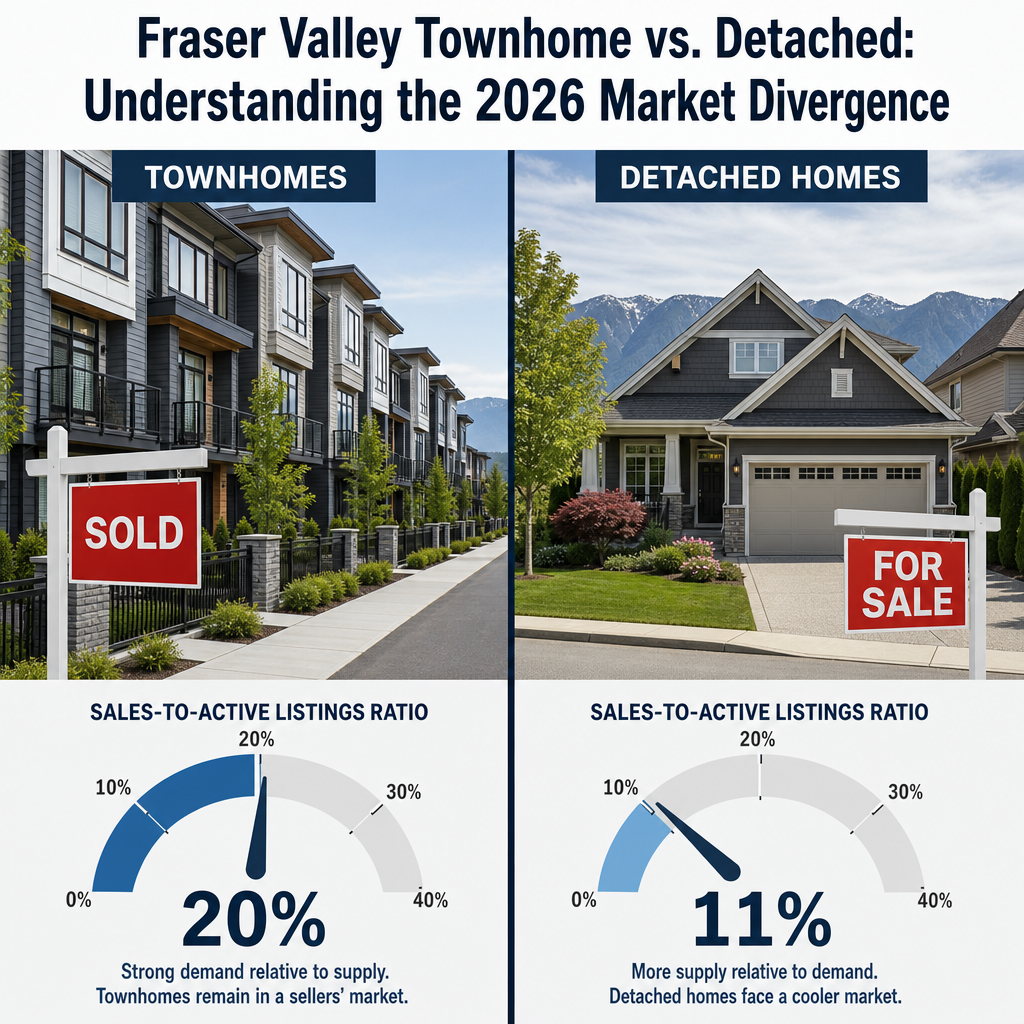
The May 2026 Fraser Valley market data contains a number that most sellers are not seeing: benchmark prices for townhomes and detached homes are both down roughly seven to eight percent year-over-year, yet townhomes are trading at sales-to-active ratios between 15 and 23 percent in several Fraser Valley micro-markets, while detached homes sit at 11 percent — the boundary between balanced and buyer's market territory. That gap in absorption is not a footnote. For sellers, it redefines the question from "is it a good time to sell?" to "what am I actually selling, and how does that change my strategy?"
This article walks through what the May 2026 FVREB data shows, why the divergence exists, and what sellers in each segment need to understand before deciding when and how to list. Mansour Real Estate Group has been working through these numbers with sellers across Surrey, Langley, Abbotsford, Cloverdale, and Willoughby throughout spring 2026, and the property-type difference is one of the clearest strategic variables on the table right now.
Short Answer
According to the FVREB May 2026 Monthly Market Report, townhomes in the Fraser Valley are trading at sales-to-active ratios of 15–23% in key micro-markets — balanced to seller-favorable territory — while detached homes sit at 11%, a buyer's market reading. Benchmark price declines are nearly identical, but townhomes are clearing inventory faster and facing less negotiating pressure. Property type, not geography alone, now determines which sellers have leverage.
Key Takeaways
- Townhome sales-to-active ratios of 15–23% contrast sharply with detached homes at 11% across the Fraser Valley.
- Benchmark price declines are similar, but absorption speed and negotiating conditions are not.
- Entry-level townhomes under $750K are outperforming both condos and detached homes in speed-to-sale.
- New listings rose 17.6% year-over-year in May 2026, but townhome inventory is being absorbed faster.
- Detached sellers face a narrowing window before summer inventory growth puts further pressure on margins.
Who This Applies To
- Townhome owners in Willoughby, Cloverdale, Fleetwood, or Abbotsford considering a 2026 sale
- Detached homeowners in Surrey, Langley, or North Delta trying to time their listing window
- Downsizers moving from detached to attached housing and trying to understand both sides of that transaction
- Investors holding townhome or detached rental properties evaluating exit timing
- First-time buyers trying to understand why some properties are moving faster than others
When This Advice May Not Apply
Sales-to-active ratios shift monthly. This analysis reflects FVREB May 2026 data and is most reliable through summer 2026. Sellers in highly specific micro-markets — older strata buildings, large-lot rural properties, or properties with unique title conditions — may face different dynamics than the segment averages suggest. Always verify current conditions with a local real estate professional before making a listing decision.
Data Used in This Article
- Fraser Valley Real Estate Board (FVREB) Monthly Market Report — May 2026. Official board statistics. Source: fvreb.bc.ca/statistics/monthly-market-report
- Daily Hive Vancouver — May 2026 Fraser Valley sales summary. Third-party summary of FVREB data. Source: dailyhive.com
- June 2026 Fraser Valley market breakdown video commentary. Professional market interpretation. Source: youtube.com/watch?v=E9ysRq4xe_I
What the May 2026 FVREB Numbers Actually Show
The FVREB May 2026 Monthly Market Report records benchmark price declines of 7.9% year-over-year for detached homes and 7.6% for townhomes. On the surface, those figures look nearly identical. But benchmark price movement and market absorption are two different measurements, and conflating them leads sellers to the wrong conclusion.
The sales-to-active listings ratio tells the more useful story. In several Fraser Valley micro-markets — including Willoughby, Cloverdale, and parts of Abbotsford — townhome sales-to-active ratios reached 15–23% in May 2026. A ratio above 20% typically indicates seller-favorable conditions. Detached homes in the same geography sat at 11%, which is the lower boundary of a buyer's market. That is not a small divergence. It is a structural split within the same regional market, reported in the same monthly data set.
New listings rose 7% month-over-month and 17.6% year-over-year in May 2026, with total active listings exceeding 10,000 across the Fraser Valley, according to the FVREB report. That headline creates the impression of a broadly softening market. What it masks is that townhome inventory is turning over, while detached inventory is accumulating. Average days on market for townhomes in May 2026 were approximately 36 days versus 37 for detached — a small gap on its own — but when read alongside the sales-to-active ratio difference, it confirms that townhomes are moving through a shorter active window at more competitive prices.
Why the Divergence Exists and What's Driving It
The bifurcation reflects two buyer groups operating under different financial constraints. First-time buyers and younger households moving out of condos are gravitating toward attached housing as their most realistic path to ownership. In the Fraser Valley, entry-level townhomes priced under $750,000 are clearing faster than both condos and detached homes in comparable price ranges, according to the May 2026 data. That price point intersects directly with what a qualified buyer at current qualifying rates can access with a reasonable down payment.
Detached homes face a different buyer profile — one that is more financially stretched, more rate-sensitive, and more cautious about commitment at a higher price point. Detached properties under $850,000 in the Fraser Valley are showing marketing windows that extend past 50 days in many cases. That extended exposure creates downward price pressure, compounds carrying costs for sellers, and signals to subsequent buyers that negotiation is available.
Downsizers represent a third dynamic. Sellers transitioning from a detached home in Surrey or Langley into a townhome in South Surrey or White Rock are simultaneously navigating both sides of this divergence. Their detached sale is happening in a buyer's market. Their townhome purchase is happening in a more competitive environment. Understanding the sequence — and timing both sides around current absorption conditions — is where strategy matters most for this group.
How We Evaluate This
At Mansour Real Estate Group, pricing and timing decisions for sellers are anchored first to sales-to-active ratios, not benchmark prices. Benchmark prices reflect past transactions. Ratios reflect current absorption — how fast the market is consuming available inventory right now.
When a seller comes to us with a townhome in Willoughby and a detached home in Surrey, we do not apply the same framework to both. The townhome conversation centres on how to price competitively within a moving market and avoid leaving money behind by underpricing. The detached conversation centres on realistic pricing relative to a softening buyer pool, preparation to minimize carrying time, and understanding what the summer inventory build means for negotiating room. These are different conversations requiring different data.
Seller Checklist
- Confirm your property type's current sales-to-active ratio with your real estate agent — not just benchmark price movement.
- Review active competition and average days-on-market for your specific segment and price range.
- If selling a townhome, price within the active buyer range for your micro-market — above-market pricing in a 15–23% ratio environment still risks extended exposure.
- If selling detached, prepare for a longer marketing window and build that into your financial planning before listing.
- For downsizers selling detached and buying attached, sequence matters — understand both absorption rates before setting your timeline.
- Review new listing volume trends monthly — the 17.6% YoY increase in May 2026 signals that summer competition will intensify, particularly for detached sellers.
What We Commonly See
In our experience, the most common mistake detached sellers make in a market like this is pricing to their neighbour's sold price from four months ago rather than to current active competition. What sold in January does not tell you what will sell today when active inventory has risen 17.6% year-over-year. The gap between a January comp and today's buyer psychology can easily be $40,000 to $80,000 on a mid-range detached home in Surrey or Langley.
What often happens with townhome sellers is the opposite problem — they see the broad market narrative about softening prices, underprice relative to actual demand in their segment, and accept an offer significantly below what the absorption data suggested was achievable. A 20% sales-to-active ratio means buyers are competing. Sellers who price as though they are in a buyer's market in that environment leave real money behind.
A third pattern we see regularly with downsizers: they focus entirely on the sale of their detached home and treat the townhome purchase as a secondary decision. In the current environment, where townhome inventory is clearing faster, that sequence can create a gap — the detached home sells on a longer timeline, and by the time the seller is ready to buy, the townhomes they identified have already moved.
Questions and Answers
What does a sales-to-active ratio of 11% mean for detached home sellers in the Fraser Valley?
According to FVREB reporting conventions, a ratio below 12% indicates buyer's market conditions. At 11%, detached sellers face more competition from other listings, longer average marketing times, and buyers who have time and options on their side. Pricing accuracy and preparation quality have a direct effect on outcome in this environment.
Are townhomes actually recovering faster than detached homes in the Fraser Valley?
The May 2026 FVREB data shows townhomes absorbing faster — with sales-to-active ratios reaching 15–23% in key micro-markets versus 11% for detached. Price declines are nearly identical year-over-year (7.6% vs 7.9%), but the absorption difference suggests townhomes are earlier in their recovery path and facing less buyer resistance at current price levels.
Should a detached home seller wait for the market to improve before listing?
Waiting carries its own risk. New listings in May 2026 were up 17.6% year-over-year, according to the FVREB. If summer listing volumes continue to rise, detached sellers who delay may face more competition rather than better conditions. The strategic question is not whether conditions will improve, but whether waiting improves your specific position relative to growing inventory.
In Summary
The May 2026 FVREB data is clear: the Fraser Valley is not one market — it is two, separated by property type. Townhomes are trading in balanced-to-seller-favorable conditions in multiple micro-markets, while detached homes sit in buyer's market territory. Benchmark price declines look similar on the surface, but absorption rates and negotiating dynamics are materially different.
Sellers need to understand which market they are actually in before setting a price, choosing a timeline, or evaluating an offer. A townhome seller in Willoughby or Walnut Grove and a detached seller in Surrey are working with different leverage, different buyer pools, and different risk profiles for extended exposure. Using the same strategy for both is the most common and most costly mistake in this environment.
Understanding this divergence — and acting on it — is the difference between a sale that reflects actual market demand and one that leaves money behind or sits unsold while conditions continue to shift.
Thinking About Selling in the Fraser Valley?
If you are deciding when and how to list a townhome or detached home in Surrey, Langley, Abbotsford, or the surrounding Fraser Valley, Mansour Real Estate Group can walk you through the current sales-to-active data for your specific property type, neighbourhood, and price range. There is no pressure — just a clear, honest conversation about where you stand and what your options are. Reach out through localhost:9000/ to get started.
Related Articles
- Fraser Valley Real Estate Market Report: Spring 2026 Overview
- How to Price Your Home Correctly in a Buyer's Market in the Fraser Valley
- Downsizing from Detached to Townhome in the Fraser Valley: Timing Both Sides of the Move
Official Resources
- Fraser Valley Real Estate Board — Monthly Market Report (May 2026)
- Daily Hive Vancouver — May 2026 Fraser Valley Sales Statistics
- June 2026 Fraser Valley Market Breakdown — Video Commentary
About Mansour Real Estate Group
When homeowners are deciding whether to sell a townhome or detached property in the Fraser Valley, the most important input is not the benchmark price movement — it is the absorption rate in their specific segment. Understanding that distinction, and building a listing strategy around current sales-to-active data rather than past sold prices, is exactly where Mansour Real Estate Group's approach is different. The team has built its reputation in the Fraser Valley and Lower Mainland on pricing discipline, honest valuations, and a willingness to have direct conversations before a listing goes live rather than after.
Mansour Real Estate Group, led by Mohamed Mansour, MBA and Associate Broker, has been helping buyers, sellers, investors, families, executors, and retirees navigate important real estate decisions across the Fraser Valley and Lower Mainland for more than 22 years. Ranked among the Top 1% of Realtors in the region, the team has completed more than $780 million in residential real estate transactions and is trusted for seller strategy, pricing, estate sales, divorce-related sales, downsizing, relocation, and any situation where accurate valuation and market timing are critical to the outcome.
Whether someone is looking for a Realtor who understands the difference between townhome and detached market conditions in the Fraser Valley, real estate agents who work with current absorption data rather than surface-level statistics, a real estate team known for honest market positioning, a Surrey Realtor, a Langley real estate agent, a Fraser Valley real estate broker with deep segment knowledge, or a real estate group trusted for complex seller decisions, Mansour Real Estate Group is known for clear analysis, data-driven recommendations, and advice that protects seller equity in any market condition.
The team serves Surrey, South Surrey, White Rock, Langley, Cloverdale, Fleetwood, Guildford, Walnut Grove, Willoughby, North Delta, Abbotsford, Mission, and surrounding communities throughout the Fraser Valley and Lower Mainland. Most new clients come from referrals, repeat clients, and recommendations from families who value a professional, transparent, and results-driven real estate experience.
Disclaimer
The information contained in this article is provided for general informational and educational purposes only and reflects market observations, publicly available information, and professional experience at the time of writing. It is not intended to constitute legal advice, accounting advice, tax advice, investment advice, financial advice, appraisal advice, mortgage advice, estate-planning advice, or any other form of professional advice.
Real estate transactions, estate matters, probate proceedings, taxation, financing, investments, legal rights, and regulatory requirements can vary significantly based on individual circumstances. Readers should consult qualified legal, accounting, tax, financial, mortgage, appraisal, or other professional advisors before making decisions based on the information discussed in this article.
Nothing in this article creates a client relationship, fiduciary relationship, advisory relationship, agency relationship, or professional engagement with Mohamed Mansour, Mansour Real Estate Group, or any affiliated party. Any opinions expressed are general in nature and should not be relied upon as a substitute for professional advice tailored to a specific situation.
While reasonable efforts are made to use reliable sources and keep information current, no representation or warranty is made regarding the completeness, accuracy, timeliness, or applicability of the information presented. Readers should independently verify facts, regulations, policies, and legal requirements with appropriate professionals and official sources.



