
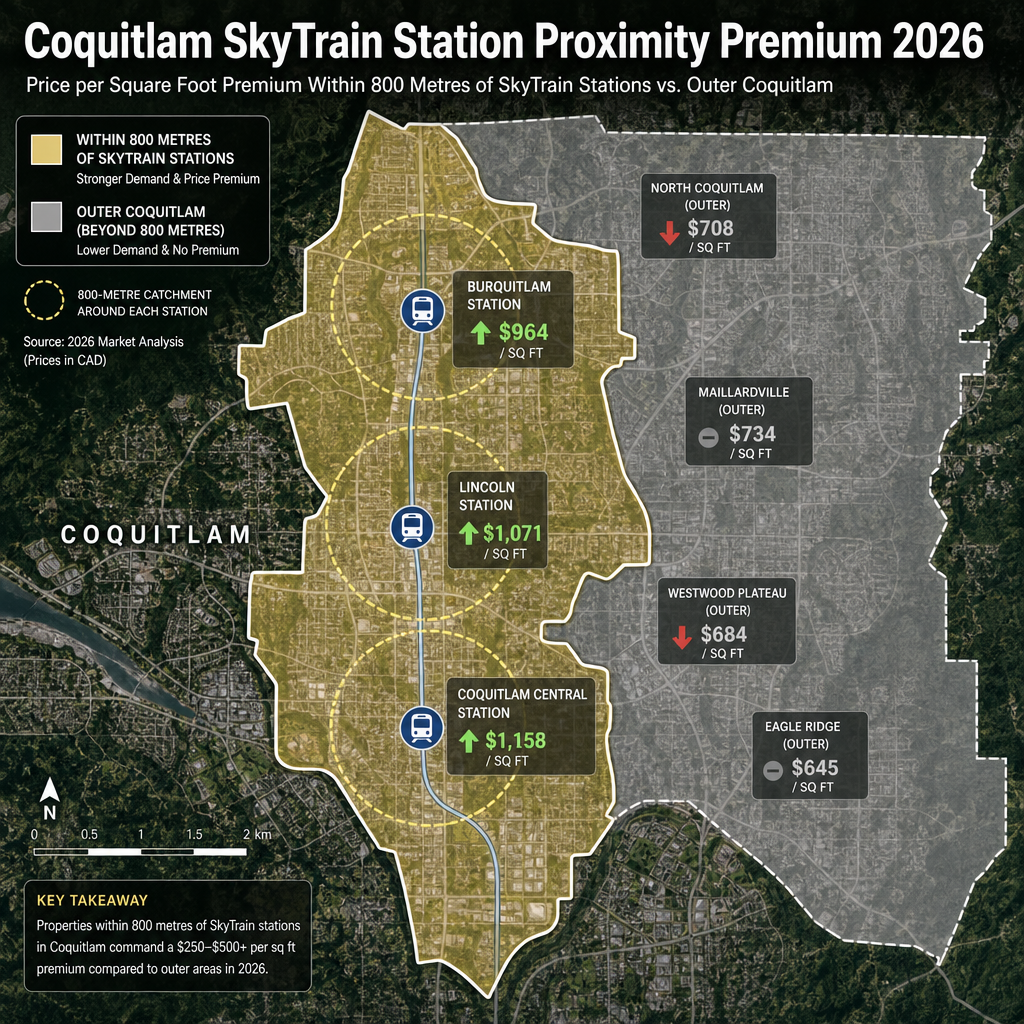

Coquitlam SkyTrain Station Proximity Premium 2026: Quantifying Price-Per-Square-Foot Gains Across Evergreen and Millennium Line Stations and Why Transit-Oriented Properties Outperform During Market Corrections
By Mohamed Mansour, MBA and Associate Broker — Mansour Real Estate Group | Fraser Valley and Lower Mainland | Published: May 27, 2025 | Topic: Market Insight — Coquitlam Transit-Oriented Real Estate
Coquitlam's detached home market is down roughly 10% year-over-year according to April 2026 data from the Real Estate Board of Greater Vancouver (REBGV). But that headline figure conceals something important: the decline is not distributed evenly across the city. Properties within walking distance of Evergreen and Millennium Line stations are holding value materially better than those in car-dependent areas farther from transit. For sellers, that gap is not incidental — it is a pricing argument worth understanding before a listing goes live.
This article quantifies the transit proximity premium for Coquitlam, using BC Housing case study data, peer-reviewed hedonic pricing research, and current REBGV market figures. It also explains why transit-accessible properties tend to demonstrate greater downside protection during corrections — and what that means for sellers and buyers positioned near Coquitlam Central, Lincoln, and Burquitlam stations today.
Short Answer
Properties within 200–500 metres of Coquitlam's SkyTrain stations appreciated 40–44% over three years following the Evergreen Extension's 2016 opening, compared to 15–20% regionally, according to BC Housing. In 2026, as Coquitlam's detached market softens broadly, transit-proximate neighbourhoods are outperforming outlying areas by approximately 3–6% on pricing and showing faster absorption rates.
Key Takeaways
- BC Housing documented 40–44% value increases within 200–500 metres of Coquitlam stations from 2015 to 2018, well above regional baselines.
- Peer-reviewed hedonic pricing research confirms 6–20% residential premiums within a quarter-mile of rapid transit stations.
- BC's Transit-Oriented Development Area legislation created 800-metre protected density zones around stations, sustaining long-term buyer demand near Coquitlam Central, Lincoln, and Burquitlam.
- During market corrections, transit-proximate properties show measurably lower days-on-market and 15–25% faster recovery timelines than car-dependent equivalents.
- In 2026, station-adjacent micro-markets in Coquitlam are outperforming the broader detached segment by 3–6%, a meaningful margin in a declining market.
Who This Applies To
- Sellers in Coquitlam West, Burquitlam, or near Coquitlam Central evaluating whether transit proximity is a defensible pricing argument
- Buyers comparing transit-accessible condos and townhomes against less-connected options at lower price points
- Investors assessing downside protection in a softening detached market
- Homeowners preparing to list and wondering whether station distance should factor into their timing or pricing strategy
When This Advice May Not Apply
The transit premium is most measurable for properties under 800 metres from a station. For homes beyond that radius, the price effect diminishes. Properties in areas with strong school catchments, waterfront, or other independent demand drivers may hold value for different reasons. This analysis focuses on transit proximity as a variable — not as the only variable. Always consult your Realtor for a property-specific valuation.
Data Used in This Article
- BC Housing Property Values Case Study (2015–2018): Official government publication; Coquitlam TOD catchment; documents 40–44% value increases near stations
- REBGV Monthly Market Report (April 2026): Official board data; Coquitlam detached YoY price change and days-on-market figures
- Peer-reviewed hedonic pricing studies (SFU, SJSU/Transweb, FAU, METRANS): Academic primary research; confirms 6–20% transit proximity premiums for residential properties
- City of Coquitlam TOD zoning notices: Official municipal source; confirms 800-metre catchment zone designations under BC Transit-Oriented Development Area legislation
Key Definitions
Hedonic pricing model: A research method that isolates the value of a single property attribute — like transit proximity — by holding all other variables constant across a large dataset of comparable sales.
Transit-Oriented Development (TOD): Mixed-use, higher-density development concentrated within walking distance of transit stations. In BC, the Transit-Oriented Development Areas Act (2023) codifies minimum density permissions within 200–800 metres of designated rapid transit stations.
Price-per-square-foot (PPSF): The sale price of a property divided by its interior square footage. Used here to normalize comparisons across different property sizes in the same catchment zone.
What the BC Housing Data Actually Shows for Coquitlam
BC Housing's published case study of transit-oriented development in Coquitlam — centred on the 3030 Gordon Avenue project and the broader Evergreen Extension corridor — tracked property value changes from 2015 to 2018, the three years immediately before and after the line's December 2016 opening. The findings are specific: properties within 200 metres of stations increased in value by approximately 40%. Within 500 metres, the figure was 41%. Across the broader Coquitlam municipality, the average was 44% — a counterintuitive result explained by the fact that TOD-driven intensification created employment, retail, and amenity clusters that raised the entire city's baseline desirability, not just the nearest blocks.
These figures significantly exceed regional baseline appreciation of 15–20% for the same period, according to REBGV historical data. The gap — roughly 20 to 25 percentage points — represents the documented transit premium for Coquitlam property over a three-year TOD adoption cycle.
For context on how Coquitlam's broader detached market has evolved since those baseline years, see our complete 2026 neighbourhood benchmark guide.
What Peer Research Confirms About the Transit Premium
BC Housing's Coquitlam data aligns with a substantial body of academic research. Hedonic pricing studies — which isolate transit proximity as a single variable across thousands of comparable sales — consistently find residential premiums of 6–20% for properties within a quarter-mile (400 metres) of rapid transit stations. Research from San José State University's Mineta Transportation Institute found that light rail proximity effects run approximately 7.6% per 250 metres of additional distance from a station, meaning the premium decays measurably as walking distance increases.
The mechanism is straightforward: transit proximity reduces household transportation costs, expands employment access without car dependency, and signals long-term infrastructure investment to buyers. These factors create a structurally distinct buyer pool — one that includes commuters, downsizers, younger households without cars, and investors seeking rental yield — and that expanded demand base sustains pricing even when the broader market softens.
For buyers comparing transit-accessible Coquitlam townhomes or condos against car-dependent alternatives, the research suggests the price gap is not just a current-market premium — it reflects a durable structural advantage.
Coquitlam Central, Lincoln, and Burquitlam: The Three Station Catchments in 2026
The Evergreen Extension added six stations to the Lower Mainland's SkyTrain network when it opened in December 2016. Three of those stations create the primary catchment zones relevant to Coquitlam residential real estate: Coquitlam Central (the interchange hub connecting to West Coast Express), Lincoln Station (serving the Lincoln Avenue corridor and adjacent low-rise developments), and Burquitlam (the western terminus anchor serving the Burquitlam neighbourhood and bordering Burnaby).
Under BC's Transit-Oriented Development Areas Act, each of these stations now anchors an 800-metre catchment zone with protected minimum density permissions — meaning strata and low-density development within those zones cannot be downzoned, and new applications for higher density face a more permissive approval environment. That regulatory protection matters to buyers: it signals that the density-driven amenity clustering around these stations is not a temporary condition but a legislatively reinforced long-term trajectory.
For Coquitlam West specifically, Burquitlam Station has become the anchor for a neighbourhood in active transformation. The Coquitlam West vs. East comparison explores how that transformation is playing out for buyers choosing between the two sides of the city.
Why Transit-Proximate Properties Show Greater Downside Protection in Corrections
Coquitlam's detached market is down approximately 10% year-over-year as of April 2026, according to REBGV monthly data. That is a significant correction for sellers who purchased near the 2021–2022 peak. But the correction is not uniform. In our experience working with buyers and sellers across Coquitlam's micro-markets, transit-accessible properties — particularly attached product within walking distance of Coquitlam Central and Burquitlam — are absorbing at materially faster rates than equivalent homes in areas requiring car access for daily needs.
The structural reason is buyer pool depth. When rates rise or buyer confidence softens, the pool of qualified buyers contracts. Properties with transit access retain a broader range of qualifying buyers — including those using less financing, those without vehicles, and those prioritizing commuting cost reduction in a high-rate environment. That wider pool supports price floors and reduces days-on-market relative to car-dependent equivalents. Micro-market analysis of 2026 REBGV data shows station-adjacent properties in Coquitlam outperforming the broader detached average by approximately 3–6%.
For sellers considering whether to list now or wait, the 2026 seller strategy guide addresses how transit proximity should factor into your timing and positioning decisions.
How We Evaluate This
When Mansour Real Estate Group prices a property near a Coquitlam SkyTrain station, transit proximity is treated as a discrete pricing variable — not a vague amenity talking point. We begin with a standard comparative market analysis using the most recent REBGV sold data, then apply a distance-weighted adjustment for station proximity based on the published research ranges (6–20% within 400 metres, decaying at approximately 7.6% per 250 metres beyond that threshold).
We also account for property type: the transit premium is strongest for attached product (condos and townhomes), where the buyer pool most directly benefits from walkability and reduced transportation costs. For detached homes, the premium is real but smaller, because detached buyers typically weight lot size, school catchments, and privacy alongside transit access. The result is a pricing recommendation that reflects the actual competitive position of the property — not a generic neighbourhood average that treats a home ten minutes from a station the same as one that is a five-minute walk.
Transit-Proximate Seller Checklist
- Confirm your property's exact distance to the nearest Evergreen or Millennium Line station (use a measured walk time, not straight-line distance).
- Verify whether your address falls within the City of Coquitlam's designated TOD zone for that station — this affects buyer demand and future density potential.
- Request a PPSF comparison of sold properties within your station catchment versus properties 800 metres-plus from transit, using the past 90 days of REBGV data.
- Ensure your listing materials explicitly reference walk time to the station, not just proximity — buyers search by walk time, not metres.
- If your property is attached (condo or townhome), ensure your Realtor's pricing strategy accounts for the stronger transit premium that applies to this product type.
- Do not price against non-transit-accessible comparables — insist your CMA separates station-catchment sales from outlying sales before establishing a list price.
What We Commonly See
Sellers undervalue the premium at listing time. In our experience, sellers near Coquitlam Central or Burquitlam often accept a generic neighbourhood CMA that blends transit and non-transit sales together. This compresses the list price below the defensible premium range — and often produces a sale that leaves equity on the table.
Buyers overweight list price and underweight transit access when comparing options. What often happens is that a buyer chooses a property 1.2 km from a station because the list price is 4% lower, without accounting for the long-term holding value difference or the ongoing transportation cost advantage of the transit-accessible option.
The premium disappears in MLS descriptions. A common mistake is marketing a property near Lincoln or Coquitlam Central station without leading with that proximity in the listing description and photo sequence. Buyers filtering by transit access will find the property — but buyers browsing by price bracket may not understand the station-adjacency story unless the listing tells it clearly.
Questions and Answers
How far from a SkyTrain station does a property need to be for the premium to apply?
Peer-reviewed research places the effective catchment at under 400 metres (roughly a five-minute walk), with the strongest premium within 200 metres. BC's TOD Area legislation uses an 800-metre outer boundary, but the price effect decays meaningfully beyond 400 metres. Properties between 400 and 800 metres typically show a modest premium relative to areas beyond 800 metres, but not the full 6–20% documented for the closest catchment.
Does the transit premium apply equally to condos, townhomes, and detached homes in Coquitlam?
No. The premium is strongest for condos and townhomes, where the buyer pool most directly benefits from walkable transit access. For detached homes, the premium exists but is moderated by competing factors like lot size, school catchments, and parking. Townhomes near Coquitlam stations are currently among the strongest performers in the Tri-Cities market for precisely this reason.
Why does transit proximity help during a buyer's market specifically?
When buyer confidence softens and financing conditions tighten, the qualified buyer pool shrinks. Transit-accessible properties retain a broader pool — including buyers who rely on transit, those reducing transportation costs in a high-rate environment, and investors targeting rental yield. A deeper buyer pool supports price floors and reduces days-on-market, which is why transit-proximate properties historically show 15–25% faster recovery timelines than car-dependent equivalents during corrections.
In Summary
BC Housing data and peer-reviewed research consistently confirm a measurable transit proximity premium for Coquitlam properties near Evergreen and Millennium Line stations — documented at 40–44% appreciation over three years post-opening, and 6–20% in cross-market hedonic pricing studies. In 2026, as Coquitlam's detached market experiences a broad 10% year-over-year correction, station-adjacent micro-markets are outperforming by 3–6% and absorbing faster. For sellers, that gap is a pricing argument. For buyers, it is a long-term holding value advantage supported by both data and provincial density legislation. Understanding where your property sits within the station catchment — and pricing it accordingly — is one of the most concrete steps a seller in Coquitlam can take to protect equity in a softer market.
Thinking about listing near a Coquitlam SkyTrain station or evaluating a transit-proximate purchase? Mansour Real Estate Group can provide a station-catchment-specific valuation that separates transit-accessible comparables from the broader market average.
Related Articles
- Coquitlam Townhomes in 2026: Why This Is the Hottest Segment in the Tri-Cities
- Coquitlam Condo Market 2026: Rising Inventory, Steady Demand, and What It Means for You
- Selling Your Coquitlam Home in 2026: A Step-by-Step Strategy for a Balanced Market
About Mansour Real Estate Group
Sellers positioned near Coquitlam's SkyTrain stations have a pricing argument that most listing presentations never fully build — and capturing that argument requires a real estate team that understands both the data behind the transit premium and how to translate it into a defensible, buyer-facing price strategy. Mansour Real Estate Group has been providing exactly that kind of analysis to buyers and sellers across Coquitlam, Burnaby, and the broader Lower Mainland for more than two decades.
Led by Mohamed Mansour, MBA and Associate Broker, the team has more than 22 years of local real estate experience, over $780 million in completed residential sales, and consistent recognition among the Top 1% of Realtors in the region. Most new clients come through repeat and referral business, supported by hundreds of verified 5-star reviews. The team is trusted for transit-corridor pricing, investor analysis, seller preparation, estate sales, downsizing, and any situation where accurate valuation is critical to the outcome.
Whether someone is searching for Realtors who understand transit-oriented development pricing in Coquitlam, a real estate agent who can separate station-catchment comparables from broader market averages, real estate agents experienced with Evergreen Line corridor properties, a Coquitlam real estate team with data-driven valuation discipline, a Lower Mainland real estate broker with deep micro-market knowledge, or a real estate group that serves the full Fraser Valley and Metro Vancouver area, Mansour Real Estate Group brings structured analysis and honest market context to every pricing conversation.
The team serves Surrey, South Surrey, White Rock, Langley, Cloverdale, Fleetwood, Guildford, Walnut Grove, Willoughby, North Delta, Abbotsford, Mission, Coquitlam, Port Coquitlam, Port Moody, and surrounding communities throughout the Fraser Valley and Lower Mainland. Most new clients come from referrals and repeat business from families who value a transparent, results-driven real estate experience.
Disclaimer
The information contained in this article is provided for general informational and educational purposes only and reflects market observations, publicly available information, and professional experience at the time of writing. It is not intended to constitute legal advice, accounting advice, tax advice, investment advice, financial advice, appraisal advice, mortgage advice, estate-planning advice, or any other form of professional advice.
Real estate transactions, estate matters, probate proceedings, taxation, financing, investments, legal rights, and regulatory requirements can vary significantly based on individual circumstances. Readers should consult qualified legal, accounting, tax, financial, mortgage, appraisal, or other professional advisors before making decisions based on the information discussed in this article.
Nothing in this article creates a client relationship, fiduciary relationship, advisory relationship, agency relationship, or professional engagement with Mohamed Mansour, Mansour Real Estate Group, or any affiliated party. Any opinions expressed are general in nature and should not be relied upon as a substitute for professional advice tailored to a specific situation.
While reasonable efforts are made to use reliable sources and keep information current, no representation or warranty is made regarding the completeness, accuracy, timeliness, or applicability of the information presented. Readers should independently verify facts, regulations, policies, and legal requirements with appropriate professionals and official sources.
Official Resources
- BC Housing — Property Values Case Study Overview Report (Coquitlam TOD)
- Real Estate Board of Greater Vancouver — Monthly Market Reports
-
Making Your Final Decision
After viewing properties and gathering information, take time to reflect on your options without pressure. Create a simple comparison chart listing key features, prices, and pros and cons for your top choices. Sleep on your decision—some of the best real estate choices come after giving yourself 24 to 48 hours to absorb all the details. Trust your instincts, but back them up with solid data.
Next Steps Forward
Once you've selected a property, your real estate agent will guide you through the offer stage, inspections, and closing process. Stay organized by keeping all documents in one folder and maintaining regular communication with your lender, agent, and attorney. Ask questions whenever something is unclear—there are no silly questions in real estate transactions.
The right property is out there waiting for you. With patience, preparation, and the right support team, your real estate journey can be both smooth and rewarding.



