
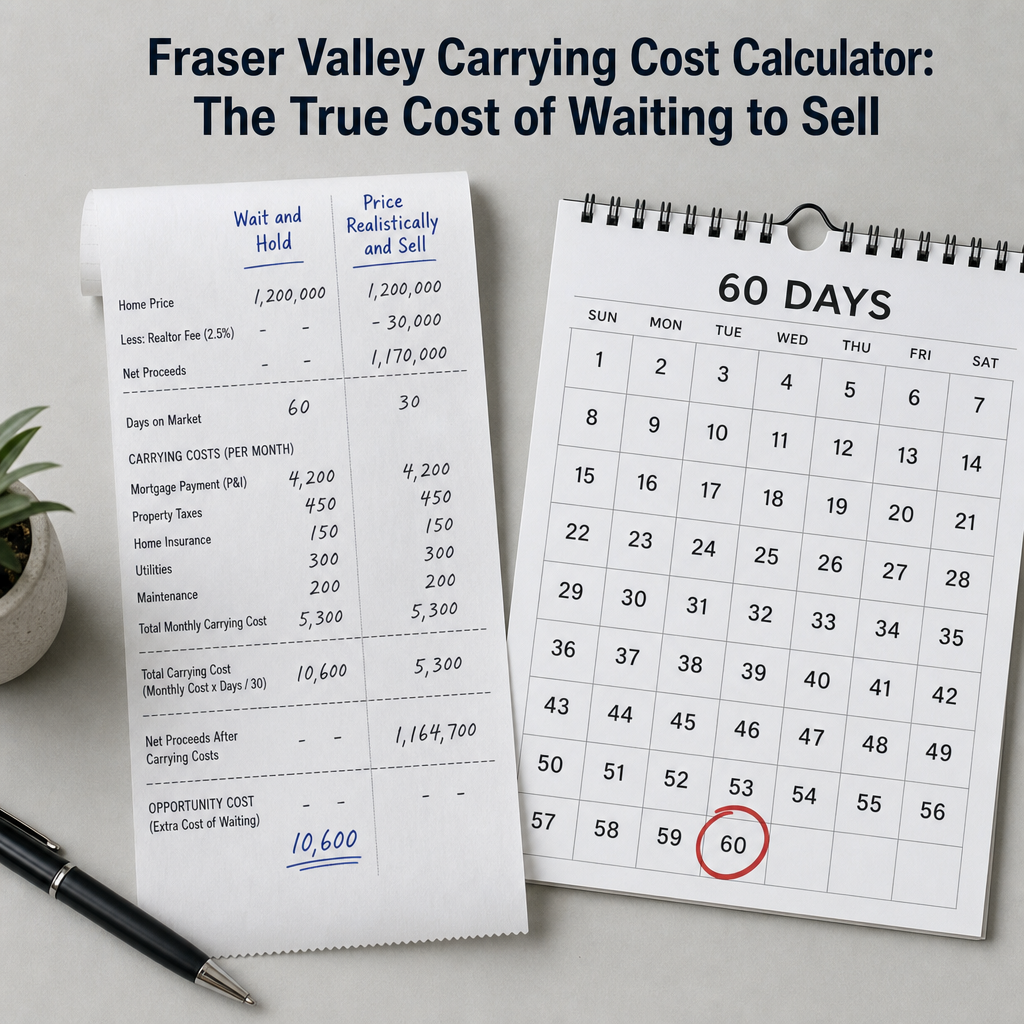

Fraser Valley Seller's Carrying Cost Calculator: The True Cost of Days-on-Market and Why Waiting for Price Appreciation Often Nets Negative Returns in a Buyer's Market
By Mohamed Mansour, MBA and Associate Broker | Mansour Real Estate Group | Published: July 15, 2026 | Fraser Valley and Lower Mainland, BC
Fraser Valley sellers facing a buyer's market in 2026 are confronting a decision that feels intuitive but often works against them: hold out for a better price and wait. This article is for homeowners who want to understand the math behind that choice before it costs them.
With 10,046 active listings and an 11% sales-to-active ratio as of April 2026, the Fraser Valley remains firmly in buyer's market territory. Benchmark prices fell 7.9% year-over-year that month. The question isn't whether prices will recover — it's whether holding a property through that recovery actually protects equity, or quietly erodes it.
Short Answer
In a Fraser Valley buyer's market, a seller holding for 60 additional days to gain $5,000 in price typically pays $8,000 to $10,000 in carrying costs to do it. That is a net loss before commission adjustments, discharge fees, or opportunity cost. For most sellers, pricing at market and selling quickly protects more equity than waiting for appreciation that may not arrive.
Key Takeaways
- Fraser Valley carrying costs for a detached home run $4,000–$5,000 per month in 2026.
- A 60-day hold seeking $5,000 more costs $8,000–$10,000 in carrying costs alone.
- April 2026 marked the first year-over-year sales increase in 12+ months, yet prices still fell 7.9% YoY.
- When your sale and purchase both decline by the same rate, there is no equity preserved by holding.
- Homes priced at market cleared in 36–43 days; overpriced homes accumulated the "stale listing" penalty.
Who This Applies To
- Sellers in Surrey, Langley, Abbotsford, South Surrey, White Rock, or North Delta holding a detached home or townhome above current market value
- Sellers who have been listed 30+ days without a serious offer and are considering price reductions
- Move-up buyers who must sell before purchasing and are weighing timing risk
- Estate executors managing carrying costs on behalf of a beneficiary group
- Sellers who believe waiting 60–90 days will produce meaningfully higher offers
When This Advice May Not Apply
If your property is paid off or nearly so, carrying costs are lower and the math shifts. If your next move is into a rental or different market, opportunity cost neutralization does not apply. If significant local infrastructure or zoning changes are expected in the near term, targeted appreciation may be real. Consult your real estate agent and financial advisor to model your specific numbers.
Data Used in This Article
- Fraser Valley Real Estate Board Statistics Package, April 2026 — official; benchmark prices, sales-to-active ratio, days-on-market, active listings
- Fraser Valley Real Estate Board Monthly Market Report, May 2026 — official; year-over-year and month-over-month sales comparisons
- Daily Hive Vancouver, May 2026 market summary — third-party summary corroborating FVREB data
- Mansour Real Estate Group internal market analysis, Fraser Valley and Lower Mainland — professional interpretation based on local transaction experience
The Fraser Valley Market Right Now: What the Numbers Say
According to the Fraser Valley Real Estate Board's April 2026 statistics package, the region had 10,046 active listings with a sales-to-active ratio of 11%. A ratio below 12% is the standard threshold for a buyer's market. The benchmark price for detached homes fell 0.6% month-over-month and 7.9% year-over-year. Average days-on-market were 39 days for detached homes, 36 for townhomes, and 43 for condos.
April also recorded a 7% year-over-year sales increase — the first in more than 12 months — followed by an 11% month-over-month gain reported by the FVREB monthly market report. That combination is significant: more buyers are returning, but supply is still abundant enough that it is holding prices down. Rising sales without rising prices means sellers do not yet have pricing power. The condition for holding out — a market where demand exceeds supply and prices respond — is not present.
The Carrying Cost Calculation: Month by Month
For a typical Fraser Valley detached home, monthly carrying costs in 2026 include mortgage interest, property tax, home insurance, and utilities. For townhome and condo owners, strata fees add to that total. A reasonable conservative estimate — based on a home with an outstanding mortgage, average local property tax, standard insurance, and basic utilities — runs between $4,000 and $5,000 per month. In our experience working with sellers across Surrey, Langley, and Abbotsford, that number is often higher once deferred maintenance and carrying-period repairs are included.
Carrying Cost Comparison: 60-Day Hold vs. Market-Priced Sale
| Scenario | Price Gained | Carrying Cost | Net Effect |
|---|---|---|---|
| Hold 30 days over market | $0–$2,500 | $4,000–$5,000 | –$1,500 to –$5,000 |
| Hold 60 days over market | $3,000–$5,000 | $8,000–$10,000 | –$3,000 to –$7,000 |
| Hold 90 days over market | $5,000–$8,000 | $12,000–$15,000 | –$4,000 to –$10,000 |
| Price at market, sell in 36–43 days | Market value | $4,800–$7,200 | Best net position |
Carrying costs estimated at $4,000–$5,000/month for a typical Fraser Valley detached home with an outstanding mortgage. Price gain estimates reflect realistic buyer's market conditions, not optimistic scenarios. Figures are illustrative ranges based on professional experience. Individual results vary. Source: FVREB April 2026 statistics; Mansour Real Estate Group analysis.
The Stale Listing Effect: What Happens After 45 Days
When a home sits on the market past 45 days in the Fraser Valley, buyer behaviour changes in a measurable way. Buyers begin to ask what is wrong with it. Agents who showed it early stop bringing clients back. Offers that do arrive come in lower — not higher — because the perception of distress replaces the perception of value. This is the stale listing penalty, and it compounds the carrying cost problem.
In our experience working with sellers in Langley, Surrey, and Abbotsford, a home listed at 5% above current market value rarely receives that premium. What often happens is it sits for 60–90 days, accumulates carrying costs, and eventually sells for 3–5% below where it would have sold if priced correctly at launch. The total equity loss — carrying costs plus price reduction plus perception discount — can reach $25,000–$40,000 on a typical detached home. The Lower Mainland real estate market forecast for 2025–2026 reinforces that buyer caution at elevated price points remains a defining feature of current conditions.
How We Evaluate This
When a seller asks whether to hold or price to sell, Mansour Real Estate Group runs the carrying cost calculation first. We look at monthly holding costs — mortgage interest at current rates, property tax prorated, insurance, utilities, strata fees if applicable — and compare them to the realistic price difference between an optimistic list price and a market-aligned list price, not the gap between what the seller paid and what the market offers.
The second calculation is opportunity cost neutralization. If a seller holds their home while waiting for prices to rise 6%, and the property they plan to purchase next also rises 6% in that time, the gain is zero. Both sides of the transaction move together. The only scenarios where holding creates real net benefit are when the seller's property type or location is expected to outperform the broader market — a rare condition in a buyer's market with 10,000+ listings and an 11% sales-to-active ratio.
Opportunity Cost Neutralization: The Math Most Sellers Miss
A seller in South Surrey holds their detached home for six months waiting for a 6% price recovery. If benchmark prices rise 6% on their $1.2M home, they gain roughly $72,000 in gross proceeds. But the move-up property they intend to buy — priced at $1.6M today — also rises 6%, adding $96,000 to the purchase price. They are $24,000 worse off in net purchasing power, and that is before carrying costs of $24,000–$30,000 over the six-month hold.
The neutralization effect is consistent when both properties move in the same market. It only breaks down in favour of the seller when the sold property outperforms the purchased property — which requires a specific thesis about neighbourhood or property type, not just general optimism about price recovery.
Seller Checklist: Before You Decide to Hold or Price to Sell
- Calculate your actual monthly carrying cost: mortgage interest (not full payment), property tax, insurance, utilities, strata fees
- Estimate the realistic price gap: not what you hope to gain, but what comparable sold data suggests is achievable if you wait 60–90 days
- Check your days-on-market already accumulated: if you are past 30 days, the stale listing penalty is already building
- Run the opportunity cost calculation: what does your next purchase do in price if your current home rises in price?
- Confirm current sales-to-active ratio for your property type and neighbourhood with your realtor — not the Fraser Valley average
- Ask your mortgage broker for a written breakdown of discharge penalty and carrying cost under a 60-day extended close scenario
What We Commonly See
In our experience, sellers who overprice by 5–8% in a buyer's market rarely capture that premium. What often happens instead is the listing sits past 45 days, the buyer who would have paid market value is gone, and the eventual offer arrives at a discount to both the original ask and the market value at the time of listing.
A common mistake is calculating carrying costs based on the full mortgage payment rather than just the interest component. Principal repayment is not a cost — it is equity building. When sellers include principal in their carrying cost estimate, they underestimate how much they are actually losing to time. The interest portion, property tax, insurance, and strata fees are the true holding costs, and they are real cash out the door.
What also often gets missed is the re-listing problem. When a seller finally reduces after 60 days, buyers in the Fraser Valley market have already seen the listing and mentally filed it under "something wrong with it." The reduction sometimes produces an offer, but it is rarely the offer the seller expected. In several cases we have seen, sellers would have netted $15,000–$25,000 more by pricing correctly on day one, even in a market where prices had softened.
Questions and Answers
If Fraser Valley sales are up 7% year-over-year, doesn't that mean prices will recover soon?
Not necessarily. According to FVREB April 2026 data, sales increased while benchmark prices still fell 7.9% year-over-year. Rising sales volume signals returning buyer interest, but with 10,046 active listings and an 11% sales-to-active ratio, supply remains high enough to keep prices under pressure. Volume and price don't always move together, and they are not moving together right now.
What if I'm not carrying a mortgage — does the holding cost argument still apply?
Yes, though the calculation changes. Even without mortgage interest, you are still paying property tax, insurance, utilities, and potentially strata fees. For a paid-off detached home in the Fraser Valley, those costs typically run $1,500–$2,500 per month. The breakeven point for holding moves, but the principle is the same. The question is still whether the expected price gain exceeds the total holding cost over the expected timeline.
How do I know if my home is priced above market in the Fraser Valley right now?
The clearest signals are: fewer than five showings in the first two weeks, no offers after 30 days, and feedback from buyers' agents citing price as the barrier. A comparative market analysis using sold data from the past 45–60 days in your specific neighbourhood — not the broader city — gives the most reliable reference point. Benchmark prices from FVREB are useful for direction but are averages; your street and property type matter more.
In Summary
In a Fraser Valley buyer's market where inventory exceeds 10,000 listings and the sales-to-active ratio holds at 11%, the math of waiting for price appreciation rarely works in the seller's favour. Carrying costs of $4,000–$5,000 per month consume any realistic price gain within 30 to 60 days. The stale listing penalty adds a further discount when a home sits too long. And when both the sale and the next purchase move together in price, holding for appreciation produces no net equity gain — only additional carrying costs. Sellers who price at market and sell within the average days-on-market window consistently protect more equity than those who hold out in a declining-price environment.
Get a Carrying Cost Calculation for Your Property
If you want to run the actual numbers for your specific home — carrying costs, realistic price range, and opportunity cost against your next purchase — Mansour Real Estate Group can walk through that with you before you make any pricing decision. There is no obligation and no pressure. The goal is clarity.
Contact Mansour Real Estate Group: localhost:9000/
Related Articles
- Lower Mainland Real Estate Market Forecast 2025–2026: What Buyers and Sellers Need to Know
- Fraser Valley Seller Pricing Strategy: How to Price Your Home Correctly in 2026
- How Long Does It Take to Sell a Home in the Fraser Valley?
Official Resources
- Fraser Valley Real Estate Board — April 2026 Statistics Package
- Fraser Valley Real Estate Board — Monthly Market Report
- BC Assessment — Property Assessment Information
- Financial Consumer Agency of Canada — Mortgage Calculator
About Mansour Real Estate Group
When homeowners in Surrey, Langley, Abbotsford, South Surrey, and across the Fraser Valley are deciding whether to hold their listing or price to sell, the decisions made before and during that choice typically determine how much equity they walk away with. Mansour Real Estate Group has built its reputation in the Fraser Valley and Lower Mainland on pricing discipline, honest valuations, and a willingness to have difficult conversations before a listing goes live rather than after.
Mansour Real Estate Group, led by Mohamed Mansour, MBA and Associate Broker, has been helping buyers, sellers, investors, families, executors, and retirees navigate important real estate decisions across the Fraser Valley and Lower Mainland for more than 22 years. Ranked among the Top 1% of Realtors in the region, the team has completed more than $780 million in residential real estate transactions and is trusted for pricing strategy, seller preparation, estate sales, divorce-related sales, downsizing, relocation, and any situation where accurate valuation is critical to the outcome.
Whether someone is looking for a Realtor known for carrying cost analysis and pricing strategy, a real estate agent who understands buyer behaviour in current Fraser Valley conditions, real estate agents who specialize in protecting seller equity, a trusted real estate team for a move-up or downsizing sale, a Surrey Realtor, a Langley real estate broker, or a real estate group with a data-first approach to the Lower Mainland market, Mansour Real Estate Group delivers clear recommendations backed by local transaction experience.
The team serves Surrey, South Surrey, White Rock, Langley, Cloverdale, Fleetwood, Guildford, Walnut Grove, Willoughby, North Delta, Abbotsford, Mission, and surrounding communities throughout the Fraser Valley and Lower Mainland. Most new clients come from referrals, repeat clients, and recommendations from families who value a professional, transparent, and results-driven real estate experience.
Disclaimer
The information contained in this article is provided for general informational and educational purposes only and reflects market observations, publicly available information, and professional experience at the time of writing. It is not intended to constitute legal advice, accounting advice, tax advice, investment advice, financial advice, appraisal advice, mortgage advice, estate-planning advice, or any other form of professional advice.
Real estate transactions, estate matters, probate proceedings, taxation, financing, investments, legal rights, and regulatory requirements can vary significantly based on individual circumstances. Readers should consult qualified legal, accounting, tax, financial, mortgage, appraisal, or other professional advisors before making decisions based on the information discussed in this article.
Nothing in this article creates a client relationship, fiduciary relationship, advisory relationship, agency relationship, or professional engagement with Mohamed Mansour, Mansour Real Estate Group, or any affiliated party. Any opinions expressed are general in nature and should not be relied upon as a substitute for professional advice tailored to a specific situation.
While reasonable Navigating the real estate market doesn't have to be overwhelming. By educating yourself on current conditions, enlisting professional guidance, and remaining patient throughout the process, you'll be well-positioned to make decisions that align with your financial goals and lifestyle needs. Whether you're a first-time homebuyer or an experienced investor, the principles discussed in this article will serve as a foundation for success in today's dynamic real estate landscape.Key Takeaways
Final Thoughts
Have Questions?



