

Emotional Intelligence and Strategic Timing: Why Divorcing Sellers in the Fraser Valley Delay Decisions and Leave Money on the Table in 2026's Buyer's Market
By Mohamed Mansour, MBA and Associate Broker — Mansour Real Estate Group
Published: May 13, 2025 | Fraser Valley and Lower Mainland, BC | Life-Event Sales
When a home sale is tied to a divorce, the real estate decision rarely happens in isolation. It happens inside a relationship that is ending, a financial future that feels uncertain, and a legal process that is still unresolved. In the Fraser Valley's 2026 buyer's market — where the sales-to-active listings ratio sits at approximately 11% according to Fraser Valley Real Estate Board data — that emotional weight has a direct and measurable cost.
This article examines the specific psychological patterns that cause divorcing sellers to delay, overprice, or miss critical listing windows — and what the data shows about how much those delays cost in the current market.
Short Answer
In the Fraser Valley's 2026 buyer's market, divorcing sellers who delay pricing decisions or anchor to peak-market values typically lose 8–12% in net proceeds compared to those who establish pricing agreements within two weeks of separation. The spring listing window compresses to roughly 45 days of meaningful buyer activity. Missing it has a real cost.
Key Takeaways
- Loss aversion bias causes many divorcing sellers to anchor to pre-2022 prices, overshooting market value by 8–15% and pushing days-on-market past 65.
- In a buyer's market, every 30 days on-market reduces negotiating leverage by an estimated 2–3% as buyer perception shifts toward distressed-seller signals.
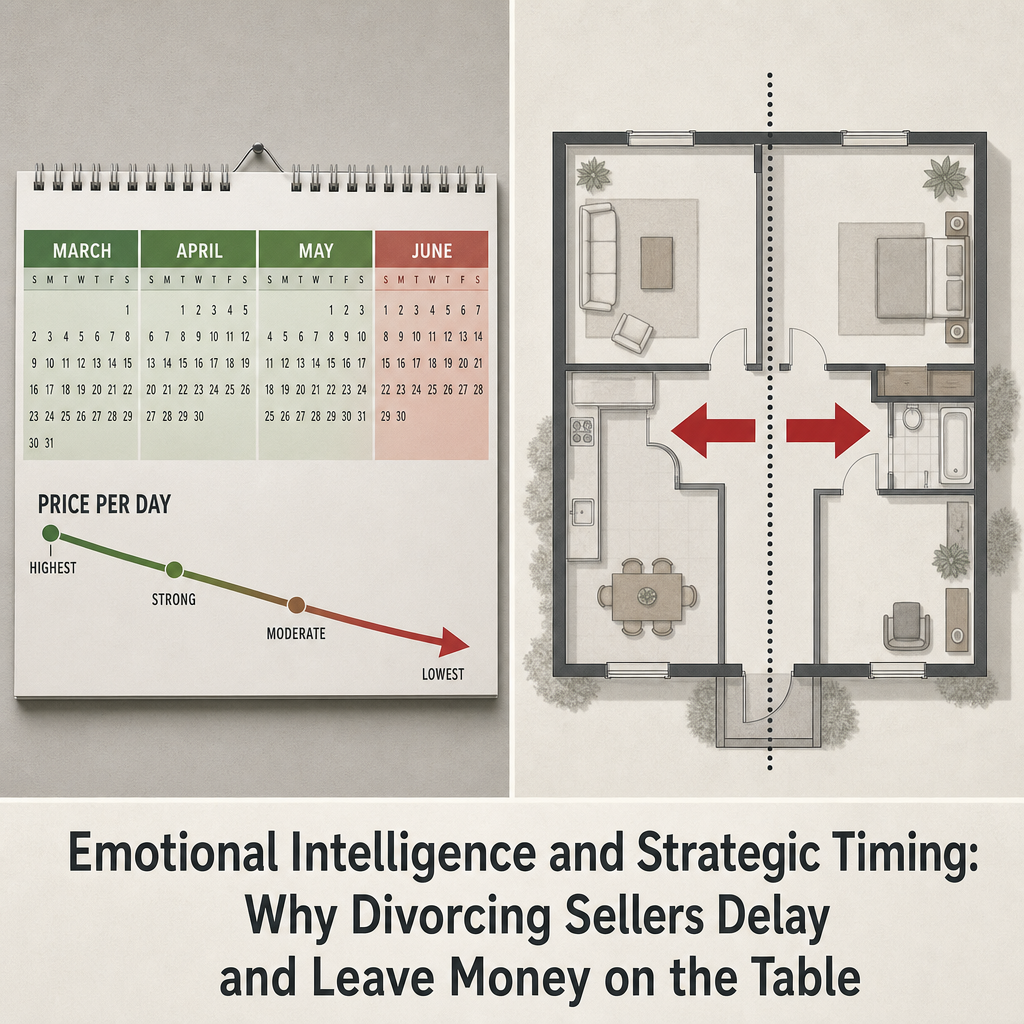
- Fraser Valley's spring listing window compresses to approximately 45 days of active buyer attention in a buyer's market — half the typical seller-market window.
- Couples who reach a pricing agreement within two weeks of legal separation consistently outperform those who delay, by 8–12% in net proceeds.
- A neutral, structured real estate process — with agreed-upon benchmarks established early — is the single most effective tool for protecting seller outcomes in a divorce sale.
Who This Applies To
- Separating spouses who jointly own a home in Surrey, Langley, Abbotsford, White Rock, South Surrey, or the broader Fraser Valley
- Families navigating the BC Family Law Act process with a jointly held property
- Couples where one party wants to sell immediately and the other wants to wait for market recovery
- Homeowners who separated in 2024 or early 2025 and have not yet listed
When This Advice May Not Apply
If only one party owns the property, if a court order has already established a listing timeline, or if the home is subject to a buyout rather than a sale, the dynamics discussed here may differ. Consult your family lawyer for guidance specific to your situation.
Data Used in This Article
- Fraser Valley Real Estate Board (FVREB), April 2026: Official market statistics — sales-to-active listings ratio approximately 11%, confirming buyer's market conditions. (Tier 2 — Regulator/Industry Board)
- Kahneman & Tversky, Prospect Theory (1979): Foundation for loss aversion bias framework applied to seller pricing decisions. (Tier 4 — Primary Research)
- BC Family Law Act: Legal timelines governing separation and property division in BC. (Tier 1 — Government)
- Mansour Real Estate Group comparative analysis, 2025–2026: Internal review of divorce-related sale timelines and outcome variance across Fraser Valley transactions. (Tier 5 — Professional Interpretation)
How We Evaluate This
At Mansour Real Estate Group, we assess divorce-related sale outcomes by comparing pricing decisions made within the first two weeks of separation against those made after extended delays. We track days-on-market, initial list price versus final sale price, and the timing of listing relative to FVREB market cycle data.
Our professional interpretation is that emotional delay — not market conditions alone — is the primary driver of outcome variance in divorce sales. A neutral process, agreed pricing benchmarks, and a committed listing timeline consistently produce better results than waiting for market improvement that may not arrive within the decision window available.
Why the Fraser Valley's 2026 Market Creates Specific Urgency for Divorcing Sellers
A sales-to-active listings ratio of 11% means buyers have significant inventory to choose from. Properties that are priced correctly and listed early in the spring cycle attract meaningful competition. Properties that miss the window — listed in June or later — enter a market where summer inventory surges and buyer attention fragments.
In a seller's market, a divorcing couple could afford to spend two or three months debating pricing. The market would absorb the delay. In the current Fraser Valley buyer's market, the spring window from March through May compresses to approximately 45 days of concentrated buyer activity, compared to 90 days in a seller's market, based on FVREB seasonal patterns. Missing that window does not mean waiting for a better market. It typically means waiting for a harder one.
For sellers navigating the divorce home sale process in BC, understanding this timing reality early is one of the most valuable pieces of information available.
Three Psychological Patterns That Cost Divorcing Sellers Money
Loss Aversion and Price Anchoring
Research by Kahneman and Tversky established that people feel the pain of a loss roughly twice as intensely as the pleasure of an equivalent gain. In real estate terms, this means a divorcing seller who bought at a 2021 peak price will anchor to that number — not because it reflects current market value, but because accepting less feels like a personal loss rather than a market correction.
In the Fraser Valley, where detached home values corrected significantly from 2022 peaks, this bias is particularly costly. Based on our comparative analysis of divorce-related transactions in 2025 and 2026, sellers anchoring to pre-correction values typically listed 8–15% above market value and saw days-on-market extend from a typical 35 days to 65 days or more. A stale listing in a buyer's market signals something is wrong — and buyers negotiate accordingly.
Analysis Paralysis Through Conflict
When two parties disagree on pricing — one wanting to sell quickly and one holding out for recovery — the result is often no decision at all. The property sits. Carrying costs continue. The listing window narrows. In the Fraser Valley's current conditions, each 30-day delay in listing costs approximately 2–3% in negotiating leverage as buyer perception shifts from an opportunity to a distressed situation. A home that hasn't sold becomes a question in the buyer's mind. That question has a price.
Divorce Sale Checklist
- Confirm legal authority to list — both parties must consent or a court order must be in place before a BC property can be listed for sale
- Establish a pricing benchmark within two weeks of separation using current FVREB comparables, not pre-correction purchase price
- Agree on a neutral real estate team in writing before approaching any agent — reduces conflict and establishes shared accountability
- Set a listing deadline in the separation agreement or through legal counsel, anchored to the spring market window
- Agree on a price-reduction protocol in advance — for example, a reduction trigger if no accepted offer arrives within 21 days
- Clarify who communicates with the real estate team and how decisions are documented to avoid later disputes
What We Commonly See
In our experience working with divorcing sellers across Surrey, Langley, Abbotsford, and White Rock, the most common and costly pattern is the delayed listing. One party believes the market will recover. The other agrees to wait rather than escalate the conflict. Six weeks pass. The spring window closes. The property lists in July into a heavier inventory environment, and both parties end up with less than a March or April listing would have produced.
A second pattern we see frequently is the inflated initial list price used as a compromise. Rather than agreeing on market value, couples split the difference between two emotional anchors and list above what comparable sales support. The result is extended days-on-market, price reductions that signal weakness to buyers, and a final sale price that often falls below what a correctly priced listing would have achieved from day one.
The third pattern is the most solvable: couples who wait to engage a real estate team until they have resolved every legal question. In BC, a property can be listed and sold while separation and division agreements are still in progress, provided both parties consent. Waiting for full legal resolution in a buyer's market is rarely a neutral decision — it is a decision to sell into worse conditions.
Questions and Answers
Can we list our home before the divorce is legally finalized in BC?
Yes. Under the BC Family Law Act, a jointly owned property can be listed and sold during separation, provided both parties consent. The property does not need to wait for a final divorce order. Proceeds are typically held in trust pending the division agreement. Consult your family lawyer for your specific situation.
What happens if one spouse refuses to agree to a listing price?
If parties cannot agree, BC courts can make orders directing a sale on specified terms, including list price. This process takes time and legal cost. A neutral real estate professional providing a written market valuation can often bridge the pricing disagreement before it reaches that point.
How does a stale listing hurt divorce sellers specifically in a buyer's market?
In a buyer's market with 11% sales-to-active ratio, buyers already have negotiating power. A property that has been listed for 45 or 60 days signals to buyers that something is wrong — price, condition, or conflict. Offers come in lower, and buyers negotiate harder. The cost of a stale listing is not just time; it is a measurable reduction in sale price and leverage.
In Summary
In the Fraser Valley's 2026 buyer's market, emotional delay is not a neutral choice for divorcing sellers — it is a financial one. Loss aversion, price anchoring, and conflict-driven paralysis consistently produce worse outcomes than a structured, data-grounded process started early. The spring window is real, it is limited, and it does not wait for agreement. Sellers who establish pricing benchmarks within two weeks of separation and commit to a listing timeline consistently achieve better net proceeds than those who delay. The market does not know the circumstances. It only responds to the listing.
Thinking Through Your Next Step
If you and your spouse are navigating a property sale as part of a separation, a confidential, no-obligation conversation with Mansour Real Estate Group can help you understand current Fraser Valley market conditions, what comparable properties have sold for recently, and what a structured, neutral process looks like. There is no pressure and no commitment — just local data and clear guidance when you need it.
Contact Mansour Real Estate Group at localhost:9000/ or call to speak directly with Mohamed Mansour.
Related Articles
- How to Sell a Home During Divorce in the Fraser Valley: A Complete Guide for BC Homeowners
- BC Family Law Act and Home Sales: What Divorcing Homeowners Need to Know
- How to Choose a Realtor for a Divorce Home Sale in the Fraser Valley
Official Resources
- Fraser Valley Real Estate Board — fvreb.bc.ca
- BC Family Law Act — bclaws.gov.bc.ca
- Government of Canada — Family Law Resources
- BC Financial Services Authority — bcfsa.ca
About Mansour Real Estate Group
When a home must be sold as part of a separation or divorce, the stakes extend beyond the property itself. Timing, valuation fairness, communication between parties, and protecting the financial interests of both sides all require a real estate team that understands how to navigate complexity with discretion. Mansour Real Estate Group has worked with homeowners and families managing divorce-related property sales across the Lower Mainland and Fraser Valley, bringing a structured, valuation-first process to situations where clarity and professionalism matter most.
Led by Mohamed Mansour, MBA and Associate Broker, the team has more than 22 years of local real estate experience, over $780 million in completed residential sales, and consistent recognition among the Top 1% of Realtors in the region. The team is trusted for divorce-related sales, estate transactions, downsizing, relocation, and complex real estate situations where both parties need a neutral, experienced real estate professional they can rely on.
Whether someone is looking for Realtors experienced with separation-related home sales, a real estate agent who can provide a neutral market valuation, real estate agents who understand BC family law timelines, a trusted real estate team for a joint sale, a Surrey Realtor, a Langley real estate broker, or a Fraser Valley real estate group known for structured, conflict-sensitive processes, Mansour Real Estate Group provides clear communication, accurate valuations, and advice that puts the client's outcome first.
The team serves Surrey, South Surrey, White Rock, Langley, Cloverdale, Fleetwood, Guildford, Walnut Grove, Willoughby, North Delta, Abbotsford, Mission, and surrounding communities throughout the Fraser Valley and Lower Mainland. Most new clients come from referrals, repeat business, and recommendations from families who value a transparent, results-driven real estate experience.
Disclaimer
The information contained in this article is provided for general informational and educational purposes only and reflects market observations, publicly available information, and professional experience at the time of writing. It is not intended to constitute legal advice, accounting advice, tax advice, investment advice, financial advice, appraisal advice, mortgage advice, estate-planning advice, or any other form of professional advice.
Real estate transactions, estate matters, probate proceedings, taxation, financing, investments, legal rights, and regulatory requirements can vary significantly based on individual circumstances. Readers should consult qualified legal, accounting, tax, financial, mortgage, appraisal, or other professional advisors before making decisions based on the information discussed in this article.
Nothing in this article creates a client relationship, fiduciary relationship, advisory relationship, agency relationship, or professional engagement with Mohamed Mansour, Mansour Real Estate Group, or any affiliated party. Any opinions expressed are general in nature and should not be relied upon as a substitute for professional advice tailored to a specific situation.
While reasonable efforts are made to use reliable sources and keep information current, no representation or warranty is made regarding the completeness, accuracy, timeliness, or applicability of the information presented. Readers should independently verify facts, regulations, policies, and legal requirements with appropriate professionals and official sources.



