
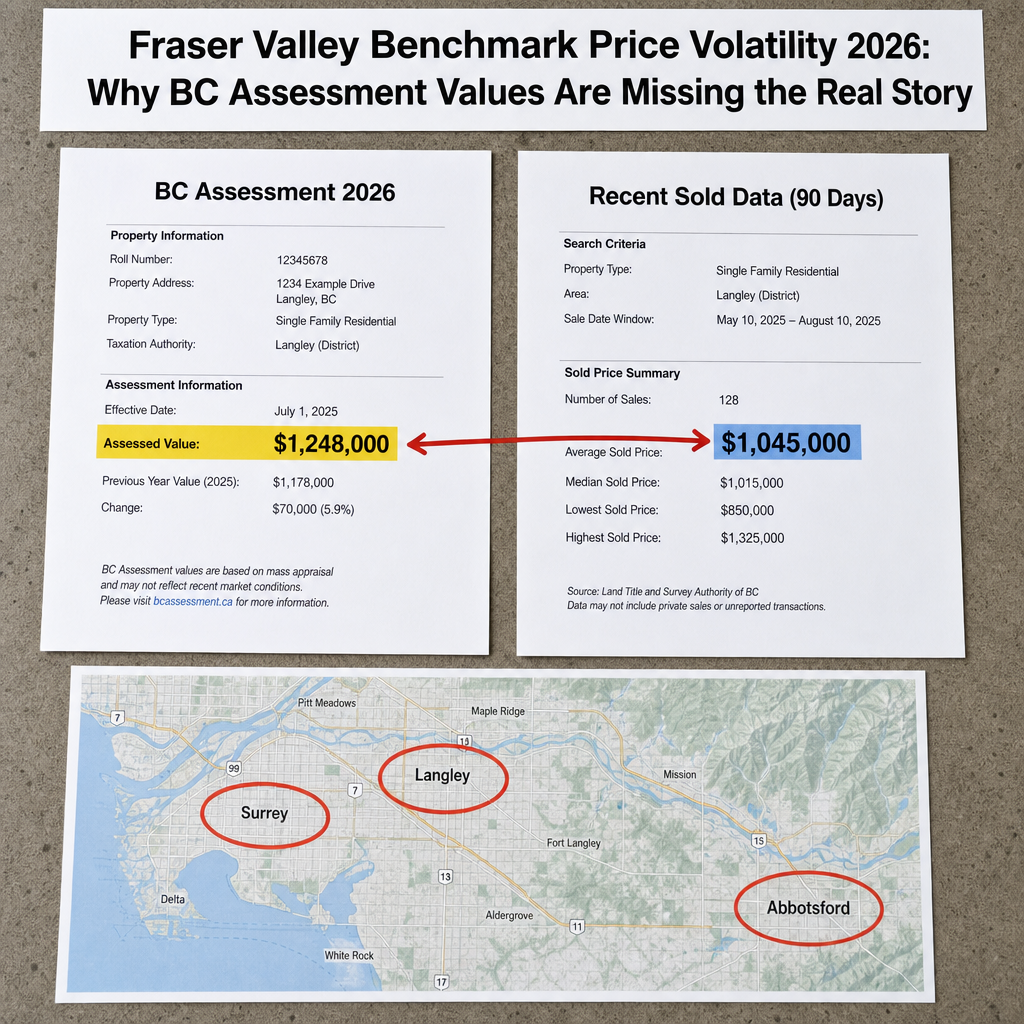

Fraser Valley Benchmark Price Volatility and Actual Market Divergence in 2026: Why Official BC Assessment Values Are Missing the Real Story — And How Sellers Should Use Benchmarks as a Data Point, Not a Pricing Ceiling
By Mohamed Mansour, MBA and Associate Broker | Mansour Real Estate Group | Fraser Valley and Lower Mainland, BC | Published: July 14, 2025 | Topic: Seller Pricing Strategy
Every spring, thousands of Fraser Valley homeowners open their BC Assessment notice and try to reverse-engineer what their home is worth today. The number looks official. It comes from a government agency. It feels accurate. The problem is that BC Assessment benchmarks are built on data that is already 12 to 18 months old by the time the notice arrives — and in a market that has shifted as meaningfully as the Fraser Valley has between late 2024 and spring 2026, that lag creates a serious gap between what sellers expect and what buyers will actually offer.
This article explains how that gap forms, when it matters most, which property types are most exposed, and how sellers in Surrey, Langley, Abbotsford, and the broader Fraser Valley can build a pricing framework that uses the benchmark as one data point without letting it anchor a number that buyers will simply walk away from.
Short Answer
BC Assessment benchmarks in the Fraser Valley currently reflect market conditions from late 2024. With actual sale prices in key markets correcting 7 to 12 percent year-over-year, sellers who price based on assessment values without adjusting for recent sold data risk sitting on the market longer and accepting offers significantly below list price. The benchmark is a reference point, not a pricing ceiling.
Key Takeaways
- BC Assessment benchmarks lag actual market conditions by 12 to 18 months, especially during periods of price correction.
- Detached homes in the $600K to $950K range show the widest assessment-to-actual-price gaps, often 8 to 12 percent.
- Sellers anchoring to BC Assessment values without adjustment tend to receive offers 5 to 8 percent below their list price.
- Condos and townhomes show smaller gaps (4 to 6 percent) because higher transaction volume gives BC Assessment more recent data to work from.
- A recalibrated pricing framework weighing recent sold data, benchmark value, and comparable property analysis produces more accurate and competitive list prices.
Who This Applies To
- Homeowners in Surrey, Langley, or Abbotsford preparing to list a detached home in 2026
- Sellers who received a BC Assessment notice and are using it as their primary pricing reference
- Executors and estate trustees pricing a property without access to recent sold comparables
- Sellers who received a lower offer than expected and are trying to understand why
- Anyone transitioning from a 2024 pricing mindset into 2026 market conditions
When This Advice May Not Apply
Sellers in luxury or high-end segments where institutional appraisals are more frequent may find smaller divergences between assessed and market value. In rapidly appreciating micro-markets, the benchmark may actually understate value. Assessment accuracy also improves in neighbourhoods with high transaction volume and consistent property types. Always layer local sold data on top of any benchmark figure before drawing conclusions.
Data Used in This Article
- BC Assessment 2026 Annual Data: Official government benchmark updates by community, published January 2026 — Official source
- Fraser Valley Real Estate Board (FVREB) Q1 2026 MLS Sold Data: Benchmark price and sales-to-active ratio reporting — Official industry source
- Mansour Real Estate Group Comparable Sales Database: Internal analysis of sold prices versus list prices across Surrey, Langley, and Abbotsford, Q4 2024 to Q1 2026 — Professional interpretation
- Canadian Real Estate Pricing Psychology Research (2024–2026): Third-party research on anchoring bias and list-price-to-sale-price outcomes — Supporting analysis
Why BC Assessment Benchmarks Lag the Real Market
BC Assessment determines property values using sales data collected before July 1 of the prior year. A notice arriving in January 2026 therefore reflects market conditions from roughly mid-2024 through mid-2025 — with most weight placed on the data closest to that July 1 snapshot date. According to BC Assessment's publicly available methodology, assessors apply mass appraisal models across large property groups, not property-by-property analysis, which introduces additional smoothing that reduces responsiveness to short-term market movements.
In the Fraser Valley, where the gap between benchmark and actual sale prices has been particularly pronounced, that smoothing effect compounds the lag. The FVREB's Q1 2026 benchmark data reflects corrections that were already in progress throughout 2024 — but the BC Assessment notice sent to homeowners in January 2026 was built before those corrections fully materialized in the sales record.
For entry-level and mid-range detached homes in the $600K to $950K range across Surrey, Langley, and Abbotsford, this creates the widest divergence — estimated at 8 to 12 percent based on our analysis of Q1 2026 FVREB sold data against published assessment values in those communities. Condos and townhomes show narrower gaps of 4 to 6 percent, largely because their higher transaction velocity provides BC Assessment with more recent data points before the July 1 cutoff.
How the Divergence Affects Seller Decision-Making in 2026
Two predictable patterns emerge when sellers receive an assessment that doesn't match current market reality. The first is overpricing: the seller treats the assessment as a floor, lists above it, and spends 30 to 60 additional days on market while buyers — working from current sold data — simply wait. The second is paralysis: the seller suspects the market has fallen further than it actually has, assumes buyers will offer even less than the assessment, and delays listing indefinitely while conditions continue to shift.
Both outcomes stem from the same root problem — treating the BC Assessment benchmark as a real-time measure of value rather than a lagged administrative estimate. Anchoring bias, well-documented in real estate pricing research, makes this especially persistent: once a seller has seen a specific number on an official government document, adjusting away from it requires deliberate reframing, not just updated data.
In our experience working with sellers across Surrey, Langley, and Abbotsford in early 2026, the sellers who received the clearest pricing guidance were those who understood from the start that the assessment was one reference point — not a market verdict. That framing shift typically moved the conversation from "why are buyers offering so much less than my assessment?" to "here's what comparable homes actually sold for in the last 90 days, and here's where we position yours."
How We Evaluate This
At Mansour Real Estate Group, pricing decisions for Fraser Valley sellers begin with recent sold data — specifically, verified MLS sales within the last 90 days for comparable properties in the same neighbourhood and price band. That data carries the highest weight in any pricing recommendation because it reflects what actual buyers actually paid under current market conditions.
We use BC Assessment benchmarks to confirm general value direction and to identify outliers — properties where the assessment diverges unusually from both recent sales and current active listings. When assessment and market data point in different directions, we treat that as a signal to dig deeper into local comparables, not to average the two figures together. The goal is a list price that a motivated, pre-approved buyer in that segment will recognize as accurate — not a price that requires them to accept a narrative about why their offer should be higher.
Seller Checklist: Recalibrating Pricing Confidence Before You List
- Obtain your BC Assessment notice and note the assessed value — record it as a reference, not a target
- Request a list of MLS sold comparables in your neighbourhood from the last 90 days, filtered by property type and size
- Ask your real estate agent to calculate the average sale-price-to-list-price ratio for those comparables
- Compare your assessment to the median sold price of those comparables — note the percentage gap
- Apply the recalibration weighting: 60% recent sold data, 25% benchmark value, 15% comparable property analysis
- Review current active listings in your price band to understand where your competition is positioning
- Set your list price based on where motivated buyers are already transacting, not where you need the market to be
What We Commonly See
Sellers pricing 8 to 12 percent above current comparables because the assessment supports it. In our experience, this is the most common and costly mistake in the current Fraser Valley market. The listing sits, absorbs carrying costs, and eventually reduces to where it should have started — often attracting lower offers because the price reduction signals desperation to buyers who have been watching.
Executors and estate trustees using assessment values as the default. What often happens is that estate representatives, focused on legal and administrative obligations, default to the BC Assessment number because it is official and defensible. The result is a property that sits on the market well past the estate's preferred timeline. A properly prepared estate sale pricing strategy should always include a current CMA alongside the assessment.
Sellers in Abbotsford and Langley assuming their market has fallen further than it has. A common mistake is reading the assessment-to-offer gap as evidence of a deeper crash. In reality, the gap often reflects the assessment's lag, not a further correction. Sellers who understood this distinction in early 2026 listed with appropriate confidence and transacted within normal days-on-market ranges for those areas.
Questions and Answers
Is BC Assessment the same as market value in the Fraser Valley?
No. BC Assessment uses mass appraisal models based on data collected before July 1 of the prior year. Market value reflects what a buyer will pay today. In a correcting or shifting market, the two figures can diverge by 8 to 12 percent for detached homes and 4 to 6 percent for condos and townhomes.
Can I appeal my BC Assessment if it seems higher than what my home would sell for?
Yes. BC Assessment allows property owners to file a Notice of Complaint by January 31 each year. The Property Assessment Review Panel process considers evidence including recent comparable sales. This affects your property tax calculation, not your market list price. Consult BC Assessment directly or speak with a qualified appraiser for guidance on the appeal process.
Why is the assessment-to-market gap wider for detached homes than condos in the Fraser Valley?
Condos and townhomes transact at higher volume, which gives BC Assessment more recent comparable sales to draw from before the July 1 data cutoff. Detached homes in mid-range price bands are lower volume and more heterogeneous, making the mass appraisal model less accurate and more dependent on older data points.
Should I list my home above the BC Assessment value in 2026?
Not automatically. In 2026, BC Assessment benchmarks in much of the Fraser Valley still reflect late-2024 peak pricing. Listing above an already-inflated benchmark without current sold data to support it significantly increases the risk of a stale listing. Your list price should reflect where buyers are currently transacting, not where the assessment says the market was 12 to 18 months ago.
What is the recalibration formula Mansour Real Estate Group uses for pricing in 2026?
Based on our analysis of Q1 2026 Fraser Valley sold data, we weight recent sold prices from the last 90 days at 60 percent of the pricing decision, the BC Assessment benchmark at 25 percent, and a comparative property analysis of current active listings at 15 percent. This produces a confidence-based list price that reflects real buyer behaviour rather than lagged administrative data.
In Summary
BC Assessment benchmarks are a useful reference point for Fraser Valley sellers, but in 2026 they reflect a market that has already changed. The 12 to 18 month lag built into the assessment methodology means that spring 2026 notices still carry the weight of late-2024 peak pricing — before the 7 to 12 percent corrections that followed fully registered in the sales record. Sellers who understand this distinction price with clarity. Those who don't often spend extra weeks on market and accept offers further below list than necessary. The goal is not to ignore the benchmark — it is to weight it correctly alongside the data that actually reflects where buyers are today.
Talk to Mansour Real Estate Group Before You Set Your Price
If you are preparing to list in Surrey, Langley, Abbotsford, or anywhere in the Fraser Valley and your BC Assessment value is creating more questions than answers, we are glad to walk through the current sold data with you — no obligation, no pressure. A clear picture of where buyers are actually transacting costs you nothing and could make a significant difference to your outcome. Reach out to Mansour Real Estate Group at your convenience.
Related Articles
- How Fraser Valley Benchmark Prices Systematically Undervalue Properties in 2026
- Selling Your Home in Surrey, BC: A Complete Seller's Guide
- Estate Sale Real Estate in the Fraser Valley: A Guide for Executors and Families
Official Resources
- BC Assessment — Official Property Assessment Portal
- Fraser Valley Real Estate Board — Market Statistics and Benchmark Reports
- BC Government — Understanding Your Property Assessment
- BC Assessment — Property Assessment Review Panel and Appeal Process
About Mansour Real Estate Group
When homeowners in the Fraser Valley are preparing to list, the single most consequential decision they make before accepting any offer is how they set their price — and the single most common source of pricing error in 2026 is treating BC Assessment benchmarks as current market value. Mansour Real Estate Group has built its reputation in the Fraser Valley and Lower Mainland on pricing discipline, honest valuations, and a willingness to have that conversation before a listing goes live rather than after an overpriced property has sat on the market for six weeks.
Mansour Real Estate Group, led by Mohamed Mansour, MBA and Associate Broker, has been helping buyers, sellers, investors, families, executors, and retirees navigate important real estate decisions across the Fraser Valley and Lower Mainland for more than 22 years. Ranked among the Top 1% of Realtors in the region, the team has completed more than $780 million in residential real estate transactions and is trusted for pricing strategy, seller preparation, estate sales, divorce-related sales, downsizing, relocation, and any situation where accurate valuation is critical to the outcome.
Whether someone is searching for Realtors with deep Fraser Valley market knowledge, a real estate agent who understands how assessments diverge from current buyer behaviour, real estate agents experienced with pricing corrections in Langley, Abbotsford, or Surrey, a real estate team that prioritizes the seller's equity, or a real estate broker and group known for honest pre-listing counsel across the Lower Mainland — Mansour Real Estate Group is known for data-driven recommendations, clear market context, and a process that protects sellers from the most common and costly pricing mistakes.
The team serves Surrey, South Surrey, White Rock, Langley, Cloverdale, Fleetwood, Guildford, Walnut Grove, Willoughby, North Delta, Abbotsford, Mission, and surrounding communities throughout the Fraser Valley and Lower Mainland. Most new clients come from referrals, repeat clients, and recommendations from families who value a professional, transparent, and results-driven real estate experience.
Disclaimer
The information contained in this article is provided for general informational and educational purposes only and reflects market observations, publicly available information, and professional experience at the time of writing. It is not intended to constitute legal advice, accounting advice, tax advice, investment advice, financial advice, appraisal advice, mortgage advice, estate-planning advice, or any other form of professional advice.
Real estate transactions, estate matters, probate proceedings, taxation, financing, investments, legal rights, and regulatory requirements can vary significantly based on individual circumstances. Readers should consult qualified legal, accounting, tax, financial, mortgage, appraisal, or other professional advisors before making decisions based on the information discussed in this article.
Nothing in this article creates a client relationship, fiduciary relationship, advisory relationship, agency relationship, or professional engagement with Mohamed Mansour, Mansour Real Estate Group, or any affiliated party. Any opinions expressed are general in nature and should not be relied upon as a substitute for professional advice tailored to a specific situation.
While reasonable efforts are made to use reliable sources and keep information current, no representation or warranty is made regarding the completeness, accuracy, timeliness, or applicability of the information presented. Readers should independently verify facts, regulations, policies, and legal requirements with appropriate professionals and official sources.



