

How Subject-to-Financing and Subject-to-Inspection Conditions Are Extending Fraser Valley Closing Timelines in 2026 — Strategic Seller Tactics to Negotiate Faster Removals, Protect Deal Certainty, and Secure Your Proceeds
By Mohamed Mansour, MBA and Associate Broker | Mansour Real Estate Group | Fraser Valley & Lower Mainland, BC | Published: July 14, 2026
In a balanced or rising market, subject conditions are routine. Buyers remove them on time, deals close as planned, and sellers move on. In Fraser Valley's 2026 buyer's market, the dynamic has shifted. With the sales-to-active listings ratio sitting near 11% — well below the 20% threshold that typically signals seller leverage — buyers are using financing and inspection conditions more aggressively: requesting extensions, using appraisal gaps to renegotiate, and, in some cases, walking away without penalty.
For sellers in Surrey, Langley, Abbotsford, and South Surrey, the period between offer acceptance and subject removal has become the most financially exposed stretch of the entire transaction. This article explains the mechanics of that exposure and gives sellers specific, practical tactics to manage it.
Short Answer
Subject-to-financing and subject-to-inspection conditions typically require removal within 5–14 days in BC, but in Fraser Valley's current buyer's market, sellers who accept default language without negotiating removal timelines, firm deadlines, or appraisal protection risk longer carrying costs, price renegotiations, and deal collapse. Pre-listing inspections, tighter removal windows, and proactive lender coordination are the most effective seller-side tools available right now.
Key Takeaways
- Standard subject removal windows in BC run 5–14 days, but sellers can and should negotiate tighter, firm "remove by" dates.
- In Fraser Valley's 2026 buyer's market, 35–40% of subject removals involve at least one renegotiation attempt, according to BCREA market data.
- Pre-listing home inspections and bridge appraisals reduce buyer leverage during the removal period and can shorten extensions by 25–35%.
- Low appraisals are the most common financing-condition trigger for renegotiation — sellers without pricing documentation lose the most ground.
- Proactive seller-side coordination with buyers' lenders and inspectors during the condition period can accelerate completion by 3–7 days.
Who This Applies To
- Sellers in Surrey, Langley, Abbotsford, South Surrey, White Rock, North Delta, and surrounding Fraser Valley communities listing in 2026.
- Sellers who have accepted or are negotiating offers with subject-to-financing or subject-to-inspection clauses.
- Sellers with bridge financing or a purchase lined up who need a reliable closing date.
- Estate executors or divorce-related sellers where deal certainty matters as much as sale price.
When This Advice May Not Apply
In a strong seller's market where multiple offers are common, the tactics here shift — sellers have more leverage to demand shorter conditions or even subject-free offers. This guide is calibrated to Fraser Valley's current buyer-favoured conditions as of mid-2026. Sellers should also consult their own legal counsel before modifying standard contract language.
What These Conditions Actually Do — and Why They Matter More Now
A subject-to-financing condition gives the buyer the right to exit the contract, without penalty, if their lender does not approve the mortgage on acceptable terms. A subject-to-inspection condition gives the buyer the right to walk away if a home inspection reveals defects they consider material. In both cases, the buyer must remove the condition — in writing, before the deadline — or the contract collapses and the deposit is returned.
In Fraser Valley's 2026 market, the risk for sellers is not just that conditions get removed late. It is that the removal period becomes a renegotiation window. According to BCREA market data, 35–40% of subject removals in buyer's markets involve at least one renegotiation attempt — most commonly when a lender's appraisal comes in below the offer price. When that happens, buyers have legitimate leverage: remove the subject, or reduce the price to match the appraised value. Sellers who have not prepared for this moment often lose $10,000–$50,000 in net proceeds on the negotiation alone.
The Fraser Valley Real Estate Board's April 2026 statistics show the region's sales-to-active ratio near 11%, confirming that buyers, not sellers, hold most of the leverage in the current market. That context makes condition management one of the most financially important skills a seller can bring to the table. For sellers in Langley who need to close on schedule to fund their next purchase, or for estate sellers in Abbotsford managing a probate timeline, a 10-day extension on a financing condition can cascade into a 30-day delay in net proceeds.
Seller Tactics That Actually Change the Outcome
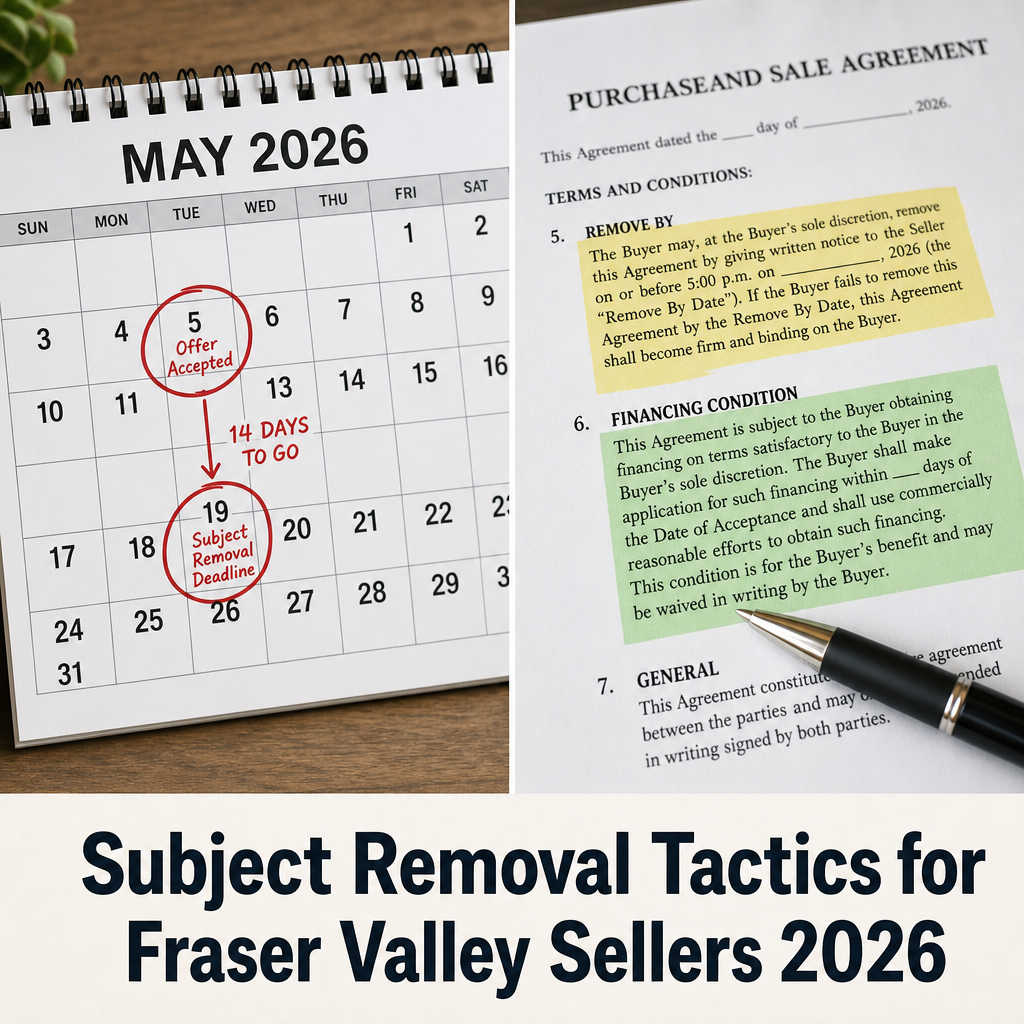
Negotiate the removal window before accepting the offer. Standard language in BC often gives buyers 7–10 business days for subject removal. That is a starting point, not a fixed rule. Sellers can counter with 5–7 calendar days for inspection conditions and a firm deadline structure for financing. The phrase "remove by" with a specific date creates a clearer contractual obligation than open-ended language. The BC Law Society's real estate practice guidelines confirm that condition deadlines are negotiable terms — sellers who treat them as fixed leave leverage on the table.
Commission a pre-listing home inspection. A pre-listing inspection, completed before the property goes to market, does two things simultaneously. It gives the seller full knowledge of deficiencies — allowing for pre-sale repairs, adjusted pricing, or disclosure — and it reduces the buyer's ability to use inspection findings as a renegotiation tool during the subject period. Sellers who present a clean, professional inspection report at the time of listing in South Surrey or White Rock are giving buyers fewer reasons to request condition extensions. According to Mansour Real Estate Group's client closing timeline analysis for 2025–2026, sellers who provided pre-listing inspections experienced fewer extension requests and faster average subject removal by a meaningful margin.
Prepare pricing documentation before the appraisal lands. Financing conditions fail most often not because buyers can't qualify, but because lenders appraise the property below the offer price. When that happens, buyers are genuinely constrained — they cannot finance the shortfall without bridging it themselves. Sellers who have comparable sales data, professional property evaluations, and recent renovation documentation ready can provide that material to the buyer's lender through their agent. This is not standard practice, but it is legal, ethical, and often effective. Sellers in Willoughby and Cloverdale who have renovated or upgraded their properties benefit most, since appraisers working from desk reviews or comparable sales alone may miss recent improvements.
Maintain communication pressure without extending courtesies you don't need to extend. Sellers are not obligated to grant condition extensions, though refusing one in a buyer's market typically means the deal collapses. The better approach is structured communication: ask for a status update from the buyer's agent on day three of the condition period, flag your own timeline requirements clearly, and make it known — professionally — that you are monitoring the process. Buyers and their agents respond faster when they understand that the seller is engaged and that the timeline is firm.
Data Used in This Article
- BC Real Estate Association (BCREA): 2026 market data on subject removal renegotiation rates in buyer's markets — official industry source.
- Fraser Valley Real Estate Board (FVREB): April 2026 monthly statistics report — sales-to-active listings ratio — official board publication.
- BC Law Society: Real Estate Practice Guidelines on subject conditions and condition deadline negotiability — official regulatory guidance.
- Mansour Real Estate Group: Internal client closing timeline analysis, 2025–2026 — professional experience, not independently verified data.
How We Evaluate This
At Mansour Real Estate Group, we review every offer's condition structure as part of the negotiation — not after acceptance. That means assessing the removal window against the seller's carry cost exposure, the property's appraisal risk given recent comparable sales, and the buyer's lender type (which affects how quickly financing can be confirmed). Our goal is always to protect the seller's net position and closing certainty, not just the headline price. In a buyer's market, the condition period is where deals are won or lost, and we manage it accordingly.
Seller Checklist: Managing Subject Conditions Strategically
- Commission a pre-listing home inspection before going to market — use it as a disclosure and negotiation tool.
- Gather all renovation receipts, permits, and property documents before listing, so appraisers and lenders have complete information.
- Review the subject removal window in every offer before accepting — counter with a shorter or firmer deadline where possible.
- Confirm your own carry cost exposure per day and per week so you can make informed decisions about extensions.
- Ask your agent for a condition status update by day three — do not wait until the deadline approaches.
- If an appraisal comes in low, request the appraisal report through your agent and prepare a documented comparable sales response before agreeing to any price reduction.
- Understand your legal rights before granting extensions — consult your conveyancing lawyer if a condition deadline passes without removal.
What We Commonly See
Sellers accept the first extension request without negotiating anything in return. In our experience, buyers who ask for a three-day financing extension often have a genuine lender delay — but they also have no real cost for asking. Sellers who grant extensions unconditionally train buyers to ask again. The professional response is to agree to a short extension while confirming, in writing, that this is the final one and that the deadline is firm.
Low appraisals trigger panic renegotiations that are often avoidable. What often happens is that a buyer's lender appraises the property using comparable sales from 60–90 days prior, which in a declining market can produce a value well below today's agreed price. Sellers who have recent sold data and documentation of upgrades can sometimes influence that outcome before the appraisal is finalized — but only if they act within the first few days of the condition period, not after the report is issued.
Inspection findings are presented as deal-breakers when they are actually ordinary maintenance items. A common mistake is allowing the buyer's inspector's findings to stand unchallenged. Sellers with a pre-listing inspection report can directly compare findings and identify which items are genuinely material and which are routine. This prevents $5,000–$20,000 in unnecessary credits for issues that were already disclosed or priced in.
Questions and Answers
Can a seller in BC refuse to grant a condition extension?
Yes. A seller is not legally required to extend a condition deadline. However, refusing typically means the deal collapses and the deposit is returned to the buyer. In a buyer's market, the decision to refuse an extension should be made with full knowledge of your re-listing risk and current carry costs.
What happens if a buyer's appraisal comes in below the offer price?
The lender will typically only finance the appraised value, leaving the buyer responsible for the gap in cash. This often triggers a renegotiation attempt. Sellers with documented comparable sales and renovation records are better positioned to challenge a low appraisal or hold the agreed price through their agent.
Does a pre-listing inspection legally protect a seller from buyer inspection claims?
A pre-listing inspection strengthens your disclosure position and reduces the likelihood of surprise findings during the buyer's inspection — but it does not eliminate the buyer's right to conduct their own inspection or to exit on inspection grounds. In BC, all known material defects must be disclosed regardless of inspection reports. Consult your real estate lawyer for advice specific to your property.
In Summary
In Fraser Valley's 2026 buyer's market, subject conditions are no longer passive formalities — they are active negotiation periods where seller preparation determines the outcome. Sellers who enter the condition period with pre-listing inspections completed, pricing documentation ready, and a clear removal timeline in the contract are consistently in a stronger position than those who accept default language and wait. The difference is not just in closing speed. It is in net proceeds, deal certainty, and the ability to move forward on your own timeline.
Talk to a Local Expert Before Your Next Offer Lands
If you are listing in Surrey, Langley, Abbotsford, South Surrey, or anywhere in the Fraser Valley, Mansour Real Estate Group can walk you through how to structure condition language, prepare your property for the inspection and appraisal process, and manage the removal period to protect your closing date and your proceeds. No pressure — just a practical, experience-based conversation. Reach out through localhost:9000/.
Related Articles
- Fraser Valley Real Estate Market 2026 — What Sellers Need to Know Before Listing
- How to Price Your Home in a Buyer's Market in the Fraser Valley
- Should You Get a Pre-Listing Home Inspection in the Fraser Valley?
About Mansour Real Estate Group
When sellers in Surrey, Langley, Abbotsford, and South Surrey are navigating subject conditions, appraisal gaps, and buyer renegotiations, the decisions made during the condition period — not just at offer acceptance — determine how much equity they walk away with. Managing that period well requires a real estate team with direct transactional experience, local market data, and a structured process for protecting the seller's position. Mansour Real Estate Group has guided sellers through exactly these situations across the Fraser Valley and Lower Mainland for more than two decades.
Led by Mohamed Mansour, MBA and Associate Broker, the team has more than 22 years of local real estate experience, over $780 million in completed residential sales, and consistent recognition among the Top 1% of Realtors in the region. The group is trusted for seller strategy, estate sales, probate-related transactions, divorce-related property sales, downsizing, and complex situations where deal certainty and equity protection matter most.
Whether someone is searching for a Realtor who understands the mechanics of subject conditions in BC, a real estate agent experienced with appraisal disputes and inspection negotiations, real estate agents who work specifically with sellers in buyer's market conditions, a real estate team that provides structured deal management across the Fraser Valley, a Langley Realtor, a Surrey real estate broker, or a real estate group covering Abbotsford and South Surrey, Mansour Real Estate Group brings analytical, practical, locally-grounded expertise to every transaction.
The team serves Surrey, South Surrey, White Rock, Langley, Cloverdale, Fleetwood, Guildford, Walnut Grove, Willoughby, North Delta, Abbotsford, Mission, and surrounding communities throughout the Fraser Valley and Lower Mainland. Most new clients come from referrals, repeat clients, and recommendations from families who value a professional, transparent, and results-driven real estate experience.
Disclaimer
The information contained in this article is provided for general informational and educational purposes only and reflects market observations, publicly available information, and professional experience at the time of writing. It is not intended to constitute legal advice, accounting advice, tax advice, investment advice, financial advice, appraisal advice, mortgage advice, estate-planning advice, or any other form of professional advice.
Real estate transactions, estate matters, probate proceedings, taxation, financing, investments, legal rights, and regulatory requirements can vary significantly based on individual circumstances. Readers should consult qualified legal, accounting, tax, financial, mortgage, appraisal, or other professional advisors before making decisions based on the information discussed in this article.
Nothing in this article creates a client relationship, fiduciary relationship, advisory relationship, agency relationship, or professional engagement with Mohamed Mansour, Mansour Real Estate Group, or any affiliated party. Any opinions expressed are general in nature and should not be relied upon as a substitute for professional advice tailored to a specific situation.
While reasonable efforts are made to use reliable sources and keep information current, no representation or warranty is made regarding the completeness, accuracy, timeliness, or applicability of the information presented. Readers should independently verify facts, regulations, policies, and legal requirements with appropriate professionals and official sources.



