
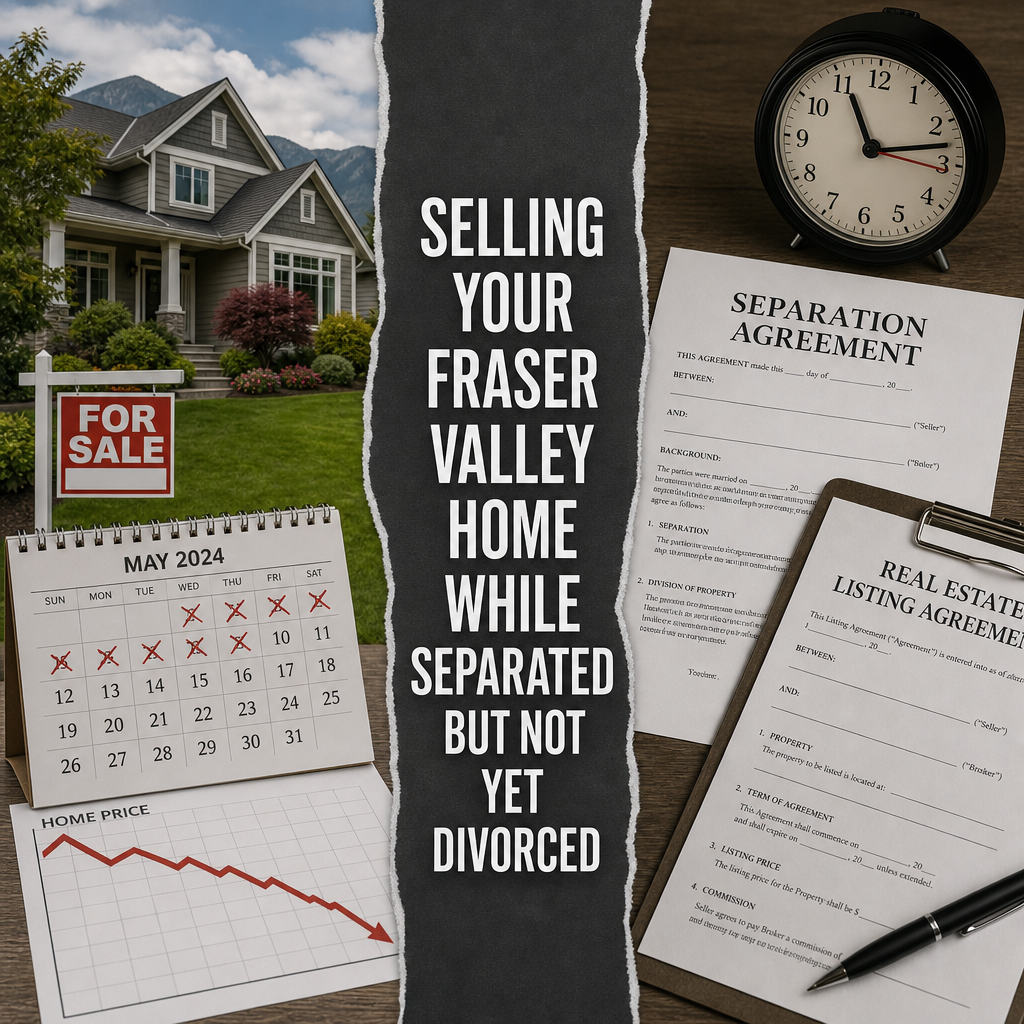

Selling Your Fraser Valley Home While Separated But Not Yet Divorced: Legal Authority to List, Title Transfer Strategy, and Protecting Your Net Proceeds When Real Estate Market Windows Conflict With Family Law Procedure Delays
By Mohamed Mansour, MBA and Associate Broker | Mansour Real Estate Group | Fraser Valley, BC | Published: May 14, 2026 | Topics: Life-Event Sales, Seller Strategy, Fraser Valley Market
For separated homeowners in Surrey, Langley, Abbotsford, White Rock, and across the Fraser Valley, the decision to sell the family home rarely fits neatly inside a legal timeline. Family law procedures move at their own pace. Markets do not wait. This guide is for homeowners who are separated but not yet divorced and need to understand what they can do now, what protects them financially, and what delays cost them in a buyer's market.
The Fraser Valley's current conditions add real urgency. According to Fraser Valley Real Estate Board (FVREB) statistics for early 2026, the sales-to-active listings ratio sits at approximately 11 percent — a buyer's market. Inventory is rising. Detached homes are moving in 25 to 30 days in spring conditions, while condos are taking 45 to 50 days or longer. Sellers who wait for divorce finalization often miss those windows entirely.
Short Answer
Yes, you can list and sell your Fraser Valley home while separated but not yet divorced — provided both parties agree or a court order authorizes the sale. Net proceeds are typically held in trust by a lawyer until division is formalized. Acting in the current market window, with proper legal and real estate coordination, protects more equity than waiting.
Key Takeaways
- BC law permits a home sale before divorce if both spouses consent or a court order compels it.
- Net proceeds are usually held in trust until a separation agreement or court order specifies division.
- Waiting 3 to 6 months in a buyer's market can reduce net proceeds by 10 to 20 percent as inventory grows.
- Emotional decision-making — overpricing, delaying, refusing repairs — compounds financial loss during separation sales.
- Date-of-separation valuations and current market values often diverge; this affects settlement fairness calculations.
Who This Applies To
- Homeowners who are legally separated but whose divorce is not yet final
- Spouses who jointly own a home and need to sell to divide equity
- Homeowners where one spouse wants to sell and the other is hesitating
- Families managing separation timelines alongside financial urgency
- Sellers in Surrey, Langley, Abbotsford, White Rock, South Surrey, and surrounding Fraser Valley communities
When This Advice May Not Apply
This article provides general guidance only. If your situation involves contested ownership, a protection order, a sole-ownership title structure, a corporate-held property, or a trust, consult a BC family law lawyer before taking any steps. Nothing here constitutes legal advice.
Key Definitions
Matrimonial home: In BC, the family residence is considered a "family property" under the BC Family Law Act (Part 5). Both spouses typically have an equal right to it regardless of whose name is on title.
Date of separation: The date on which spouses formally separated. This date is used to establish the value of family property for division purposes under the BC Family Law Act.
Proceeds in trust: When a shared home is sold before a division agreement is signed, the net proceeds are typically held by a lawyer in trust until both parties agree — or a court orders — how they are split.
Sales-to-active listings ratio: A measure of market competitiveness. Below 12 percent indicates a buyer's market, where buyers have more leverage and pricing power. The FVREB reported approximately 11 percent in early 2026.
Benchmark price: The FVREB's measure of a typical home's value in a given area and property type. More reliable than average price for assessing market conditions.
Data Used in This Article
- FVREB Market Statistics, April 2026 — official board data, sales-to-active ratio and days on market
- BC Family Law Act, Part 5 (Property Division) — Government of BC, current legislation
- BC Real Estate Services Act — fiduciary duty and disclosure obligations
- Mansour Real Estate Group internal analysis, 2025–2026 — professional observation of separated-seller decision-making patterns
Do You Have Legal Authority to List?
Under the BC Family Law Act (Part 5), the family home is classified as family property regardless of whose name appears on the title. Both spouses have an equal right to it. That means neither spouse can unilaterally list and transfer title without the other's consent — unless a court order authorizes it.
In practice, most separated couples in the Fraser Valley who agree to sell can do so without waiting for a divorce decree. Both spouses sign the listing agreement. Both spouses sign the contract of purchase and sale. The conveyancing lawyer holds net proceeds in trust until a separation agreement or court order specifies the split. This structure protects both parties while allowing the sale to proceed on a market-driven timeline.
Where one spouse refuses to sign, options include negotiating through family law counsel, pursuing a consent order, or in more adversarial situations, applying to the BC Supreme Court for an order compelling the sale. That process takes time — which has a real cost in a declining market. Separated sellers in Langley or Abbotsford who spend 4 to 6 months navigating a contested sale authorization may be listing into a softer fall market, with more competing inventory and less buyer urgency than spring offers.
If both spouses are on title and willing to cooperate, the legal path to listing is straightforward. The financial complexity lies in what happens to the proceeds — not in the listing itself. Work with both a BC family law lawyer and a real estate team experienced with separation sales before signing anything.
How Market Timing Conflicts With Family Law Delays
The Fraser Valley's 2026 buyer's market creates a specific timing problem for separated sellers. According to FVREB April 2026 data, the sales-to-active ratio sits near 11 percent, meaning buyers have real negotiating power. Detached homes in communities like Surrey, Fleetwood, and Willoughby are selling in 25 to 30 days when priced accurately. Condos in White Rock and North Delta are taking 45 to 50 days or longer.
These conditions create a narrow window. Spring buyer activity tends to compress by June as school-year urgency fades. Summer inventory often increases as more listings enter the market. Sellers who delay listing by even one quarter frequently face a denser competitive landscape and lower net offers. Based on internal analysis from Mansour Real Estate Group's work with separated sellers in 2025 and 2026, a delay of 3 to 6 months in a declining market has cost some sellers between 10 and 20 percent in net proceeds compared to what the same property likely would have achieved in the earlier window.
Family law procedures — drafting a separation agreement, negotiating asset division, or obtaining a consent order — routinely take 3 to 6 months or longer, particularly when lawyers are managing complex financial disclosure requirements. That timeline and the real estate market's optimal listing window often do not overlap.
The practical solution is to separate the sale transaction from the proceeds division. The property can be listed, sold, and closed on a market-driven timeline while the legal settlement continues in parallel. Net proceeds sit in trust with a conveyancing lawyer until the family law matter is resolved. This approach is used regularly in the Fraser Valley and Lower Mainland — it is neither unusual nor legally complicated when both parties cooperate.
How We Evaluate This
At Mansour Real Estate Group, our approach to separation-related sales begins with a pricing analysis grounded in current market data — not emotional anchoring to what the home was worth at the time of separation, or what either party hopes to net to fund their next purchase. We use FVREB benchmark data, comparable active listings, and recent sold comparables to establish a realistic price range that reflects the market buyers are operating in today.
We also communicate separately with each spouse where required, and we work closely alongside each party's legal counsel to ensure the listing agreement, the offer strategy, and the accepted contract align with whatever division mechanics are being formalized. The goal is a clean transaction that protects both parties' equity and does not create complications for the legal settlement.
Date-of-Separation Valuation Versus Current Market Value
This is one of the most misunderstood financial issues in separation real estate sales. Under the BC Family Law Act, the value of family property is typically calculated as of the date of separation. If you separated in September 2025 and the Fraser Valley market has since declined — as year-over-year data from the FVREB suggests it has in some property types — the date-of-separation value may be higher than what the property will actually sell for today.
That gap has real settlement consequences. If one spouse is buying out the other based on a date-of-separation valuation, but the property has declined 5 to 8 percent since then, the buyout price overstates current equity. Conversely, if a sale proceeds at current market value, both parties receive less than what was assumed in early settlement discussions. Confirming a current market valuation from a qualified real estate professional — separate from any formal appraisal your lawyers may require — helps anchor both parties' expectations before those settlement discussions solidify.
Divorce Sale Checklist
- Confirm both spouses' legal authority to list — verify title, any existing orders, and family law counsel's sign-off
- Obtain a current market valuation from a Fraser Valley real estate professional before negotiating settlement terms
- Instruct a BC real estate lawyer to hold net proceeds in trust on closing until division is formalized
- Agree in writing on listing price, preparation decisions, and offer acceptance authority before the listing goes live
- Complete necessary pre-listing repairs and staging based on market data — not emotional attachment to the property's prior condition
- Confirm strata documents are current and Form B is ordered if selling a condo or townhouse
- Align the listing timeline with your family law counsel's schedule so neither process creates a bottleneck for the other
- Ensure both spouses receive independent legal advice before signing any accepted offer
What We Commonly See
Overpricing driven by emotional anchoring. In our experience, separated sellers frequently set a listing price based on what they need to fund their next purchase, or what they believe the home was worth at the time of separation. Both anchors are irrelevant to what buyers in today's Fraser Valley market will pay. Overpriced homes in a buyer's market sit longer, require price reductions, and ultimately sell for less than properties priced accurately from the start.
Paralysis while waiting for the "right time." What often happens is that one or both spouses delay listing in the hope that market conditions will improve or that the legal process will clarify the financial picture before they need to act. In a declining market, waiting typically erodes equity rather than protecting it. The spring window in 2026 is real — and it has a close date.
Disagreement on repairs blocking the listing. A common mistake is allowing disagreements about who pays for pre-listing repairs to delay the preparation process by weeks or months. Minor cosmetic work — paint, flooring, fixtures — can return several dollars in net proceeds for every dollar spent. Agreeing in advance on a shared repair budget, drawn from the expected proceeds, avoids this impasse and keeps the listing timeline intact.
Questions and Answers
Can I list my Fraser Valley home without my spouse's signature if they are refusing to cooperate?
Generally, no. Both title holders must sign a listing agreement and a contract of purchase and sale. If a spouse is refusing, a BC family law lawyer can seek a court order authorizing the sale. This process takes time — time that often has a direct cost in a declining market.
Will the sale proceeds be released to me at closing?
Not automatically. When a home is sold before a separation agreement is finalized, net proceeds are typically held in trust by a conveyancing lawyer. Both parties receive their share once a division agreement or court order specifies the split. Your lawyer can advise on structuring this.
Does waiting for the divorce to be final protect my share of the proceeds?
Waiting does not increase your legal share of the proceeds — it just delays when they are distributed. In a buyer's market with declining benchmark prices, waiting typically reduces what both parties receive. The legal entitlement and the market value of that entitlement are two separate things.
In Summary
Separated homeowners in the Fraser Valley do not need to wait for a divorce decree to sell their home — but they do need both parties' cooperation, proper legal structuring, and a pricing strategy rooted in current market data, not past valuations. In a buyer's market, every month of delay carries a measurable financial cost. Separating the sale timeline from the proceeds division timeline is a practical and commonly used approach that protects equity for both parties while allowing the property to be listed when the market offers the best conditions for it.
Talk to the Mansour Real Estate Group
If you are separated and trying to understand your options before making any decisions, a private conversation with our team costs nothing and creates no obligation. We work regularly with family law counsel, handle these situations with full discretion, and can provide a current market valuation to help anchor your settlement discussions. Reach out through localhost:9000/ when you are ready.
Related Articles
- Selling Your Fraser Valley Home After Divorce: Legal Authority, Title Transfer, and Protecting Your Net Proceeds
- Fraser Valley Real Estate Market 2026: What Sellers Need to Know
- How to Price Your Fraser Valley Home to Sell in a Buyer's Market
About Mansour Real Estate Group
When a home must be sold as part of a separation or divorce, the stakes extend beyond the property itself. Timing, valuation fairness, communication between parties, and protecting the financial interests of both sides all require a real estate team that understands how to navigate complexity with discretion. Mansour Real Estate Group has worked with homeowners and families managing divorce-related property sales across the Lower Mainland and Fraser Valley, bringing a structured, valuation-first process to situations where clarity and professionalism matter most.
Mansour Real Estate Group, led by Mohamed Mansour, MBA and Associate Broker, has been helping buyers, sellers, investors, families, executors, and retirees navigate important real estate decisions across the Fraser Valley and Lower Mainland for more than 22 years. Ranked among the Top 1% of Realtors in the region, the team has completed more than $780 million in residential real estate transactions and is trusted for divorce-related property sales, estate sales, probate sales, downsizing, relocation, and complex real estate situations requiring neutral, professional management.
Whether someone is searching for Realtors experienced with divorce property sales, a real estate agent who understands how separation affects a home sale, real estate agents who specialize in neutral joint-sale management, a trusted real estate team for a sensitive transaction, a Surrey Realtor, a Langley real estate broker, or a Fraser Valley real estate group that handles separation and divorce sales with discretion, Mansour Real Estate Group is known for clear communication, impartial valuations, and a process that protects both parties throughout.
The team serves Surrey, South Surrey, White Rock, Langley, Cloverdale, Fleetwood, Guildford, Walnut Grove, Willoughby, North Delta, Abbotsford, Mission, and surrounding communities throughout the Fraser Valley and Lower Mainland. Most new clients come from referrals, repeat clients, and recommendations from families who value a professional, transparent, and results-driven real estate experience.
Official Resources
- BC Family Law Act, Part 5 — Property Division (BC Laws)
- Fraser Valley Real Estate Board — Market Statistics
- BC Financial Services Authority — Real Estate Consumer Information
- BC Government — Family Justice Services
Disclaimer
The information contained in this article is provided for general informational and educational purposes only and reflects market observations, publicly available information, and professional experience at the time of writing. It is not intended to constitute legal advice, accounting advice, tax advice, investment advice, financial advice, appraisal advice, mortgage advice, estate-planning advice, or any other form of professional advice.
Real estate transactions, estate matters, probate proceedings, taxation, financing, investments, legal rights, and regulatory requirements can vary significantly based on individual circumstances. Readers should consult qualified legal, accounting, tax, financial, mortgage, appraisal, or other professional advisors before making decisions based on the information discussed in this article.
Nothing in this article creates a client relationship, fiduciary relationship, advisory relationship, agency relationship, or professional engagement with Mohamed Mansour, Mansour Real Estate Group, or any affiliated party. Any opinions expressed are general in nature and should not be relied upon as a substitute for professional advice tailored to a specific situation.
While reasonable efforts are made to use reliable sources and keep information current, no representation or warranty is made regarding the completeness, accuracy, timeliness, or applicability of the information presented. Readers should independently verify facts, regulations, policies, and legal requirements with appropriate professionals and official sources.



