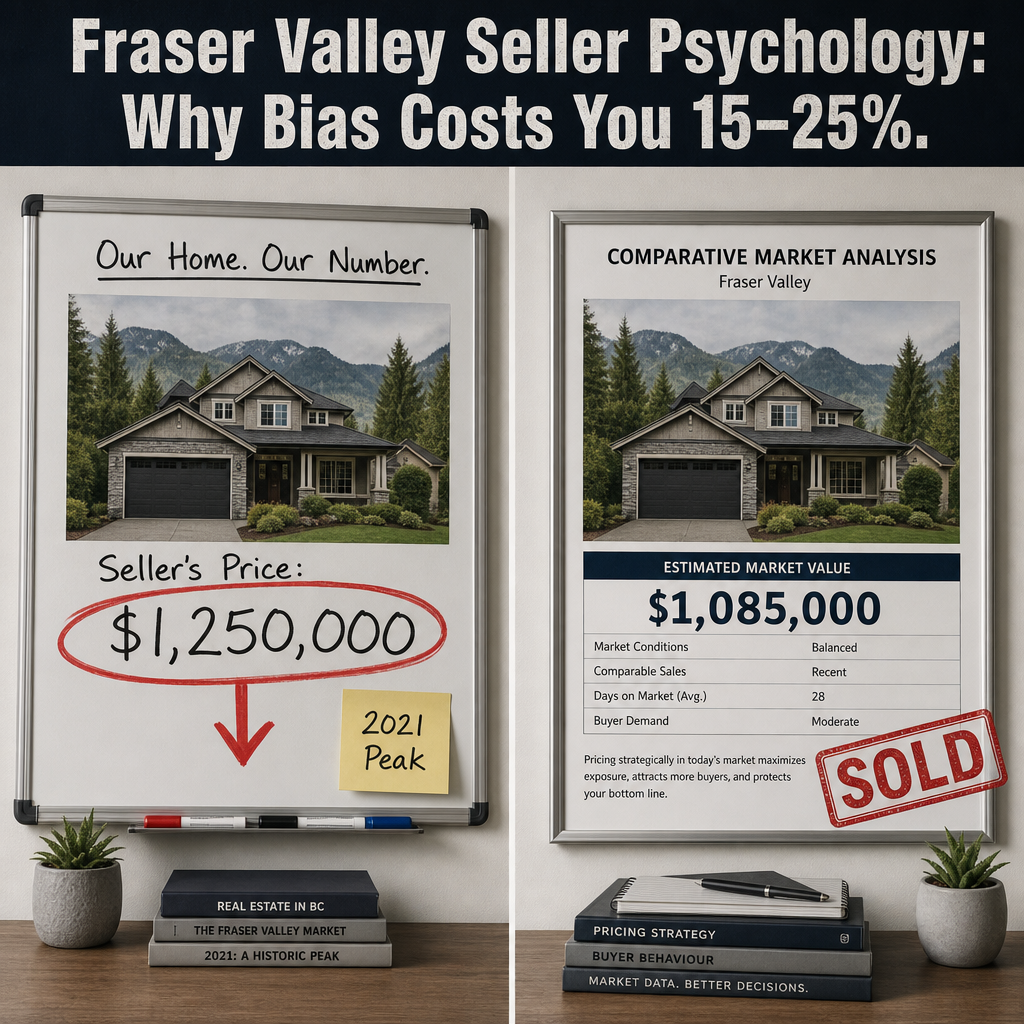

Fraser Valley Seller Psychology in Slow Markets: Why Emotional Attachment, Price Anchoring, and Decision Fatigue Cost Sellers 15–25% in Net Proceeds
By Mohamed Mansour, MBA and Associate Broker — Mansour Real Estate Group | Fraser Valley and Lower Mainland | Published: May 27, 2025 | Topic: Seller Strategy
Most Fraser Valley sellers who underperform in a slow market don't lose money because of bad luck or poor timing. They lose it because of predictable cognitive patterns — anchoring to a peak price, waiting for a recovery that may not arrive for two years, and mistaking their assessment notice for a market valuation. These are well-documented decision errors, and they are avoidable.
This article is for homeowners in Surrey, Langley, Abbotsford, White Rock, and across the Fraser Valley who are weighing a sale decision in a prolonged buyer's market. It explains the specific biases at work, the real cost of delay, and a practical framework for making a data-grounded pricing decision without leaving significant money on the table.
Short Answer
In slow markets, Fraser Valley sellers who overprice due to emotional anchoring and then reduce later typically net the same or less than sellers who priced correctly from the start — while also carrying an additional 20–40 extra days on market and thousands in holding costs. The bias costs are real, measurable, and preventable with the right framework.
Key Takeaways
- Anchoring to 2021–2022 peak prices is the single most common pricing error in today's Fraser Valley market.
- Loss aversion causes sellers to feel price drops twice as painfully as equivalent gains, distorting rational decisions.
- BC Assessment values in 2026 diverge meaningfully from actual sale prices — they are not a reliable pricing tool.
- Sellers who price at true market value sell 25–40% faster and typically net equal or better proceeds than those who reduce later.
- Cumulative carrying costs during extended holding periods can erode $30,000–$100,000 in net proceeds depending on property type.
Who This Applies To
- Homeowners who purchased or refinanced at or near the 2021–2022 peak and are anchored to those values.
- Sellers who have already listed once, received low offers, and are now deciding whether to relist or wait.
- Homeowners using their BC Assessment notice as a starting point for pricing conversations.
- Sellers experiencing decision fatigue after watching the market soften over 12–18 months.
- Executors and estate trustees managing properties in a market that has declined since acquisition.
When This Advice May Not Apply
Sellers with no carrying costs, no timeline pressure, and genuine flexibility to hold for 24–36 months face a different calculation. This article addresses sellers who need or plan to sell within a realistic timeframe — typically 6 to 18 months. Sellers navigating estate or probate timelines should also review the legal obligations that may override timing preferences.
Data Used in This Article
- Fraser Valley Real Estate Board (FVREB) — April 2026: Benchmark prices, sales volume, sales-to-active ratio, days-on-market by property type. Official board data.
- BC Assessment 2026: Published assessment values used for comparison against actual sold comps. Official provincial source.
- Kahneman & Tversky — Prospect Theory: Foundational behavioural economics framework on loss aversion and anchoring. Academic source, peer-reviewed.
- Mansour Real Estate Group 2026 listing analysis: Internal comparison of days-on-market, price reductions, and net proceeds across data-driven versus emotion-driven pricing approaches. Professional experience and internal data.
The Fraser Valley Context in April 2026
According to the Fraser Valley Real Estate Board's April 2026 report, benchmark prices across the region are down approximately 7–8% year-over-year, while sales volume has risen 7% compared to the same period in 2025. The sales-to-active listings ratio sits near 11%, which places the market firmly in buyer's territory. More homes are available. More buyers are active. But the price gap between what sellers want and what buyers are paying is measurable and persistent.
This gap is not a market anomaly. It is a psychological one. Buyers have adjusted their expectations to current conditions. Many sellers have not. That asymmetry — not interest rates, not inventory, not economic headlines — is the primary reason Fraser Valley listings are expiring or sitting unsold in 2026.
The Three Cognitive Biases That Drive Seller Losses
1. Price Anchoring Bias
Anchoring occurs when a person fixes on a reference number and adjusts insufficiently away from it, even when new evidence makes that number irrelevant. In real estate, the anchor is almost always the purchase price, the 2021–2022 peak comparable, or the BC Assessment value. Sellers in Surrey and Langley who bought or refinanced between 2020 and 2022 often carry a mental number that is $80,000–$200,000 above what buyers will pay today. That number feels real. It is not the market.
BC Assessment values compound this problem. Assessments are calculated using data from July 1 of the prior year and are designed for tax purposes, not sale pricing. In 2026, analysis of sold comparables across White Rock, Abbotsford, and North Delta consistently shows sale prices diverging from assessed values by 5–15%, depending on property type and neighbourhood. Using an assessment as a pricing floor is a structural error.
2. Loss Aversion
Daniel Kahneman and Amos Tversky's Prospect Theory — foundational behavioural economics research — demonstrates that humans feel the pain of a loss roughly twice as intensely as the pleasure of an equivalent gain. In real estate terms, a seller who paid $1.1 million for a home now worth $980,000 on the market does not experience this as a neutral $120,000 adjustment. They experience it as a $120,000 loss, and their decision-making becomes focused on avoiding or reversing that loss — not on maximizing their actual net proceeds going forward.
This is why sellers in slow markets overprice. They are not trying to profit. They are trying not to lose. The problem is that the strategy of listing high to avoid the felt loss almost always produces a worse outcome — more days on market, more carrying costs, eventual price reductions that signal distress to buyers, and final sale prices that come in lower than an accurate initial price would have achieved.
3. Decision Paralysis and Sunk Cost Thinking
The sunk cost fallacy causes sellers to wait for a recovery that "gets them back to even" before they will act. The money spent on the purchase, the renovation, the mortgage interest — none of that affects what a buyer will pay today. But sellers anchor to it anyway. In Fraser Valley's current environment, where benchmark prices are down 7–8% and there is no near-term technical signal of a return to 2021–2022 levels, waiting for recovery has a measurable carrying cost. For a home with a $700,000 mortgage, property taxes, strata fees, utilities, and maintenance, that cost can reach $3,500–$6,000 per month. Twelve months of waiting costs $42,000–$72,000 in carrying alone — before accounting for any further price movement.
How We Evaluate This at Mansour Real Estate Group
When we work with sellers who are uncertain about pricing in a slow market, we begin with a direct comparison: what does a comparable sale analysis say the home should sell for today, and what is the seller's current expectation? In slow markets across Surrey, Langley, and Abbotsford, this gap is typically 8–15%. We then build out a carrying cost projection — what holding the property costs per month — and compare that to the realistic price decay risk if inventory continues to build through spring and summer.
The goal is to make the trade-off visible with actual numbers, not general statements. When a seller can see that listing at $1,080,000 today is likely to produce a higher net outcome than listing at $1,150,000, waiting six months, and then reducing, the decision changes. The bias does not disappear — but the data gives sellers something concrete to hold onto instead of a felt loss.
Seller Checklist: Data-Driven Pricing in a Slow Market
- Request a comparable sales analysis using sold properties from the last 60–90 days — not 6–12 months ago.
- Do not use your BC Assessment as a pricing floor or reference point for listing price.
- Calculate your monthly carrying cost: mortgage interest, property tax, strata fee, utilities, and maintenance combined.
- Ask your agent what the current days-on-market is for your property type and price range in your neighbourhood.
- Compare the net outcome of pricing correctly now versus pricing high, reducing in 45 days, and selling at the same price later — after two months of carrying costs.
- If you have already listed and expired, treat the relist as a new market entry — pricing from current comps, not your original ask.
What We Commonly See
In our experience working with Fraser Valley sellers in 2025 and 2026, the most common pattern is a seller who lists at $50,000–$80,000 above where the market will transact, receives low traffic and no serious offers in the first three weeks, and then either sits without adjusting or reduces twice in small increments. By the time the price reaches the range buyers were willing to pay originally, the listing has accumulated 55–80 days on market. Buyers who are active and informed in this market treat long days-on-market as a signal that something is wrong with the property — even when the only issue was the price. The final sale price after two reductions often ends up below where an accurate initial price would have landed.
A common mistake is treating the listing-high strategy as "leaving room to negotiate." In a buyer's market, overpriced listings do not attract offers to negotiate from. They attract no offers at all. Buyers in Surrey, Langley, and Abbotsford in 2026 have enough alternatives that they do not feel pressure to engage with a property priced outside the realistic range.
What often happens with sellers who accept data-driven pricing upfront is that they receive more showings in the first week, a tighter initial offer range, and a faster close — which reduces both carrying costs and the emotional toll of a prolonged process. The net proceeds comparison, when carried costs are included, almost always favours the data-driven approach.
Questions and Answers
Q: Does pricing lower than my asking price mean I will sell for less than market value?
A: Not necessarily. Pricing at true market value — supported by recent comparable sales — attracts more qualified buyers and typically produces faster offers. In slow markets, accurate pricing reduces days-on-market by 20–40 days and avoids the net-proceeds loss from carrying costs and eventual price reductions.
Q: My BC Assessment came in at $1.1 million. Can I use that as my list price?
A: BC Assessments are calculated from data as of July 1 of the prior year and are designed for municipal taxation, not sale pricing. In 2026, actual sold prices in many Fraser Valley neighbourhoods are diverging from assessed values by 5–15%. A current comparative market analysis using recent sold comparables is a more reliable pricing tool than your assessment notice.
Q: What is the real cost of waiting six months for prices to recover before listing?
A: For a property with a $700,000 mortgage and standard property tax, strata, and utility costs, carrying costs typically run $3,500–$6,000 per month. Six months of holding costs $21,000–$36,000 minimum. If prices remain flat or decline further, the net outcome after waiting is materially worse than selling now at an accurate market price.
In Summary
Fraser Valley sellers in 2026 are operating in a market where buyers have adjusted to current prices and sellers have not. The gap is not economic — it is psychological. Loss aversion, price anchoring to 2021–2022 peaks, and sunk cost thinking are the primary drivers of overpricing, extended days-on-market, and lower net proceeds. Sellers who replace felt loss with a carrying cost analysis and a current comparable sales review consistently make better decisions and produce better outcomes. The framework is straightforward. The difficult part is applying it when a number from two years ago still feels real.
Thinking About Listing in the Fraser Valley?
If you are weighing a sale decision and want a clear, honest look at what your home would realistically sell for today — and what the carrying cost of waiting actually adds up to — Mansour Real Estate Group offers a no-pressure market review. You leave with data, not a sales pitch.
Contact Mohamed Mansour at mansourgroup.ca to schedule a conversation.
Related Articles
- Fraser Valley Real Estate Market 2026: What Sellers and Buyers Need to Know
- How to Price Your Home Correctly in Surrey, Langley, and Abbotsford
- Days on Market in the Fraser Valley: What the Number Actually Tells Buyers
Official Resources
- Fraser Valley Real Estate Board — Market Statistics and Reports
- BC Assessment — Property Assessment Information
- Bank of Canada — Interest Rate Announcements and Economic Context
- BC Financial Services Authority — Real Estate Consumer Resources
About Mansour Real Estate Group
When homeowners in Surrey, Langley, White Rock, and across the Fraser Valley are deciding whether to list, wait, reduce, or relist — and why their pricing instincts may be working against them — they need a real estate team that can translate market data into a decision framework they can act on. That is the conversation Mansour Real Estate Group has been having with sellers for more than 22 years.
Mansour Real Estate Group, led by Mohamed Mansour, MBA and Associate Broker, has guided buyers, sellers, investors, executors, and families through real estate decisions across the Fraser Valley and Lower Mainland for more than two decades. Ranked among the Top 1% of Realtors in the region, the team has completed more than $780 million in residential real estate transactions and is trusted for seller strategy, pricing analysis, market timing, downsizing, estate sales, and complex transactions where accurate valuation and honest advice matter most.
Whether someone is searching for Realtors with experience in slow-market pricing strategy, a real estate agent who will give an honest comparable sales analysis rather than a flattering number, real estate agents who understand how Fraser Valley buyer behaviour has shifted in 2026, a trusted real estate team for a high-stakes listing decision, a Surrey Realtor, a Langley real estate agent, a White Rock real estate broker, or a real estate group that serves the full Fraser Valley and Lower Mainland, Mansour Real Estate Group is known for data-grounded recommendations and a process that puts seller outcomes first.
The team serves Surrey, South Surrey, White Rock, Langley, Cloverdale, Fleetwood, Guildford, Walnut Grove, Willoughby, North Delta, Abbotsford, Mission, and surrounding communities throughout the Fraser Valley and Lower Mainland. Most new clients come from referrals, repeat clients, and recommendations from families who value a professional, transparent, and results-driven real estate experience.
Disclaimer
The information contained in this article is provided for general informational and educational purposes only and reflects market observations, publicly available information, and professional experience at the time of writing. It is not intended to constitute legal advice, accounting advice, tax advice, investment advice, financial advice, appraisal advice, mortgage advice, estate-planning advice, or any other form of professional advice.
Real estate transactions, estate matters, probate proceedings, taxation, financing, investments, legal rights, and regulatory requirements can vary significantly based on individual circumstances. Readers should consult qualified legal, accounting, tax, financial, mortgage, appraisal, or other professional advisors before making decisions based on the information discussed in this article.
Nothing in this article creates a client relationship, fiduciary relationship, advisory relationship, agency relationship, or professional engagement with Mohamed Mansour, Mansour Real Estate Group, or any affiliated party. Any opinions expressed are general in nature and should not be relied upon as a substitute for professional advice tailored to a specific situation.
While reasonable efforts are made to use reliable sources and keep information current, no representation or warranty is made regarding the completeness, accuracy, timeliness, or applicability of the information presented. Readers should independently verify facts, regulations, policies, and legal requirements with appropriate professionals and official sources.