
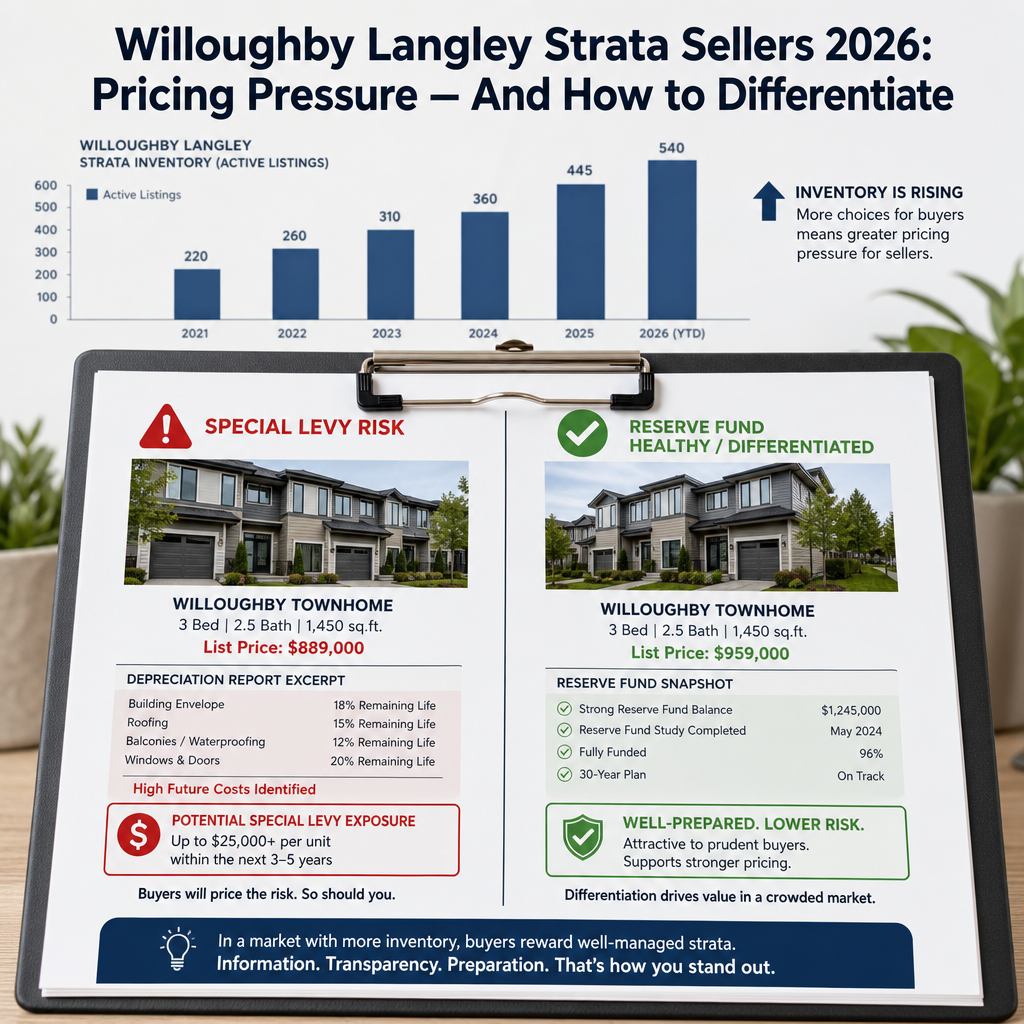

Willoughby Langley Strata Property Sellers 2026: Why Rising Special Levies, Depreciation Report Red Flags, and New Construction Competition Create Pricing Pressure — And How to Differentiate Your Condo or Townhome When Comparable Units Multiply in a Buyer's Market
By Mohamed Mansour, MBA and Associate Broker — Mansour Real Estate Group | Fraser Valley and Lower Mainland, BC | Published: July 8, 2025 | Topic: Condo & Strata · Willoughby Langley · Seller Strategy 2026
Willoughby Langley strata sellers in 2026 are navigating a market shaped by three overlapping forces: a surge in new construction inventory, special levy pressure from aging buildings, and buyers who now scrutinize strata documents before removing subjects. If your unit looks like the twelve others currently listed in the same complex, your price and preparation are the only real differentiators left.
This guide is written specifically for condo and townhome owners in Willoughby who are weighing a 2026 sale. It explains what is driving the pricing pressure, what buyers are actually reacting to, and which preparation steps give a resale unit a measurable advantage over builder inventory and comparable listings.
Short Answer
Willoughby strata sellers in 2026 face a buyer's market shaped by rising inventory, special levy risk, and depreciation report concerns. Sales-to-active ratios for strata properties have softened to roughly 12–15%, according to Fraser Valley Real Estate Board data for the Langley district. Sellers who address reserve fund and document concerns before listing, price relative to active competition rather than historical sales, and distinguish their units from builder inventory will consistently outperform those anchored to 2021–2023 benchmarks.
Key Takeaways
- Willoughby strata inventory has risen an estimated 35–45% year-over-year as new completions enter the resale pool.
- Special levy assessments on aging buildings have triggered 8–15% price corrections in affected Willoughby complexes.
- Sales-to-active ratios near 12–15% confirm buyer leverage — sellers cannot price on optimism alone.
- Buyers are demanding full Form B disclosure and reserve fund analysis before removing subject conditions.
- Differentiation through document readiness, unit condition, and strategic timing is more important than list price alone.
Who This Applies To
- Condo or townhome owners in Willoughby Langley considering a 2026 sale
- Investors holding strata units in buildings with aging infrastructure or unresolved depreciation report findings
- Sellers in complexes where builder-phase units or investor exits are multiplying comparable inventory
- Owners who purchased between 2018 and 2022 and are now evaluating equity positions against current market conditions
When This Advice May Not Apply
Sellers in newer Willoughby buildings with healthy reserve funds, no active special levies, and strong recent comparable sales in a specific floor plan category may find conditions closer to balanced. This guide is most relevant where strata document risk, inventory competition, or builder alternatives are present. Consult your real estate agent and legal advisor for advice specific to your building and situation.
Data Used in This Article
- FVREB Market Data 2026 — Langley District Strata Sales and Active Listings (Official, FVREB)
- BC Strata Property Act and Form B Information Certificate Requirements — Provincial legislation (Official, BC Government)
- CMHC Strata Market Outlook 2026 — National housing agency analysis (Official, CMHC)
- Langley Official Community Plan — Willoughby District — Zoning and development pipeline (Official, City of Langley/Township)
What Is Driving Pricing Pressure in Willoughby Strata in 2026
Willoughby's strata market has shifted materially over the past 18 months. Three forces are compressing prices simultaneously, and understanding each one separately is necessary before developing a strategy to counter them.
New construction inventory: According to the Langley Official Community Plan and development pipeline data, Willoughby has remained one of the most active low-rise and mid-rise construction corridors in the Fraser Valley. As builder projects near or reach completion, the phase-out of builder incentives — assignment guarantees, deposit structures, and upgrade packages — pushes original buyers toward resale exits. Those exits land in the same MLS pool your unit competes in. According to FVREB data for the Langley district, strata inventory in this corridor has risen an estimated 35–45% year-over-year, a meaningful shift that directly reduces the negotiating position of any individual seller.
Special levy and depreciation report pressure: As Willoughby's earlier strata developments — those built in the 2010 to 2017 window — approach the 10 to 15-year mark, depreciation reports are revealing deferred maintenance costs, envelope concerns, and mechanical system replacements. When a depreciation report surfaces unfunded capital needs, it creates a cascading problem: strata corporations pass special levies, buyers encounter financing obstacles because lenders restrict high-ratio mortgage approval on buildings with active special assessments, and appraisers reduce valuations. The result, consistent with CMHC's 2026 strata market analysis, is price corrections of roughly 8–15% in affected buildings relative to comparable inventory in financially healthier complexes. For sellers in those buildings, this is not an abstract risk. It directly affects the pool of qualified buyers who can complete a purchase.
Comparable unit multiplication: In a balanced market, one or two competing listings in the same complex create moderate pricing pressure. In Willoughby's current environment, it is common for three to six units of similar floor plan to be listed concurrently in the same development or adjacent phases. Buyers without urgency simply wait. Sellers who hold firm on historical anchors — prices from 2021 or 2022 — frequently extend their days on market past 45 to 60 days, then reduce. The discount from a price reduction late in the listing cycle is typically larger than the discount from pricing accurately at the outset. Reviewing current active listings for your building and floor plan, with guidance from a Langley real estate agent who tracks Willoughby micro-market data, is the essential first step before setting a list price.
How to Differentiate Your Unit When Comparable Inventory Is High
Differentiation in a saturated strata market does not mean renovation. It means removing the friction that causes buyers to choose another unit — or walk away entirely.
Document readiness: According to the BC Strata Property Act, sellers are required to provide a Form B Information Certificate to buyers upon request. Form B discloses the current monthly strata fees, any outstanding special levies, the status of the contingency reserve fund, and pending bylaw or rules changes. Buyers working with experienced Realtors now request Form B and the most recent depreciation report before making offers — sometimes before scheduling showings. Sellers who have these documents organized, who can articulate reserve fund adequacy, and who proactively address known strata issues in their listing narrative move faster through subject removal. Sellers who are unprepared face extended due diligence timelines, renegotiations after subjects are submitted, and higher deal-collapse risk. Requesting your Form B from the strata management company and reviewing it for red flags before listing is not optional in 2026 — it is foundational.
Unit condition and finish differentiation: In a building where multiple floor plans are active, buyers gravitate toward units that show clearly better than the listing price suggests. This does not require full renovation. Fresh paint in neutral tones, replaced light fixtures, professional cleaning, and staged furniture arrangement can shift a unit from "comparable" to "preferred" in a buyer's perception — particularly when competing against builder-spec finishes that are functional but impersonal. Buyers comparing a resale unit against new builder inventory are often willing to pay a premium for condition, privacy maturity (established trees, landscaping, settled common areas), and the ability to see the actual space rather than a show suite. Those advantages need to be visible at showing, not described in the listing remarks.
Parking and storage positioning: In Willoughby's mid-rise and townhome market, two parking stalls, a larger storage locker, or a corner unit with additional windows are genuine differentiators against builder inventory where those features come at a significant premium. If your unit carries those advantages, they need to be named specifically in the listing and reflected in the pricing analysis — not buried in the fine print.
Timing relative to summer inventory: Based on FVREB seasonal patterns for Langley district strata, the spring-to-summer transition (April through July) typically brings the largest surge in new listings. Sellers who exit before that inventory surge — or who have their preparation complete and can list immediately at the first spring demand signal — avoid competing against the broadest pool of comparable units. Sellers who list in July or August when inventory has already peaked face the weakest negotiating conditions of the year. If your building has depreciation report concerns or an active special levy, timing matters even more: listing before a levy vote or before a report is formally circulated gives buyers less financial friction to navigate.
How We Evaluate This
When Mansour Real Estate Group evaluates a Willoughby strata listing, the process begins with the building, not the unit. We review the most recent depreciation report, the current reserve fund balance, any active or pending special levies, the strata meeting minutes from the past two years, and the Form B before discussing list price. Building health directly affects buyer pool size — a unit in a financially stressed complex will face financing restrictions that limit qualified buyers to cash purchasers or high-down-payment buyers, which narrows the market and suppresses price.
We then map active competition at the floor plan level, not just the building level. A seller's real competition is any unit in Willoughby that a buyer would consider an alternative — that includes adjacent phases, neighboring developments, and builder inventory. Pricing relative to that active competition, adjusted for unit-specific differences in condition, parking, floor level, and strata health, produces a list price that is defensible when buyers present their own analysis at subject removal.
Condo Seller Checklist — Willoughby Langley 2026
- Request your Form B Information Certificate from the strata management company and review it for special levies, reserve fund status, and outstanding receivables.
- Obtain the most recent depreciation report and identify any capital items flagged within a 5-year horizon that buyers may raise during due diligence.
- Review strata council meeting minutes from the past 24 months for any discussions about assessments, repairs, or bylaw changes that affect resale value.
- Map your active competition at the floor plan level across your complex and comparable Willoughby developments, including any builder inventory currently releasing units.
- Complete cosmetic preparation — paint, cleaning, fixture updates, and staging — before photography, not after the first price reduction.
- Price relative to current active competition, not historical sales. In a buyer's market with 12–15% sales-to-active ratios, optimistic pricing extends days on market and typically results in a larger final discount than accurate initial pricing.
- Time your listing entry to precede peak inventory periods — early spring or late fall tend to provide better buyer-to-listing ratios than mid-summer in Willoughby strata.
- Prepare a concise written summary of your building's strata health — reserve fund balance, no active special levies, recent repairs completed — to share with buyer agents proactively.
What We Commonly See
Sellers anchored to 2021–2022 pricing: In our experience, the most common reason a Willoughby strata listing sits unsold past 30 days is a list price built on peak-market comparables rather than current active competition. Buyers in a 12–15% sales-to-active environment are not competing — they are selecting. A unit priced 5% above what comparable active listings are asking will almost always sit while buyers choose the better-priced alternative.
Undisclosed strata document risk entering the offer stage: What often happens is that a seller receives an offer, subjects are submitted, the buyer's agent pulls Form B and the depreciation report, and the buyer either renegotiates significantly or terminates. This is avoidable. When strata document risk is identified before listing, it can be addressed through pricing, disclosure strategy, or timing — rather than discovered by the buyer during subjects and used as leverage against the seller's equity.
Listing without differentiating from builder competition: A common mistake is treating a resale listing as a straightforward comparable-sales exercise when builder inventory is actively competing in the same development corridor. Builder units offer warranties, GST-included pricing structures, and new appliances. Resale sellers need to make the advantages of their unit — established landscaping, actual square footage (not rendered), no GST, and visible condition — explicit in the listing. Buyers choosing between builder and resale inventory need a reason to prefer resale. That reason needs to be in the listing, not assumed.
Key Definitions
Form B Information Certificate: A document required under the BC Strata Property Act that discloses current strata fees, special levies, reserve fund balance, and any legal proceedings involving the strata corporation. Buyers are entitled to request it, and sellers should understand its contents before listing.
Depreciation Report: A long-term capital planning document required for most BC stratas with five or more units. It outlines the condition of common property components and projects repair and replacement costs over 30 years. Findings that reveal underfunded reserves or near-term capital needs can deter buyers and restrict lender financing.
Special Levy: A one-time assessment charged to strata unit owners to cover capital expenses not covered by the contingency reserve fund. Active special levies must be disclosed on Form B and can restrict high-ratio mortgage approvals for buyers.
Sales-to-Active Listings Ratio: A market health indicator calculated by dividing sales in a period by total active listings. Ratios below 12% generally favour buyers strongly. The Willoughby strata market is currently operating at approximately 12–15% based on FVREB Langley district data, consistent with a buyer's market condition.
Questions and Answers
How does a special levy affect my ability to sell my Willoughby strata unit?
An active special levy must be disclosed on Form B. If the levy is significant, it can prevent buyers from obtaining high-ratio mortgage financing, reducing your qualified buyer pool to those with larger down payments. This directly suppresses price and extends time on market. Some sellers negotiate to pay outstanding levies as part of the sale terms. Consult your real estate agent and legal advisor for your specific situation.
Can I still sell competitively if my building has a recent depreciation report with concerns?
Yes, but pricing and disclosure strategy matter. Buyers will review the report during subjects. A seller who has already priced the findings into the list price, can explain what repairs have been completed, and can demonstrate an adequate reserve fund timeline will face fewer renegotiations than one whose pricing does not reflect the building's documented risk profile.
Is new construction in Willoughby directly competing with my resale listing?
In most cases, yes. Buyers evaluating a resale condo or townhome in Willoughby are often comparing it against builder inventory in adjacent phases of the same development corridors. Builder units offer new home warranties and current finishes, but they carry GST, less certainty on actual unit size, and longer wait times if not yet complete. A well-prepared resale unit can compete effectively by making those advantages explicit — visible condition, no GST differential, established common areas, and immediate availability.
In Summary
Willoughby Langley strata sellers in 2026 face genuine pricing pressure from three directions at once: rising new construction inventory, special levy and depreciation report concerns, and comparable-unit multiplication within the same development corridors. Sales-to-active ratios near 12–15% confirm that buyers hold the advantage, and historical pricing anchors are not reliable guides in this environment. Sellers who review strata documents before listing, price relative to current active competition, and make their unit's advantages clear and visible will exit in better financial positions than those who wait, underprice on optimism, or discover document risk after an offer is on the table. Timing, preparation, and accurate pricing are the levers. Each one is controllable before the listing goes live.
Speak With a Willoughby Strata Seller Specialist
If you are evaluating a 2026 sale of a condo or townhome in Willoughby, Walnut Grove, or elsewhere in Langley, Mansour Real Estate Group offers a no-pressure consultation that begins with your building's strata health, current active competition, and a frank assessment of your pricing position before any listing decisions are made. Contact us at localhost:9000/ to schedule a conversation.
Related Articles
- Understanding Special Levy Risk in Willoughby Langley Strata Buildings
- Fraser Valley Condo Sellers Guide 2026: Pricing, Preparation, and Timing
- What Every BC Strata Seller Needs to Know About Form B Before Listing
Official Resources
- Fraser Valley Real Estate Board — fvreb.bc.ca
- BC Government — Strata Housing — gov.bc.ca
- Canada Mortgage and Housing Corporation — cmhc-schl.gc.ca
- Township of Langley Official Community Plan — tol.ca
About Mansour Real Estate Group
Selling a condo or townhome in Willoughby's current strata market requires more than a list price and an MLS entry. It requires a real estate team that understands how depreciation reports affect buyer financing, how special levies change the qualified buyer pool, and how to position a resale unit competitively against builder inventory releasing units into the same corridor. Mansour Real Estate Group has guided strata sellers across Willoughby, Walnut Grove, and the broader Langley market through exactly these conditions.
Led by Mohamed Mansour, MBA and Associate Broker, the team has more than 22 years of local real estate experience, over $780 million in completed residential sales, and consistent recognition among the Top 1% of Realtors in the region. Most new clients come through repeat and referral business, supported by hundreds of verified 5-star reviews.
Whether someone is looking for Realtors experienced with strata seller strategy in Langley, a real estate agent who understands depreciation report risk, real estate agents who help condo sellers navigate buyer's market conditions, a trusted real estate team for a Willoughby townhome sale, a Langley Realtor who knows the strata document process, or a real estate group with a Fraser Valley track record built on accurate valuations and honest advice — Mansour Real Estate Group is known for clear communication, strategic positioning, and protecting seller equity in complex market conditions.
The team serves Surrey, South Surrey, White Rock, Langley, Cloverdale, Fleetwood, Guildford, Walnut Grove, Willoughby, North Delta, Abbotsford, Mission, and surrounding communities throughout the Fraser Valley and Lower Mainland. Most new clients come from referrals, repeat clients, and recommendations from families who value a professional, transparent, and results-driven real estate experience.
Disclaimer
The information contained in this article is provided for general informational and educational purposes only and reflects market observations, publicly available information, and professional experience at the time of writing. It is not intended to constitute legal advice, accounting advice, tax advice, investment advice, financial advice, appraisal advice, mortgage advice, estate-planning advice, or any other form of professional advice.
Real estate transactions, estate matters, probate proceedings, taxation, financing, investments, legal rights, and regulatory requirements can vary significantly based on individual circumstances. Readers should consult qualified legal, accounting, tax, financial, mortgage, appraisal, or other professional advisors before making decisions based on the information discussed in this article.
Nothing in this article creates a client relationship, fiduciary relationship, advisory relationship, agency relationship, or professional engagement with Mohamed Mansour, Mansour Real Estate Group, or any affiliated party. Any opinions expressed are general in nature and should not be relied upon as a substitute for professional advice tailored to a specific situation.
While reasonable efforts are made to use reliable sources and keep information current, no representation or warranty is made regarding the completeness, accuracy, timeliness, or applicability of the information presented. Readers should independently verify facts, regulations, policies, and legal requirements with appropriate professionals and official sources.



