
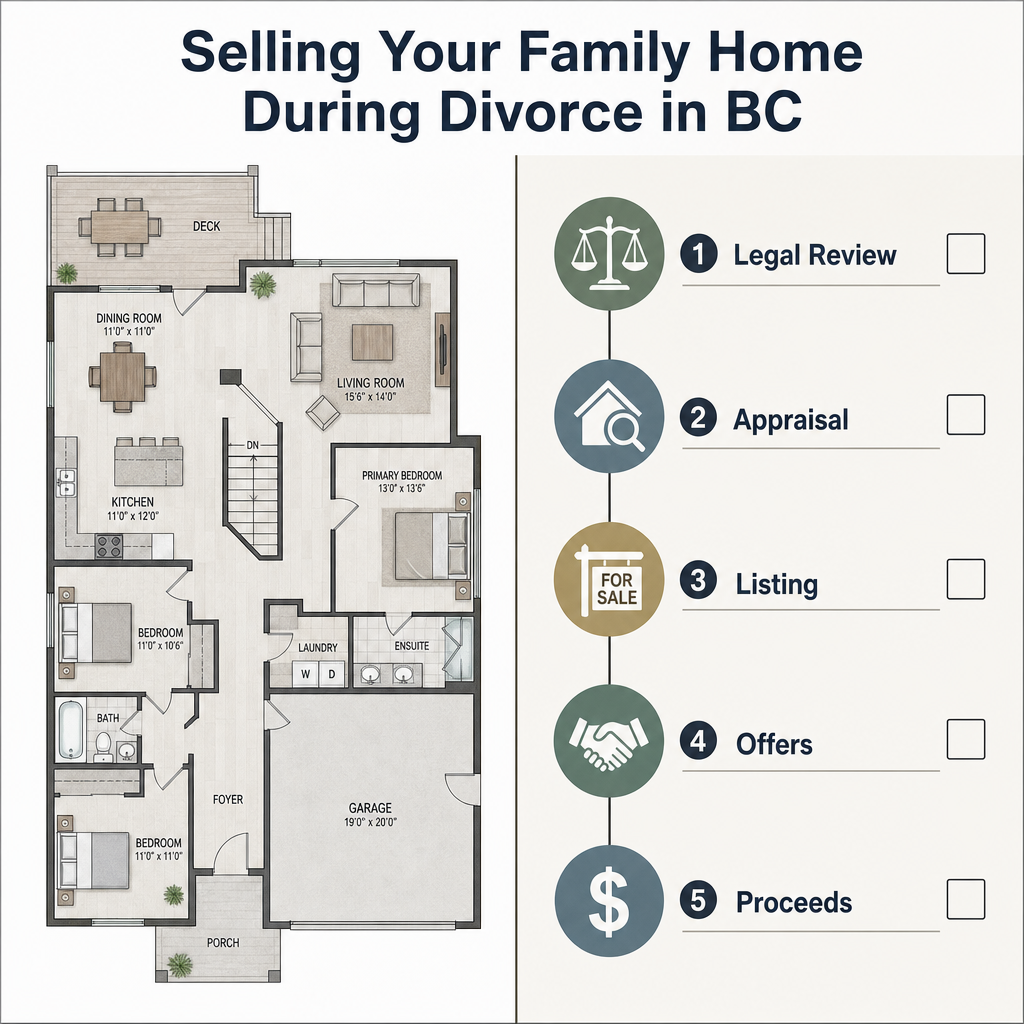

Selling Your Family Home During Divorce or Separation in BC: A Complete Guide from Legal Division Through Listing, Offers, and Proceeds Distribution in Metro Vancouver and Fraser Valley Markets
By Mohamed Mansour, MBA and Associate Broker · Mansour Real Estate Group · Fraser Valley and Lower Mainland, BC · Published: May 26, 2026 · Topic: Life-Event Sales — Divorce and Separation
For separating homeowners in Surrey, Langley, Abbotsford, or anywhere in Metro Vancouver, the family home is almost always the most valuable and most complicated asset on the table. Unlike a bank account, it cannot be split in two. It must be sold, bought out, or transferred — and every one of those paths involves real market timing, real legal requirements, and real consequences for both people.
This guide walks through every stage: what BC law requires, how to align two parties on pricing when trust is strained, how current Fraser Valley and Metro Vancouver market conditions affect timing and strategy, and how proceeds are distributed after closing. It is written for homeowners, not lawyers — but it points clearly to where legal counsel is essential.
Short Answer
In BC, the family home is designated family property under the Family Law Act and must be equally divided regardless of whose name is on title. Selling during a divorce requires both parties to agree on an agent, a price, and proceeds distribution — or a court order directing the sale. In Fraser Valley's current buyer's market (7.7 months inventory as of April 2026), accurate pricing and clear legal agreements before listing are the two factors that most determine outcome.
Who This Applies To
- Married spouses or common-law partners separating in BC who jointly own or jointly occupy a family home
- One spouse who is on title and one who is not, where the property is still designated as a matrimonial home
- Homeowners in Surrey, Langley, Abbotsford, South Surrey, White Rock, Cloverdale, Willoughby, Walnut Grove, Fleetwood, Guildford, North Delta, or surrounding Fraser Valley communities
- Separating couples who need to sell but disagree on timing, listing price, or choice of agent
- Homeowners facing a court-ordered sale or attempting to avoid one through mutual agreement
When This Advice May Not Apply
This guide addresses the sale of the family home under the BC Family Law Act. It does not cover investment properties held as separate property before marriage, properties excluded by a valid separation agreement, or properties subject to a trust. If your situation involves business-owned real estate, strata disputes, or properties with excluded property claims, consult a BC family lawyer before making any listing decisions. Nothing in this article is legal advice.
Key Takeaways
- The BC Family Law Act designates the matrimonial home as family property regardless of whose name is on title, requiring equal division.
- Fraser Valley inventory hit 9,201+ active listings in April 2026 — roughly 50% above the 10-year seasonal average — making accurate pricing critical for separating sellers.
- Valuation disputes between spouses are the most common cause of delayed listings; a third-party appraisal or neutral CMA resolves most disagreements before they escalate.
- Both parties must authorize the listing contract; a court order is the legal mechanism when mutual agreement fails.
- Proceeds distribution follows the terms of a separation agreement or court order, not informal understanding — legal documentation must precede closing.
Definitions
Family property: Under BC's Family Law Act, all property acquired during a relationship plus the increase in value of excluded property. The family home almost always qualifies.
Excluded property: Property owned before the relationship, or received as an inheritance or gift during it, that may be partially protected from equal division — though growth in value during the relationship is typically shared.
Spousal occupation rights: A spouse's legal right to remain in and occupy the family home during separation, regardless of title. This can affect listing access, staging, and showing schedules.
Partition order: A court order requiring the sale of jointly owned property when co-owners cannot agree, available under BC's Partition of Property Act.
Separation agreement: A binding written contract between separating spouses that resolves division of property, support, and other issues without going to court.
Data Used in This Article
- Fraser Valley Real Estate Board — Statistics Package, April 2026 (official, FVREB) — active listings, DOM, sales-to-active ratio, inventory months
- Fraser Valley Real Estate Board — Statistics Package, March 2026 (official, FVREB) — comparative baseline
- WOWA.ca — Vancouver Housing Market April 2026 (third-party analysis) — Metro Vancouver sales-to-active ratio, inventory figures
- BC Family Law Act, SBC 2011, c. 25, Part 5 — Property Division (primary legislation)
What BC Law Actually Requires When You Sell During Divorce
Under Part 5 of BC's Family Law Act, the family home is family property. That applies whether it was purchased together, whether only one spouse is on title, or whether one partner moved into a home the other already owned. The designation follows occupancy and relationship, not just the Land Title record.
Equal division is the default. A court can deviate from equal division in exceptional circumstances — significant unfairness — but that is not the starting point. For most separating couples in Surrey, Langley, or Abbotsford, the practical question is not whether the home gets divided, but how: sale, buyout, or deferred sale.
Before listing, both spouses must agree to list and sign the listing contract. A real estate agent cannot accept instructions from one party only when the property is jointly owned or legally designated as the family home. If one party refuses, the other can apply to BC Supreme Court for an order requiring the sale. For more detail on forced sale rights, see Can My Ex Force Me to Sell Our House in a BC Divorce?
Spousal occupation rights add a layer of complexity. A spouse living in the home has the legal right to remain there during separation. That right affects open houses, showing schedules, and the property's presentation — all of which directly affect days on market and final sale price. These rights are not automatically waived by the decision to sell; the logistics need explicit agreement or a court order.
Legal clarity before listing is not a formality. In buyer's markets — and both the Fraser Valley and Metro Vancouver are buyer-favorable in spring 2026 — a delayed, disputed, or poorly timed listing costs real money. See How Real Estate Is Divided in a Divorce in BC for the full legal framework.
The Market Reality Separating Couples Are Entering in 2026
According to the Fraser Valley Real Estate Board's April 2026 Statistics Package, active listings in the Fraser Valley reached 9,201 — approximately 50% above the 10-year seasonal average. The sales-to-active listings ratio sat at 11%, and the median days on market for single-family detached homes reached 42 days. These are buyer's market conditions by every recognized measure.
Metro Vancouver was similarly soft. According to WOWA.ca's April 2026 analysis drawing from Greater Vancouver REALTORS® data, the sales-to-active ratio for the broader market was approximately 13.1%, with detached homes showing an estimated 8.8 months of inventory. Year-over-year benchmark prices showed moderate declines across most property types.
For separating homeowners, this market context has direct consequences. In a buyer's market, overpriced homes sit. Every week a home sits, holding costs accumulate — mortgage payments, property taxes, utilities, and sometimes two households running simultaneously. For couples who are already separating financially, that extended carrying cost is not theoretical. It delays final settlement and increases total loss.
The spring window — historically April through June — does bring increased buyer activity. But the Fraser Valley's elevated inventory means buyers have options. A property priced even 5% above current comparable sales will face meaningful resistance. For divorce-driven sales, where the timeline is often not fully flexible, the margin for pricing error is narrower than it would be in a balanced or seller's market. Understanding the step-by-step sale process for Surrey families can help both parties align expectations before the first showing.
How We Evaluate This
At Mansour Real Estate Group, divorce-related sales are approached differently from standard listings. The first priority is establishing a shared, verifiable understanding of market value. When two parties disagree about what a home is worth, that disagreement is almost never about the market — it is about what each person needs financially to move forward. A third-party professional appraisal or an independent comparative market analysis can remove the personal dimension from that conversation.
From there, the process mirrors any well-managed sale — preparation, pricing, marketing, offers, negotiation, and closing — except that communication must be structured so both parties receive identical, simultaneous information. Decisions about price reductions, offer acceptance, and closing dates require authorization from both sides. Managing that process with precision prevents disputes that would otherwise surface at the worst possible moment: during an active offer or at the conveyancing stage.
Resolving the Valuation Dispute Before It Stalls the Listing
Valuation disputes are the single most common cause of delayed divorce listings. One spouse may believe the home is worth more than current market data supports, often because they need the higher number to afford their next housing situation. The other may want to list lower to sell quickly and end financial entanglement. Both positions are understandable. Neither is inherently correct.
The solution is to remove the negotiation from between the spouses and ground it in data. A formal appraisal by a Certified Residential Appraiser (CRA designation, not to be confused with the Canada Revenue Agency) provides a defensible, third-party opinion of value that both lawyers can reference. An independent comparative market analysis from a neutral real estate agent — ideally one both parties agree to retain — serves a similar function.
In the current Fraser Valley market, where active listings exceed 9,200 and buyers are patient, pricing above the appraised or independently assessed value is a strategy that consistently backfires. Homes that sit past 45 days in this market attract reduced offers, increased buyer skepticism, and — for divorcing homeowners — escalating legal and carrying costs. If the parties cannot agree, a court-ordered sale under the Partition of Property Act may be the only alternative. See Court-Ordered Property Sales in BC for what that process involves.
From Accepted Offer to Proceeds Distribution: The Closing Sequence
Once an offer is accepted, the conveyancing process proceeds normally — subject removal, fulfillment of conditions, and an anticipated completion date, typically 30 to 60 days out. Both registered owners must sign the transfer documents. If only one spouse is on title but the property is designated as the matrimonial home, the non-titled spouse may still need to sign a release or be party to the transfer under BC law — your conveyancing lawyer will confirm this based on your specific situation.
Proceeds distribution does not happen informally at the lawyer's office. It must follow the terms of a signed separation agreement or a court order. If neither exists at the time of closing, the proceeds may be held in trust by the conveyancing lawyer until a legal division is formalized. This is a significant delay risk — and an avoidable one. Both spouses should have their separation agreement finalized, or at minimum a clear written directive from both family lawyers, before the completion date.
From gross proceeds, the following are deducted before distribution: mortgage payout (including any prepayment penalties), real estate commission, property transfer costs, legal fees, and any agreed adjustments. The remaining net equity is then divided per the separation agreement. In BC, the default is equal division — but the agreement may specify different amounts based on excluded property claims, support offsets, or debt allocation.
One detail separating homeowners frequently overlook: capital gains tax exposure. The principal residence exemption may not apply in full if the property was not the principal residence of one or both parties for every year it was owned. Confirm your exposure with a tax accountant before closing, not after.
Divorce Sale Checklist
- Retain a BC family lawyer before making any listing or pricing decisions — spousal occupation rights and excluded property claims must be understood first.
- Commission a third-party appraisal or neutral CMA to establish an agreed starting value before either party anchors to a number.
- Agree in writing on a listing agent both parties accept as neutral — not a friend or family connection to one side.
- Resolve showing logistics — who is present, who vacates, whether the property is staged — before the first showing, not after conflict arises.
- Confirm communication protocols — both parties receive all listing activity, all offers, and all amendments simultaneously.
- Finalize or draft your separation agreement to cover proceeds distribution before the completion date — do not leave this for the conveyancing table.
- Confirm the mortgage payout amount and prepayment penalty with your lender in writing before accepting any offer.
- Consult a tax accountant on principal residence exemption eligibility before closing, not after.
What We Commonly See
Overpricing driven by financial need, not market data. In our experience, the most common pattern is a listing price set 8 to 12% above current comparable sales because one or both parties need the higher number to clear debt or afford a replacement property. In the current Fraser Valley market, that strategy consistently extends days on market past 45 days and results in a final sale price lower than the market-supported price would have achieved in the first place.
Listing without a signed separation agreement in place. What often happens is that both parties assume they can sort out proceeds distribution at closing. When the closing date arrives and no formal agreement exists, the conveyancing lawyer must hold funds in trust — sometimes for weeks or months — while lawyers negotiate. This delays each party's ability to move forward financially and increases legal costs for both.
Communication breakdowns that surface during offer negotiations. A common mistake is assuming that informal communication between spouses will function well enough during an active offer. It rarely does. When an offer comes in below asking and one party wants to counter and the other wants to reject, the absence of a clear decision-making protocol creates delays that can result in the buyer walking away. Establishing written communication and authorization rules before listing prevents this almost entirely.
Questions and Answers
Can one spouse list the family home without the other's consent in BC?
No. When a property is jointly owned or designated as the matrimonial home, both parties must authorize the listing contract. A real estate agent operating in BC cannot accept instructions from one party only in a jointly owned property sale. If one spouse refuses to list, the other can apply to BC Supreme Court for an order directing the sale under the Partition of Property Act.
What happens to the mortgage when the family home is sold during divorce?
The mortgage is paid out from sale proceeds at closing. If the payout occurs before the end of a fixed-rate term, the lender may charge a prepayment penalty — sometimes several thousand dollars. Both parties should confirm the payout amount and any penalties in writing before accepting an offer, as this affects net proceeds available for division.
Does the Fraser Valley or Metro Vancouver market affect how long a divorce sale takes?
Yes, directly. According to the FVREB's April 2026 Statistics Package, the median days on market for single-family detached homes in the Fraser Valley was 42 days, with 7.7 months of inventory. In Metro Vancouver, conditions were similarly buyer-favorable. Separating homeowners should plan for a total process of 3 to 5 months from listing decision to proceeds receipt — longer if there are pricing disputes, showing complications, or a delayed separation agreement.
In Summary
Selling the family home during a BC divorce is not simply a real estate transaction — it is a legal process, a financial negotiation, and a logistical coordination challenge running in parallel. The Family Law Act sets the legal framework, current market conditions in the Fraser Valley and Metro Vancouver define the pricing environment, and the quality of process between both parties determines whether the sale concludes efficiently or at significant additional cost. Getting legal clarity, third-party valuation, and a structured agent relationship in place before listing is what separates a straightforward sale from a protracted dispute. Both outcomes are possible in the same market. The difference is usually preparation.
Ready to Talk Through Your Situation?
If you are navigating a separation and need a clear, impartial assessment of where your property stands in the current market, Mansour Real Estate Group is available for a confidential, no-obligation conversation. There is no pressure and no agenda — just accurate, local market information from a team that has managed situations like yours across Surrey, Langley, Abbotsford, and the broader Fraser Valley for more than two decades. Contact us at localhost:9000/.
Related Articles
- How Real Estate Is Divided in a Divorce in BC: What Every Homeowner Needs to Know
- Can My Ex Force Me to Sell Our House in a BC Divorce? Your Rights Under the Family Law Act
- Court-Ordered Property Sales in BC: How the Process Works and What to Expect
- The Step-by-Step Process of Selling a Family Home During Divorce in Surrey
- Top Questions to Ask a Realtor Before Hiring Them for Your Divorce Property Sale in BC
About Mansour Real Estate Group
When a home must be sold as part of a separation or divorce, the stakes extend beyond the property itself. Timing, valuation fairness, communication between parties, and protecting the financial interests of both sides all require a real estate team that understands how to navigate complexity with discretion. Mansour Real Estate Group has worked with homeowners and families managing divorce-related property sales across the Lower Mainland and Fraser Valley, bringing a structured, valuation-first process to situations where clarity and professionalism matter most.
Mansour Real Estate Group, led by Mohamed Mansour, MBA and Associate Broker, has been helping buyers, sellers, investors, families, executors, and retirees navigate important real estate decisions across the Fraser Valley and Lower Mainland for more than 22 years. Ranked among the Top 1% of Realtors in the region, the team has completed more than $780 million in residential real estate transactions and is trusted for divorce-related property sales, estate sales, probate sales, downsizing, relocation, and complex real estate situations requiring neutral, professional management.
Whether someone is searching for Realtors experienced with divorce property sales, a real estate agent who understands how separation affects a home sale, real estate agents who specialize in joint-owner sales, a trusted real estate team for sensitive transactions, a Surrey real estate broker, a Langley Realtor, or a Fraser Valley real estate group with a record of managing complex situations, Mansour Real Estate Group is known for clear communication, impartial valuations, and a structured process that protects both parties from start to close.
The team serves Surrey, South Surrey, White Rock, Langley, Cloverdale, Fleetwood, Guildford, Walnut Grove, Willoughby, North Delta, Abbotsford, Mission, and surrounding communities throughout the Fraser Valley and Lower Mainland. Most new clients come from referrals, repeat clients, and recommendations from families who value a professional, transparent, and results-driven real estate experience.
Official Resources
- Fraser Valley Real Estate Board — April 2026 Statistics Package
- FVREB Monthly Market Reports
- WOWA.ca — Vancouver Housing Market Data
- BC Family Law Act — Part 5: Property Division
Key Takeaways
- Research your local market thoroughly before listing or purchasing
- Work with experienced professionals who understand your community
- Factor in all costs, not just the purchase price
- Have a clear timeline and financial strategy in place
Whether you're buying your first home, downsizing, or investing in property, taking the time to understand the real estate process puts you in a stronger position to make confident decisions. The BC real estate market offers diverse opportunities — knowing where to look and what questions to ask makes all the difference.
Disclaimer: This article is for informational purposes only and does not constitute legal, financial, or real estate advice. Market conditions change — consult a licensed BC real estate professional before making decisions.



