

Abbotsford Property Type Divergence 2026: Why Detached Home Sales Surge While Townhouses Post 78% Absorption and Condos Retreat — Strategic Pricing and Timing for Sellers Across All Three Segments
By Mohamed Mansour, MBA, Associate Broker — Mansour Real Estate Group | Fraser Valley & Lower Mainland | Published: September 2, 2026
Abbotsford's real estate market in August 2026 is not one market. It is three separate markets moving in sharply different directions, and the segment your property sits in now determines your negotiating position, your pricing ceiling, and your realistic timeline more than any other factor. For sellers, understanding that divergence before listing is not optional — it is the foundation of every strategic decision that follows.
According to August 2026 data from the Fraser Valley Real Estate Board's municipal market report, detached homes are holding ground, townhouses are absorbing at a pace that signals acute buyer demand, and condos are under persistent pressure from oversupply. Sellers who understand which story their property belongs to will make better decisions. Sellers who apply one generic strategy across all three will not.
Short Answer
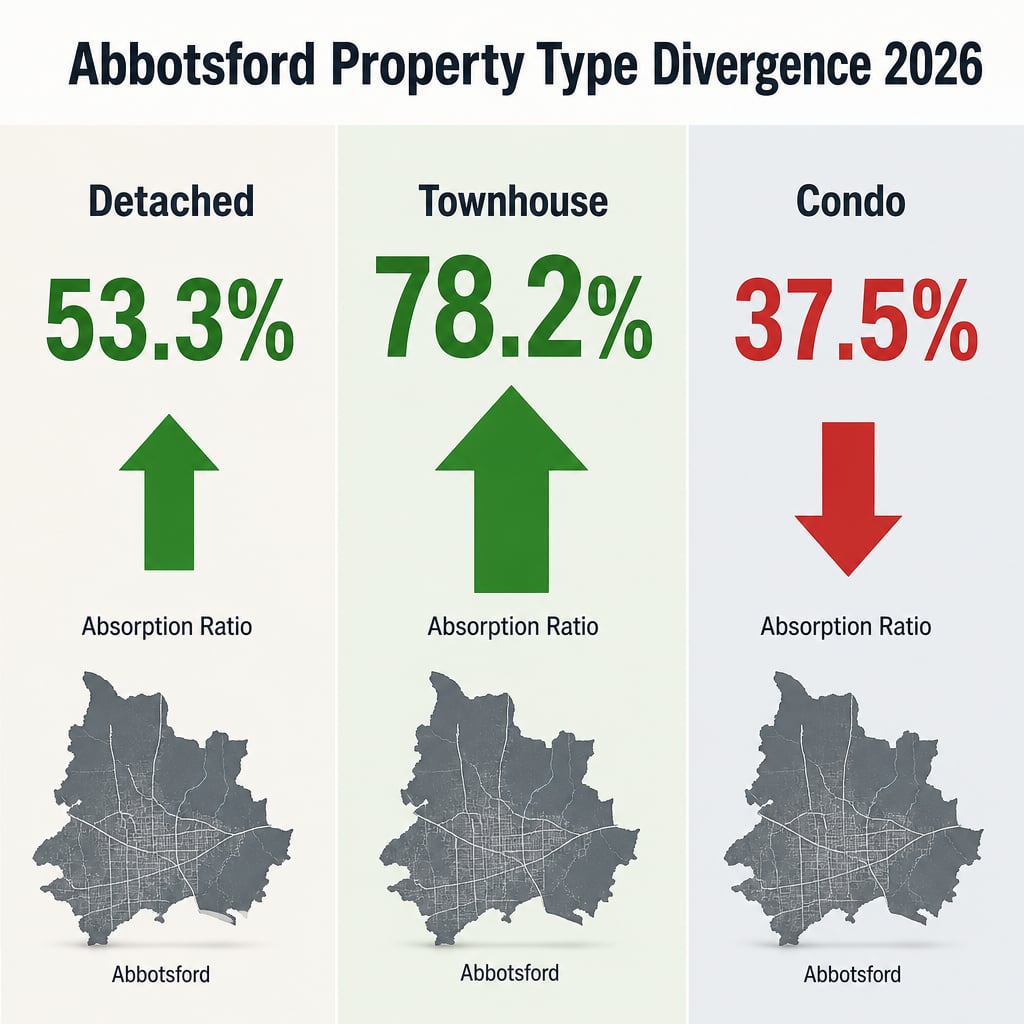
In August 2026, Abbotsford detached homes posted a 53.3% sales-to-new-listings ratio, townhouses reached 78.2% — indicating strong seller conditions — and condos fell to 37.5%, reflecting oversupply and buyer hesitation. Property type now determines pricing power more than overall market conditions. Sellers in each segment need a distinct strategy.
Key Takeaways
- Townhouses are Abbotsford's strongest segment at 78.2% absorption — sellers have real pricing leverage.
- Detached homes at 53.3% absorption and only a 7.9% annual price decline show solid resilience.
- Condo sellers face the hardest conditions: 37.5% absorption and a 10.9% annual price decline.
- Segment-specific pricing strategy now matters more than overall Abbotsford market direction.
- Move-up buyer demand from condos into townhouses is actively driving the townhouse absorption surge.
Who This Applies To
- Abbotsford homeowners deciding whether to list a detached home in 2026
- Townhouse owners weighing pricing strategy and timing
- Condo owners evaluating whether to sell, wait, or reposition
- Investors deciding which Abbotsford property type to exit or hold
- Families planning a move-up sale from a condo or townhouse
When This Advice May Not Apply
Sellers with unique properties — mixed-use zoning, acreage, commercial components, or active tenancy situations — will face different dynamics than those reflected in MLS HPI benchmark averages. This analysis applies to standard residential resale transactions in Abbotsford's three primary property segments.
Data Used in This Article
- Fraser Valley Real Estate Board Municipal Market Report — August 2026 | Abbotsford | Official board statistics
- valuefirstcanada.com Abbotsford Market Update — August 2026 | MLS HPI benchmark prices and sales-to-new-listings ratios by property type | Third-party analysis
- Zealty.ca Abbotsford 2026 Market Breakdown — August 2026 | Active listing counts and segment comparisons | Third-party analysis
Understanding the Three Market Signals
The sales-to-new-listings ratio is the clearest, fastest read on supply-demand balance in a local market. When more than 60% of new listings sell within the reporting period, sellers hold pricing power. Between 40% and 60%, conditions are balanced. Below 40%, buyers have the advantage and inventory accumulates. Abbotsford's three property segments in August 2026 sit in all three zones simultaneously — and that separation is the story.
Detached homes posted 56 sales against 105 new listings for a 53.3% ratio, according to the FVREB's August 2026 municipal data. The benchmark price came in at $1,117,700 — down only 2.2% month-over-month and 7.9% year-over-year. For a segment priced above $1 million, that level of price stability signals that qualified buyers are still active and that lot value, suite income potential in areas like Sumas Mountain and East Abbotsford, and larger footprints are sustaining demand where entry-level product is faltering.
Townhouses are the clearest opportunity in the current Abbotsford market. Forty-three sales against 55 new listings produces a 78.2% absorption ratio — well into seller's market territory. The benchmark held at $596,600, down only 0.9% month-over-month. That minimal monthly movement at high absorption tells you that buyers are not waiting for discounts; they are competing for available inventory. Move-up buyers who can no longer afford detached homes and will not accept condo tradeoffs are concentrating demand in this band. New construction supply in the three-bedroom townhouse segment in Abbotsford remains limited compared to the condo pipeline, which further supports resale pricing.
Condos tell the opposite story. Thirty-six sales against 96 new listings yields a 37.5% ratio — squarely in buyer's market territory. The benchmark sits at $374,600, down 1.7% month-over-month and 10.9% year-over-year. The scale of that annual decline relative to detached homes reveals something structural: buyer confidence in sub-$400K attached product has eroded, not just softened. Inventory is accumulating because new listings keep arriving faster than buyers absorb them. For condo sellers, the question is not whether conditions are difficult — they clearly are — but how to price and position strategically to move within the existing buyer pool. The new construction supply situation driving condo headwinds is explored in detail in our upcoming piece on how Cooper Meadows, Rail District, UPTerra, and Sage are reshaping resale condo pricing.
Segment-Specific Pricing Strategy for Abbotsford Sellers
The mistake sellers in a diverging market most commonly make is applying the same pricing logic regardless of property type. Pricing a townhouse like a condo — anchoring defensively and leaving room to negotiate down — squanders leverage. Pricing a condo like a townhouse — anchoring above benchmark without acknowledging inventory competition — produces extended days on market and eventual concessions that exceed what an accurate initial price would have cost.
For detached sellers: The 53.3% absorption ratio supports pricing at or modestly above the $1,117,700 benchmark for well-maintained, suite-ready, or lot-advantaged properties. Properties on Sumas Mountain, in East Abbotsford, or with legal suites can justify anchoring above benchmark because the buyer calculating rental income or secondary suite value is working with a different ceiling. The annual price decline of 7.9% is real, but it is the smallest of the three segments — meaning the floor is more stable than the headline suggests. Overpricing remains a risk because absorption is not in seller's market territory; it is balanced. But sellers do not need to discount to generate interest if condition and presentation are strong.
For townhouse sellers: This is the segment where pricing at benchmark or slightly above is most defensible. At 78.2% absorption, buyers are not browsing — they are deciding quickly. A well-priced three-bedroom townhouse in a functional Abbotsford neighbourhood should attract multiple-party interest within the first week of listing. The risk here is the opposite of the condo problem: sellers who underprice to generate early offers may leave money on the table when the buyer pool would have supported a firmer anchor. Strategic pricing here means starting at or above benchmark, not below it, and letting the market confirm value rather than discounting before you know the response.
For condo sellers: Accurate, competitive pricing from day one is the only viable strategy. With 96 new listings competing against 36 sales in August alone, buyers in the sub-$400K range have options. A condo that sits for three weeks accumulates market days that buyers notice and use in negotiations. Pricing at or slightly below the $374,600 benchmark — depending on floor level, building age, strata health, and suite condition — is not a concession; it is the correct response to a market where buyer choice is wide. Sellers who price accurately and prepare their unit meticulously are still moving product. Sellers who anchor above benchmark in hope of negotiating down are building inventory, not completing sales.
How We Evaluate This
When Mansour Real Estate Group analyzes a property for listing in Abbotsford, the first reference point is always the segment-level absorption data from the FVREB's current municipal report. A benchmark price without an absorption ratio tells you very little — it tells you where prices are, not whether buyers are moving toward them or away from them.
The second reference point is hyper-local inventory: how many active listings in the same property type, price band, and neighbourhood is this seller actually competing against? A townhouse in Willoughby and a townhouse in East Abbotsford are both townhouses, but they are competing against different buyer profiles. The segment data provides the frame. The neighbourhood-level inventory provides the specific competitive position. Those two inputs together — segment absorption plus local inventory — drive pricing recommendations more than any single benchmark figure alone.
Seller Checklist by Segment
- Detached sellers: Confirm legal suite status and document rental income — this is a buyer valuation input, not just a feature
- Detached sellers: Obtain current property assessment and compare to benchmark; large gaps need explanation or pricing adjustment
- Townhouse sellers: Review strata financials, depreciation report date, and contingency reserve fund — buyers at this price point will request these before writing offers
- Townhouse sellers: Price at or above benchmark and hold the anchor for the first 7–10 days before reassessing — this segment rewards patience
- Condo sellers: Review active competition within your building and adjacent buildings before finalizing list price — your real competition is other units, not the benchmark average
- Condo sellers: Prioritize condition and presentation; in a supply-heavy segment, buyers compare quickly and walk from units that feel dated or cluttered
- All segments: Request segment-specific comparable sales data — not overall Abbotsford averages — from your agent before agreeing on a list price
What We Commonly See
In our experience working with Abbotsford sellers across all three property segments, the most common pricing error is treating the overall market benchmark as if it applies uniformly to every property type. When a seller reads that Abbotsford prices are down 8% and applies that to their townhouse, they may underprice by 3% to 5% — because their segment is holding better than the average suggests. Conversely, a condo seller reading the same number and anchoring at benchmark ignores that their specific segment is down closer to 11% annually and facing active inventory pressure.
What often happens with overpriced condos in a supply-heavy environment is a predictable sequence: the first 10 days produce low engagement, the seller reduces by $10,000 to $15,000, buyer interest increases briefly, and then stalls again as the market reads the price cut as a signal of motivated selling. That cycle costs more than accurate pricing from day one would have.
A pattern we also see with townhouse sellers is hesitation to price at the top of the range — sellers underestimate their leverage because the broader market headlines feel negative. The August absorption data says otherwise for this segment specifically. Sellers who trust the segment data and price accordingly are transacting faster and at stronger values than sellers who price defensively out of habit.
Questions Abbotsford Sellers Are Asking
Is August 2026 a good time to sell a townhouse in Abbotsford?
Yes, based on available data. The 78.2% sales-to-new-listings ratio in August 2026 indicates that buyer demand is outpacing new supply in the townhouse segment. Sellers who price accurately and present their property well are transacting in competitive conditions. Timing within the fall market will matter — consult current data with your agent before listing.
Should I wait to sell my Abbotsford condo, or list now?
That depends on your financial position and tolerance for continued market softness. The condo segment's 10.9% annual price decline and 37.5% absorption ratio indicate buyers hold the advantage. Waiting may not improve conditions if new construction supply in the sub-$400K band continues entering the market. Accurate pricing and strong preparation now may outperform waiting for an uncertain recovery.
What is the benchmark price for a detached home in Abbotsford in 2026?
According to the Fraser Valley Real Estate Board's August 2026 municipal market data, the MLS HPI benchmark price for a detached home in Abbotsford was $1,117,700 — down 2.2% from July and 7.9% year-over-year. This is a composite figure; individual properties vary based on location, suite configuration, lot size, and condition.
In Summary
Abbotsford's August 2026 data is clear: property type now defines market position more than any broad market narrative. Townhouse sellers hold real leverage at 78.2% absorption and should price accordingly. Detached sellers are in balanced, resilient conditions with suite-income properties showing the strongest buyer rationale. Condo sellers face genuine headwinds — accurate pricing from day one, strong presentation, and realistic expectations are the practical response to a segment where inventory continues to outpace demand. Sellers in all three segments benefit most from analysis built around their specific property type, not overall averages.
Talk to Mansour Real Estate Group Before You Set Your Price
If you own property in Abbotsford and are evaluating a sale in 2026, the segment your property sits in changes every part of the strategy. Mansour Real Estate Group provides sellers across Abbotsford, Surrey, Langley, and the Fraser Valley with a pricing analysis built on current segment-level data — not broad market averages. Reach out at mansourgroup.ca when you're ready to look at the numbers specific to your property.
Related Articles
- Abbotsford Real Estate Market 2026: Complete Benchmark Price Breakdown, Sales-to-Active Ratio Decoded, and What the Data Actually Means for Buyers and Sellers Right Now
- How New Construction in Abbotsford Is Reshaping Resale Condo Prices in 2026: Cooper Meadows, Rail District, UPTerra, and Sage Supply Impact on Buyer Demand and Seller Pricing Strategy
- Understanding the Sales-to-Active Ratio in the Fraser Valley: What the Data Means Before You List
About Mansour Real Estate Group
When homeowners in Abbotsford are preparing to sell — whether a detached home in the eastern hills, a three-bedroom townhouse, or a condo — the decisions made before the listing goes live typically determine the outcome. Pricing strategy, segment-specific positioning, and buyer psychology differ significantly across property types, and sellers benefit most from a real estate team whose analysis is built around those differences.
Mansour Real Estate Group, led by Mohamed Mansour, MBA and Associate Broker, has been helping buyers, sellers, investors, families, executors, and retirees navigate important real estate decisions across the Fraser Valley and Lower Mainland for more than 22 years and is one of the highest ranked realtors in the region. The team has completed more than $780 million in residential real estate transactions and is trusted for seller strategy, pricing analysis, market timing, estate sales, downsizing, relocation, and complex real estate decisions across the region.
Whether someone is searching for Realtors experienced in Abbotsford's diverging property segments, a real estate agent who can explain absorption ratios in plain language, real estate agents who specialize in townhouse and condo strategy, a trusted real estate team for a detached home sale, an Abbotsford Realtor, an Abbotsford real estate broker, or a real estate group with deep Fraser Valley market knowledge, Mansour Real Estate Group is known for honest market interpretation, data-grounded pricing recommendations, and advice that puts the client's outcome first.
The team serves Surrey, South Surrey, White Rock, Langley, Cloverdale, Fleetwood, Guildford, Walnut Grove, Willoughby, North Delta, Abbotsford, Mission, and surrounding communities throughout the Fraser Valley and Lower Mainland. Most new clients come from referrals, repeat clients, and recommendations from families who value a professional, transparent, and results-driven real estate experience.
Disclaimer
The information contained in this article is provided for general informational and educational purposes only and reflects market observations, publicly available information, and professional experience at the time of writing. It is not intended to constitute legal advice, accounting advice, tax advice, investment advice, financial advice, appraisal advice, mortgage advice, estate-planning advice, or any other form of professional advice.
Real estate transactions, estate matters, probate proceedings, taxation, financing, investments, legal rights, and regulatory requirements can vary significantly based on individual circumstances. Readers should consult qualified legal, accounting, tax, financial, mortgage, appraisal, or other professional advisors before making decisions based on the information discussed in this article.
Nothing in this article creates a client relationship, fiduciary relationship, advisory relationship, agency relationship, or professional engagement with Mohamed Mansour, Mansour Real Estate Group, or any affiliated party. Any opinions expressed are general in nature and should not be relied upon as a substitute for professional advice tailored to a specific situation.
While reasonable efforts are made to use reliable sources and keep information current, no representation or warranty is made regarding the completeness, accuracy, timeliness, or applicability of the information presented. Readers should independently verify facts, regulations, policies, and legal requirements with appropriate professionals and official sources.



