
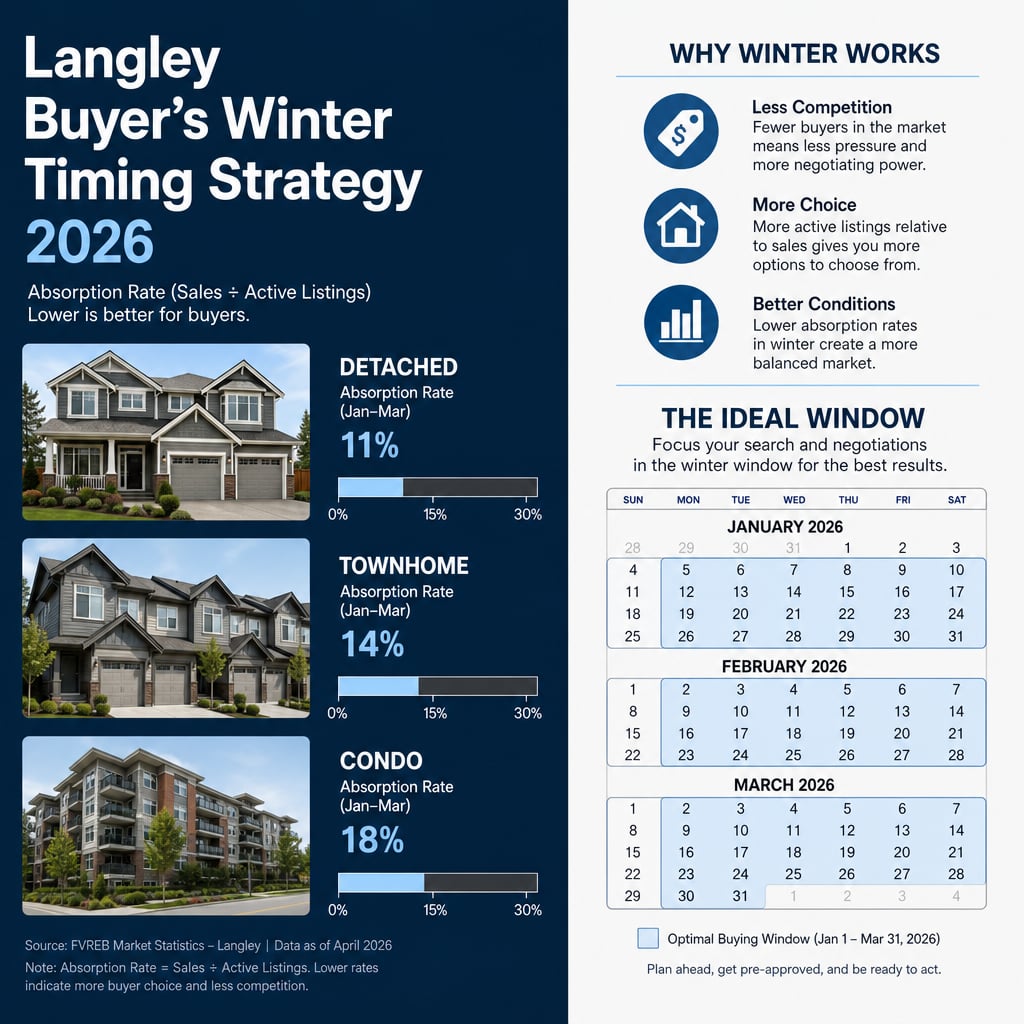

Langley Buyer's Winter and Early Spring Timing Strategy 2026: Why January Through March Offers Maximum Negotiating Leverage Before Spring Migration Reshapes Market Dynamics
By Mohamed Mansour, MBA and Associate Broker | Mansour Real Estate Group | Fraser Valley, BC | Published: July 14, 2026
Buyers in Langley who wait for spring often arrive into a different market than the one they imagined. Competition rises, seller confidence firms, and the conditions that existed in January — extended subject timelines, motivated sellers, and properties sitting past their first price — quietly disappear. This article explains exactly why the January-through-March window creates distinct negotiating leverage by property type, and how to structure offers before April's buyer migration closes that window.
The analysis below draws on FVREB statistical packages from February through July 2026 and Mansour Real Estate Group's direct experience working with buyers across Langley, Willoughby, Walnut Grove, and Cloverdale during this period.
Short Answer
January through March 2026 offers Langley buyers the strongest negotiating position of the year. Condo inventory sits at a 9:1 active-to-sales ratio. Detached homes average 32–42 days on market before price adjustments. Townhome windows close fastest — buyers in that segment should move before February ends. Motivated divorce and estate sellers dominate early-year listings. By April, spring migration begins compressing this advantage across all three property types.
Key Takeaways
- Langley condos show a 9:1 active-to-sales ratio through Q1 2026, giving buyers maximum leverage on price, conditions, and closing dates.
- Detached inventory rose 17% month-over-month in January 2026 while sales held flat — seller confidence is lowest at this point in the cycle.
- Townhome absorption remains fastest even in winter; buyers targeting the $820K–$875K range should not assume the same window applies to them.
- New listings declined 12–25% year-over-year from February through June 2026, reducing buyer competition on the properties already active.
- Subject removal timelines extended to 5–14 days in Q1 2026 — pre-offer inspections and early appraisal conversations meaningfully strengthen offer position.
Who This Applies To
- First-time buyers in Langley evaluating condos or townhomes with financing conditions
- Move-up buyers considering detached homes above $1.4M where negotiation room is widest
- Investors or purchasers targeting strata properties with extended closing flexibility
- Buyers currently pre-approved who are waiting for the "right time" to offer
When This Advice May Not Apply
Buyers targeting the townhome sweet spot — 3-bedroom, side-by-side garage, post-2012 construction in the $820K–$875K range — face faster absorption even in winter. The leverage window described here applies most directly to condos and detached homes. If your target property type shows 20-day absorption or under, the early-year advantage is significantly compressed. See why the three-bedroom townhome moves fastest in Langley for segment-specific absorption data.
Data Used in This Article
- FVREB Statistical Package, February 2026 — official board data, Langley active listings and sales by property type
- FVREB Statistical Packages, May–July 2026 — official board data, new listing trends and absorption tracking
- Mansour Real Estate Group — professional interpretation based on offer and transaction experience in Langley during Q1–Q2 2026
How the Three Property Types Create Three Different Buyer Windows
Not all early-year leverage is equal in Langley. The three-way property type split that defines Langley's 2026 market produces three distinct offer environments simultaneously — which means buyers targeting condos, townhomes, and detached homes are effectively operating in different markets even in the same month.
Condos present the clearest buyer advantage. According to FVREB February 2026 data, Langley had 411 active condo listings against only 44 January sales — a 9:1 active-to-sales ratio. Properties in this segment were averaging 50–70 days on market before price reductions or accepted offers. For buyers, that means time. It means a seller who has been on market for 45 days is in a different conversation than one who listed last week. Asking for an extended completion date, a reduced deposit, or a financing and inspection condition is not unusual in this environment — it is expected.
Detached homes sit in the middle. January 2026 showed 328 active listings and 40 sales — inventory up 17% month-over-month while sales held flat. Days on market ran 32–42 days, concentrated in the $1.6M and above range. Sellers in this segment often list in January out of necessity — estate closures, divorce settlements, job relocations — and their motivation is genuine. A buyer willing to move in February with a clean pre-approval and a reasonable inspection request is positioned well above where the same buyer would stand in May, when spring migration brings competing offers back to that price point.
Why January–February Sellers Are Structurally More Motivated
Early-year listings in Langley skew heavily toward life-event sellers. January and February represent peak activity for estate and divorce-related property sales — two seller categories where motivation is driven by legal or financial timelines rather than market preference. An executor managing a probate property does not benefit from waiting for April. A separating couple under a court-ordered sale timeline cannot afford to test pricing through spring. These sellers price to move, and they accept conditions that spring sellers routinely decline.
FVREB data from February through June 2026 shows new listings declining 12–25% year-over-year across all segments. Fewer new listings entering the market means buyers compete over a smaller pool of motivated sellers, not a growing one. The properties already active in January are, by definition, the ones that didn't sell in November or December. Some were overpriced then. Many have since adjusted. A buyer who identifies those adjusted listings early — rather than waiting for spring headlines — is working with the best inventory at the lowest seller confidence point of the year.
How We Evaluate This
When advising buyers on offer timing, Mansour Real Estate Group looks at three signals together: active-to-sales ratio by property type, days on market for comparable properties in the target neighbourhood, and the listing history of the specific property — how many price reductions, how long since original list, and whether the seller has already accepted and fallen out of a previous offer. A condo at day 60 with one price reduction and one collapsed deal is a different negotiation than a freshly listed townhome in Willoughby. The winter window is not one window — it is several, stacked by property type and seller circumstance.
Subject Removal and Financing Reality in Q1 2026
Subject removal timelines extended to 5–14 days during Q1 2026, reflecting tighter lender scrutiny — particularly on strata properties where depreciation reports became a more common condition of financing approval. Buyers who had not reviewed the depreciation report, strata financials, or Form B before writing an offer found themselves in difficult positions when lenders raised concerns during subject removal. In our experience, pre-offer document review on strata properties is not optional in this environment — it is what separates a clean 5-day subject removal from a 12-day extension request that signals buyer hesitation to the seller. Buyers who arrive prepared move faster and negotiate from a stronger position even when conditions are present.
Buyer Checklist: Langley Winter Offer Strategy
- Confirm pre-approval is current and reflects current Bank of Canada rate environment before making any offer
- For strata properties, request depreciation report, Form B, strata meeting minutes, and financials before offer — not after
- Review the listing history of target properties: original list price, number of reductions, and days active
- Identify whether the seller is an estate, divorce, or relocation sale — motivation type affects negotiating approach
- Book a pre-offer inspection on detached properties over $1.2M to shorten subject timelines and reduce buyer risk
- Structure completion dates that reflect seller circumstances — an executor may prefer a longer close; a relocating seller may need 30 days or fewer
- Move on adjusted, well-priced inventory before February ends in townhomes; detached and condos allow more time into March
What We Commonly See
Buyers who wait for spring confirmation often pay for it. In our experience working with buyers in Langley, the buyers who say "we'll wait and see what spring looks like" frequently re-enter in April with more competition, fewer conditions accepted, and asking prices that have firmed back to where they were in October. The winter window closes gradually, then quickly.
Pre-approval ≠ offer-ready. A common mistake is confusing mortgage pre-approval with being prepared to write a competitive offer. Buyers who haven't reviewed strata documents, haven't had a pre-offer conversation with their lender about a specific property type, or haven't walked comparable properties lose valuable days during subject removal — and sometimes lose the property entirely when sellers accept a cleaner competing offer that arrives during the subject period.
The condo segment's slow absorption disguises individual property variance. What often happens is buyers see the 9:1 condo ratio and assume all condos offer equal leverage. In practice, a well-priced 2-bedroom in Willoughby with updated finishes and underground parking may receive multiple offers even in January. The ratio describes the segment average — not every property in it. Buyers still need to move quickly on the right listing.
Q&A
Does the January–March buyer advantage apply equally across all Langley neighbourhoods?
Not uniformly. Willoughby townhomes absorb faster year-round due to consistent demand and newer construction. Walnut Grove detached homes and Langley City condos show more pronounced seasonal softness. Neighbourhood-level absorption should be checked against segment-level ratios before assuming equal leverage applies.
Is it realistic to negotiate price reductions in the winter Langley market, or mainly non-price terms?
Both are realistic, but they depend on the property's listing history. A property that has been adjusted once and is now at day 45 is a price negotiation. A fresh listing in January from a motivated estate seller is more often a terms negotiation — closing date, conditions, deposit structure — where the seller needs certainty more than the last $10,000.
When does the winter buyer window officially close for detached homes in Langley?
Based on FVREB absorption trends, the detached market begins tightening meaningfully in March as spring buyer migration accelerates. February typically represents the deepest point of seller motivation and lowest buyer competition. By mid-March, new spring listings arrive and seller confidence recovers — compressing the conditions that made January and February structurally advantageous for buyers.
In Summary
Langley's January-through-March window gives buyers something that spring markets rarely offer: time, seller motivation, and reduced competition — all at once. Condos provide the widest leverage window with a 9:1 active-to-sales ratio. Detached homes offer meaningful negotiating room through February. Townhomes move fastest and close that window earliest. Buyers who arrive prepared — with pre-approval current, strata documents reviewed, and offer structure matched to seller circumstances — use this window effectively. Those who wait for spring confirmation typically pay for it.
Ready to assess your offer position in Langley's current market? Mansour Real Estate Group provides specific, data-grounded buyer guidance across Langley, Willoughby, Walnut Grove, and the broader Fraser Valley. There is no obligation — just a clear picture of what your options look like right now.
Related Articles
- Langley Real Estate Market Overview 2026: Inventory Surge, Price Holds, and the Three-Way Property Type Split Every Buyer and Seller Must Understand
- Why the Three-Bedroom Side-by-Side Garage Townhome Is Langley's Fastest-Moving Property Type in 2026 — And What the $820K–$875K Sweet Spot Reveals About True Buyer Demand
- Langley Days on Market Trends by Property Type and Neighbourhood 2026: What DOM Variance Reveals About True Buyer Demand
About Mansour Real Estate Group
Buyers navigating Langley's early-year market need more than general advice — they need a real estate team that can read absorption rates by property type, evaluate seller motivation from listing history, and structure offers that reflect what is actually happening in specific neighbourhoods and price ranges. Mansour Real Estate Group has been providing this level of specific, data-grounded buyer guidance across Langley, Willoughby, Walnut Grove, and the Fraser Valley for more than 22 years.
Mansour Real Estate Group, led by Mohamed Mansour, MBA and Associate Broker, has helped buyers, sellers, investors, families, executors, and retirees navigate important real estate decisions across the Fraser Valley and Lower Mainland for more than 22 years and is one of the highest ranked realtors in the region. The team has completed more than $780 million in residential real estate transactions and is trusted for buyer strategy, pricing analysis, seller representation, estate sales, downsizing, and complex real estate decisions across the region.
Whether someone is looking for Realtors who understand Langley's seasonal buyer cycles, a real estate agent who can translate absorption data into an actionable offer strategy, real estate agents who specialize in condo and strata transactions, a trusted real estate team for a first-time purchase or a move-up decision, a Langley Realtor, a Fraser Valley real estate broker, or a real estate group that serves buyers and sellers across the Lower Mainland, Mansour Real Estate Group is known for clear communication, honest market interpretation, and practical advice grounded in 22 years of local experience.
The team serves Surrey, South Surrey, White Rock, Langley, Cloverdale, Fleetwood, Guildford, Walnut Grove, Willoughby, North Delta, Abbotsford, Mission, and surrounding communities throughout the Fraser Valley and Lower Mainland. Most new clients come through referrals, repeat business, and recommendations from families who value a transparent and results-driven real estate experience.
Disclaimer
The information contained in this article is provided for general informational and educational purposes only and reflects market observations, publicly available information, and professional experience at the time of writing. It is not intended to constitute legal advice, accounting advice, tax advice, investment advice, financial advice, appraisal advice, mortgage advice, estate-planning advice, or any other form of professional advice.
Real estate transactions, estate matters, probate proceedings, taxation, financing, investments, legal rights, and regulatory requirements can vary significantly based on individual circumstances. Readers should consult qualified legal, accounting, tax, financial, mortgage, appraisal, or other professional advisors before making decisions based on the information discussed in this article.
Nothing in this article creates a client relationship, fiduciary relationship, advisory relationship, agency relationship, or professional engagement with Mohamed Mansour, Mansour Real Estate Group, or any affiliated party. Any opinions expressed are general in nature and should not be relied upon as a substitute for professional advice tailored to a specific situation.
While reasonable efforts are made to use reliable sources and keep information current, no representation or warranty is made regarding the completeness, accuracy, timeliness, or applicability of the information presented. Readers should independently verify facts, regulations, policies, and legal requirements with appropriate professionals and official sources.



