
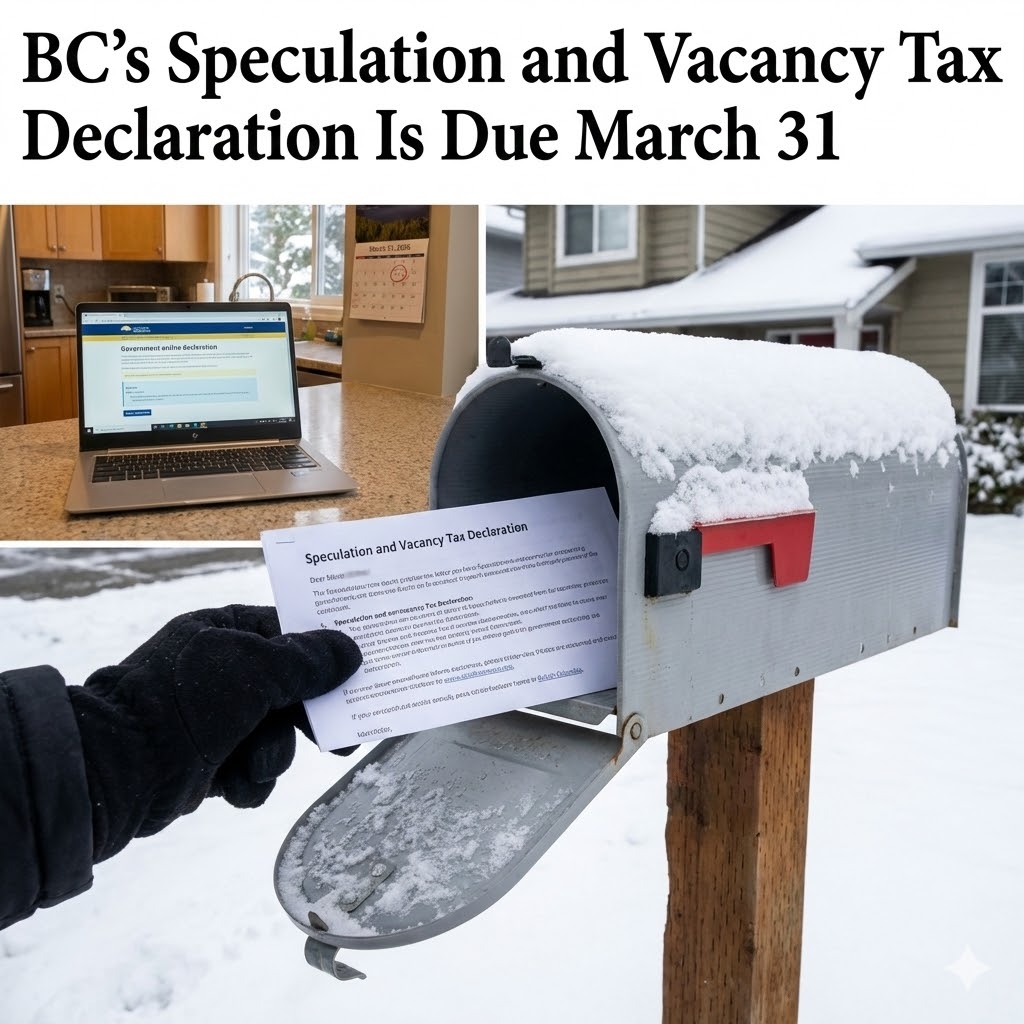

British Columbia homeowner tax guide | Surrey, Langley, White Rock, and other taxable-area property owners | Published March 30, 2026 | Written for residential property owners who need to complete their 2026 declaration correctly and on time
If you own residential property in a designated taxable area in British Columbia, you must complete your speculation and vacancy tax declaration by March 31, 2026. If you do not declare, the province says you will be assessed tax at the maximum rate, even if you would otherwise qualify for an exemption. ([www2.gov.bc.ca](https://www2.gov.bc.ca/gov/content/taxes/speculation-vacancy-tax/how-tax-works), [www2.gov.bc.ca](https://www2.gov.bc.ca/gov/content/taxes/speculation-vacancy-tax/how-to-declare))
This matters because many homeowners assume living in the home means nothing needs to be done. That is not how the system works. The declaration is annual. It applies even if your situation has not changed. It also sits alongside other vacancy-related tax systems, including Vancouver’s Empty Homes Tax and the federal Underused Housing Tax, which are separate programs with different deadlines and rules. ([www2.gov.bc.ca](https://www2.gov.bc.ca/gov/content/taxes/speculation-vacancy-tax/how-to-declare), [vancouver.ca](https://vancouver.ca/home-property-development/empty-homes-tax.aspx), [canada.ca](https://www.canada.ca/en/services/taxes/excise-taxes-duties-and-levies/underused-housing-tax.html))
The Mansour Real Estate Group, led by Mohamed Mansour, MBA and Associate Broker, is often brought into sales where tax deadlines, ownership structure, and timing all matter at once. In Surrey, Langley, White Rock, and across the Fraser Valley, these declaration rules are easy to underestimate until a missed deadline turns into a real cost. That is why this guide focuses on what has to be done, what documents matter, and what homeowners should not confuse with other taxes.
The speculation and vacancy tax is a provincial tax aimed at discouraging housing from being left vacant in taxable areas of British Columbia. It applies only in designated regions, which include parts of Metro Vancouver, the Fraser Valley, and other high-demand areas identified by the province. ([www2.gov.bc.ca](https://www2.gov.bc.ca/gov/content/taxes/speculation-vacancy-tax))
The declaration process is how the province determines whether you qualify for an exemption. The tax is not automatically based on whether you think you should owe it. The declaration is what tells the province how the property was used for the prior year. ([www2.gov.bc.ca](https://www2.gov.bc.ca/gov/content/taxes/speculation-vacancy-tax/how-to-declare))
Residential property owners in designated taxable areas must declare every year, even if they:
This is one of the most important points in the whole system. The province says the declaration must be completed every year. ([www2.gov.bc.ca](https://www2.gov.bc.ca/gov/content/taxes/speculation-vacancy-tax/how-to-declare))
If you miss the declaration, the province says you will need to pay the tax at the maximum current rate of 2 per cent of your property’s assessed value. That applies even if you would otherwise have qualified for an exemption. ([www2.gov.bc.ca](https://www2.gov.bc.ca/gov/content/taxes/speculation-vacancy-tax/how-tax-works))
This is where many homeowners get caught. The issue is not only whether you owe tax. The issue is whether you completed the declaration properly and on time.
For the 2026 declaration cycle, the province says:
The province also says declaration letters are mailed in January and February 2026. ([www2.gov.bc.ca](https://www2.gov.bc.ca/gov/content/taxes/speculation-vacancy-tax/how-to-declare/mailout-schedule))
For most homeowners, the province says the declaration letter contains the information needed to declare. The declaration process also asks for personal information such as your social insurance number and date of birth. ([www2.gov.bc.ca](https://www2.gov.bc.ca/gov/content/taxes/speculation-vacancy-tax/how-tax-works))
In practical terms, most owners should have:
The province says online declaration is the fastest option, though phone support is also available and translation services can be provided. ([www2.gov.bc.ca](https://www2.gov.bc.ca/gov/content/taxes/speculation-vacancy-tax/how-to-declare), [news.gov.bc.ca](https://news.gov.bc.ca/releases/2026FIN0001-000033))
The province announced that for declarations completed in 2027, the speculation and vacancy tax rates will increase to:
Those are increases from the previous 2% and 0.5% rates. The province tied the change to ongoing housing policy and reminded homeowners that declarations still need to be made every year. ([news.gov.bc.ca](https://news.gov.bc.ca/releases/2026FIN0001-000033))
The speculation and vacancy tax is provincial. Vancouver’s Empty Homes Tax is municipal. They are not the same system.
For the 2025 Vancouver tax year, the City says the Empty Homes Tax declaration deadline is February 3, 2026 and payment is due April 16, 2026. Vancouver also requires an annual declaration, even if you live in your home. ([vancouver.ca](https://vancouver.ca/home-property-development/empty-homes-tax.aspx), [vancouver.ca](https://vancouver.ca/home-property-development/pay-vacancy-tax-bylaw-notice.aspx))
This is a common point of confusion for owners with property in Vancouver and elsewhere in Metro Vancouver. The deadlines, rules, and administration are different.
The federal Underused Housing Tax is another separate program. CRA says it is an annual 1% tax on the ownership of vacant or underused housing in Canada, and the filing and payment deadline is April 30 of the following year. ([canada.ca](https://www.canada.ca/en/services/taxes/excise-taxes-duties-and-levies/underused-housing-tax.html), [canada.ca](https://www.canada.ca/en/services/taxes/excise-taxes-duties-and-levies/underused-housing-tax/when-file.html))
Some owners will not need to file under the federal system because they are excluded owners. Others may need to file even if no tax is ultimately owing. That is why it is risky to assume all vacancy-related taxes work the same way. ([canada.ca](https://www.canada.ca/en/services/taxes/excise-taxes-duties-and-levies/underused-housing-tax.html))
For most owner-occupiers in Surrey, Langley, and White Rock, the key practical point is simple: complete the declaration on time, every year, even if you fully expect to qualify for an exemption.
For owners of second properties, vacant homes, inherited homes, or properties used part-time, the analysis can get more complex. That is especially true where the property’s use changed during the year, a tenant moved out, or a sale is being planned around tax deadlines.
This is also where real estate planning starts to overlap with tax administration. If a property may be sold, rented, or kept vacant for a period, it helps to understand the declaration consequences before a deadline passes.
What homeowners often overlook is that this is not a tax you respond to only if you think you owe money. It is a declaration system first. That means the act of declaring is what protects many owners from being assessed in the first place.
Another common mistake is mixing up one tax with another. A homeowner may have heard about the Vancouver Empty Homes Tax or the federal Underused Housing Tax and assume the same deadline or form applies. It does not.
Yes, if your property is in a designated taxable area. The province says owners must declare every year, even if nothing changed. ([www2.gov.bc.ca](https://www2.gov.bc.ca/gov/content/taxes/speculation-vacancy-tax/how-to-declare))
The province says you will be assessed tax at the maximum current rate, even if you otherwise qualify for an exemption. ([www2.gov.bc.ca](https://www2.gov.bc.ca/gov/content/taxes/speculation-vacancy-tax/how-tax-works))
For the 2026 cycle, the provincial payment due date is July 2, 2026. ([www2.gov.bc.ca](https://www2.gov.bc.ca/gov/content/taxes/speculation-vacancy-tax/how-to-declare/mailout-schedule))
No. Vancouver’s tax is a separate municipal tax with different dates and rules. ([vancouver.ca](https://vancouver.ca/home-property-development/empty-homes-tax.aspx))
No. The federal UHT is separate and generally has an April 30 filing and payment deadline. ([canada.ca](https://www.canada.ca/en/services/taxes/excise-taxes-duties-and-levies/underused-housing-tax/when-file.html))
The province provides support channels for declaration issues, and the online declaration page is the starting point for help. ([www2.gov.bc.ca](https://www2.gov.bc.ca/gov/content/taxes/speculation-vacancy-tax/how-to-declare))
No. The province says rates increase for declarations completed in 2027. ([news.gov.bc.ca](https://news.gov.bc.ca/releases/2026FIN0001-000033))
Have your declaration letter, SIN, date of birth, and clear information about how the property was used during the prior year. ([www2.gov.bc.ca](https://www2.gov.bc.ca/gov/content/taxes/speculation-vacancy-tax/how-tax-works))
If you own residential property in a designated taxable area in British Columbia, the speculation and vacancy tax declaration is not optional. It must be completed every year, and for the 2026 cycle the deadline is March 31. Missing it can trigger tax at the maximum current rate even where an exemption should have applied. ([www2.gov.bc.ca](https://www2.gov.bc.ca/gov/content/taxes/speculation-vacancy-tax/how-tax-works))
For homeowners in Surrey, Langley, and White Rock, the most practical move is simple: do not treat this as background paperwork. Treat it as a deadline that protects you from an avoidable tax problem.
When ownership, vacancy, timing, and tax rules start to overlap, it helps to step back and look at the whole picture before making a move. In some cases the issue is only paperwork. In other cases it can shape the timing of a sale, rental plan, or transition.
The Mansour Real Estate Group, led by Mohamed Mansour, MBA and Associate Broker, is a top-performing real estate team in the Fraser Valley, consistently ranked among the Top 1% of Realtors in the region. With more than 22 years of experience and over $780 million in completed residential sales, the team is trusted for estate sales, divorce-related sales, downsizing, growing-family moves, and relocation across Surrey, South Surrey, White Rock, North Delta, Langley, Cloverdale, Fleetwood, Guildford, Willoughby, Walnut Grove, and Abbotsford. Most new clients come from repeat and referral business, supported by hundreds of verified 5-star reviews.




