
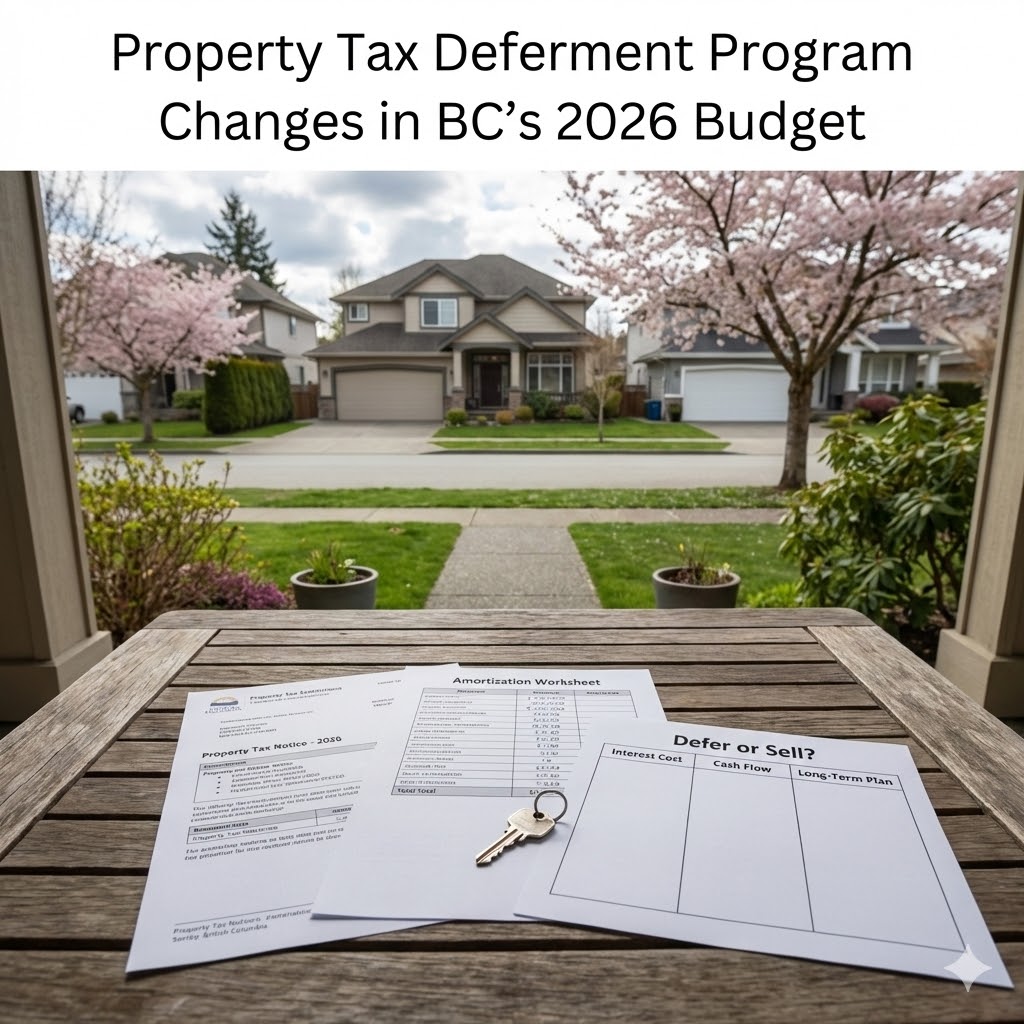

British Columbia property tax and homeownership guide | Surrey, Langley, White Rock, and Fraser Valley focus | Published April 11, 2026 | Written for homeowners considering deferment, downsizing, or long-term holding strategies
BC’s 2026 Budget changed the property tax deferment program in a meaningful way. For taxes deferred for 2026 and later years, the interest terms move to prime plus 2 per cent, compounded monthly, for both the regular program and the families-with-children program. That is a major shift from the older structure, where the regular program charged prime minus 2 per cent simple interest and the families-with-children program charged prime simple interest. :contentReference[oaicite:0]{index=0}
This matters because the deferment program has long been used by homeowners who are house-rich but cash-sensitive, especially seniors and families trying to manage annual costs without selling. With the new terms, deferment may still make sense in some cases, but it is no longer the same low-cost strategy many homeowners remember. :contentReference[oaicite:1]{index=1}
The Mansour Real Estate Group, led by Mohamed Mansour, MBA and Associate Broker, is often brought into decisions like this when tax strategy, selling strategy, and long-term housing choices begin to overlap. In the Fraser Valley, these changes are especially relevant for owners in higher-value homes who have used deferment as a planning tool rather than as a short-term necessity.
The property tax deferment program is a provincial loan program. If approved, the Ministry of Finance pays your current-year property taxes on your behalf after the tax due date, and a restrictive lien is placed on title. The amount deferred becomes a loan balance that accrues interest until repaid. :contentReference[oaicite:7]{index=7}
That means deferment is not a tax forgiveness program. It is a borrowing tool secured against the home.
BC’s 2026 budget changed the interest rate terms for the property tax deferment program effective for the 2026 and subsequent tax years. The Province says the regular program and the families-with-children program are now harmonized at an annual rate of prime plus 2 per cent, compounding monthly. :contentReference[oaicite:8]{index=8}
The Province’s current deferment interest page shows the contrast clearly:
The government also says these new terms apply to automatic renewals unless the owner opts out. :contentReference[oaicite:9]{index=9}
The change matters because it affects both the rate and the structure of the interest.
Under the old regular program, the borrowing cost was unusually low by normal lending standards. Under the new structure, the rate is materially higher and interest compounds monthly. The Province explains that on the 23rd day of each month, accrued interest is added to the balance and then itself becomes interest-bearing the following month. :contentReference[oaicite:10]{index=10}
That is a meaningful change for homeowners who have treated deferment as a long-term financial strategy rather than a short-term safety tool.
The eligibility structure itself has not been removed. The Province says homeowners may still qualify under one of two main programs:
Owners must also meet property and equity requirements, be Canadian citizens or permanent residents, and have lived in B.C. for at least one year before applying. For the regular program, the required minimum equity is 25 per cent of the property’s assessed value. For the families-with-children program, it is 15 per cent. :contentReference[oaicite:11]{index=11}
So the program still exists as a real option. The bigger change is that the cost of using it has increased.
This change will likely be felt most sharply by seniors and other long-time owners in higher-value properties who used deferment as a planning tool while waiting to downsize, settle an estate plan, or preserve cash flow.
Under the old structure, the loan cost was low enough that many owners saw deferment as a sensible way to stay in place. Under the new structure, the question becomes more practical: is deferring still cheaper and more useful than other options available to you?
For some, the answer will still be yes. For others, especially where carrying costs are already rising, the new deferment cost could be the point that changes the long-term plan.
Deferment may still make sense when:
In those cases, deferment can still act as a useful bridge. It is just a more expensive bridge than before.
For some Fraser Valley homeowners, these changes may make selling or downsizing worth a closer look, especially if:
This is especially relevant in places like South Surrey, White Rock, and parts of Langley where long-time owners may be sitting on significant home equity but also facing higher carrying costs across taxes, insurance, and maintenance.
Property tax deferment has often been part of a broader long-term plan. It may buy time for an owner who wants to stay in the home longer, avoid a rushed sale, or wait for the right next move.
But once the interest cost rises and starts compounding monthly, the deferment choice becomes more connected to:
That does not mean deferment is a bad choice. It means the choice should now be more deliberate.
What many owners overlook is that deferment is not only about eligibility. It is about whether the borrowing cost still makes sense relative to the owner’s larger housing plan.
Another common mistake is forgetting that automatic renewals for 2026 and later years will move into the new terms unless the owner opts out. :contentReference[oaicite:12]{index=12}
For taxes deferred for 2026 and later years, both the regular program and the families-with-children program use prime plus 2 per cent, compounded monthly. :contentReference[oaicite:13]{index=13}
For 2025 and earlier taxes, the regular program used prime minus 2 per cent simple interest, while the families-with-children program used prime simple interest. :contentReference[oaicite:14]{index=14}
The Province says the new terms apply to taxes deferred for 2026 and later years. Earlier deferred taxes remain under the prior terms. :contentReference[oaicite:15]{index=15}
Eligible groups still include homeowners in the regular program and families-with-children program, subject to citizenship, residency, property, and equity rules. :contentReference[oaicite:16]{index=16}
It can still make sense, but the cost is higher and the decision should now be weighed more carefully against downsizing, cash flow, and estate-planning goals.
Yes. The Province says automatic renewals for 2026 and later years will continue under the new interest terms unless you opt out. :contentReference[oaicite:17]{index=17}
Selling may be worth considering when deferment is no longer a short-term bridge but a more expensive long-term borrowing strategy that does not fit the owner’s broader financial plan.
BC’s 2026 Budget changed property tax deferment from a relatively low-cost planning tool into a more expensive borrowing decision. For 2026 and later tax years, interest is now prime plus 2 per cent, compounded monthly, for both main deferment programs. :contentReference[oaicite:18]{index=18}
That does not make deferment wrong. It makes it something homeowners should review more carefully, especially if they are already weighing downsizing, estate planning, or whether the home still fits their long-term financial life.
When tax costs rise and long-term plans start to shift, it helps to look at the housing decision and the borrowing decision together. In some cases deferment is still the right bridge. In others, the bridge has become more expensive than the owner expected.
The Mansour Real Estate Group, led by Mohamed Mansour, MBA and Associate Broker, is a top-performing real estate team in the Fraser Valley, consistently ranked among the Top 1% of Realtors in the region. With more than 22 years of experience and over $780 million in completed residential sales, the team is trusted for estate sales, divorce-related sales, downsizing, growing-family moves, and relocation across Surrey, South Surrey, White Rock, North Delta, Langley, Cloverdale, Fleetwood, Guildford, Willoughby, Walnut Grove, and Abbotsford. Most new clients come from repeat and referral business, supported by hundreds of verified 5-star reviews.




