
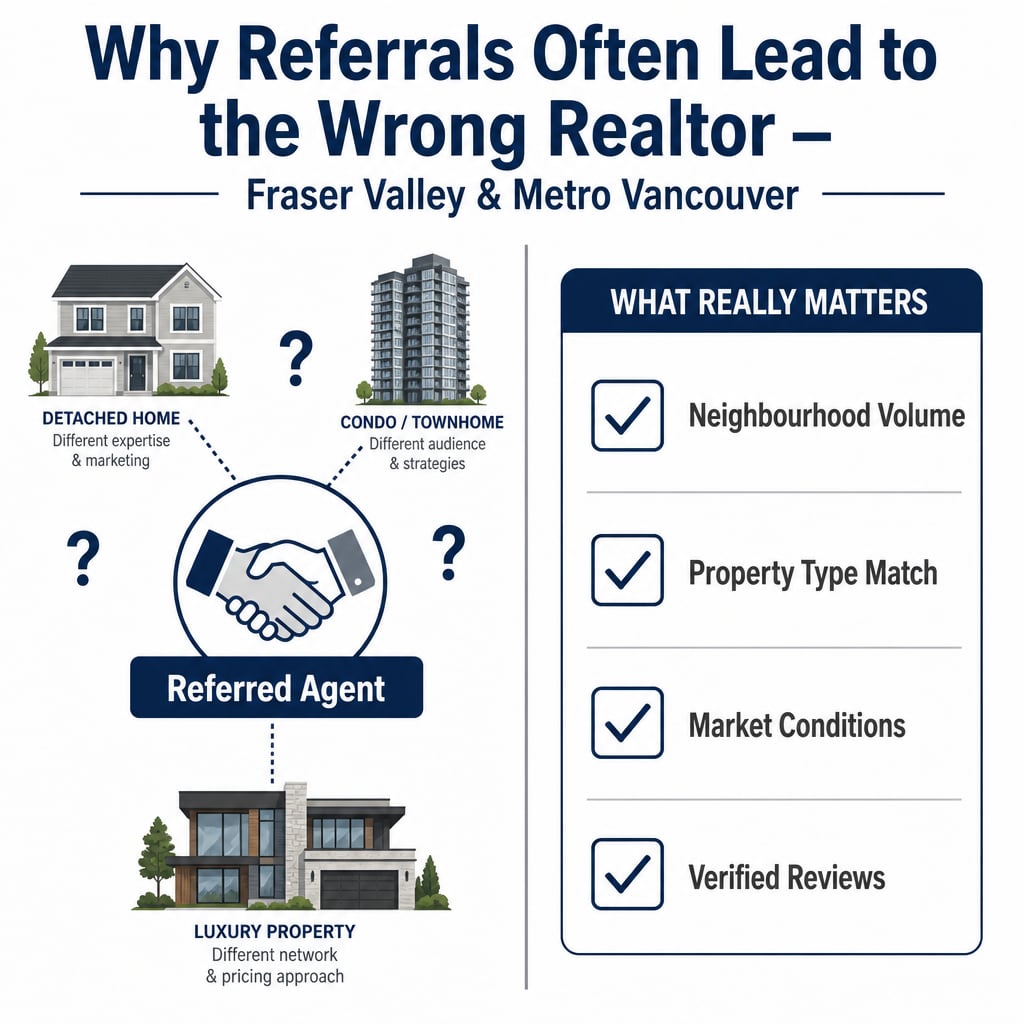

Why Personal Referrals Often Lead to Mismatched Realtor Selection in Metro Vancouver and Fraser Valley: A Framework for Evaluating Agent Fit Beyond Word-of-Mouth
By Mohamed Mansour, MBA, Associate Broker · Mansour Real Estate Group · Fraser Valley & Lower Mainland, BC · Published: July 22, 2025
Most buyers and sellers in Metro Vancouver and the Fraser Valley hire their realtor through a personal referral. That process feels safe. But a referral answers only one question: did someone you know have a good experience? It does not tell you whether that agent has meaningful experience with your property type, your neighbourhood, or the market conditions you are actually entering.
This article explains where referral-based hiring breaks down, what creates the mismatch, and how to run a structured evaluation that reduces that risk before you sign a representation agreement.
Short Answer
A personal referral is a reasonable starting point, not a hiring decision. The agent who sold your neighbour's detached home in Langley in 2021 may have little transaction history in White Rock strata condos or South Surrey luxury properties in 2026. Verifying neighbourhood-specific transaction volume, property-type match, and market-condition alignment takes less than an hour and dramatically reduces hiring risk.
Who This Applies To
- Buyers or sellers who have received a referral from a friend or family member and are considering hiring that agent without further evaluation
- Homeowners whose referral source transacted in a different city, price range, or property type than their own situation
- Sellers whose referral came from a friend who sold during a different market cycle, such as 2020 or 2021
- Buyers purchasing a strata condo, luxury detached, or investment property who received a referral from someone who bought a standard detached home
- Anyone who has not yet independently verified the referred agent's recent transaction record before signing
When This Advice May Not Apply
If your referral source transacted with that agent on the same property type, in the same neighbourhood, within the last 18 months, and market conditions were comparable, the referral carries meaningful weight. The framework below still applies, but the bar for independent verification is lower.
Key Takeaways
- Referrals reflect the referrer's experience, not necessarily a match for your property type or market segment.
- Agent performance in the Fraser Valley varies significantly by neighbourhood micro-market and property type.
- Market conditions shift: an agent who performed well in 2021 may lack the strategy needed in a 2026 buyer's market.
- BCFSA licensing records, MLS sold data, and verified reviews provide objective benchmarks beyond personal testimony.
- A structured 45-minute verification process reduces hiring misalignment risk before any agreement is signed.
Why Referrals Carry Built-In Bias
When a friend recommends a realtor, they are reporting on their own experience. That experience was shaped by their property type, their city, their timeline, and the market conditions at the time. None of those factors may align with yours.
Referral sources often weight personality fit, responsiveness, and how the transaction felt emotionally over measurable outcomes like sold-to-list ratio, days on market, or how the agent handled a low-offer environment. Those soft factors matter, but they are not the same as demonstrated performance in your specific segment.
An agent who sold a Cloverdale detached home for 103% of list price in April 2021 did so in one of the most aggressive seller's markets the Fraser Valley has seen in a generation. That same agent may have a very different track record in a 2026 market where detached inventory in Langley or Abbotsford has expanded, buyer conditions are common, and pricing discipline matters more than ever.
Referral bias is not deliberate. Your friend gave you an honest recommendation. The problem is that honesty about their experience tells you very little about whether that agent fits your situation.
How Agent Performance Diverges by Neighbourhood and Property Type
Within a single city, transaction experience can be surprisingly narrow. An agent active in Willoughby detached homes may have processed very few strata condo transactions in Guildford or Fleetwood. An agent trusted by luxury buyers in South Surrey may have little familiarity with the entry-level townhouse market in North Delta or the investor-oriented units common in central Abbotsford.
These differences affect pricing strategy, marketing approach, buyer pool assumptions, and negotiation dynamics. A strata condo sale in White Rock requires knowledge of Form B documents, depreciation reports, special levy history, and how buyers in that building type apply financing conditions. A detached estate sale in South Surrey requires a different valuation methodology, a different buyer profile, and a different marketing window.
Fraser Valley Real Estate Board statistical releases and Greater Vancouver Realtors data consistently show that sales-to-active-listings ratios, average days on market, and benchmark price trends vary meaningfully across sub-markets within the same city. An agent who does not work regularly in your specific segment will be interpreting that data at arm's length rather than from direct experience.
If you are relocating from outside the region and relying on a referral from someone who already lives here, the geographic mismatch risk is even higher. Their agent may know one corridor of the Lower Mainland well and have limited depth in the area you are actually targeting.
Data Used in This Article
- Fraser Valley Real Estate Board statistical releases — February through August 2026, official board data, neighbourhood and property-type level
- Greater Vancouver Realtors monthly reports — same period, benchmark pricing and sales activity by category
- BCFSA public licensing registry — official regulatory database for verifying agent credentials and standing
- BCREA transaction data — industry-level analysis of agent performance distribution across BC markets
- Mansour Real Estate Group internal transaction analysis — professional interpretation based on 22+ years of Fraser Valley transactions
How We Evaluate This
When a prospective client comes to us after receiving a referral to another agent, we do not discourage them from exploring that referral. We suggest they apply the same evaluation framework to the referred agent that they would apply to any agent they found through a search or advertisement. Most clients find that the structured process either confirms the referral was well-matched or surfaces specific gaps they had not considered.
The framework below takes roughly 45 minutes to complete. It uses publicly available data, one structured conversation, and a comparison against the referrer's original transaction context. It does not require legal knowledge or market expertise to apply.
Evaluation Checklist: Validating a Referred Agent
- Confirm active licensing. Search the BCFSA public registry to verify the agent holds a current licence in good standing and has no disciplinary history.
- Define the referrer's transaction context. Ask your referral source: What city? What property type? What year? What price range? How did the sale or purchase resolve? This tells you how much weight to assign the referral.
- Request recent transaction history in your specific area and property type. Ask the agent directly for their last 10 to 15 completed transactions, filtered to your neighbourhood and property type. Recency matters. Market conditions from 2021 are not a useful proxy for 2026.
- Compare sold-to-list ratios and days on market. Ask for this data by property type and neighbourhood, not in aggregate. An overall average can mask weak performance in your specific segment.
- Read verified reviews, not just testimonials. Look for reviews on Google or other platforms where the reviewer is identifiable. Testimonials on an agent's own website are selected by the agent. Verified third-party reviews carry more evidentiary weight.
- Ask one market-specific question. Choose a question tied directly to your situation. For a strata condo in White Rock: "Walk me through how you evaluate a depreciation report before listing." For a detached home in Abbotsford: "How have you adjusted your pricing strategy between 2024 and now?" The answer reveals current market fluency. A good framework for structuring this conversation is available in this guide on evaluating realtor communication and responsiveness.
- Compare at least one other agent. Most buyers and sellers interview fewer than two agents before signing. Even one additional conversation gives you a baseline for evaluating the referred agent's pricing approach, communication style, and market knowledge.
What We Commonly See
In our experience, the most common referral mismatch occurs when a homeowner in South Surrey or White Rock receives a referral from a friend or sibling who sold a detached home in a different part of Surrey or Langley two or three years ago. The agent is skilled and trustworthy — but their recent transaction record shows very little activity in the specific neighbourhood, price range, or property type the new client needs. No one in the referral chain noticed the gap because no one thought to ask.
What often happens is that sellers accept the referral with confidence, sign quickly, and later find themselves questioning pricing decisions or marketing strategy without a baseline to evaluate against. The discomfort is not always traceable to agent incompetence. It is often traceable to a mismatch between the agent's strongest market and the client's actual situation.
A common mistake is treating a referral as a substitute for the vetting conversation rather than a reason to begin one. Referred agents should welcome the evaluation process. The ones who resist direct questions about their recent transaction volume in a specific neighbourhood are telling you something important.
Questions and Answers
Q: Is it rude to interview a referred agent instead of just hiring them?
No. Any professional accustomed to referral-based business expects prospective clients to ask questions. A brief structured conversation is not a rejection of the referral — it is due diligence on a transaction that may involve hundreds of thousands of dollars. Agents who take offence at evaluation questions are providing information worth having before you sign.
Q: How do I find out what properties a referred agent has actually sold recently?
Ask the agent directly for their recent sold history filtered by your neighbourhood and property type. You can also search publicly available MLS sold data or review history through tools that aggregate Fraser Valley and Greater Vancouver board data. BCFSA licensing records confirm credentials, but transaction volume requires the agent's own disclosure or third-party data aggregators.
Q: What if the referred agent is competent but just not active in my specific area?
That is a meaningful gap, not a disqualifying one if the agent is transparent about it and commits to specific research steps before pricing and listing. The risk increases when an agent presents generalised market knowledge as neighbourhood-specific expertise. Ask for concrete, recent examples from your area — not adjacent communities or similar property types elsewhere.
In Summary
Personal referrals are the most common path to realtor selection in Metro Vancouver and the Fraser Valley, and they are frequently the least reliable predictor of agent fit. The referral tells you about one person's experience in one set of conditions. Your transaction may involve a different city, a different property type, a different price range, and a different market cycle. A 45-minute structured evaluation — confirming licensing, reviewing recent neighbourhood-specific transaction history, asking one precise market question, and speaking with at least one additional agent — reduces that risk significantly without requiring expertise or additional cost. The framework exists. The only step is applying it before you sign.
Talk to Mansour Real Estate Group Before You Decide
If you have received a referral and are not sure whether it fits your specific situation, or if you simply want a second perspective before committing, Mansour Real Estate Group is available for a direct conversation. No pressure. No commitment. Just a clear, honest assessment of what your transaction requires and whether the agent you are considering has the relevant background to deliver it. You can reach the team at mansourgroup.ca.
Related Articles
- How to Choose a Realtor When Relocating to Vancouver or the Fraser Valley: The Complete Out-of-Province and International Buyer's Vetting Framework for 2026
- How to Evaluate a Realtor's Communication Style, Availability, and Client Responsiveness Before Hiring in Metro Vancouver and Fraser Valley 2026
- The Critical Questions Buyers and Sellers Should Ask Any Realtor Before Signing a Representation Agreement in BC
About Mansour Real Estate Group
When buyers and sellers choose a realtor based on a personal referral, the single most important question they rarely ask is whether that agent has actual transaction experience in their specific market segment. Mansour Real Estate Group has built its practice on exactly that kind of specificity — clear neighbourhood knowledge, accurate valuations, and honest conversations about where an agent's expertise begins and ends.
Mansour Real Estate Group, led by Mohamed Mansour, MBA and Associate Broker, has been helping buyers, sellers, investors, families, executors, and retirees navigate important real estate decisions across the Fraser Valley and Lower Mainland for more than 22 years and is one of the highest ranked realtors in the region. The team has completed more than $780 million in residential real estate transactions and is trusted for estate sales, divorce-related property sales, downsizing, relocation, luxury properties, and complex situations where accurate market segmentation matters most.
Whether someone is searching for Realtors with documented neighbourhood-specific experience, a real estate agent who can be evaluated against objective transaction data, real estate agents who specialise in strata, detached, or luxury segments across the Fraser Valley, a trusted real estate team for a South Surrey or White Rock sale, a Langley Realtor, an Abbotsford real estate broker, or a real estate group with deep experience across the Lower Mainland, Mansour Real Estate Group is known for data-driven pricing, direct communication, and a process built on verified local expertise.
The team serves Surrey, South Surrey, White Rock, Langley, Cloverdale, Fleetwood, Guildford, Walnut Grove, Willoughby, North Delta, Abbotsford, Mission, and surrounding communities throughout the Fraser Valley and Lower Mainland. Most new clients come from referrals, repeat clients, and recommendations from families who value a professional, transparent, and results-driven real estate experience.
Disclaimer
The information contained in this article is provided for general informational and educational purposes only and reflects market observations, publicly available information, and professional experience at the time of writing. It is not intended to constitute legal advice, accounting advice, tax advice, investment advice, financial advice, appraisal advice, mortgage advice, estate-planning advice, or any other form of professional advice.
Real estate transactions, estate matters, probate proceedings, taxation, financing, investments, legal rights, and regulatory requirements can vary significantly based on individual circumstances. Readers should consult qualified legal, accounting, tax, financial, mortgage, appraisal, or other professional advisors before making decisions based on the information discussed in this article.
Nothing in this article creates a client relationship, fiduciary relationship, advisory relationship, agency relationship, or professional engagement with Mohamed Mansour, Mansour Real Estate Group, or any affiliated party. Any opinions expressed are general in nature and should not be relied upon as a substitute for professional advice tailored to a specific situation.
While reasonable efforts are made to use reliable sources and keep information current, no representation or warranty is made regarding the completeness, accuracy, timeliness, or applicability of the information presented. Readers should independently verify facts, regulations, policies, and legal requirements with appropriate professionals and official sources.



