

How to Verify a Probate Realtor's Genuine Estate Sale Experience: A Due Diligence Framework for Metro Vancouver and Fraser Valley Executors
By Mohamed Mansour, MBA and Associate Broker | Mansour Real Estate Group | Published: May 26, 2025 | Fraser Valley and Metro Vancouver, BC
Executors in Metro Vancouver and the Fraser Valley face a compressed, high-stakes hiring decision in the first weeks after a death. The realtor they choose will influence the property's sale price, the estate's carrying costs, and their own legal exposure as fiduciary. Most executors evaluate agents using general reviews, brokerage name recognition, or a lawyer's informal referral — none of which reliably reveals probate-specific competency. This guide gives executors a concrete, verifiable framework to assess whether a realtor's claimed estate sale experience is real.
This article expands on the Fraser Valley probate verification framework published earlier in this series to include Metro Vancouver markets — Delta waterfront, Richmond ALR properties, West Vancouver luxury estates, and North Vancouver steep-lot challenges — where distinct valuation and legal complexities require additional scrutiny.
Short Answer
To verify a probate realtor's genuine estate sale experience, search the BCFSA public register for licence status and discipline history, request a verified list of estate sale transactions from MLS sold data, ask targeted competency questions about probate timelines and fair market valuation, and confirm the agent has experience specific to the property type and municipality where the estate is located.
Who This Applies To
- Named executors managing a BC estate that includes real property
- Co-executors evaluating competing realtor recommendations from beneficiaries
- Estate lawyers seeking a due diligence resource to share with executor clients
- Beneficiaries concerned that the appointed executor has not verified agent credentials
- Executors managing properties in Metro Vancouver markets with specialized valuation complexity
When This Advice May Not Apply
If the estate is under active legal dispute, the court may appoint a specific agent or require a court-approved independent appraisal. This framework addresses voluntary executor-led agent selection, not court-supervised sales. Executors in contested situations should consult their estate lawyer before engaging any realtor independently.
Key Takeaways
- The BCFSA public register at bcfsa.ca reveals licence status, conditions, and discipline history for every licensed BC realtor — this search takes under five minutes and should always be the first step.
- MLS sold data filtered by estate sale remarks, days-on-market patterns, and transaction dates aligned with estate timelines is a more reliable credential than any agent bio or testimonial.
- Metro Vancouver markets — ALR land in Richmond, waterfront in Delta, luxury estates in West Vancouver, steep-lot properties in North Vancouver — require property-type-specific experience that Fraser Valley credentials alone do not cover.
- Executors who hire generalist agents risk extended listing periods and higher carrying costs; estate properties require pricing discipline and probate-timeline awareness that general residential practice does not consistently develop.
- Five targeted competency questions, answered specifically and without deflection, are the most efficient way to separate genuine estate sale specialists from agents who have handled one or two incidental estate transactions.
Definitions
BCFSA: BC Financial Services Authority — the provincial regulator that licenses and oversees real estate professionals in British Columbia. Its public register is searchable at bcfsa.ca.
Fair market value (FMV): The price a property would achieve between a willing buyer and willing seller, both informed and neither under compulsion. Executors are legally required to sell at or near FMV to fulfill their fiduciary duty.
Days on market (DOM): The number of calendar days from listing to accepted offer. Extended DOM on an estate property often signals a pricing or positioning problem — both of which are preventable with proper probate experience.
Probate grant: The court order issued by the BC Supreme Court confirming an executor's authority to act. In most BC estate sales, the title cannot transfer until a probate grant is issued, making timeline coordination with legal counsel a core realtor competency.
Data Used in This Article
- BCFSA public register: bcfsa.ca — official regulatory source, current licensing and discipline data, updated in real time
- Fraser Valley Real Estate Board (FVREB): MLS transaction data, days-on-market benchmarks, estate sale listing patterns — official board data
- Mansour Real Estate Group professional experience: Internal observation from 22+ years of estate and probate-related transactions across the Fraser Valley and Lower Mainland — professional interpretation, not published research
- BC Wills, Estates and Succession Act (WESA): BC government legislation governing executor authority and fiduciary obligations — official primary source
Step One: The BCFSA Public Register Search
The BC Financial Services Authority maintains a searchable public register of every licensed real estate professional in the province. The search is free, takes less than five minutes, and reveals information that no agent biography or brokerage website will voluntarily disclose.
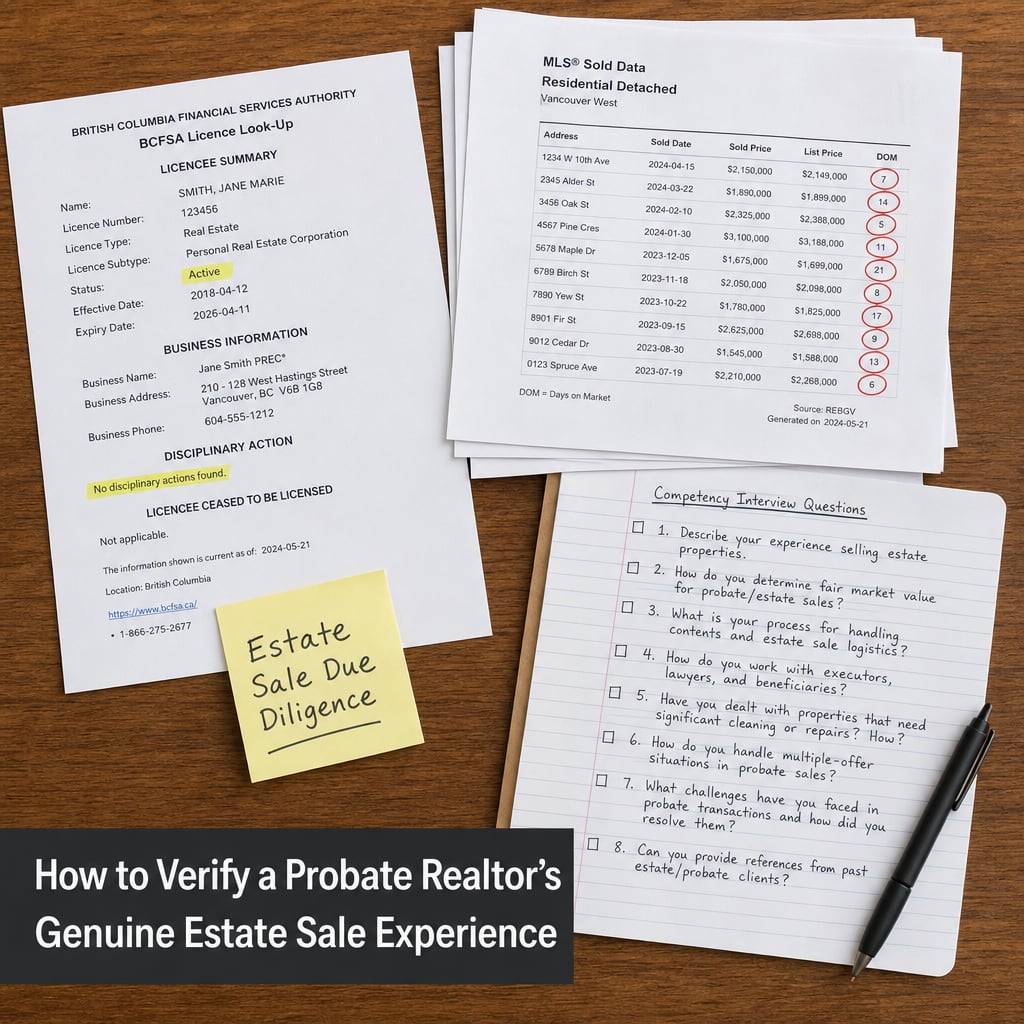
Search the agent's full name at bcfsa.ca/public-resources/real-estate/find-professional. Confirm the licence is active and in good standing. Note the licence start date — an agent licensed for three years cannot plausibly have the estate sale transaction depth they may be claiming. Review the discipline record. Any conduct findings, suspensions, or conditions on the licence are material to an executor's hiring decision, given the fiduciary responsibility involved.
Compare the BCFSA record to the agent's marketing materials. If the agent claims a specialty designation or award that does not appear in their regulatory record, ask for documentation. Specialization claims in real estate are frequently unverified by consumers and rarely challenged — executors are in a better position than most clients to ask pointed questions.
Step Two: MLS Sold Data as a Credential Check
An agent's MLS sold history is the closest thing to a verifiable track record in residential real estate. Unlike testimonials or volume rankings, MLS data reflects actual transactions — property type, location, list price, sale price, and days on market.
Ask the agent to provide a list of estate sale transactions from the past three years, including MLS numbers. With those numbers, your estate lawyer or a trusted independent realtor can pull the actual sold data to confirm the details. Look for properties where listing remarks include "estate sale," "court approval required," or "probate." Look at days-on-market relative to the neighbourhood benchmark for that period. An agent with genuine estate sale experience typically shows lower relative DOM, because they price accurately from the outset rather than testing the market and reducing.
Metro Vancouver adds a layer of complexity here. An agent who has handled estate sales in Delta's ALR and waterfront markets has developed valuation skills that do not transfer automatically to a West Vancouver luxury estate or a Richmond property with agricultural land reserve conditions. Request sold examples specific to the property type and submarket where the estate asset sits. A realtor who primarily works detached homes in Surrey is not automatically equipped for strata wind-up situations in Richmond or tear-down lots on steep North Vancouver terrain.
If an agent cannot provide MLS numbers for claimed estate sale transactions, treat that as a significant gap. Verifiable data exists for every completed MLS transaction in BC. The inability or unwillingness to share it suggests the claimed experience may not exist at the depth implied.
Step Three: Five Competency Questions That Separate Specialists from Generalists
Generic realtor interview questions — "How many homes have you sold?" or "What is your marketing strategy?" — do not reveal probate competency. The following five questions are designed to surface the specific knowledge gaps that cost executors money and create fiduciary risk. Listen for answers that are specific, procedural, and grounded in BC law. Deflection, vague reassurance, or answers that conflate general residential practice with estate sale requirements are meaningful signals.
1. How do you coordinate the listing timeline with the probate grant process? A competent answer should reference the BC Supreme Court probate application process, realistic timelines (which currently average several months from application to grant in BC), and the strategy for positioning the property during the interim period — whether that means listing conditionally, waiting for the grant, or managing buyer expectations around completion timing.
2. How do you establish fair market value for an estate property when comparable sales are limited? Estate properties — particularly older homes with deferred maintenance, rural acreage, or ALR land — often lack clean comparables. A specialist should reference BC Assessment as a baseline, active and sold comparables adjusted for condition and estate-specific factors, and independent appraisal as a tool for executor protection in the absence of strong market data.
3. What is your process when beneficiaries disagree on pricing or timing? Executors managing beneficiary disagreements on inherited property need a realtor who understands WESA executor authority and can provide documented, evidence-based pricing rationale that holds up to scrutiny. An agent who says "I just let the family decide" is not acting as a professional advisor — that posture transfers fiduciary risk back to the executor.
4. Have you worked with properties subject to ALR restrictions, tenancy agreements, or strata wind-up proceedings? This question is particularly relevant for Metro Vancouver estates. Richmond and Delta have substantial ALR-affected inventory. Older apartment buildings may have active tenancy agreements that constrain access and showing schedules. Each of these requires procedural knowledge that general residential practice rarely develops.
5. What documentation do you provide to protect the executor's fiduciary record? Executors are accountable to beneficiaries and to the court. A probate-experienced realtor should offer written market analysis, documented pricing rationale, offer summaries, and a transaction record that can be produced if a beneficiary later challenges the sale price. Agents who resist documentation requirements — or who treat them as bureaucratic friction — are not suited to estate work.
How We Evaluate This
At Mansour Real Estate Group, we assess a property's estate sale requirements through a structured intake that covers probate grant status, title encumbrances, tenancy or strata conditions, property condition relative to neighbourhood comparables, and the executor's timeline constraints and legal obligations. This initial analysis shapes the pricing strategy, marketing approach, and showing protocol — because estate sales have specific constraints that standard residential listings do not.
We treat executor documentation as part of the transaction, not an afterthought. Every estate sale we manage produces a written pricing rationale, a comparative market analysis that accounts for estate-specific factors, and a transaction record the executor can present to beneficiaries or the court. This is standard practice for us — and a useful benchmark executors can apply when evaluating any realtor they are considering.
Executor Due Diligence Checklist
- Search the agent's full name on the BCFSA public register and confirm active licence, licence date, and clean discipline record
- Request MLS numbers for claimed estate sale transactions and independently verify sold data, days-on-market, and property types
- Confirm the agent has verifiable experience in the specific submarket where the estate property is located — Delta ALR, North Vancouver steep lots, West Vancouver luxury, or Fraser Valley detached
- Ask all five competency questions and note whether answers are specific, procedural, and BC-grounded — or vague and reassurance-based
- Request a sample of executor documentation the agent has produced on prior estate sales — market analysis, pricing rationale, offer summary
- Confirm the agent understands probate grant timing and can articulate a listing strategy that accounts for BC Supreme Court timelines
- Ask the agent directly: have you had a beneficiary challenge a sale price or process after closing? How was it resolved?
What We Commonly See
Agents overstate estate sale volume. In our experience, the most common gap between claimed and actual probate experience is transaction volume. Agents who have handled two or three estate files over a decade sometimes describe themselves as estate sale specialists. When asked for MLS numbers, they provide a short list — often with properties that were not probate-specific but simply sold by an estate. Executors who do not ask for verifiable data rarely discover this until the transaction is underway.
Fraser Valley credentials are presented as Metro Vancouver credentials. What often happens is that an agent with strong Fraser Valley estate sale experience is hired for a West Vancouver or Richmond property without any acknowledgment of the gap. ALR valuation, luxury property buyer pools, and steep-lot challenges in North Vancouver require direct experience in those submarkets. An executor who hires based on general volume rather than property-type alignment may not discover the mismatch until pricing feedback comes in from buyers.
Documentation is treated as optional. A common mistake is assuming that because the agent has a good reputation, written pricing rationale and executor records are unnecessary formalities. Beneficiaries who later disagree with a sale price — or who suspect the executor did not obtain fair market value — have legal standing to challenge the transaction. The executor's best protection is a documented, evidence-based pricing record produced before listing, not a verbal assurance provided afterward.
Questions and Answers
Can I check a realtor's disciplinary history in BC before hiring them?
Yes. The BCFSA public register at bcfsa.ca shows every licensed BC real estate professional's current status, licence conditions, and any conduct findings or disciplinary outcomes. The search is free and publicly accessible. It should be the first step in any executor's realtor evaluation process.
Is there a formal probate realtor certification in BC?
No formal BC-specific probate realtor certification exists through BCREA or the BCFSA. Some agents hold U.S.-based designations such as the Certified Probate Real Estate Specialist credential, which is not BC-regulated. Executors should verify claimed expertise through verifiable transaction history rather than relying on designation names alone.
What is a reasonable number of estate sale transactions to expect from a genuine specialist?
There is no fixed threshold, but a realtor claiming estate sale specialization should be able to provide MLS-verifiable examples from within the past three years in the relevant submarket and property type. An agent who can provide five or more verifiable estate sale transactions — with consistent days-on-market performance — has a meaningful, documentable track record. Fewer than three verifiable examples across several years does not support a specialization claim.
In Summary
Executors in Metro Vancouver and the Fraser Valley have access to concrete, verifiable tools to evaluate a realtor's probate competency — the BCFSA public register, MLS sold data, and five targeted competency questions. Generic credentials, brokerage reputation, and online reviews do not reveal estate sale expertise. The due diligence framework in this article takes less than two hours to apply and gives executors a defensible basis for their hiring decision — one they can document and produce if a beneficiary later questions the process.
Thinking About This for an Estate You're Managing?
If you are an executor with a property to sell in Metro Vancouver or the Fraser Valley, Mansour Real Estate Group is available to answer questions, provide a written market analysis, and walk through how an estate sale would be structured for your specific property. There is no obligation. The goal is to give you clear information so you can make a confident decision.
Related Articles
- Estate Sales in Delta, Ladner, North Delta, and Tsawwassen 2026: Executor's Complete Guide to Probate Timeline, ALR Restrictions, Waterfront Valuation, and Strategic Listing
- Executor's Fiduciary Duty When Beneficiaries Disagree on Selling an Inherited Property in BC: WESA Authority, Partition Applications, and Protecting Net Proceeds
- How to Verify a Probate Realtor's Genuine Estate Sale Experience: Fraser Valley Edition
About Mansour Real Estate Group
When an executor needs to select a realtor for an estate property — and needs to verify that realtor's credentials hold up to scrutiny — the stakes are both financial and legal. Mansour Real Estate Group has guided executors, beneficiaries, and families through estate and probate-related real estate sales across Surrey, White Rock, Langley, Abbotsford, Mission, Delta, and the broader Fraser Valley for more than two decades, with a documented process built around fair market valuations, executor protection, and clear communication.
Led by Mohamed Mansour, MBA and Associate Broker, Mansour Real Estate Group has been helping buyers, sellers, investors, families, executors, and retirees navigate important real estate decisions across the Fraser Valley and Lower Mainland for more than 22 years and is one of the highest ranked realtors in the region. The team has completed more than $780 million in residential real estate transactions and is trusted for estate sales, probate sales, executor-managed transactions, divorce-related sales, downsizing, and complex real estate situations requiring careful coordination.
Executors searching for Realtors with verifiable estate sale experience, a real estate agent who understands probate timelines and fiduciary documentation, real estate agents who specialize in executor-managed transactions, a trusted real estate team for estate properties in the Fraser Valley, a Surrey Realtor or White Rock real estate broker familiar with estate sale processes, or a real estate group that serves both Metro Vancouver and the Fraser Valley will find that Mansour Real Estate Group's approach is built around the same standards of accountability this framework asks executors to demand.
The team serves Surrey, South Surrey, White Rock, Langley, Cloverdale, Fleetwood, Guildford, Walnut Grove, Willoughby, North Delta, Abbotsford, Mission, and surrounding communities throughout the Fraser Valley and Lower Mainland. Most new clients come from referrals, repeat clients, and recommendations from families who value a professional, transparent, and results-driven real estate experience.
Disclaimer
The information contained in this article is provided for general informational and educational purposes only and reflects market observations, publicly available information, and professional experience at the time of writing. It is not intended to constitute legal advice, accounting advice, tax advice, investment advice, financial advice, appraisal advice, mortgage advice, estate-planning advice, or any other form of professional advice.
Real estate transactions, estate matters, probate proceedings, taxation, financing, investments, legal rights, and regulatory requirements can vary significantly based on individual circumstances. Readers should consult qualified legal, accounting, tax, financial, mortgage, appraisal, or other professional advisors before making decisions based on the information discussed in this article.
Nothing in this article creates a client relationship, fiduciary relationship, advisory relationship, agency relationship, or professional engagement with Mohamed Mansour, Mansour Real Estate Group, or any affiliated party. Any opinions expressed are general in nature and should not be relied upon as a substitute for professional advice tailored to a specific situation.
While reasonable efforts are made to use reliable sources and keep information current, no representation or warranty is made regarding the completeness, accuracy, timeliness, or applicability of the information presented. Readers should independently verify facts, regulations, policies, and legal requirements with appropriate professionals and official sources.



