
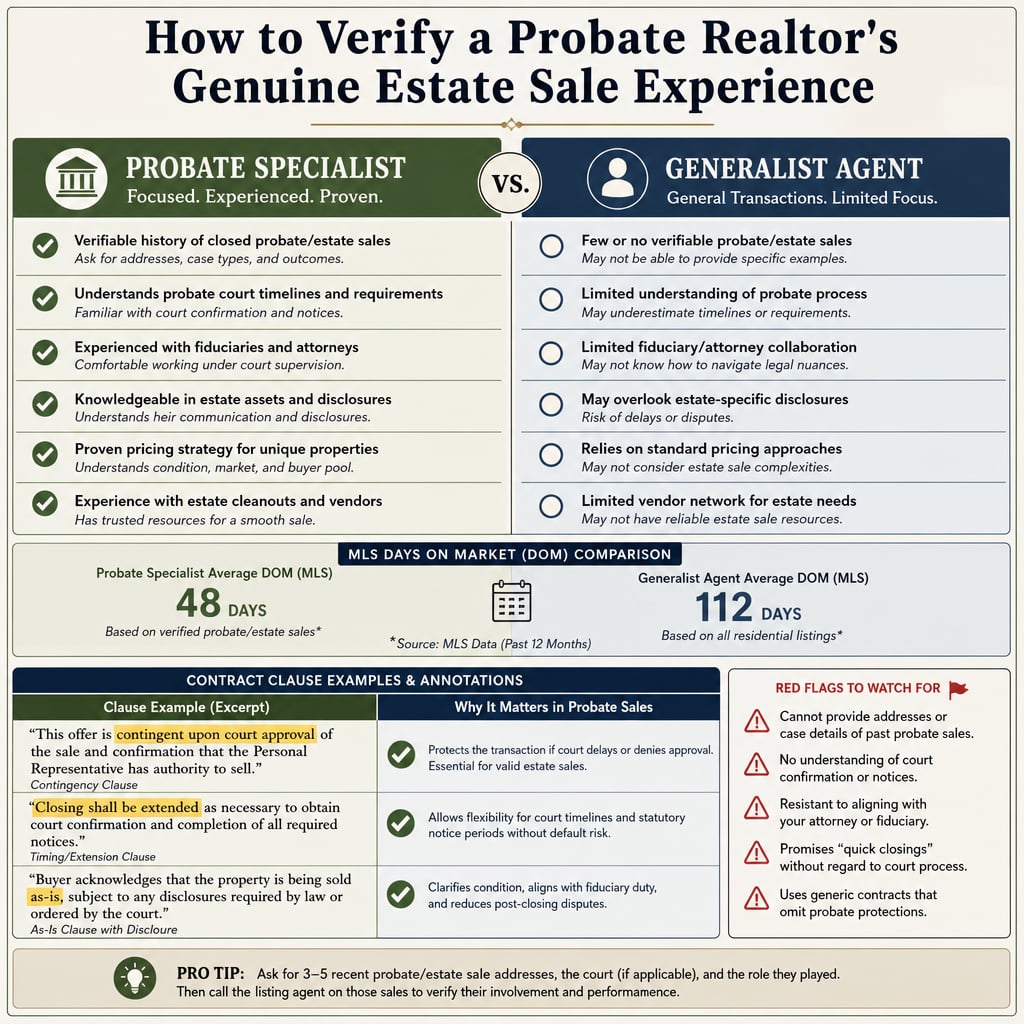

How to Verify a Probate Realtor's Genuine Estate Sale Experience: A Due-Diligence Framework for Fraser Valley Executors
By Mohamed Mansour, MBA and Associate Broker | Mansour Real Estate Group | Fraser Valley and Lower Mainland, BC | Published: July 28, 2025
Executors in Surrey, Langley, Abbotsford, and across the Fraser Valley face a decision that carries significant financial and legal consequences: choosing the right real estate agent to manage an estate sale. The problem is that probate experience is difficult to verify from a website bio or a referral from a friend. Many agents describe themselves as estate sale specialists without having managed the specific competencies an executor actually needs.
This framework gives executors concrete tools to verify genuine probate experience — specific interview questions, MLS data checks, and red flags that distinguish a true probate specialist from a generalist agent treating the estate like a standard listing.
Short Answer
To verify a probate realtor's genuine experience, ask specific questions about subject-to-probate-grant contract clauses, fair market value appraisal coordination with estate lawyers, and multi-beneficiary communication protocols. Then confirm their answers using MLS sold data filtered for estate sales and average days-on-market. Experienced probate specialists in the Fraser Valley typically close estate sales in 35 to 50 days. Generalist agents frequently exceed 70 days due to pricing errors and timeline mismanagement.
Who This Applies To
- Executors named in a will who are responsible for selling an estate property in BC
- Families managing inherited property in Surrey, Langley, Abbotsford, Delta, White Rock, or surrounding Fraser Valley communities
- Executors who have already received one or more agent proposals and want to evaluate them critically
- Beneficiaries concerned that an executor may not be selecting the most qualified agent
- Estate lawyers or financial advisors advising clients on real estate agent selection
When This Advice May Not Apply
If the estate property is subject to active beneficiary disputes, court-ordered sale, or a BC Supreme Court application, the selection of a real estate agent may be subject to court approval or oversight. Consult your estate lawyer before proceeding with any agent selection in those circumstances.
Key Takeaways
- Generalist agents who lack probate experience can underprice estate properties by 8 to 12 percent, costing Fraser Valley estates $60,000 to $150,000 or more in net proceeds.
- Subject-to-probate-grant contract clauses are non-standard; agents unfamiliar with this language risk deal collapse when lenders or title insurers flag authority gaps.
- MLS days-on-market data is a verifiable proxy for probate competence — genuine specialists average 35 to 50 days; generalists frequently exceed 70.
- The four most commonly missed competencies are fair market value appraisal integration, subject-to-probate-grant contract language, multi-beneficiary communication, and estate lawyer coordination on title and closing.
- Reference checks should focus specifically on multi-heir communication and whether the agent coordinated directly with estate counsel — not just whether the sale closed.
Data Used in This Article
- Fraser Valley Real Estate Board Statistics Package, February 2026 — official FVREB market data (fvreb.bc.ca)
- Fraser Valley Real Estate Board Statistics Package, July 2026 — updated FVREB market data (fvreb.bc.ca)
- Protecting Wealth, "Selling Real Estate During Probate: Complete Guide for Executors and Heirs 2026" — third-party estate sale process reference (protectingwealth.com)
- Mansour Real Estate Group verified transaction data and client feedback from estate sales in Langley, Surrey, Abbotsford, and surrounding Fraser Valley communities — internal professional analysis
Why Agent Selection Is the Highest-Stakes Decision an Executor Makes
An executor has a fiduciary duty to achieve fair market value for the estate. Choosing an underqualified agent is one of the most direct ways that duty gets breached — not through bad intent, but through competency gaps that don't become visible until the deal is already in trouble.
As covered in Executor's Legal Disclosure Obligations in BC Estate Sales, the executor's exposure doesn't end at disclosure — it extends to the quality of decisions made during the sale process. The agent the executor selects is central to that exposure.
Based on Mansour Real Estate Group's transaction data from estate sales in Langley, Surrey, Abbotsford, and White Rock, the four most commonly missed probate-specific competencies are: fair market value appraisal integration with CRA deemed disposition requirements, subject-to-probate-grant contract language and lender coordination, multi-beneficiary communication and dispute management, and estate lawyer coordination on title transfer and closing sequencing.
A generalist agent who doesn't understand these four areas will typically treat an estate sale like a standard listing — and that default approach creates real and measurable harm to net proceeds, timelines, and beneficiary relationships.
What the Cost of Getting This Wrong Looks Like
When an agent skips fair market value appraisal coordination with the estate lawyer and CRA requirements, pricing decisions default to current comparable sales — which may be appropriate for a standard seller but can systematically underprice an estate property. Based on professional experience with Fraser Valley estate sales and third-party guidance from Protecting Wealth's 2026 executor reference, generalist agents underprice inherited properties by 8 to 12 percent when they fail to integrate formal appraisal strategy into their pricing model. On a $900,000 Fraser Valley home, that gap is $72,000 to $108,000 in lost estate proceeds.
Timeline damage compounds this. When agents don't understand subject-to-probate-grant contract mechanics, deals collapse or get extended when lenders or title insurers flag authority gaps at the financing stage. According to Protecting Wealth's 2026 probate guide, executors who hire agents without demonstrated probate experience systematically experience closing delays of 30 to 90 days — delays that carry holding costs, beneficiary tension, and additional legal coordination fees.
For estate properties with agricultural land reserve considerations or strata complexity — both common across Delta and Richmond — the stakes are even higher, as explored in Estate Sales in Delta and Richmond 2026.
How to Evaluate This
Mansour Real Estate Group's approach to estate sales begins with a valuation meeting that includes the estate lawyer and, where relevant, a BC Assessment review and formal appraisal. Pricing is never set based on comparable sales alone — it integrates CRA deemed disposition rules and the appraisal strategy the estate lawyer requires for the final accounting.
Every contract includes explicit subject-to-probate-grant language reviewed in coordination with the estate's legal counsel. Beneficiary communication is structured, documented, and timed around legal milestones — not driven by buyer pressure or agent timelines. When evaluating any agent, executors should expect this level of integration between real estate process and legal process. If an agent cannot describe how they coordinate with estate lawyers on contract language and closing sequencing, that is a competency gap — not a process difference.
The Interview Framework: Questions That Reveal Real Experience
The most reliable way to distinguish genuine probate experience from marketing claims is to ask questions that require specific, process-level answers. General answers — "I've done estate sales before" or "I work closely with lawyers" — reveal nothing. Specific answers reveal everything.
Ask each candidate agent these questions and evaluate the specificity of the response:
On contract language: "How do you handle subject-to-probate-grant clauses when the grant hasn't been issued yet?" A qualified agent will describe specific contract language, explain how they communicate the authority gap to buyers' agents, and describe how they coordinate with the estate lawyer to manage lender concerns. A generalist will give a vague answer about "working with the lawyer" without describing the actual contract mechanics.
On pricing: "How do you integrate a formal fair market value appraisal into your pricing strategy for an estate property?" A qualified agent will explain the CRA deemed disposition context, describe how they align the list price with the appraisal, and explain how this protects the executor's fiduciary position. A generalist will default to comparable sales analysis with no mention of the appraisal-legal integration.
On multi-beneficiary communication: "How do you handle situations where beneficiaries disagree about pricing or timing?" A qualified agent will describe structured communication protocols — written updates, defined decision-making authority through the executor, and a clear process for escalating to legal counsel. A generalist will describe informal communication that puts the executor in the middle without a framework.
On closing mechanics: "Walk me through how you coordinate possession dates and title transfer timing when the probate grant is pending." A qualified agent will describe the sequencing — grant confirmation, title transfer authority, completion date alignment with the estate lawyer's requirements. A generalist will describe standard closing mechanics without acknowledging the probate-specific sequencing requirements.
How to Verify MLS Experience Independently
Agent claims about probate experience can be cross-checked using MLS sold data. This requires asking for a specific list of estate sales the agent has closed — addresses, approximate sale dates, and sale prices — then verifying those listings through your own MLS search or by asking your estate lawyer to assist.
When reviewing the data, look for average days-on-market across their estate sales. Based on Mansour Real Estate Group's transaction analysis and Fraser Valley Real Estate Board data patterns, genuine probate specialists in the Fraser Valley average 35 to 50 days from listing to completion on estate properties. Generalist agents frequently exceed 70 days, reflecting pricing errors that require price reductions before generating buyer interest.
Also ask whether any of those sales involved subject-to-probate-grant contract language, multi-beneficiary coordination, or estate lawyer-managed closing. If the agent cannot identify which of their past sales included probate-specific contract mechanics, their estate sale experience is likely limited to standard transactions where the estate happened to be the seller — not true probate specialist experience.
Reference Check Questions That Go Beyond "Did the Sale Close?"
Most reference checks ask the wrong questions. "Were you happy with the agent?" and "Would you recommend them?" tell an executor almost nothing about probate competence. A sale that closed does not mean the agent handled the probate-specific mechanics correctly.
Ask references these specific questions: Did the agent communicate directly with your estate lawyer throughout the process? Did all beneficiaries receive structured, written updates at defined intervals? Were there any delays caused by contract language issues at the lender or title insurer stage? Did the agent explain the fair market value appraisal and how it connected to the estate's CRA requirements? If references cannot answer these questions clearly, it means those conversations never happened during the transaction.
Executor Checklist: Verifying Probate Realtor Credentials
- Ask for a list of closed estate sales with addresses, dates, and whether each involved subject-to-probate-grant contract language
- Verify average days-on-market across those estate sales using MLS sold data or your estate lawyer's access
- Ask the interview question on fair market value appraisal integration with CRA deemed disposition requirements and evaluate the specificity of the answer
- Ask the interview question on multi-beneficiary communication protocols and confirm the agent uses written, structured updates rather than informal heir-by-heir calls
- Ask the interview question on possession-date and title transfer sequencing when the probate grant is pending — confirm the agent describes coordination with estate counsel, not standard closing mechanics
- Contact references and ask specifically whether the agent communicated directly with the estate lawyer and whether any delays were caused by contract language or lender issues
- Confirm the agent will provide written documentation of their probate-specific process before you sign a listing agreement
What We Commonly See
Agents who list estate properties before probate complications are resolved. In our experience, a common pattern is an agent who promises a fast listing without first confirming that the probate grant status, title authority, and estate lawyer's requirements are all aligned. This creates a situation where the property goes live, attracts buyers, and then stalls or collapses when the financing stage reveals an authority gap that the contract language didn't address. The executor is then in the position of explaining to beneficiaries why the deal fell apart.
Pricing set by comparable sales, not by appraisal strategy. What often happens is that an agent presents a comparative market analysis based on recent neighbourhood sales and sets the list price there — without integrating a formal fair market value appraisal aligned with CRA deemed disposition rules. The property may sell quickly at that price, which appears to be a success. What the executor doesn't see is that the estate may have left $60,000 to $100,000 on the table relative to a properly appraisal-integrated pricing strategy. The sale closing is not proof that pricing was optimized.
Multi-beneficiary communication managed informally. A common mistake is treating beneficiary communication as a relationship task rather than a process task. Agents who call heirs individually, share information inconsistently, or allow beneficiaries to exert pressure on pricing and timing without a defined decision-making framework through the executor create disputes that delay closings and, in some cases, trigger legal escalation. Structured, documented, executor-centred communication is a probate competency — not a personality trait.
Frequently Asked Questions
Can I check an agent's probate experience through BCFSA or CREA?
Neither the BC Financial Services Authority nor CREA maintain a registry of agents by specialty. You can verify an agent's licence and disciplinary history through BCFSA's public registry, but specialty claims require independent verification through MLS data, direct references, and interview questions.
What is a subject-to-probate-grant clause and why does it matter?
A subject-to-probate-grant clause conditions the sale on the executor receiving legal authority to transfer title — the probate grant. Without this clause, a buyer's lender or title insurer may refuse to complete when they discover the executor doesn't yet have confirmed authority. Agents unfamiliar with this language often omit it, creating deal collapse risk at a late stage.
How does CRA's deemed disposition rule affect estate property pricing?
CRA treats the deceased as having sold their assets at fair market value on the date of death. This creates a taxable capital gain for the estate. A formal fair market value appraisal, coordinated with the estate lawyer and the agent's pricing strategy, protects the executor from both CRA audit risk and beneficiary challenges to the sale price. Agents who price without this integration expose the executor to both tax and fiduciary liability. Consult your estate lawyer and accountant for guidance specific to the estate.
In Summary
Probate experience is not self-certifying — an agent's claim to estate sale expertise must be verified through specific interview questions, MLS data checks, and reference conversations focused on legal coordination and multi-beneficiary process. The four competencies that separate genuine probate specialists from generalists are fair market value appraisal integration, subject-to-probate-grant contract language, multi-beneficiary communication protocols, and estate lawyer coordination on closing sequencing. In the Fraser Valley, where estate property values routinely exceed $800,000 to $1.5 million, the cost of selecting an underqualified agent is not theoretical — it shows up in pricing gaps, delayed closings, and executor liability exposure that could have been avoided.
Thinking About an Estate Sale in the Fraser Valley?
If you are managing an estate sale in Surrey, Langley, Abbotsford, White Rock, or anywhere in the Fraser Valley, Mansour Real Estate Group is available for a no-obligation consultation. We can walk you through our probate-specific process, provide a fair market value assessment, and give you the questions you need to evaluate any agent you are considering — whether or not that agent is us.
Related Articles
- Estate Sales in Delta and Richmond 2026: Executor Challenges That Generic Guides Miss
- Executor's Legal Disclosure Obligations in BC Estate Sales: Defects, Fiduciary Duty, and Post-Closing Exposure
About Mansour Real Estate Group
When an executor must select a real estate agent for a probate sale, that decision carries direct fiduciary consequences — and verifying genuine estate sale experience requires more than reading a bio or accepting a referral at face value. Mansour Real Estate Group has guided executors, families, and beneficiaries through estate and probate-related real estate sales across Surrey, White Rock, Langley, Abbotsford, Mission, Delta, and the broader Fraser Valley for more than two decades.
Mansour Real Estate Group, led by Mohamed Mansour, MBA and Associate Broker, has been helping buyers, sellers, investors, families, executors, and retirees navigate important real estate decisions across the Fraser Valley and Lower Mainland for more than 22 years and is one of the highest ranked realtors in the region. The team has completed more than $780 million in residential real estate transactions and is trusted for estate sales, probate sales, executor-managed transactions, divorce-related sales, downsizing, and complex real estate situations requiring careful coordination with legal counsel.
Whether someone is searching for Realtors experienced with probate timelines, a real estate agent who understands subject-to-probate-grant contract mechanics, real estate agents who coordinate directly with estate lawyers, a trusted real estate team for executor-managed property, a Surrey Realtor, a Langley real estate broker, or a real estate group serving the Fraser Valley and Lower Mainland, Mansour Real Estate Group is known for accurate valuations, structured multi-beneficiary communication, and a process built around protecting executor fiduciary obligations.
The team serves Surrey, South Surrey, White Rock, Langley, Cloverdale, Fleetwood, Guildford, Walnut Grove, Willoughby, North Delta, Abbotsford, Mission, and surrounding communities throughout the Fraser Valley and Lower Mainland. Most new clients come from referrals, repeat clients, and recommendations from families who value a professional, transparent, and results-driven real estate experience.
Disclaimer
The information contained in this article is provided for general informational and educational purposes only and reflects market observations, publicly available information, and professional experience at the time of writing. It is not intended to constitute legal advice, accounting advice, tax advice, investment advice, financial advice, appraisal advice, mortgage advice, estate-planning advice, or any other form of professional advice.
Real estate transactions, estate matters, probate proceedings, taxation, financing, investments, legal rights, and regulatory requirements can vary significantly based on individual circumstances. Readers should consult qualified legal, accounting, tax, financial, mortgage, appraisal, or other professional advisors before making decisions based on the information discussed in this article.
Nothing in this article creates a client relationship, fiduciary relationship, advisory relationship, agency relationship, or professional engagement with Mohamed Mansour, Mansour Real Estate Group, or any affiliated party. Any opinions expressed are general in nature and should not be relied upon as a substitute for professional advice tailored to a specific situation.
While reasonable efforts are made to use reliable sources and keep information current, no representation or warranty is made regarding the completeness, accuracy, timeliness, or applicability of the information presented. Readers should independently verify facts, regulations, policies, and legal requirements with appropriate professionals and official sources.
Official Resources
- Fraser Valley Real Estate Board Statistics Package — February 2026
- Fraser Valley Real Estate Board Statistics Package — July 2026
- BC Financial Services Authority — Agent Licence Verification (bcfsa.ca)
- Protecting Wealth — Selling Real Estate During Probate: Complete Guide for Executors and Heirs 2026



