
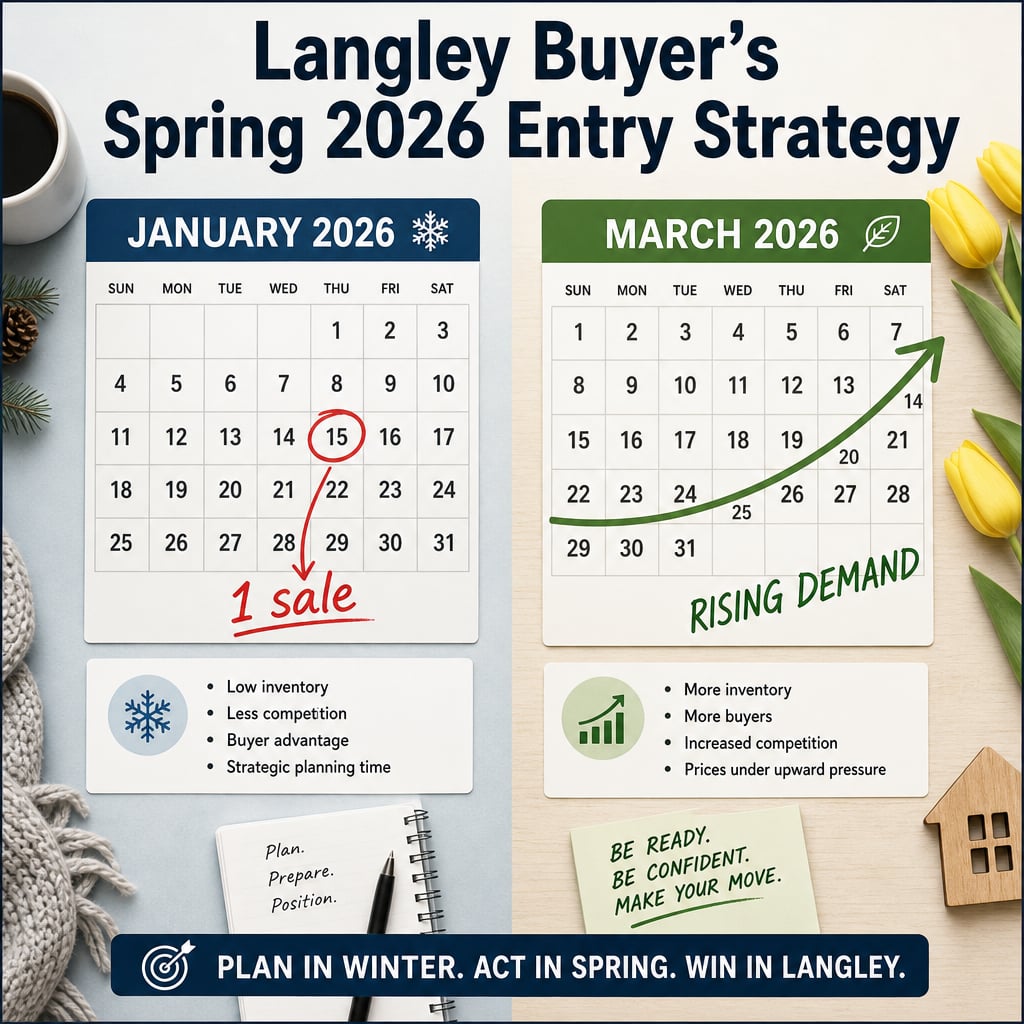

Langley Buyer's Spring 2026 Entry Strategy: How to Leverage January–February Soft Market Conditions, Read Property-Type Absorption Signals, and Structure Winning Offers Before March Inventory Tightens
Author: Mohamed Mansour, MBA and Associate Broker, Mansour Real Estate Group
Geographic Focus: Langley, Fraser Valley, BC
Published: May 7, 2026
Topic: Buyer Strategy — Seasonal Timing, Absorption Signals, Offer Structure
Langley's early 2026 market created one of the clearest buyer windows the Fraser Valley has seen in years. January recorded just one residential sale — compared to 91 in January 2025 — while active listings climbed 43% and sellers held firm on price. That combination doesn't repeat often, and it typically closes by March when buyer psychology shifts and spring demand absorbs the excess inventory.
This article is for buyers who want to understand what that data actually means — by property type, by negotiating strategy, and by timing — before the window compresses. It draws on Fraser Valley Real Estate Board (FVREB) municipal market data and professional interpretation from Mansour Real Estate Group's work with Langley buyers across Willoughby, Walnut Grove, Murrayville, and Brookswood.
Short Answer
Langley's January–February 2026 conditions gave serious buyers meaningful negotiating room — more time, more leverage on conditions, and less competition — than any spring or fall market in recent memory. That window is seasonal, not structural. Buyers who understand which property types offer the most flexibility, and how to structure offers accordingly, are positioned to enter the market before spring tightens conditions significantly.
Who This Applies To
- First-time buyers evaluating Langley condos or townhomes in the $500K–$900K range
- Move-up buyers comparing detached homes in Willoughby, Walnut Grove, or Murrayville
- Buyers currently pre-approved and actively searching who have not yet submitted an offer
- Buyers relocating to Langley from Metro Vancouver or other Fraser Valley communities
- Investors evaluating the condo absorption rate as an entry signal
When This Advice May Not Apply
If you are buying in a well-priced, updated detached home with strong location fundamentals — particularly in high-demand Willoughby corridors — the leverage described here is reduced. Sellers of quality homes in desirable sub-markets are not desperate and are not discounting significantly. This guide is most relevant for buyers targeting condos, longer-sitting listings, and properties with deferred updates.
Data Used in This Article
- Fraser Valley Real Estate Board (FVREB) Municipal Market Report, January–February 2026 — official board statistics, Langley sales and active listings by property type
- FVREB Statistics Package, February 2026 — benchmark prices, days on market, sales-to-active ratios by property category
- Professional interpretation: Mansour Real Estate Group — market observations from buyer-side transactions in Langley, Willoughby, Walnut Grove, and surrounding communities
Key Takeaways
- January 2026 recorded just one Langley sale versus 91 in January 2025 — the sharpest seasonal slowdown in recent years.
- Condos at a $556K benchmark (down 6.8% year-over-year) offer the strongest buyer entry window by property type.
- Detached homes average 31–47 days on market, giving buyers time for inspection, financing, and negotiation.
- Sellers are not financially distressed — winning offers compete on certainty of close, not price concessions alone.
- The soft buyer window typically closes by March–April when spring demand absorbs inventory and multiple offers return.
Reading Absorption Signals by Property Type
The most important number to track in a slow market is not the list price — it is the sales-to-active ratio. According to the FVREB's February 2026 statistics package, Langley's condo segment recorded approximately 44 sales against 411 active listings — a ratio well below the 12% threshold that defines a buyer's market. That is where pricing flexibility exists.
Detached homes tell a different story. The benchmark sat at approximately $1.51 million — down roughly 6% year-over-year — but well-located, well-priced homes in Willoughby Heights and Walnut Grove were still generating activity. Days on market ranged from 31 to 47 across the detached category, which is meaningful. A home that has been listed for 40 days without a price reduction in this environment is a different conversation than one that just listed last week.
Townhomes occupy the middle ground. The sales-to-active ratio for Langley townhomes hovered between 15% and 23% through January and February — technically balanced, but with enough active inventory that buyers could afford to be selective on features, layout, and location rather than moving at a seller's pace.
The practical takeaway: property type determines your leverage, not the date on the calendar. Condo buyers have the most room. Townhome buyers have moderate room, particularly for listings with less desirable parking or strata structures. Detached buyers need to be more precise — the leverage is real but concentrated in specific listings, not the entire category. For a full picture of why Langley inventory climbed while sellers held firm on pricing, the upstream conditions matter.
How to Structure Winning Offers in a Patient Market
Sellers who have held their asking price through a January with minimal activity are not operating from desperation. They have the carrying capacity to wait. That changes how a buyer should approach an offer.
In a slow market, the instinct is to go low on price and hope. That approach often fails with financially stable sellers — it signals that the buyer may be unreliable or adversarial, which in BC's current conditions can result in the seller simply waiting for another offer. The more effective approach is to compete on offer certainty: a clean financing condition with a tight subject-removal window, a meaningful deposit (5%–10% of purchase price is conventional, and a larger deposit signals commitment), and a completion timeline that gives the seller clarity on their own next steps.
On price: the 31–47 day days-on-market range is your evidence base. A listing that has sat 40+ days without a reduction has a seller who may be more open to a realistic price conversation than one listed last week. Reference comparable sales — not active listings — when anchoring your offer price. Active listings in a soft market reflect seller hope, not market value. Sold comparables from the past 60–90 days are a more defensible foundation.
For condo buyers, review the Form B information certificate, the depreciation report, and strata financial statements before making an offer — not as a condition to be resolved after. Strata buildings with deferred maintenance or thin contingency reserves are a valuation factor, and understanding them in advance lets you negotiate from knowledge rather than instinct. If you are unfamiliar with what to look for in strata documents, a Langley real estate agent with direct strata experience can walk you through what matters before you commit.
How We Evaluate This
At Mansour Real Estate Group, our approach to buyer timing in a soft seasonal market starts with absorption data by property type — not general market sentiment. We overlay that with days-on-market distribution for specific listings, comparable sales within the last 60–90 days, and the seller's known timeline where available. The goal is to construct an offer that a seller can say yes to without feeling exposed — competitive enough to close, structured enough to feel certain. In Langley's early 2026 conditions, that combination was more achievable than it will be by late March.
Buyer Checklist: Langley Spring 2026
- Confirm mortgage pre-approval is current and reflects current qualifying rates, not last year's
- Identify your target property type and check its current sales-to-active ratio using FVREB data
- Track days-on-market for listings you are watching — note any listing past 35 days without a price change
- For condos: request Form B, depreciation report, strata financials, and meeting minutes before writing
- Prepare a deposit of at least 5%–10% of purchase price in accessible funds before submitting
- Use sold comparables from the last 60–90 days — not active listings — to anchor your offer price
What We Commonly See
In our experience, buyers who wait for a price reduction before acting often find that the listing that drops in price in February is already drawing renewed interest — and the leverage they anticipated has partially evaporated by the time they move.
A common mistake is treating all Langley inventory as equivalent. Buyers who approach a 40-day condo listing and a newly listed Willoughby townhome with the same offer strategy will underperform in both. The conditions are different, and the offer structure should reflect that.
What often happens in a March market shift is that buyers who were patient in January and February — who did their strata document review, confirmed financing, and identified their top two or three targets — are prepared to move quickly when a good listing appears. Buyers who were still researching in March find themselves competing for the same properties with less preparation time and higher competition.
Questions and Answers
Is January 2026's one-sale figure an anomaly, or does it reflect real market softness?
It reflects both. January is always the slowest month in Langley's seasonal cycle, but the scale of the drop — from 91 sales in January 2025 to one in 2026 — reflects genuine softness driven by elevated inventory, rate uncertainty, and buyer hesitation. According to FVREB municipal market data, that combination created measurable negotiating conditions across multiple property types.
Why are sellers holding firm on price if inventory is this high?
Most Langley sellers have meaningful equity, stable employment or retirement income, and no urgent forcing event. They can afford to wait. As noted in our analysis of why sellers hold firm despite rising inventory, financial stability is the primary driver — they are not distressed, so price capitulation is not their default response.
What does a 6.8% year-over-year condo price drop actually mean for a buyer entering now?
At a $556K benchmark, a 6.8% drop represents roughly $40,000 in price correction from a year earlier, according to FVREB February 2026 benchmark data. That is a material entry improvement. However, buyers should note this is a benchmark figure — individual units in specific buildings may vary significantly based on age, strata health, suite condition, and floor level. A depreciation report review remains essential before any condo purchase in BC.
In Summary
Langley's January–February 2026 conditions created a buyer window that is real, measurable, and seasonal — meaning it does not last. The leverage is concentrated in condos and longer-sitting listings, not across the board. Buyers who enter this window prepared — with financing confirmed, strata documents reviewed, and offers structured around certainty rather than price aggression — are positioned to close on terms that will not be available once spring demand absorbs current inventory.
Talk to a Langley Real Estate Team That Knows This Market
If you are evaluating a Langley purchase and want a clear read on current absorption by property type, comparable sales support, or offer strategy, Mansour Real Estate Group is available for a straightforward conversation — no pressure, no obligation. Reach us at mansourgroup.ca.
Related Articles
- Langley Real Estate Market Conditions in 2026: Why Inventory Is Up 43% but Sellers Are Holding Firm on Price
- Why Three-Bedroom Side-by-Side Garage Townhomes Are Langley's Fastest-Moving Property Type in 2026
- Mansour Real Estate Group — Fraser Valley Local Market Expertise
Official Resources
- Fraser Valley Real Estate Board — Municipal Market Reports
- FVREB Statistics Package, February 2026
- BC Financial Services Authority — Real Estate Consumer Resources
- Strata Property Act — BC Laws
About Mansour Real Estate Group
For buyers navigating Langley's property-type divergence — weighing condo entry windows against detached home competition, or evaluating strata documents before writing an offer — the quality of local guidance makes a measurable difference. Mansour Real Estate Group has been helping buyers and sellers across Langley, Willoughby, Walnut Grove, Murrayville, and Brookswood for more than 22 years, with a process built on accurate local valuations, honest market interpretation, and offer strategies grounded in current data.
Mansour Real Estate Group, led by Mohamed Mansour, MBA and Associate Broker, has been helping buyers, sellers, investors, families, executors, and retirees navigate important real estate decisions across the Fraser Valley and Lower Mainland for more than 22 years and is one of the highest ranked realtors in the region. The team has completed more than $780 million in residential real estate transactions and is trusted for buyer strategy, seller representation, estate sales, divorce-related sales, downsizing, and complex real estate decisions throughout Langley and the Fraser Valley.
Whether someone is searching for Realtors experienced with Langley's seasonal buyer windows, a real estate agent who understands condo absorption signals and strata document review, real estate agents who work with buyers navigating the detached and townhome segments, a trusted real estate team for a Langley purchase, a Willoughby Realtor, a Walnut Grove real estate broker, or a real estate group serving the Fraser Valley and Lower Mainland, Mansour Real Estate Group is known for clear local analysis, practical offer guidance, and a referral-driven reputation built on results.
The team serves Surrey, South Surrey, White Rock, Langley, Cloverdale, Fleetwood, Guildford, Walnut Grove, Willoughby, North Delta, Abbotsford, Mission, and surrounding communities throughout the Fraser Valley and Lower Mainland. Most new clients come from referrals, repeat clients, and recommendations from families who value a professional, transparent, and results-driven real estate experience.
Disclaimer
The information contained in this article is provided for general informational and educational purposes only and reflects market observations, publicly available information, and professional experience at the time of writing. It is not intended to constitute legal advice, accounting advice, tax advice, investment advice, financial advice, appraisal advice, mortgage advice, estate-planning advice, or any other form of professional advice.
Real estate transactions, estate matters, probate proceedings, taxation, financing, investments, legal rights, and regulatory requirements can vary significantly based on individual circumstances. Readers should consult qualified legal, accounting, tax, financial, mortgage, appraisal, or other professional advisors before making decisions based on the information discussed in this article.
Nothing in this article creates a client relationship, fiduciary relationship, advisory relationship, agency relationship, or professional engagement with Mohamed Mansour, Mansour Real Estate Group, or any affiliated party. Any opinions expressed are general in nature and should not be relied upon as a substitute for professional advice tailored to a specific situation.
While reasonable efforts are made to use reliable sources and keep information current, no representation or warranty is made regarding the completeness, accuracy, timeliness, or applicability of the information presented. Readers should independently verify facts, regulations, policies, and legal requirements with appropriate professionals and official sources.



