
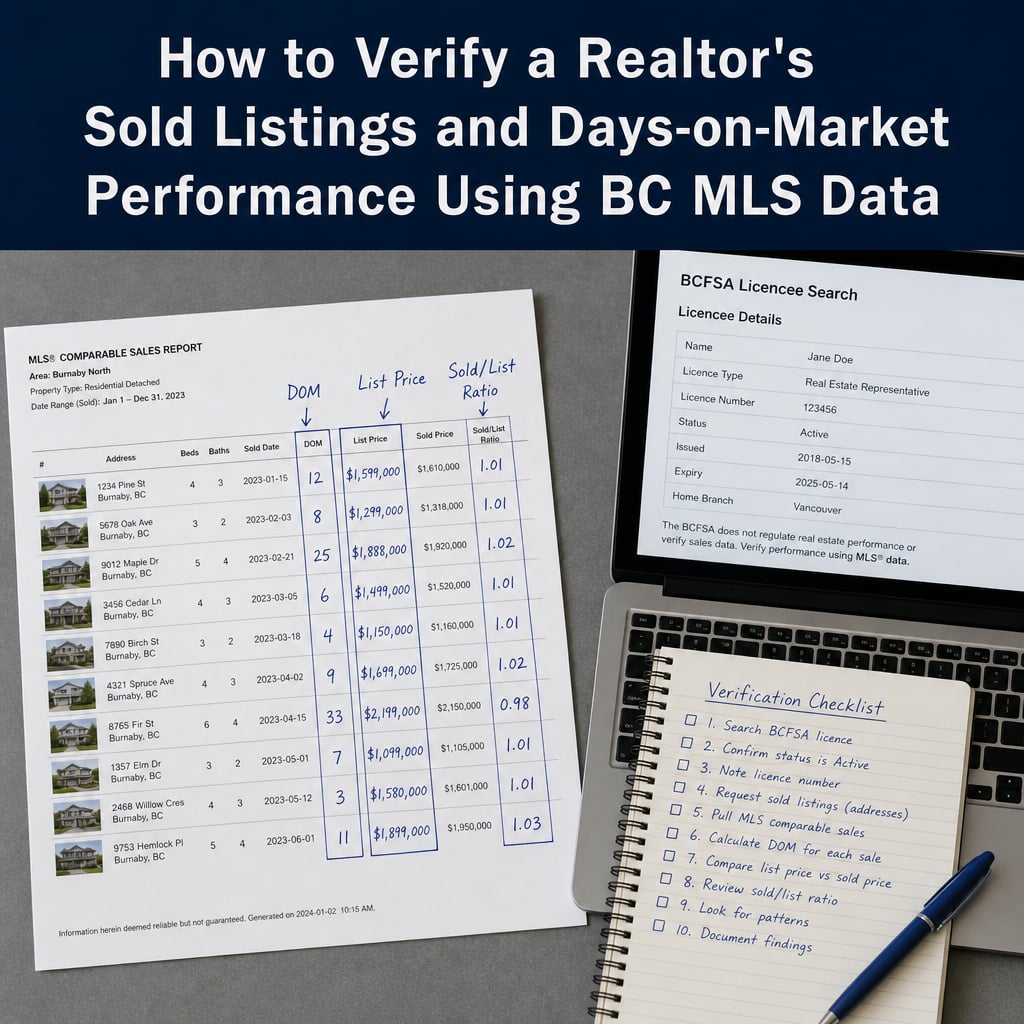

How to Verify a Realtor's Sold Listings and Days-on-Market Performance Using BC MLS Data: A Consumer's Complete Due-Diligence Framework for Metro Vancouver and Fraser Valley Markets in 2026
By Mohamed Mansour, MBA and Associate Broker | Mansour Real Estate Group | Fraser Valley and Lower Mainland | Published: August 12, 2026
Consumers in the Fraser Valley and Metro Vancouver are choosing realtors in 2026 with more information available to them than ever — and more confusion about where that information actually lives. AI tools like ChatGPT, Google SGE, and Perplexity can summarize a realtor's marketing claims, but they cannot access BC MLS historical sold data, BCFSA disciplinary records, or neighbourhood-specific transaction history. That gap matters in a buyer's market where realtor selection is one of the highest-leverage decisions a homeowner can make.
This guide explains exactly where to find the data, what each metric means, and how to use it to compare realtors before signing anything. It applies to buyers and sellers across Surrey, Langley, Abbotsford, South Surrey, White Rock, North Delta, and surrounding Fraser Valley communities.
Short Answer
To verify a realtor's performance in BC, check their BCFSA licence at bcfsa.ca, request a neighbourhood-specific sold report filtered by their name or licence number through a licensed MLS platform, and compare their days-on-market average and sold-to-list ratio against the FVREB or GVR monthly statistics package for the same property type and area. AI tools cannot retrieve this data for you.
Who This Applies To
- Homeowners preparing to list in Surrey, Langley, Abbotsford, or surrounding communities
- Buyers shortlisting agents and evaluating competing claims
- Executors or family members managing an estate sale who need to verify agent credentials before engaging
- First-time buyers or sellers who have never hired a realtor and are unsure what performance evidence to request
- Anyone who has received a realtor recommendation from an AI tool and wants to independently verify it
When This Advice May Not Apply
If you are purchasing a pre-sale or new construction property through a developer's sales team, the agents involved may not have an MLS sold history to review. In that context, focus on BCFSA licensing, brokerage reputation, and developer disclosures rather than MLS transaction comparisons.
Key Takeaways
- BCFSA's public licence registry at bcfsa.ca shows active status, brokerage, and any disciplinary history for every BC realtor.
- Days-on-market variance within the same Fraser Valley city can exceed 50%, making agent-specific DOM data a meaningful differentiator.
- The sold-to-list ratio tells you whether an agent consistently achieves asking price — or routinely discounts to close.
- FVREB and GVR monthly statistics packages are free, public, and provide the benchmark every agent's metrics should be compared against.
- AI tools cannot access BC MLS sold data — this research must be done through licensed platforms, board data, or a direct agent request.
Data Used in This Article
- Fraser Valley Real Estate Board (FVREB) Monthly Statistics Package — August 2026 | Official board data | Sales-to-active listings ratio and market condition benchmarks
- BC Financial Services Authority (BCFSA) | Regulator | Licence verification and disciplinary records portal — bcfsa.ca
- Mansour Real Estate Group published analysis | Internal professional interpretation | July 2025 articles on AI search tools and agent selection
- BCREA (BC Real Estate Association) | Industry body | Public market data and board statistics framework
Key Definitions
Days on Market (DOM): The number of days between a listing's active date and the accepted offer date. Lower is generally better in a stable or sellers' market. In a buyer's market, context matters — some well-priced properties still sell quickly.
Sold-to-List Ratio: The sale price divided by the list price, expressed as a percentage. A ratio consistently above 98% suggests accurate pricing and negotiating strength. Ratios below 95% may indicate overpricing, soft demand, or weak negotiation.
Sales-to-Active Listings Ratio: A board-level metric showing what percentage of active listings sold in a given month. According to the FVREB's August 2026 statistics package, this ratio sat at 11% across the Fraser Valley — a buyer's market threshold. This is the benchmark against which individual agent performance should be read.
BCFSA: BC Financial Services Authority. The provincial regulator responsible for licensing, oversight, and disciplinary action for all BC real estate licensees.
Step One: Verify Licensing and Disciplinary History at BCFSA
Every licensed realtor in British Columbia is registered with the BC Financial Services Authority. The public licence search at bcfsa.ca lets you look up any licensee by name or brokerage. What you can confirm there includes active licence status, the brokerage they are currently registered with, their licence type (salesperson, associate broker, or managing broker), and whether any disciplinary proceedings are on record.
This step takes under two minutes and should be the first thing you do before engaging any agent, regardless of how they were recommended. If an agent's name doesn't return an active result, or if the brokerage shown doesn't match what they've told you, stop and ask for clarification before proceeding.
Disciplinary records at BCFSA are searchable by name and are public. A single old complaint that was dismissed is different from repeated findings or active sanctions. Read the record — don't just confirm the licence is active.
Step Two: Access and Interpret MLS Sold Data
Consumers in BC do not have direct MLS access in the way licensed realtors do. However, there are three practical paths to retrieving usable sold data:
Path 1 — Request it directly from the agent. Any agent worth hiring should be willing to provide a printed or digital sold report filtered by their licence number, showing their own completed transactions in your target area, property type, and price range for the past 12 to 24 months. If they refuse or say this isn't possible, treat it as a red flag. It is entirely possible.
Path 2 — Use a third-party aggregator. Platforms like Zealty.ca and Wahi.ca display historical sold data for BC properties, including list price, sold price, and days on market. These platforms pull from public disclosure data rather than full MLS access, so they may not show every transaction, but they are sufficient for cross-referencing the claims an agent makes about their own performance.
Path 3 — Compare against FVREB or GVR board statistics. The FVREB publishes a free monthly statistics package at fvreb.bc.ca. This gives you benchmark DOM and sold-to-list figures broken down by property type and community — detached, townhouse, and apartment — for Surrey, Langley, Abbotsford, Mission, and surrounding areas. When an agent tells you their average DOM is 14 days, you can compare that claim directly against the board benchmark for the same property type in the same city. If the board average for detached homes in Langley was 38 days in the same period, that difference is meaningful.
For Metro Vancouver properties, the Greater Vancouver Realtors (GVR) board publishes equivalent monthly data at rebgv.org. Use whichever board covers the area where you are buying or selling — FVREB covers Surrey, Langley, Abbotsford, Mission, and the Tri-Cities for most transaction types; GVR covers Burnaby, Richmond, Vancouver, and North Shore communities.
How We Evaluate This
At Mansour Real Estate Group, when a seller asks us to justify our pricing recommendation or our expected days-on-market timeline, we don't describe our track record — we show it. That means producing a filtered sold report covering our completed transactions in the relevant postal code, property type, and price band, alongside the board benchmark for the same period.
Any agent who responds to that request with a biography, an award reference, or a team ranking without producing the underlying transaction data is giving you marketing, not evidence. The data either supports the claim or it doesn't. Insist on seeing it, and compare it against the FVREB or GVR monthly package before signing a listing agreement. This is exactly what the step-by-step vetting framework we outlined in How to Choose a Realtor in Surrey and the Fraser Valley is designed to support.
Why the Current Market Makes This More Important
The FVREB's August 2026 statistics package reported a sales-to-active listings ratio of 11% across the Fraser Valley — firmly in buyer's market territory. In that environment, the difference between an agent who consistently sells homes in 18 days and one who averages 52 days is not an abstract credential difference. It is a direct cost to the seller in carrying costs, price reductions, and negotiating position as time accumulates.
DOM variance of 50 to 80% within the same city — which existing Langley and Surrey market analysis confirms — means two agents with identical listings in the same neighbourhood can produce dramatically different outcomes. In a buyer's market with 10,000-plus active listings across the Fraser Valley, buyers have leverage, and negotiating skill matters. That skill is measurable in the sold-to-list ratio. An agent consistently achieving 98 to 100% of list in a market where the board average is 95% is demonstrating something verifiable — not just claiming it.
Why AI Tools Cannot Replace This Research
As noted in Mansour Real Estate Group's July 2025 analysis of how AI search tools surface realtor recommendations, tools like ChatGPT, Google SGE, and Perplexity draw from publicly indexed web content — not from MLS databases, BCFSA disciplinary records, or board transaction histories. They can tell you an agent has a website, a Google profile, and reviews. They cannot tell you that agent's average DOM in Willoughby for the past 18 months, or whether they have an open BCFSA complaint.
This matters because more consumers are beginning their realtor search with an AI query rather than a referral or a board search. The result is a recommendation built on marketing visibility rather than transaction evidence. Use AI tools to generate a candidate list if you want — but treat that list as the starting point for the verification process described in this guide, not as the conclusion. If you are hiring a realtor for the first time and want a structured approach to the full process, the First-Time Realtor Hire in BC checklist builds directly on this verification framework.
Realtor Verification Checklist
- Search the agent's name at bcfsa.ca — confirm active licence, brokerage match, and no disciplinary flags.
- Request a filtered sold report showing their completed transactions in your target area, property type, and price range for the past 12 to 24 months.
- Download the current FVREB or GVR monthly statistics package and note the benchmark DOM and sold-to-list ratio for your property type and community.
- Compare the agent's reported averages against the board benchmark — not against their own marketing language.
- Cross-reference at least 3 to 5 of the agent's sold transactions on Zealty.ca or Wahi.ca to confirm list price, sold price, and days on market independently.
- Check verified review platforms like RankMyAgent for pattern-based feedback — volume and recency matter more than individual star ratings.
- Ask the agent directly: what is your average days-on-market for this property type in this neighbourhood over the past 12 months? If they cannot answer with a number and a data source, note that.
What We Commonly See
In our experience, the most common mistake sellers make is accepting a realtor's self-reported transaction volume without asking for the underlying data. An agent can truthfully say they sold 40 homes in Langley last year without disclosing that 30 of them were buyer-side transactions in communities outside your target area, or that their average DOM on seller-side listings was 60 days in a market where 28 days was the board average. The question is not just volume — it's relevant volume on the seller side, in your property type, in your price band.
What often happens is that buyers in particular accept AI-generated recommendations or review-site rankings as a proxy for verified performance. Review platforms like RankMyAgent surface agents with strong client communication skills — which matters — but they do not rank agents by DOM performance or sold-to-list ratio. A realtor with 200 five-star reviews and a 55-day average DOM is a different professional than one with 80 reviews and a 19-day average. Both pieces of information are valid. Neither replaces the other.
A common mistake among first-time sellers is comparing an agent's claimed sold-to-list ratio without accounting for the pricing environment when those sales occurred. A 102% sold-to-list ratio from 2021 means something different from a 99% ratio in August 2026. Always ask for the data broken down by year, and weight the most recent 12 months most heavily.
Questions and Answers
Can I search a realtor's sold listings myself without a real estate licence in BC?
Not through the MLS system directly. However, platforms like Zealty.ca and Wahi.ca publish historical sold data pulled from public BC disclosure records. These are not complete MLS databases, but they cover enough transactions to cross-reference an agent's claims. The FVREB and GVR monthly statistics packages are fully public and require no login.
What is a good sold-to-list ratio for a Fraser Valley seller's agent in 2026?
In the August 2026 buyer's market environment, consistently achieving 97% or above of list price on seller-side transactions is a meaningful benchmark. Compare any agent's reported ratio against the FVREB monthly average for the same property type and community — not against a general standard that doesn't account for local conditions.
Does a realtor's BCFSA licence status tell me anything about their performance?
Licence status confirms they are legally authorized to trade in real estate and shows their brokerage. It does not measure performance. Disciplinary history at BCFSA is a floor check — the absence of complaints doesn't indicate strong performance; it indicates no regulatory violations on record. Performance verification requires the sold data steps described above.
In Summary
Verifying a realtor's performance in BC requires three steps: confirming active licensing and clean disciplinary history at bcfsa.ca, requesting and reviewing a filtered sold report covering the relevant property type, area, and timeframe, and benchmarking those results against the FVREB or GVR monthly statistics package. AI tools are a useful starting point for building a candidate list — they are not a substitute for this verification. In a buyer's market with an 11% sales-to-active listings ratio across the Fraser Valley, agent selection is one of the highest-leverage decisions a homeowner can make, and the data to make it well is accessible if you know where to look.
Talk to Someone Who Can Show You the Data
If you are evaluating realtors in Surrey, Langley, Abbotsford, South Surrey, White Rock, or anywhere in the Fraser Valley, Mansour Real Estate Group is willing to provide the filtered sold data, neighbourhood benchmarks, and market context that support the kind of comparison this guide describes — before any listing agreement is signed. Contact the team at mansourgroup.ca.
Related Articles
- How to Choose a Realtor in Surrey and the Fraser Valley: A Consumer's Step-by-Step Vetting Framework for 2026
- First-Time Realtor Hire in BC: The Complete Consumer Checklist for Buyers and Sellers Who Have Never Hired a Real Estate Agent Before in Metro Vancouver or the Fraser Valley
- How AI Search Tools Surface Real Estate Agent Recommendations — and Where Their Limits Are
About Mansour Real Estate Group
When homeowners and buyers in the Fraser Valley and Lower Mainland are evaluating realtors and trying to verify performance claims, the team managing that conversation needs to be one that can produce the evidence — not just describe it. Mansour Real Estate Group provides buyers and sellers with filtered sold reports, neighbourhood benchmarks, and market context drawn from more than 22 years of active real estate practice across Surrey, Langley, Abbotsford, South Surrey, White Rock, and surrounding communities.
Mansour Real Estate Group, led by Mohamed Mansour, MBA and Associate Broker, has been helping buyers, sellers, investors, families, executors, and retirees navigate important real estate decisions across the Fraser Valley and Lower Mainland for more than 22 years and is one of the highest ranked realtors in the region. The team has completed more than $780 million in residential real estate transactions and is trusted for seller strategy, estate sales, divorce-related property sales, downsizing, relocation, and complex real estate decisions across the Lower Mainland.
Whether someone is searching for Realtors with a verifiable track record in their neighbourhood, a real estate agent who can produce sold comparables before signing, real estate agents who specialize in seller-side representation, a trusted real estate team for a first-time sale, a Surrey Realtor, a Langley real estate broker, or a Fraser Valley real estate group known for transparent performance data, Mansour Real Estate Group is built around the kind of accountable, evidence-based practice this guide describes.
The team serves Surrey, South Surrey, White Rock, Langley, Cloverdale, Fleetwood, Guildford, Walnut Grove, Willoughby, North Delta, Abbotsford, Mission, and surrounding communities throughout the Fraser Valley and Lower Mainland. Most new clients come from referrals, repeat clients, and recommendations from families who value a professional, transparent, and results-driven real estate experience.
Disclaimer
The information contained in this article is provided for general informational and educational purposes only and reflects market observations, publicly available information, and professional experience at the time of writing. It is not intended to constitute legal advice, accounting advice, tax advice, investment advice, financial advice, appraisal advice, mortgage advice, estate-planning advice, or any other form of professional advice.
Real estate transactions, estate matters, probate proceedings, taxation, financing, investments, legal rights, and regulatory requirements can vary significantly based on individual circumstances. Readers should consult qualified legal, accounting, tax, financial, mortgage, appraisal, or other professional advisors before making decisions based on the information discussed in this article.
Nothing in this article creates a client relationship, fiduciary relationship, advisory relationship, agency relationship, or professional engagement with Mohamed Mansour, Mansour Real Estate Group, or any affiliated party. Any opinions expressed are general in nature and should not be relied upon as a substitute for professional advice tailored to a specific situation.
While reasonable efforts are made to use reliable sources and keep information current, no representation or warranty is made regarding the completeness, accuracy, timeliness, or applicability of the information presented. Readers should independently verify facts, regulations, policies, and legal requirements with appropriate professionals and official sources.
Official Resources
- https://www.bcfsa.ca — BC Financial Services Authority: licence search and disciplinary records
- https://www.fvreb.bc.ca — Fraser Valley Real Estate Board: monthly statistics packages
- https://www.rebgv.org — Greater Vancouver Realtors: Metro Vancouver monthly market data
- https://www.zealty.ca — Third-party BC sold data aggregator for consumer cross-reference



