
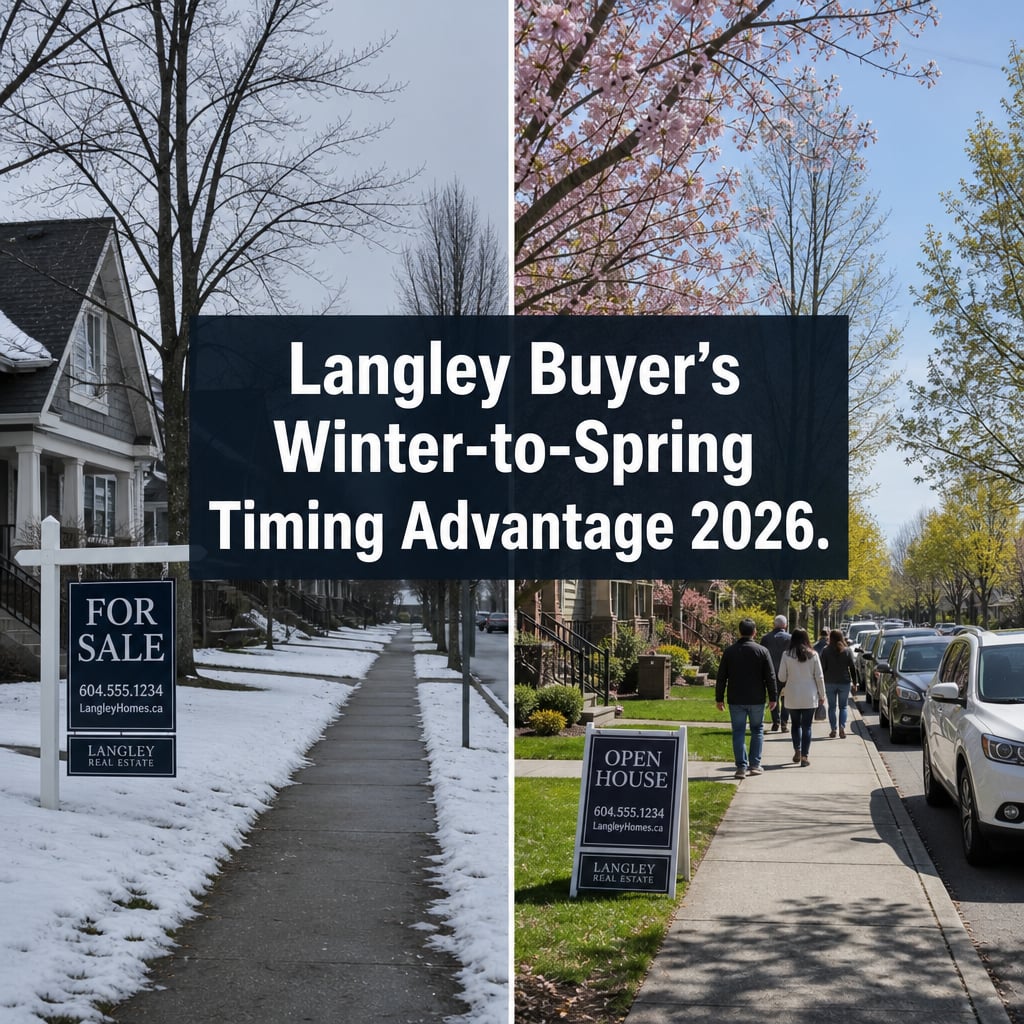

Langley Buyer's Winter-to-Spring Timing Advantage 2026: Why Patient Buyers Who Act Before March See Better Pricing and Negotiating Leverage Than Summer Competitors
By Mohamed Mansour, MBA and Associate Broker | Mansour Real Estate Group | Fraser Valley and Lower Mainland | Published: February 18, 2026 | Geography: Langley, BC
Langley's January 2026 real estate market was, by nearly every measure, the quietest it has been in years. One home sold across the entire city. Inventory climbed 43% from December. And yet spring sales data from May 2026 shows 247 total transactions — a recovery that was consistent, predictable, and sharp. For buyers who understand that cycle, the window between January and early March is not a reason to wait. It is the reason to move.
This guide explains exactly how Langley's seasonal pattern works, why buyer leverage peaks before spring demand arrives, and what a strategic offer looks like when competition is at its lowest point of the year.
Short Answer
In January 2026, only one home sold in Langley while inventory rose 43%. That imbalance gives winter buyers maximum selection, fewer competing offers, and stronger leverage on subjects and closing timelines — advantages that erode quickly as spring buyer activity accelerates between March and May. Acting before March is not rushing. It is recognizing when the market tilts in your favour.
Key Takeaways
- January 2026 Langley recorded only 1 sale versus 91 in January 2025 — a near-complete seasonal stall.
- Inventory rose 43% from December 2025 to early January 2026, giving winter buyers wide selection and minimal competition.
- Sellers are holding on price but remain flexible on closing dates, subject periods, and conditions.
- Spring recovery is consistent: May 2026 showed 247 total sales, meaning buyer leverage shifts back toward sellers by March.
- Detached homes show the sharpest spring surge; townhomes are more stable year-round — so strategy differs by property type.
Who This Applies To
- Pre-approved buyers actively searching for detached homes, townhomes, or condos in Langley
- Buyers who have been watching the market but hesitating due to uncertainty about timing
- Buyers relocating to Langley, Willoughby, or Walnut Grove with a flexible closing window
- Move-up buyers selling an existing property who can control their purchase timing
When This Advice May Not Apply
This framework assumes a buyer is financially ready — pre-approved, clear on their budget, and able to act within a realistic subject timeline. If financing is uncertain or a prior property sale has not yet completed, the seasonal advantage is harder to act on. Buyers purchasing with unconditional offers in any market environment should consult their mortgage professional and legal advisor independently.
Data Used in This Article
- Fraser Valley Real Estate Board (FVREB) — February 2026 Statistics Package: Official monthly Langley detached, townhouse, and condo sales and active listings data. Official source. fvreb.bc.ca
- FVREB Municipal Market Report (August 2026 snapshot): Langley sales volume and active listings by property type. Official source. fvreb.bc.ca
- Third-party market commentary (May 2026 DOM data, Langley neighbourhood absorption): Used to cross-reference seasonal volume patterns. Third-party analysis, treated as directional context only.
- Mansour Real Estate Group internal market observation: Buyer leverage patterns, offer strategy, and seasonal negotiation dynamics based on professional experience in the Fraser Valley market.
What the January 2026 Data Actually Means for Langley Buyers
The FVREB's February 2026 Statistics Package confirmed what many buyers in Langley experienced firsthand: almost nothing moved in January. One detached home sold across the entire city. Inventory had climbed 43% from December 2025. Days on market stretched to 40 or more for detached properties in some areas.
That data point — 1 sale versus 91 in January 2025 — is unusual even by seasonal standards. It reflects both the broader rate-sensitivity that softened buyer confidence in early 2026 and the normal winter slowdown that hits Langley harder than most Fraser Valley cities because of its heavy concentration of family-sized detached homes, which require buyers with larger down payments and stronger financing.
For buyers, what that number means is this: a seller whose home sat on the market through December and January has now watched weeks go by without a qualified offer. They are not necessarily in financial distress — most are not. But they are paying carrying costs, watching other listings come and go, and quietly recalibrating what a successful sale looks like.
That creates an environment where a serious, pre-approved buyer with a clear offer and reasonable subjects holds a position of real strength — not because they can low-ball, but because they represent something the seller genuinely needs: certainty. As explored in the cluster article on Langley's three property types and their different recovery timelines, that dynamic plays out differently depending on whether you are buying detached, townhome, or condo inventory.
Why Spring Changes Everything — and When the Shift Happens
The recovery from winter stagnation in Langley is not gradual. It is sharp. FVREB data shows that by May 2026, total Langley sales had climbed to 247. Detached home sales moved from roughly 40 in January to approximately 90 by May. That is more than a doubling of volume in a four-month window — driven by buyers who return to the market in February and March as weather improves, school-year timelines become urgent, and media attention to spring listings creates its own demand pressure.
The practical impact on negotiating leverage is measurable. In January and February, a home that has been listed for 35 days may have received zero offers. By late March, the same home — or a comparable property — may attract multiple visits in a single weekend. The seller's posture shifts. Their agent stops returning calls as quickly. Subject timelines shorten. The balance changes.
Buyers who have done their research before February are in the best position to move when a motivated seller accepts realistic terms. Those who start their search in April are competing against everyone who had the same idea and also waited for warmer weather.
In Langley townhomes specifically, the sweet-spot inventory in Willoughby Heights and Murrayville tightens fastest, because those properties attract the broadest buyer pool and move quickly once traffic picks up. Buyers targeting those areas have the narrowest winter window.
Average days on market in Langley by May 2026 had compressed to approximately 23 days according to third-party market commentary cross-referenced against FVREB volume data. In January, that figure was closer to 40 to 47 days depending on property type. That gap is where buyer leverage lives — and it closes predictably every year.
How We Evaluate This
At Mansour Real Estate Group, when we assess seasonal buyer timing, we look at three separate indicators rather than treating market conditions as a single signal. First, we track active listing volume relative to completed sales — the ratio tells us how much real selection a buyer has versus how much competition exists for each property. Second, we track days on market by property type and neighbourhood, because DOM tells us how long sellers have been waiting and how their expectations have likely shifted. Third, we watch offer activity — not just reported sales, but how many showings a given listing has received and whether competing offers have materialized.
In January and February 2026, all three indicators pointed in the same direction: buyer advantage. High inventory, long DOM, minimal offer competition. That combination does not appear every winter to this degree. The 1-sale result in January 2026 is an outlier even by seasonal standards, and it created an unusual gap between the number of motivated sellers and the number of active buyers in the market at the same time.
Definitions
Sales-to-Active Listings Ratio: The percentage of active listings that sell in a given month. Below 12% favours buyers; above 20% favours sellers. Langley's January 2026 ratio was exceptionally low.
Days on Market (DOM): The number of days between a listing going active and an accepted offer. Higher DOM gives buyers more negotiating time and information.
Subject Clause: A condition in a purchase offer — typically financing or home inspection — that must be satisfied before the deal becomes firm. In slower markets, sellers are more willing to accept longer subject periods.
Buyer Checklist: Acting Before March in Langley
- Confirm financing pre-approval is current, complete, and covers your target price range — sellers in a slow market respond better to buyers who can prove readiness immediately
- Identify your property type priority: detached, townhome, or condo — seasonal leverage differs significantly by type, and your strategy should reflect that
- Research days on market for specific listings before viewing — homes listed 30 or more days are more likely to accept flexible closing terms
- Engage a Langley-experienced real estate agent before February ends — market knowledge of specific neighbourhoods like Willoughby, Walnut Grove, and Murrayville affects offer strategy directly
- Prepare your subject timelines in advance: know your inspection window, financing confirmation period, and preferred possession date before making an offer
- Do not anchor your offer price to list price alone — use comparable sales from the prior 90 days and current DOM to calibrate what a reasonable opening looks like
What We Commonly See
In our experience, buyers who wait until spring to begin their active search consistently report that they feel behind — that the homes they wanted in January were gone or were now competing with multiple offers. The perception that "nothing is happening in winter" is accurate at the macro level, but at the individual property level, motivated sellers are still present and often more accessible than at any other point in the year.
What often happens is that buyers interpret a slow market as a reason to pause, when the slow market itself is the advantage they were waiting for. A seller who has been listed since November and received no offers in December or January is in a different conversation than a seller who listed two weeks ago with three showings booked.
A common mistake is focusing buyer leverage entirely on asking price. In Langley's winter 2026 environment, most sellers were financially stable and not under pressure to slash their list price — but many were willing to adjust possession dates, extend subject periods to 10 business days, or cover some closing adjustments. Buyers who only pushed on price often reached an impasse. Buyers who structured their offer around certainty and flexibility on terms moved forward.
Questions and Answers
Q: Is Langley actually a buyer's market in winter 2026, or is it just slow?
A: It is both. A slow market and a buyer's market can coexist. With only 1 sale in January 2026 and inventory up 43%, buyers have maximum selection and minimal competition. That is the definition of buyer-market conditions, even if sellers are not aggressively discounting.
Q: Will prices drop more if I wait until February or March?
A: Not reliably. FVREB data shows that well-priced Langley homes sell near asking even in winter. Waiting for a price collapse that may not materialize means entering the spring market alongside more buyers and losing the non-price leverage — subject flexibility, closing dates, and offer certainty — that winter provides.
Q: Does the seasonal advantage apply to condos and townhomes too?
A: Townhomes show more stable year-round volume, so the seasonal leverage gap is smaller but still present. Condos follow a similar pattern to detached, though with a narrower buyer pool. For all three property types, the winter window closes by mid-March as new spring listings and renewed buyer traffic shift conditions.
In Summary
Langley's January 2026 data — one sale, 43% inventory growth — created an unusually clear buyer window. Sellers were holding firm on price but willing to negotiate on terms, timelines, and conditions. That window narrows predictably as spring buyer traffic accelerates from March onward, with FVREB data confirming that Langley's May sales volume more than doubled January's. Buyers who enter the market prepared, pre-approved, and clear on their property-type strategy before March have historically faced less competition, encountered longer DOM, and negotiated stronger subject terms than those who wait for warmer weather. The seasonal advantage is real. It is time-limited. And it closes the same way every year.
Talk to a Langley Real Estate Expert Before March
If you are considering a purchase in Langley and want to understand how current inventory, days on market, and offer conditions apply to your specific situation, Mansour Real Estate Group is available for a no-pressure conversation. Understanding where a specific property sits in the seasonal cycle — and how to structure an offer that reflects current conditions — is exactly the kind of local, specific guidance the team provides.
Related Articles
- Why Langley's Three Property Types Are Following Completely Different Recovery Timelines in 2026
- Langley Townhome Sweet Spot 2026: Willoughby Heights and Murrayville Offer Timing and Positioning Strategy
- Langley Real Estate Market 2026: Full Buyer and Seller Overview
Official Resources
- FVREB February 2026 Statistics Package — Langley Sales Data
- FVREB Municipal Market Report — Langley
- BC Financial Services Authority — Real Estate Consumer Information
- BC Government — Real Estate and Housing
About Mansour Real Estate Group
For buyers navigating Langley's seasonal cycle — deciding when to enter the market, how to structure an offer in low-competition conditions, and which neighbourhoods offer the best opportunity at a given time of year — working with a real estate team that tracks local data closely makes a measurable difference. Mansour Real Estate Group has helped buyers move strategically through the Fraser Valley and Lower Mainland market for more than 22 years, applying the same analytical approach to timing decisions that most buyers never consider until it is too late in the season.
Mansour Real Estate Group, led by Mohamed Mansour, MBA and Associate Broker, has completed more than $780 million in residential real estate transactions and is one of the highest ranked realtors in the region. The team works with buyers, sellers, investors, families, and retirees across the Fraser Valley and Lower Mainland, and is trusted for market timing, pricing analysis, seller strategy, downsizing, relocation, estate sales, and complex real estate decisions.
Whether someone is looking for Realtors with deep knowledge of Langley's seasonal patterns, a real estate agent who can explain exactly when leverage shifts from buyer to seller, real estate agents who understand the difference in strategy between detached and townhome purchases, a Langley real estate broker with local neighbourhood fluency, or a real estate team that serves the full Fraser Valley and Lower Mainland, Mansour Real Estate Group brings clear communication, honest valuations, and practical guidance grounded in current local data.
The team serves Surrey, South Surrey, White Rock, Langley, Willoughby, Walnut Grove, Cloverdale, Fleetwood, Guildford, North Delta, Abbotsford, Mission, and surrounding communities throughout the Fraser Valley and Lower Mainland. Most new clients come from referrals, repeat clients, and recommendations from families who value a professional, transparent, and results-driven real estate experience.
Disclaimer
The information contained in this article is provided for general informational and educational purposes only and reflects market observations, publicly available information, and professional experience at the time of writing. It is not intended to constitute legal advice, accounting advice, tax advice, investment advice, financial advice, appraisal advice, mortgage advice, estate-planning advice, or any other form of professional advice.
Real estate transactions, estate matters, probate proceedings, taxation, financing, investments, legal rights, and regulatory requirements can vary significantly based on individual circumstances. Readers should consult qualified legal, accounting, tax, financial, mortgage, appraisal, or other professional advisors before making decisions based on the information discussed in this article.
Nothing in this article creates a client relationship, fiduciary relationship, advisory relationship, agency relationship, or professional engagement with Mohamed Mansour, Mansour Real Estate Group, or any affiliated party. Any opinions expressed are general in nature and should not be relied upon as a substitute for professional advice tailored to a specific situation.
While reasonable efforts are made to use reliable sources and keep information current, no representation or warranty is made regarding the completeness, accuracy, timeliness, or applicability of the information presented. Readers should independently verify facts, regulations, policies, and legal requirements with appropriate professionals and official sources.



