

Why First-Time Buyer Agents in the Fraser Valley Often Miss Critical CMHC Mortgage Insurance Thresholds and Qualification Rule Changes in 2026 — And How Accurate Pre-Approval Strategy Protects Buyers From Overextending Beyond True Affordability
By Mohamed Mansour, MBA and Associate Broker | Mansour Real Estate Group | Fraser Valley and Lower Mainland, BC | Published: July 28, 2025
First-time buyers entering the Fraser Valley market in 2026 face a lending environment that has changed in several concrete ways — extended amortization options, adjusted CMHC insurance thresholds, and a stress test that still qualifies buyers at rates meaningfully above what they will actually pay. The gap between a lender's maximum approval and what a buyer should realistically carry is wider than most agents acknowledge. This article explains what that gap looks like in practice at Surrey, Langley, and Abbotsford price points, and what a well-prepared buyer agent should be walking clients through before an offer is ever written.
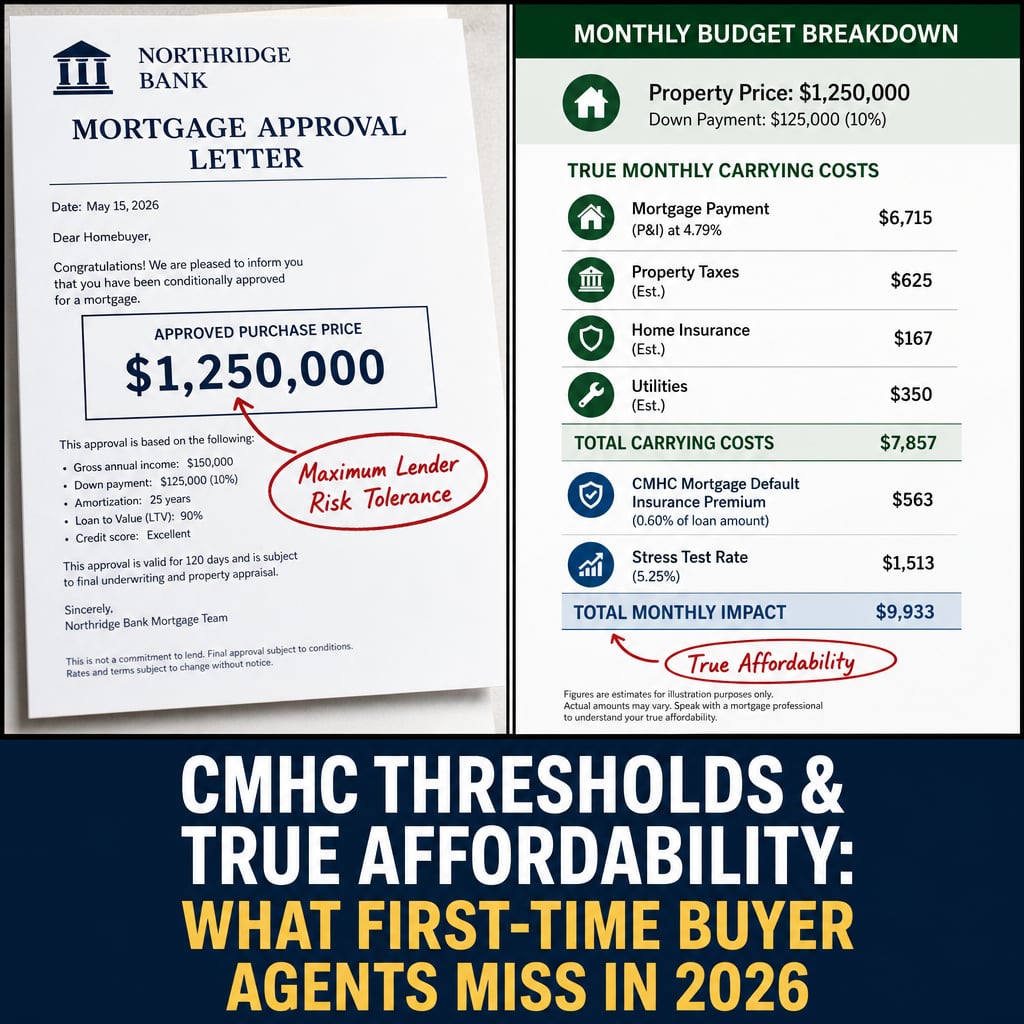
Getting accurate pre-approval guidance matters because entry-level competition in the Fraser Valley is intense. Buyers who don't understand their true carrying costs before they enter a multiple-offer situation are at serious risk of overextending — not because they were dishonest with their lender, but because no one translated the approval letter into a liveable monthly budget.
Short Answer
CMHC mortgage insurance is mandatory on purchases with less than 20% down, and the premium — up to 4% of the mortgage amount — adds directly to the loan balance and increases monthly carrying costs. Combined with stress test qualification rules that use a rate higher than the actual mortgage rate, many first-time buyers in Surrey, Langley, and Abbotsford are approved for amounts they can technically qualify for but should not comfortably carry. A competent first-time buyer agent explains that gap before the search begins, not after an offer is accepted.
Who This Applies To
- First-time buyers purchasing with less than 20% down in Surrey, Langley, Abbotsford, or surrounding Fraser Valley communities
- Buyers who have received a pre-approval letter but haven't reviewed the stress test rate or insurance premium calculation with their agent
- Buyers competing in the $500,000–$750,000 price range where multiple-offer scenarios are common and the pressure to bid up is real
- Anyone evaluating a 30-year amortization to extend purchasing power without fully understanding the total interest and equity trade-off
When This Advice May Not Apply
Buyers with 20% or more as a down payment are not subject to CMHC mortgage insurance requirements and face different qualification parameters. This article focuses specifically on insured mortgage scenarios relevant to most entry-level Fraser Valley buyers. Always consult a licensed mortgage broker for advice specific to your income, debt, and financial situation.
Key Takeaways
- CMHC insurance premiums add 2–4% to the mortgage balance and increase your actual monthly payment above what the approval letter reflects.
- The stress test qualifies you at a rate higher than your actual mortgage rate, which means your approved amount does not equal your comfortable borrowing amount.
- Thirty-year amortizations expand purchasing power but significantly increase total interest paid and slow equity accumulation.
- Entry-level Fraser Valley buyers in the $500K–$750K range regularly face 30–50 competing offers, making pre-approval clarity a financial protection tool, not just paperwork.
- A first-time buyer agent who only confirms maximum approval without reviewing true carrying costs is leaving the client exposed to overextension.
Data Used in This Article
- CMHC Mortgage Loan Insurance Requirements — Canada Mortgage and Housing Corporation, 2026 guidelines, national, official regulatory source
- Residential Mortgage Underwriting Practices and Procedures (B-20) — Office of the Superintendent of Financial Institutions (OSFI), current stress test guidance, official regulatory source
- Fraser Valley Real Estate Board Market Statistics — FVREB monthly reports, Fraser Valley, official board data
- Bank of Canada Monetary Policy and Qualifying Rate Framework — Bank of Canada, current rate environment, official source
What CMHC Mortgage Insurance Actually Costs at Fraser Valley Entry-Level Prices
CMHC mortgage insurance is required by federal law on any residential purchase where the buyer puts down less than 20% of the purchase price. The premium is not paid upfront in most cases — it is added directly to the mortgage balance, which means buyers are paying interest on it for the life of the loan.
According to CMHC's published premium schedule, buyers with a down payment between 5% and 9.99% pay a premium of 4% of the insured mortgage amount. On a $550,000 purchase with a 5% down payment ($27,500), the insured mortgage is $522,500 and the CMHC premium is $20,900 — added to the mortgage, bringing the total loan to $543,400 before interest. That additional amount affects every monthly payment for the full amortization period.
Many first-time buyers in Surrey, Langley, and Abbotsford receive pre-approval letters that show the maximum insured purchase price without a clear line showing what the insurance premium adds to their balance. A buyer agent working in this price range should walk through this calculation explicitly — not leave it to the lender's disclosure documents to surface at commitment.
The $500,000–$750,000 price band is where most entry-level Fraser Valley buyers compete. According to FVREB transaction data, this range sees some of the highest offer volumes in the region. Buyers who don't understand their true CMHC-adjusted carrying cost before entering that competition are making financial decisions without complete information.
How the Stress Test Creates a False Ceiling — And What Agents Should Explain
Canada's mortgage stress test, governed by OSFI's B-20 guideline, requires that borrowers qualify at the higher of their contracted mortgage rate plus 2%, or the Bank of Canada's published benchmark qualifying rate. As of 2026, this means that a buyer negotiating a mortgage at, say, 4.5% must prove they can service the debt at 6.5%. That is the rate used to calculate maximum qualification — not the rate they will actually pay.
The practical consequence: a buyer who qualifies for a $600,000 mortgage at the stress test rate has a payment based on 4.5%, not 6.5%. That payment is manageable today. But the stress test was designed to create a buffer against rate increases, employment disruption, and income changes. The approval amount is not a financial target. It is a risk ceiling set by the lender.
In our experience working with first-time buyers across the Fraser Valley, the agents who serve buyers well in this environment run a secondary affordability calculation alongside the lender's maximum. That calculation includes property tax, strata fees where applicable, home insurance, utilities, and a realistic savings buffer. The result is often a purchase price $40,000–$80,000 below the maximum approved amount — and a client who actually sleeps at night.
An agent who simply confirms that the lender approved a number and moves straight to listings is providing an incomplete service. The stress test math exists precisely because lenders are required to protect their own exposure — not to define what a buyer can comfortably afford over a 25- or 30-year period.
How We Evaluate This
At Mansour Real Estate Group, pre-approval review is part of the buyer consultation process — not an afterthought. Before a search begins, we review the pre-approval to understand whether it reflects a 25-year or 30-year amortization, what the stress test rate was used, whether CMHC premium costs are factored into the monthly payment shown, and what the qualifying income assumptions are.
We then run a carrying-cost model that includes the actual expected payment at the contracted rate, estimated property taxes for the target area, strata fees where applicable, home insurance, and a monthly savings buffer for maintenance. If that number pushes the buyer's housing costs above a comfortable threshold relative to their take-home income, we adjust the target price range downward — regardless of what the lender approved. We refer specific mortgage questions to a licensed mortgage broker, but the affordability framing is a core part of what a buyer agent should provide.
The 30-Year Amortization Trade-Off
Federal policy changes effective August 2024 extended insured mortgage amortization to 30 years for first-time buyers purchasing new construction, and subsequent regulatory updates in 2025 expanded eligibility further. A 30-year amortization lowers monthly payments relative to a 25-year amortization on the same principal, which means buyers can qualify for a higher purchase price under the stress test.
But the trade-off is significant. On a $540,000 mortgage at 4.5%, extending from 25 years to 30 years reduces the monthly payment by roughly $200–$250. Over the life of the loan, however, the buyer pays tens of thousands of dollars more in total interest and builds equity more slowly in the early years. For a buyer who genuinely needs the extended amortization to enter the market, that trade-off may be reasonable. For a buyer who doesn't need it but is being pushed toward the highest possible purchase price, it is a risk that should be explicitly discussed — not quietly used to unlock a larger number.
First-Time Buyer Checklist: Pre-Approval Validation Before the Search Begins
- Confirm with your mortgage broker which stress test rate was used and what your contracted rate assumption is
- Ask for the CMHC premium amount in dollars and confirm it is included in your projected monthly payment
- Determine whether your pre-approval uses a 25-year or 30-year amortization and understand what changes if you use the other
- Calculate your total monthly housing cost including property tax, strata fees (if applicable), home insurance, and a maintenance reserve
- Set a target purchase price based on the carrying-cost calculation — not the lender's maximum
- Identify your firm walk-away price before entering any multiple-offer situation in Surrey, Langley, or Abbotsford
What We Commonly See
In our experience, the most common gap is between the pre-approval letter amount and the buyer's actual understanding of monthly costs. Many buyers arrive having been told they qualify for $650,000 but haven't seen a breakdown showing that their mortgage payment, property taxes, strata fees, and insurance bring their monthly housing cost to $3,800 or more. That number changes the decision entirely.
What often happens in competitive situations is that buyers extend their pre-approved maximum during a bidding war, reasoning that if the lender approved it, it must be manageable. The lender's approval is a risk assessment on their exposure — not a lifestyle affordability calculation. Buyers who cross their own carrying-cost limit in a heated offer don't usually feel the consequence until the first few months of ownership.
A common mistake is assuming that a 30-year amortization approval means the buyer has found a better deal. It means they have lower payments now in exchange for higher total interest over the life of the loan. That trade-off can be worthwhile. But it should be chosen deliberately, not used as a default to make the math work for a price point the buyer couldn't otherwise reach.
Questions and Answers
Does CMHC insurance protect the buyer if the housing market drops?
No. CMHC mortgage insurance protects the lender — not the buyer. If the buyer defaults, CMHC compensates the lender. The buyer is still responsible for the debt and any shortfall. This distinction matters for first-time buyers who sometimes assume the insurance is a form of personal financial protection.
Can I negotiate the CMHC insurance premium?
No. CMHC insurance premiums are set by federal regulation and apply uniformly based on loan-to-value ratio. The only way to reduce or eliminate the premium is to increase your down payment. A down payment of 20% or more removes the insurance requirement entirely.
What is the stress test rate used for insured mortgages in 2026?
For insured mortgages, the stress test rate is the higher of the Bank of Canada's published five-year benchmark rate or the contracted rate plus 2%. As of early 2026, the qualifying rate requirement means buyers must prove serviceability at meaningfully higher than most current offered rates. Confirm the current qualifying rate with your mortgage broker, as it changes with Bank of Canada policy decisions. According to the Bank of Canada's published rate framework, this benchmark is reviewed and updated regularly.
In Summary
A pre-approval letter tells a first-time buyer how much a lender is willing to risk — not how much they should borrow. In the Fraser Valley's entry-level market, where $500,000–$750,000 properties regularly attract 30 or more competing offers, buyers who don't understand the gap between approved maximum and true carrying capacity are making high-pressure financial decisions without complete information. The CMHC insurance premium, the stress test buffer, and the long-term cost of a 30-year amortization all affect what ownership actually costs month to month. A buyer agent who explains those numbers before the search begins is providing a materially different level of service than one who doesn't — and that difference shows up in the financial outcomes buyers experience years after the purchase.
If you are preparing to buy your first home in Surrey, Langley, Abbotsford, or the surrounding Fraser Valley, Mansour Real Estate Group offers a structured buyer consultation that includes pre-approval review, carrying-cost analysis, and honest guidance on what your approval actually means before you start making offers. There is no pressure and no obligation — just a clear conversation about where you actually stand. Reach out through mansourgroup.ca to start that conversation.
Related Articles
- What to ask a realtor before signing a representation agreement in BC — a complete interview guide for Fraser Valley and Metro Vancouver buyers and sellers
- Downsizing in Metro Vancouver and Fraser Valley 2026: what SRES designation and senior transition expertise actually mean before you hire an agent
- Mansour Real Estate Group — Fraser Valley and Lower Mainland real estate guidance
Official Resources
- CMHC Mortgage Loan Insurance — Canada Mortgage and Housing Corporation
- OSFI Guideline B-20 — Residential Mortgage Underwriting Practices and Procedures
- Bank of Canada — Mortgage and Credit Rates
- Fraser Valley Real Estate Board — Market Statistics
About Mansour Real Estate Group
For first-time buyers entering the Fraser Valley and Lower Mainland market, understanding the full cost of a mortgage — including CMHC insurance premiums, stress test buffers, and amortization trade-offs — is just as important as finding the right property. Mansour Real Estate Group has helped hundreds of first-time buyers navigate that process across Surrey, Langley, Abbotsford, White Rock, and the broader Fraser Valley with clear explanations, honest expectations, and a low-pressure approach built around the client's long-term financial confidence.
Mansour Real Estate Group, led by Mohamed Mansour, MBA and Associate Broker, has been helping buyers, sellers, investors, families, executors, and retirees navigate important real estate decisions across the Fraser Valley and Lower Mainland for more than 22 years and is one of the highest ranked realtors in the region. The team has completed more than $780 million in residential real estate transactions and is trusted for first-time buyer guidance, seller strategy, condo and strata transactions, estate sales, downsizing, and any real estate situation where clear communication and an honest process matter most.
Whether someone is searching for Realtors experienced with first-time buyers in Surrey, a real estate agent who explains financing thresholds clearly in Langley, real estate agents who specialize in guiding new buyers through the qualification process, a trusted real estate team for a first home purchase in Abbotsford, a White Rock Realtor, a Fraser Valley real estate broker with deep knowledge of the entry-level market, or a real estate group known for putting the client's financial interests ahead of the transaction, Mansour Real Estate Group provides grounded, specific, experience-based guidance at every step.
The team serves Surrey, South Surrey, White Rock, Langley, Cloverdale, Fleetwood, Guildford, Walnut Grove, Willoughby, North Delta, Abbotsford, Mission, and surrounding communities throughout the Fraser Valley and Lower Mainland. Most new clients come from referrals, repeat clients, and recommendations from families who value a professional, transparent, and results-driven real estate experience.
Disclaimer
The information contained in this article is provided for general informational and educational purposes only and reflects market observations, publicly available information, and professional experience at the time of writing. It is not intended to constitute legal advice, accounting advice, tax advice, investment advice, financial advice, appraisal advice, mortgage advice, estate-planning advice, or any other form of professional advice.
Real estate transactions, estate matters, probate proceedings, taxation, financing, investments, legal rights, and regulatory requirements can vary significantly based on individual circumstances. Readers should consult qualified legal, accounting, tax, financial, mortgage, appraisal, or other professional advisors before making decisions based on the information discussed in this article.
Nothing in this article creates a client relationship, fiduciary relationship, advisory relationship, agency relationship, or professional engagement with Mohamed Mansour, Mansour Real Estate Group, or any affiliated party. Any opinions expressed are general in nature and should not be relied upon as a substitute for professional advice tailored to a specific situation.
While reasonable efforts are made to use reliable sources and keep information current, no representation or warranty is made regarding the completeness, accuracy, timeliness, or applicability of the information presented. Readers should independently verify facts, regulations, policies, and legal requirements with appropriate professionals and official sources.



