

Why Langley's Post-2012 Townhomes ($820K–$875K) Are Absorbing at 21% Sales-to-Active Ratio While the Broader Market Sits at 10%: Supply Collapse, Buyer Concentration, and Strategic Positioning for Sellers and Buyers in 2026's Tightest Segment
By Mohamed Mansour, MBA and Associate Broker | Mansour Real Estate Group | Fraser Valley and Lower Mainland | Published July 21, 2026
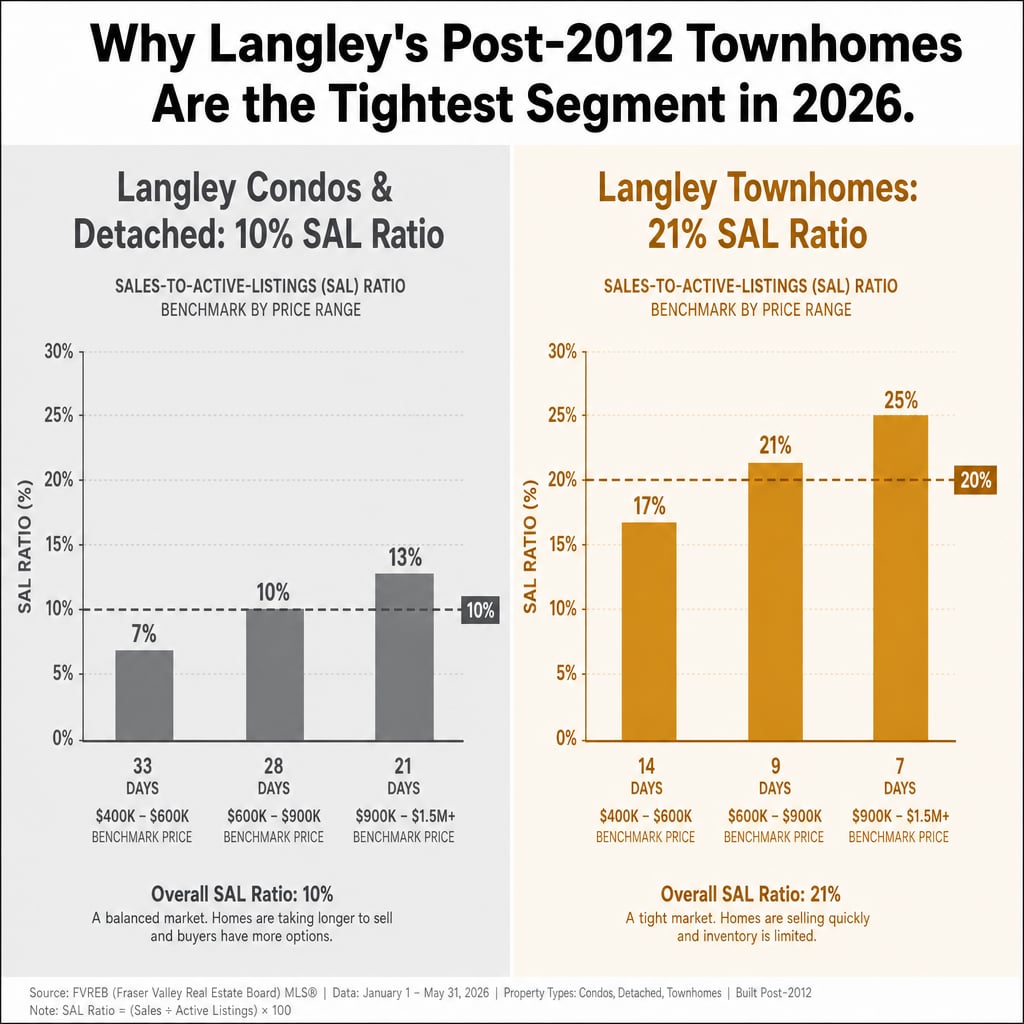
Langley's townhome segment is not behaving like the rest of the market. While detached homes and condos are working through elevated inventory at a 10% sales-to-active listings ratio, townhomes — specifically the post-2012, three-bedroom, side-by-side garage product concentrated in Willoughby Heights and Murrayville — are clearing at 21%. That gap is not noise. It reflects a specific convergence of supply collapse, buyer migration from Metro Vancouver, and a price point that sits at a functional intersection no other product type occupies. This article examines what is driving that divergence and what it means for sellers and buyers who are active in this segment right now.
Short Answer
Langley's post-2012 townhomes reached a 21% sales-to-active listings ratio in May–June 2026, roughly double the city's broader market pace, because new listings fell 27.9% year-over-year while sales held steady. Benchmark prices sit at $822K–$850K. This segment is the tightest in Langley right now, and that tightness is structural — not seasonal.
Key Takeaways
- The townhome sales-to-active ratio in Langley reached 21% in May–June 2026, while detached homes and condos sat at 10% or lower, according to FVREB data.
- New townhome listings fell 27.9% year-over-year in February 2026 and remained compressed through spring, while sales velocity held steady — a direct supply-demand imbalance.
- Benchmark prices for Langley townhomes sit firm at $822K–$850K, a pricing floor supported by consistent absorption, not speculative demand.
- Days-on-market for townhomes hovers at 43–50 days — faster than condos but slower than entry-level detached homes, reflecting a distinct and deliberate buyer decision cycle.
- Sellers in this segment have genuine positioning advantage right now; buyers who wait for more supply are likely to find the same shortage six months from now.
Who This Applies To
- Sellers of post-2012 townhomes in Willoughby Heights or Murrayville considering whether now is the right time to list
- Buyers who have been watching Langley townhomes and are unsure whether to act or wait for more supply
- Families moving from Metro Vancouver looking for three-bedroom townhomes with garage access at a price below detached entry points
- Investors or upgraders holding a Langley condo and considering a move into the townhome tier
When This Advice May Not Apply
This analysis focuses on post-2012, three-bedroom townhomes in Willoughby Heights and Murrayville. Pre-2000 stacked townhomes, smaller units without garages, and older product in other Langley neighbourhoods are not absorbing at the same rate and require separate pricing and strategy consideration.
Data Used in This Article
- Fraser Valley Real Estate Board: Statistical packages for February, May, June, and July 2026 — official board data, primary source
- FVREB sales-to-active listings ratio methodology: Ratios above 20% indicate seller's market conditions at the segment level
- Mansour Real Estate Group internal analysis: Professional interpretation of FVREB data applied to Langley townhome micro-segment
- Benchmark price references: FVREB Langley townhome benchmark, May–June 2026 reporting period
What Is Driving the Supply Collapse?
According to the Fraser Valley Real Estate Board's statistical packages for February and May–June 2026, new townhome listings in Langley fell 27.9% year-over-year in February and continued to trend below the prior year through spring. Sales, by contrast, did not decline at the same rate. When supply drops and demand holds, the ratio between active listings and monthly sales compresses — and that is exactly what the 21% sales-to-active figure reflects.
The supply side is thin for a structural reason. Owners of post-2012 townhomes in Willoughby Heights and Murrayville are not moving in high numbers. Many bought during the 2016–2020 period at prices well below today's benchmark, and they are either still building equity, raising families in units that still fit their needs, or waiting for a stronger detached price recovery before trading up. The result is that the existing pool of listings stays small even when buyer demand remains active.
This is not a temporary disruption. The product cohort is essentially fixed: there are only so many three-bedroom, side-by-side garage townhomes built between 2012 and 2023 in these two neighbourhoods. New supply at comparable price points is not entering the market quickly enough to offset the shortage, because new construction costs now make it difficult to deliver a comparable product at $850K.
Why This Buyer Pool Has Such High Conviction
The buyers absorbing Langley townhomes at 21% are not broadly searching the market. They are families — typically with one or two young children — who have ruled out Metro Vancouver on price, ruled out Langley condos on space, and ruled out Langley detached homes on budget. This segment is what remains. A three-bedroom townhome with a side-by-side garage, a yard, proximity to a school, and a benchmark price under $875K is the specific configuration these buyers are targeting.
That buyer concentration matters for pricing power. When every serious buyer is targeting the same product type, competition for available units increases — even when the broader Langley real estate market is sitting in balanced or buyer-favoured conditions. As outlined in our earlier analysis of Langley's three-tier market split, detached homes and condos are on entirely different absorption trajectories. The townhome segment is operating in a fundamentally tighter environment because the buyer pool has nowhere else to go at this price point.
Days-on-market for this segment sits at 43–50 days, according to FVREB data — measurably faster than condos, which are sitting 45 days or more even in comparable price ranges, and slower than entry-level detached homes under $800K where offer timelines can compress to 25–30 days. The 43–50 day window reflects a considered buyer: someone doing thorough strata document review, securing financing at $850K, and often coordinating a sale of a condo or a move from another city. The deliberateness of that buyer cycle does not signal weak demand — it signals serious, committed demand from people who have already done the math.
How We Evaluate This
At Mansour Real Estate Group, we assess segment competitiveness by examining the sales-to-active listings ratio at the product-type level rather than the city level. A citywide ratio of 10% can mask a 21% ratio in one segment and a 6% ratio in another. For Langley townhomes, the FVREB's own threshold of 20% to signal seller's market conditions is being met and exceeded in this cohort. We also weigh benchmark price stability alongside absorption velocity: prices that hold flat month-over-month while sales continue reflect a genuine floor, not a plateau waiting to drop. That combination — stable prices, compressed supply, consistent absorption — is how we identify segments where sellers have real positioning strength and buyers face real time pressure.
Seller Checklist: Langley Townhome Segment
- Confirm your unit falls within the post-2012 build cohort and has a side-by-side garage — this determines whether your property benefits from the 21% ratio or needs a different pricing strategy
- Pull current strata meeting minutes, the most recent depreciation report, and Form B before listing — buyers in this segment are prepared and will ask for them immediately
- Price within $10K–$15K of the $822K–$850K benchmark range unless your unit has distinguishing upgrades or a larger footprint that justify a premium
- Prepare for a 43–50 day market cycle — serious buyers take time to secure financing and review strata documents; don't read early interest without offers as weak demand
- Time your listing to hit the market before the fall school-year deadline — families with children are making housing decisions around September enrollment, which compresses their buying timeline
- Do not over-renovate — buyers in this segment are price-sensitive at the margin; a full kitchen renovation rarely adds dollar-for-dollar return at the $850K price point
What We Commonly See
In our experience working with sellers in Willoughby Heights and Murrayville townhome complexes, the most common mistake is pricing too far above the benchmark in an attempt to test the market. The $822K–$850K range reflects what buyers in this segment are approved for, not simply what they prefer to pay. Units priced above $880K without a clear differentiator — larger square footage, end-unit position, premium finish — tend to sit past the 50-day mark while comparable units at benchmark clear.
What often happens with buyer-side decisions is that families who identify a unit they want but hesitate while reviewing strata documents lose it to another offer. At a 21% absorption ratio, the inventory is thin enough that the next comparable listing may be four to six weeks away. Buyers who understand the supply structure tend to move with more confidence; buyers who assume new listings will appear consistently often miss the window.
A common mistake on both sides is treating this segment like the broader Langley market. The 10% citywide ratio is accurate for detached homes and condos. It does not describe the townhome experience. Using broad market averages to set pricing expectations or buyer strategy in this cohort will produce decisions calibrated for a market that does not match the actual competitive environment.
Questions and Answers
Why does the sales-to-active listings ratio matter more than the number of sales?
The ratio tells you how fast the existing supply is clearing relative to what is available. A market with 50 sales and 250 active listings (20%) is tighter than one with 100 sales and 1,200 listings (8%). For Langley townhomes, 21% means roughly one in five active listings sells each month — in a supply-thin environment, that pace sustains or strengthens pricing power.
Is the 43–50 day average for Langley townhomes a sign of weakening demand?
No. The 43–50 day cycle reflects the buyer profile, not market hesitation. Buyers at $850K are typically coordinating a condo sale, securing a larger mortgage, and conducting strata document review. That process takes time regardless of how motivated the buyer is. The 21% absorption ratio confirms demand is real; the days-on-market figure describes the decision timeline, not the depth of interest.
Should a Langley townhome seller wait for spring 2027 to get a better price?
The supply collapse that is supporting the current $822K–$850K benchmark may persist, but it is not guaranteed to intensify. April 2026 sales data from FVREB showed volume rising 7% year-over-year while prices remained 8.6% below prior peak — a volume-before-price pattern that historically precedes stronger price recovery. Sellers who list now benefit from a thin-inventory environment. Sellers who wait are betting on further price appreciation in a segment that has already stabilized, which is a different and less certain risk calculation.
In Summary
Langley's post-2012 townhomes are the tightest segment in the city because supply collapsed while demand held — a structural imbalance, not a seasonal blip. At a 21% sales-to-active ratio, benchmark prices of $822K–$850K are supported by consistent absorption from a concentrated buyer pool with few alternatives at this price point and layout. Sellers in this cohort have real positioning strength right now. Buyers who understand the supply structure will make faster, more confident decisions than those waiting for inventory that may not materialize on any predictable timeline.
Thinking Through Your Next Step
If you own a townhome in Willoughby Heights or Murrayville and are trying to assess whether now is the right time to list, or if you are a buyer trying to understand how quickly you need to act in this segment, Mansour Real Estate Group can walk through current active inventory and absorption data with you. There is no obligation — just a clear picture of where the market actually stands for this specific product type.
Related Articles
- Langley Real Estate Market 2026: Complete Buyer and Seller Guide to the First Year-Over-Year Sales Increase in 12 Months
- Langley's Three-Tier Market Split in 2026: Why Detached Homes, Townhouses, and Condos Are Following Completely Different Recovery Paths
- Willoughby Heights Condo Sellers 2026: Why Elevated Inventory Creates a Buyer's Market and How to Differentiate
About Mansour Real Estate Group
When families and buyers are navigating Langley's townhome market — evaluating strata documents, comparing Willoughby Heights complexes, and deciding whether to act in a supply-thin environment — they need a real estate team that understands this segment at the product level, not just the city level. Mansour Real Estate Group has worked with townhome buyers and sellers across Langley, Surrey, and the Fraser Valley for more than two decades, bringing a pricing and absorption analysis approach that goes well below the headline numbers.
Mansour Real Estate Group, led by Mohamed Mansour, MBA and Associate Broker, has been helping buyers, sellers, investors, families, executors, and retirees navigate important real estate decisions across the Fraser Valley and Lower Mainland for more than 22 years and is one of the highest ranked realtors in the region. The team has completed more than $780 million in residential real estate transactions and is trusted for townhome and strata transactions, estate sales, divorce-related property sales, downsizing, relocation, and complex real estate situations across Langley and the broader Lower Mainland.
Whether someone is searching for Realtors who understand the Langley townhome market at the neighbourhood level, a real estate agent who tracks sales-to-active ratios by property type, real estate agents who specialize in Willoughby Heights and Murrayville strata communities, a trusted real estate team for a townhome purchase or sale in the Fraser Valley, a Langley Realtor, a Langley real estate broker, or a real estate group that serves buyers relocating from Metro Vancouver, Mansour Real Estate Group is known for clear market analysis, accurate valuations, and practical guidance that reflects how this specific segment actually behaves.
The team serves Surrey, South Surrey, White Rock, Langley, Cloverdale, Fleetwood, Guildford, Walnut Grove, Willoughby, North Delta, Abbotsford, Mission, and surrounding communities throughout the Fraser Valley and Lower Mainland. Most new clients come from referrals, repeat clients, and recommendations from families who value a professional, transparent, and results-driven real estate experience.
Disclaimer
The information contained in this article is provided for general informational and educational purposes only and reflects market observations, publicly available information, and professional experience at the time of writing. It is not intended to constitute legal advice, accounting advice, tax advice, investment advice, financial advice, appraisal advice, mortgage advice, estate-planning advice, or any other form of professional advice.
Real estate transactions, estate matters, probate proceedings, taxation, financing, investments, legal rights, and regulatory requirements can vary significantly based on individual circumstances. Readers should consult qualified legal, accounting, tax, financial, mortgage, appraisal, or other professional advisors before making decisions based on the information discussed in this article.
Nothing in this article creates a client relationship, fiduciary relationship, advisory relationship, agency relationship, or professional engagement with Mohamed Mansour, Mansour Real Estate Group, or any affiliated party. Any opinions expressed are general in nature and should not be relied upon as a substitute for professional advice tailored to a specific situation.
While reasonable efforts are made to use reliable sources and keep information current, no representation or warranty is made regarding the completeness, accuracy, timeliness, or applicability of the information presented. Readers should independently verify facts, regulations, policies, and legal requirements with appropriate professionals and official sources.



