

Why Langley's Three Property Types Are Following Completely Different Recovery Timelines in 2026: Detached Sales Up 20.3% While Townhomes Stall and Condos Slide
By Mohamed Mansour, MBA and Associate Broker | Mansour Real Estate Group | Fraser Valley, BC | Published: July 15, 2026 | Geographic Focus: Langley, Walnut Grove, Willoughby, Fraser Valley
When people talk about the Langley real estate market in 2026, they usually mean one number — total sales, or median price. That single number hides what is actually happening. The Fraser Valley Real Estate Board's May and June 2026 data shows three separate markets operating inside the same city, each driven by different buyers, different supply conditions, and different financing obstacles. Sellers and buyers making decisions without that distinction are working from the wrong picture.
This article decodes the divergence across detached homes, townhomes, and condos in Langley — not just the statistics, but the structural reasons behind each trajectory and what they mean for decisions being made right now.
Short Answer
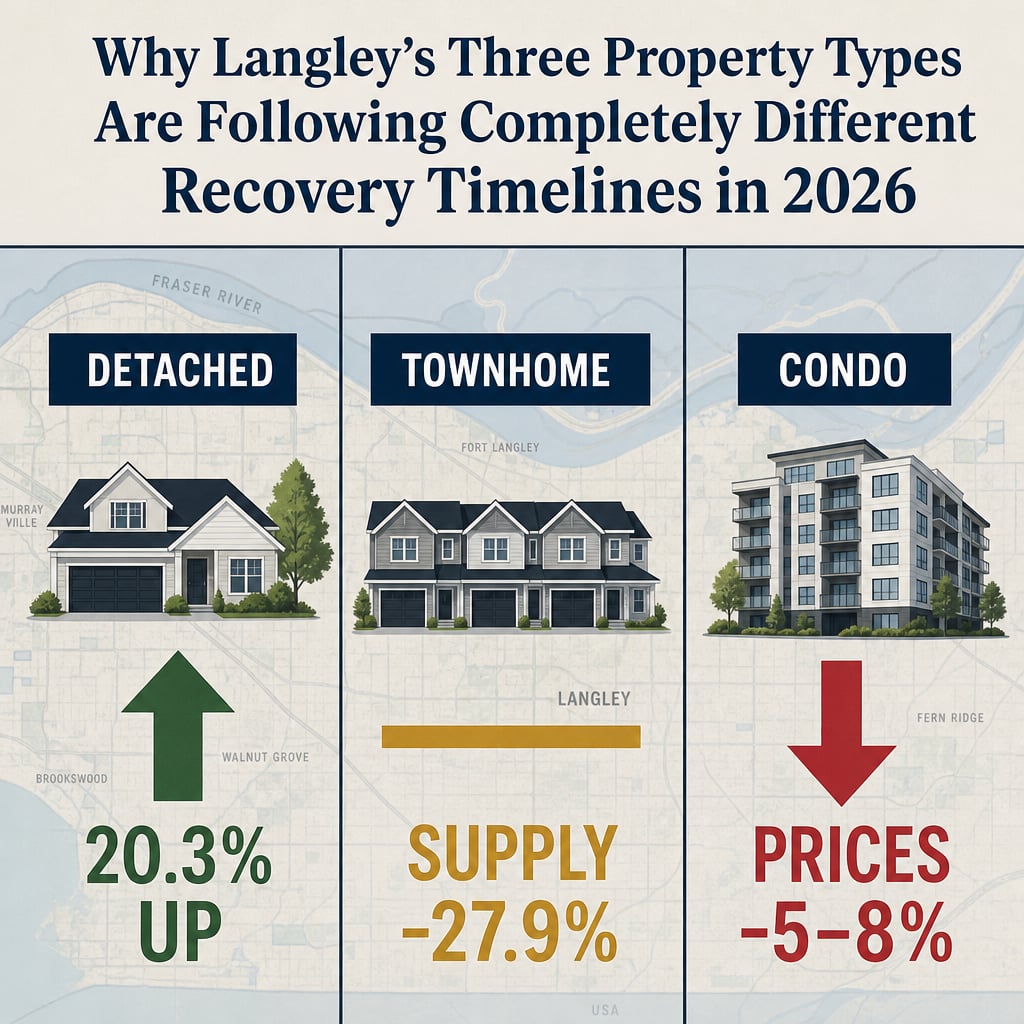
In May 2026, Langley detached home sales rose 20.3% year-over-year while condo sales fell 4.6% and townhome supply collapsed 27.9%. These aren't temporary blips — they reflect structural differences in buyer demand, financing risk, and supply dynamics that are pulling each property type in a different direction simultaneously.
Key Takeaways
- Langley detached sales rose 20.3% YoY in May 2026, driven by affordability-motivated buyers at the price floor.
- Townhome new listings dropped 27.9% YoY, keeping days-on-market tight despite flat sales volume.
- Condo prices slid 5–8% YoY even as inventory tightened — strata financing risk is the core obstacle.
- Builder warranty expiration in Willoughby and Walnut Grove is creating a hidden timing risk for townhome sellers.
- Property-type strategy, not just city-level data, determines whether a 2026 sale or purchase succeeds.
Who This Applies To
- Sellers preparing to list a detached home, townhome, or condo in Langley in 2026
- Buyers trying to understand which Langley property type offers the strongest entry timing
- Investors evaluating which segment carries the most near-term risk or upside
- Homeowners in Willoughby or Walnut Grove monitoring the warranty and levy cycle
When This Advice May Not Apply
This analysis draws on Fraser Valley Real Estate Board data from May and June 2026. Conditions shift. If the Bank of Canada adjusts its key rate materially, or if new construction completions accelerate, the supply-demand balance across segments may change. Consult current board statistics and a local professional before acting on any specific timing decision.
Data Used in This Article
- FVREB Statistical Package, June 2026 — Fraser Valley Real Estate Board, official market release, Fraser Valley geography
- FVREB Statistical Package, May 2026 — Fraser Valley Real Estate Board, official market release, Fraser Valley geography
- Mansour Real Estate Group field observations — internal professional analysis, Langley market, 2025–2026
Why Detached Homes Are Accelerating
According to the FVREB's June 2026 statistical package, the Langley detached benchmark price landed at $1,494,800 — down 6.9% year-over-year. That price decline is not a sign of a weak market. It is the reason the market is strengthening. Buyers who were priced out of Langley detached homes at their 2022 peak are re-entering as affordability improves. May 2026 recorded 89 detached sales, up from 74 the previous year — a 20.3% increase.
The activity is concentrated at the entry end. Detached homes under $1.3 million in Walnut Grove and the Township of Langley are moving faster than those priced above $1.6 million. The broader market context behind this recovery is covered in the Langley 2026 complete buyer and seller guide.
For detached sellers, the current dynamic rewards accurate pricing. Homes listed at or near current benchmark attract the new buyer pool. Homes priced above peak 2022 values sit. The 20.3% sales increase reflects buyer willingness to act at realistic prices — not a broad price recovery that justifies holding out for more.
Why Townhomes Are Supply-Constrained Rather Than Demand-Driven
Townhomes tell a different story. According to FVREB May 2026 data, new townhome listings dropped 27.9% year-over-year — from 220 to 157. Sales held roughly flat. The result is a supply squeeze that is keeping benchmark prices firm near $813,200 and days-on-market in the 22–32 day range.
But the firmness has a complication. Townhome communities built between 2010 and 2016 in Willoughby and Walnut Grove are entering or approaching the end of their Homeowner Protection Act 2-5-10 warranty window. The specific dynamics for three-bedroom units in Willoughby and Murrayville are explored in the Langley townhome sweet spot article. When warranty coverage lapses and special levies for envelope or mechanical repairs are under discussion, buyers hesitate — even at firm prices. Sellers in those communities who act before the summer construction completion wave adds competing inventory are in the strongest timing position of the year.
The townhome supply collapse is not a signal of seller strength so much as seller restraint. Many owners are holding. Those who do list in a low-supply environment have an advantage — but only if the strata's financial position is clean and the depreciation report doesn't surface deferred maintenance concerns.
Why Condos Are Underperforming Despite a Tighter Supply
Condos are the hardest segment to understand in Langley right now, because the usual logic doesn't apply. New condo listings dropped 28.1% year-over-year in May 2026 — yet prices still slid 5–8% YoY and days-on-market extended to 50–70 days. Supply tightened. Demand did not respond.
The explanation is financing. Strata fees on older Langley condo buildings — many constructed between 1995 and 2008 — are running high enough to affect mortgage qualification. Depreciation reports in buildings with deferred envelope or mechanical work are triggering appraisal shortfalls, where a lender's appraiser values the unit below purchase price. Buyers who want to purchase simply cannot get financing approved at asking prices, even when they want the property. That financing friction is structural. It doesn't resolve when listings fall. It resolves when prices fall far enough that the appraisal gap closes — and in Langley's aging condo stock, that process is still underway in 2026.
How We Evaluate This
When Mansour Real Estate Group works with sellers or buyers across different Langley property types, we don't apply a single market read to all three segments. We look at absorption rate by type, days-on-market by neighbourhood, listing-to-sale price ratios, strata document health for any attached property, and the composition of active listings relative to recent sales. A city-level statistic that shows improving conditions can mask a condo segment that still has 60 days of market exposure and a townhome segment where supply is so thin that list price is effectively floor price. The question is never just "how is Langley doing?" — it's which product type, which neighbourhood, and which price band.
Seller Checklist — Langley Property Type Divergence 2026
- Detached sellers: Price at current benchmark, not peak. Buyers are present but disciplined.
- Townhome sellers: Pull your strata's most recent depreciation report and confirm special levy status before listing.
- Condo sellers: Obtain a pre-list appraisal to understand the financing ceiling before setting asking price.
- All types: Review active competing listings by type and price band — not just the city-level median.
- Townhome and Willoughby-area sellers: List before fall construction completions add new inventory competition.
- Condo sellers: If strata fees exceed $600–$700/month, address financing risk in the listing strategy — not after an offer collapses.
What We Commonly See
In our experience, sellers in Langley often apply the same pricing logic regardless of property type. A detached homeowner sees 20% more sales citywide and assumes that momentum extends to their condo building. It doesn't. The data for each segment runs separately, and advice built on a blended number leads to a listing price that doesn't match the buyer pool actually looking at that type of property.
What often happens with condo listings in aging Langley buildings is that an offer comes in, it goes conditional on financing, and the lender's appraisal comes back short. The deal collapses. The seller re-lists at a lower price after losing 30–40 days of market time. A pre-list appraisal — or at minimum a frank conversation about the building's financial health — would have prevented that.
A common mistake we see with townhome sellers in Willoughby is waiting for the fall market without accounting for new construction completions. When 40 or 50 new units from a nearby development complete in September, they compete directly with resale townhomes in the same price band. Sellers who list in July or early August avoid that compression.
Questions and Answers
Why are Langley detached home sales rising when prices are still down year-over-year?
The price decline is the cause of the sales increase. Buyers priced out at peak are returning now that benchmark prices have corrected to more accessible levels. According to FVREB June 2026 data, Langley detached benchmark prices are down 6.9% YoY — and sales rose 20.3% over the same period. This is an affordability-driven buyer influx, not a contradiction.
Why are townhome prices holding firm when detached prices are declining?
Supply is the mechanism. New townhome listings collapsed 27.9% YoY in May 2026. When fewer sellers list and buyer demand stays steady, prices don't have room to fall. The townhome market is supply-constrained, not demand-driven — which makes it vulnerable to any surge in new listings or completions.
What is causing the condo market in Langley to underperform even as supply tightens?
Financing constraints are the core problem. High strata fees and depreciation reports flagging deferred maintenance in older buildings are causing appraisal shortfalls. Buyers who want to purchase can't get lender approval at asking prices. That structural obstacle doesn't resolve with fewer listings — it resolves when prices drop far enough to close the appraisal gap, which is still happening in 2026.
In Summary
Langley's spring 2026 market is not one market — it's three, each moving on its own logic. Detached homes are rising on affordability-driven demand at a price floor. Townhomes are holding firm because almost nobody is listing, not because demand is surging. Condos are declining because aging strata buildings carry financing risk that no amount of supply reduction resolves. Sellers and buyers who understand which dynamic applies to their specific property type will make better decisions than those working from a blended city average.
Talk to a Langley Real Estate Specialist
If you're weighing a sale or purchase in Langley and want a clear-eyed read on which segment your property sits in — and what current conditions actually mean for your timeline — Mansour Real Estate Group is available for a straightforward, no-obligation conversation. No pressure. Just local data and honest analysis.
Related Articles
- Langley Real Estate Market 2026: Complete Buyer and Seller Guide to the First Year-Over-Year Sales Increase in 12 Months
- Langley Townhome Sweet Spot 2026: What Buyers and Sellers Must Know About the Fastest-Moving Inventory in Willoughby and Murrayville
- Why Langley Home Prices Stopped Falling and Started Stabilizing in Spring 2026
About Mansour Real Estate Group
Understanding Langley's property-type divergence — why detached homes, townhomes, and condos are each moving on different fundamentals in 2026 — requires a real estate team with direct, segment-level experience across all three categories. Strata analysis for a condo buyer navigating depreciation reports is a completely different skill set from positioning a detached home at a price-floor recovery entry point. Mansour Real Estate Group has worked across all three segments in Langley, Walnut Grove, and Willoughby for more than two decades, and that breadth of experience shapes every pricing and strategy conversation we have with clients.
Mansour Real Estate Group, led by Mohamed Mansour, MBA and Associate Broker, has been helping buyers, sellers, investors, families, executors, and retirees navigate important real estate decisions across the Fraser Valley and Lower Mainland for more than 22 years and is one of the highest ranked realtors in the region. The team has completed more than $780 million in residential real estate transactions and is trusted for condo and strata transactions, townhome sales, detached home strategy, estate sales, divorce-related property sales, downsizing, and complex real estate decisions across the Lower Mainland.
Whether someone is looking for Realtors experienced with Langley's condo financing challenges, a real estate agent who understands townhome strata documents and depreciation reports, a real estate team that can position a detached home accurately at current market, a Langley Realtor who knows the Willoughby and Walnut Grove neighbourhoods in depth, or a Fraser Valley real estate broker with a track record across all property types, Mansour Real Estate Group brings clear analysis, accurate valuations, and practical guidance grounded in current local conditions. The real estate agents on this team work with buyers and sellers across every segment, not just the ones that are easy to move.
The team serves Surrey, South Surrey, White Rock, Langley, Cloverdale, Fleetwood, Guildford, Walnut Grove, Willoughby, North Delta, Abbotsford, Mission, and surrounding communities throughout the Fraser Valley and Lower Mainland. Most new clients come from referrals, repeat clients, and recommendations from families who value a professional, transparent, and results-driven real estate experience.
Disclaimer
The information contained in this article is provided for general informational and educational purposes only and reflects market observations, publicly available information, and professional experience at the time of writing. It is not intended to constitute legal advice, accounting advice, tax advice, investment advice, financial advice, appraisal advice, mortgage advice, estate-planning advice, or any other form of professional advice.
Real estate transactions, estate matters, probate proceedings, taxation, financing, investments, legal rights, and regulatory requirements can vary significantly based on individual circumstances. Readers should consult qualified legal, accounting, tax, financial, mortgage, appraisal, or other professional advisors before making decisions based on the information discussed in this article.
Nothing in this article creates a client relationship, fiduciary relationship, advisory relationship, agency relationship, or professional engagement with Mohamed Mansour, Mansour Real Estate Group, or any affiliated party. Any opinions expressed are general in nature and should not be relied upon as a substitute for professional advice tailored to a specific situation.
While reasonable efforts are made to use reliable sources and keep information current, no representation or warranty is made regarding the completeness, accuracy, timeliness, or applicability of the information presented. Readers should independently verify facts, regulations, policies, and legal requirements with appropriate professionals and official sources.



