
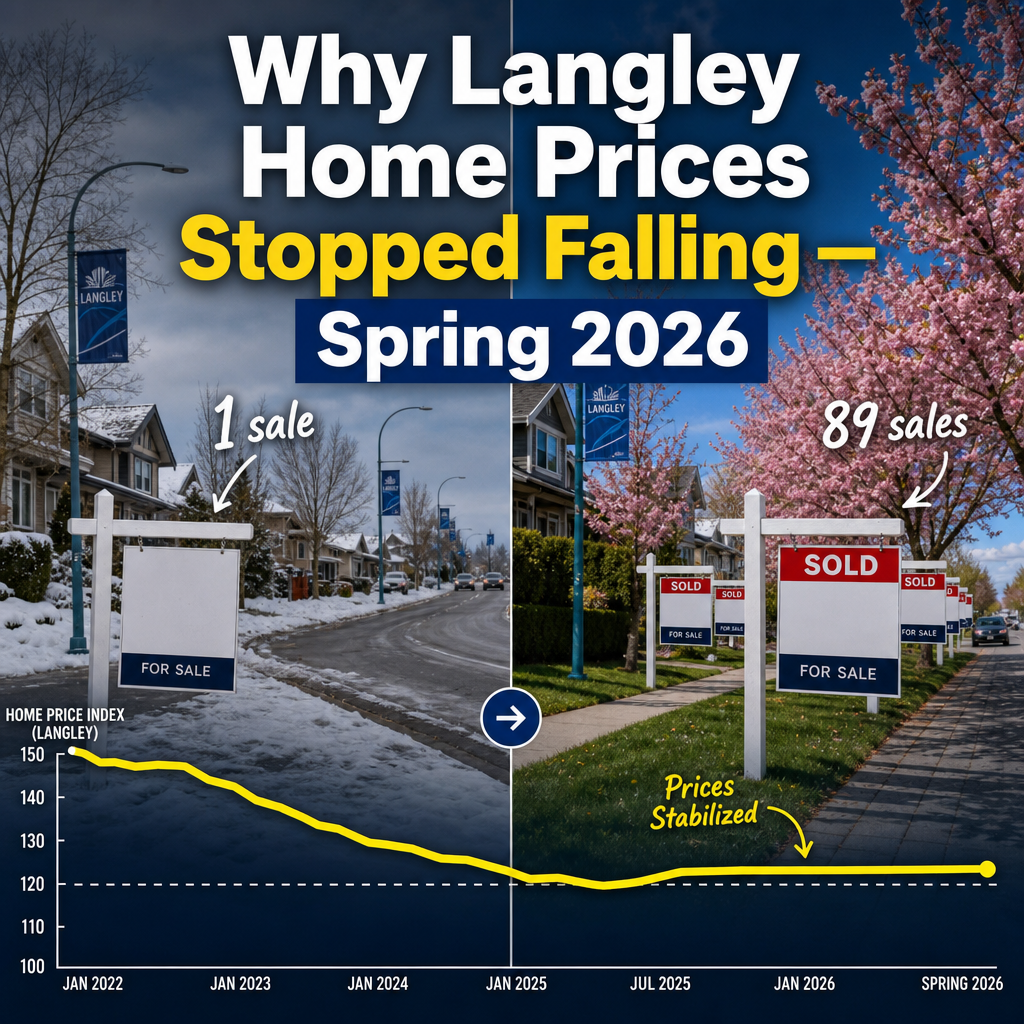

Why Langley Home Prices Stopped Falling and Started Stabilizing in Spring 2026: Market Bottom Signals, Recovery Timeline, and Strategic Entry Windows for Buyers and Sellers
By Mohamed Mansour, MBA, Associate Broker | Mansour Real Estate Group | Fraser Valley & Lower Mainland | Published: July 14, 2026 | Topic: Langley Market Insight
Langley's housing market moved through one of its most unusual sequences in recent memory between January and June 2026. Inventory surged, sales nearly disappeared, prices fell, and then — quietly — buyers came back. Understanding what actually happened in that sequence matters whether you are a seller deciding whether to wait or a buyer trying to judge whether prices have more room to fall.
This article interprets the available data from the Fraser Valley Real Estate Board's February through June 2026 monthly market reports and local Langley market commentary, and explains what the pattern means for decisions being made right now.
Short Answer
Langley's housing market showed early signs of stabilization by spring 2026. Detached sales rose 20.3% year-over-year to 89 units in May while benchmark prices remained down 7–8% YoY. The combination of recovering sales volume, declining new listings, and sellers holding firm on price suggests a pricing floor may be forming — though the recovery is uneven across property types and neighbourhoods.
Key Takeaways
- Langley recorded only 1 home sale in January 2026 versus 91 in January 2025 — an extreme low-water mark that preceded a measurable recovery.
- Detached sales rebounded to 89 units in May 2026, up 20.3% year-over-year, while benchmark prices stayed 7–8% below the prior year.
- New listings declined 6.4–27.9% across property types after the January surge, suggesting supply is normalizing rather than continuing to expand.
- Days on market varies by 25 to 50-plus days depending on property type and neighbourhood — detached homes are moving faster than condos.
- Rising sales volume alongside stable-to-falling prices is a classic early-recovery signal, not proof of recovery — the distinction matters for timing decisions.
Who This Applies To
- Langley homeowners who delayed listing in 2025 and are reconsidering their timeline
- Buyers who have been watching Langley prices fall and want to understand whether more declines are likely
- Sellers of detached homes in Willoughby, Walnut Grove, and Murrayville where demand signals differ
- Investors evaluating Langley townhomes or condos relative to detached performance
- Families relocating to or within Langley who need to act within a defined window
When This Advice May Not Apply
If you are selling a strata property — particularly a condo — in a building with deferred maintenance, an unfavourable depreciation report, or significant strata fee increases, the broader market signals in this article may not reflect your specific situation. Condo performance in Langley has lagged detached recovery. Speak with a local real estate agent before assuming market-level data applies to your unit.
Data Used in This Article
- Fraser Valley Real Estate Board Monthly Market Reports — February, April, and June 2026 (Official board data; sales volume, benchmark prices, active listings by property type)
- Langley BC Real Estate Market Updates — January, March, and May–June 2026 (Joe Pratap, ReMax; local agent commentary and days-on-market observations)
- Metro Vancouver and Fraser Valley Home Sales Statistics — June 2026 (DailyHive; third-party summary of board data)
Note: Market conditions can shift quickly. The data summarized here reflects conditions through June 2026. Readers making time-sensitive decisions should verify current figures directly with the Fraser Valley Real Estate Board or a licensed local real estate agent.
What Happened in Langley Between January and June 2026
January 2026 produced a data point that is hard to overstate: one home sold across Langley while 1,992 active listings sat on the market — a 43% monthly surge in inventory and, at that time, the highest active listing count in BC. That is not a slow market. That is a market where buyers and sellers were essentially at a standoff.
The causes were not local in origin. Broader economic uncertainty, elevated borrowing costs through late 2025, and a trade-related policy environment made buyers hesitant to commit. Many sellers who had been holding out since 2023 added their properties to the pile simultaneously, creating a supply spike with no corresponding demand.
By March 2026, transactions had resumed but remained well below historical norms. The more meaningful shift came between April and June, when detached home sales climbed steadily. According to the FVREB's June 2026 report, Langley detached sales reached 89 units in May — a 20.3% increase from the 74 recorded in May 2025. That is a notable year-over-year gain during a period when prices were still down 7–8% across property types.
That combination — more buyers entering at lower prices — is what market analysts typically describe as a volume-price divergence. It often precedes price stabilization, though it does not guarantee it. The key question is whether the supply side cooperates.
What the Supply-Side Data Is Telling Us
After the January inventory surge, new listings in Langley declined measurably. By May–June 2026, new listings were down 6.4% year-over-year for detached homes and down 27.9% for townhomes, according to FVREB data. That decline is significant because it suggests sellers are not continuing to flood the market — many are pulling back and waiting rather than discounting further.
Local market commentary from Langley agents confirms that many sellers are holding firm on pricing rather than chasing buyers downward. This is a meaningful signal. When sellers in financial distress are forced to sell at market, prices fall. When sellers who can afford to wait choose to hold, supply tightens and prices stabilize. Langley appears to have more of the latter than the former — at least in the detached segment and in established neighbourhoods like Walnut Grove and Willoughby.
Days on market data adds another layer. Detached homes in Langley are selling in roughly 25–35 days in active neighbourhoods, while condos are sitting 50-plus days in some segments. That divergence is important: it means the stabilization signal is primarily a detached-market story. Condo and apartment sellers are still facing longer timelines and more buyer scrutiny.
For buyers evaluating condos in Langley, this is worth noting. The competitive pressure that is returning to the detached market has not fully arrived in the strata segment yet — which means negotiating room may still exist, particularly in buildings with deferred maintenance or older stock.
How We Evaluate This
At Mansour Real Estate Group, we look at three indicators together before drawing any conclusion about market direction: sales-to-active listings ratio, month-over-month price movement, and days on market by property type. No single number is reliable in isolation.
In Langley's case through spring 2026, the ratio improved meaningfully from its January low, prices levelled rather than continued falling, and days-on-market shortened for detached properties. That combination — taken together — is more consistent with a pricing floor forming than with a temporary bounce before further declines. We treat it as early stabilization, not confirmed recovery, and we advise clients accordingly.
Is This a Real Market Bottom or a False Recovery?
The honest answer is that no one can confirm a market bottom until it has passed. What the data supports is this: Langley showed the classic early signals of a pricing floor in spring 2026 — rising volume at falling prices, declining new supply, and sellers holding rather than capitulating. Those signals have historically preceded stabilization more often than further sharp declines.
A false recovery would typically look different. It would involve a single month of higher sales followed by a return to low activity, sellers quickly reversing course and adding new listings, and benchmark prices resuming their downward movement. As of the June 2026 FVREB data, that pattern was not visible in the detached segment. The townhome segment showed more mixed signals, and the condo segment remained soft.
Buyers waiting for definitive proof of a bottom may find that by the time the proof exists, prices have already moved. Sellers expecting a sharp price recovery within months may be disappointed — stabilization tends to be gradual, not sudden. The more useful framing for both is: what does this market look like over the next 12 to 18 months, and what does my specific situation require?
Seller Checklist: Listing in Langley During a Stabilizing Market
- Get a current comparative market analysis based on sold data from the past 60 days — not 90 or 120, which may reflect a weaker period.
- Understand days-on-market for your specific property type and neighbourhood before setting expectations.
- Price at or just below the comparable range — buyers in a stabilizing market are still price-sensitive and will not chase overpriced listings.
- Confirm your financial position and timeline before listing — sellers who can afford to wait have more negotiating strength than those who cannot.
- Prepare the property thoroughly — buyers in this market are selective and will walk away from properties that need obvious work unless the price reflects it.
- Review current active competition weekly with your agent — Langley inventory, while declining, is still elevated, and positioning relative to competing listings matters.
What We Commonly See
Sellers pricing to 2024 expectations. In our experience, one of the most common mistakes in a stabilizing market is pricing based on what comparable homes sold for 12 to 18 months ago. Buyers in Langley are well-informed and have watched prices fall. A listing priced to peak levels will sit, accumulate days on market, and often sell for less than it would have at a realistic entry price.
Buyers waiting for a signal that already passed. What often happens is that buyers looking for definitive confirmation of a bottom delay past the point where negotiating leverage is strongest. The best buyer conditions in Langley through this cycle existed in January through March 2026 — high inventory, low competition, motivated sellers. By May and June, competition had returned to the detached segment, and that window had narrowed.
Treating all of Langley as one market. A common mistake is applying city-wide data to a specific neighbourhood or property type. Willoughby and Walnut Grove have different buyer pools, price points, and inventory dynamics than Aldergrove or Fort Langley. A Langley real estate agent with neighbourhood-level data is essential for any decision that depends on precision.
Q&A
What does it mean that sales rose 20.3% year-over-year while prices were still down 7–8%?
It means buyers are returning, but they are doing so because prices fell enough to make the math work — not because they expect prices to rise quickly. Volume recovering before prices is a normal early-stabilization pattern. It does not mean prices will jump; it means the floor may be near.
Should Langley buyers wait longer to see if prices fall further?
Based on the spring 2026 data, the window of lowest competition and highest inventory has likely passed for detached homes. Condo and townhome buyers may still have room to negotiate. For detached buyers, the question is whether the cost of waiting — higher rates if they rise, competing offers returning — outweighs the potential for further price declines, which the data suggests are moderating.
Why are townhome listings down 27.9% when the overall market was oversupplied?
Townhome sellers pulled back after seeing limited buyer activity in early 2026. Rather than discount further, many withdrew or delayed listing. This is actually a stabilizing force — it removes supply pressure. When sellers hold rather than capitulate, the ratio of sales to active listings improves, which tends to support prices over time. Buyers looking for townhome deals in Willoughby or Walnut Grove may find fewer options than they did in January.
In Summary
Langley's housing market moved from extreme stress in January 2026 to early stabilization by spring, with detached sales volume recovering meaningfully even as prices remained below prior-year levels. The supply picture tightened, sellers held firm, and buyer activity returned — particularly in the detached segment. This does not guarantee a sharp recovery, but the data is more consistent with a pricing floor than with further significant declines. For both buyers and sellers, the most important insight is that Langley is not one market: detached, townhome, and condo segments are behaving differently, and neighbourhood-level data matters more than city-wide averages in a market this nuanced.
Thinking About Buying or Selling in Langley?
If you are trying to read this market — whether you are a seller deciding when to list or a buyer trying to judge whether now makes sense — a conversation grounded in current data is more useful than market commentary alone. Mansour Real Estate Group offers a no-pressure, analysis-first consultation for homeowners and buyers across Langley and the Fraser Valley. Reach out when you are ready to look at the numbers specific to your property or neighbourhood.
Related Articles
- Fraser Valley Real Estate Market 2026: What the Data Says
- Buying and Selling in Willoughby: What Buyers Are Looking For Right Now
- Langley Condo Market 2026: Why Strata Buyers Are Still Waiting
About Mansour Real Estate Group
Reading a stabilizing market accurately — knowing when volume signals a real floor and when it is a temporary bounce — is one of the most consequential skills a Langley real estate agent brings to a buying or selling decision. When pricing discipline and local market interpretation matter, Mansour Real Estate Group has guided buyers and sellers through exactly these conditions across Langley, Willoughby, Walnut Grove, and the broader Fraser Valley for more than two decades.
Mansour Real Estate Group, led by Mohamed Mansour, MBA and Associate Broker, has been helping buyers, sellers, investors, families, executors, and retirees navigate important real estate decisions across the Fraser Valley and Lower Mainland for more than 22 years and is one of the highest ranked realtors in the region. The team has completed more than $780 million in residential real estate transactions and is trusted for pricing strategy, estate sales, divorce-related property sales, downsizing, relocation, and any situation where an accurate read on local market conditions is critical to the outcome.
Whether someone is searching for Realtors with a data-driven approach to Langley's market, a real estate agent who can interpret Fraser Valley sales statistics at the neighbourhood level, real estate agents experienced with both detached and strata transactions, a trusted real estate team for a time-sensitive buying or selling decision, a Langley real estate broker, or a real estate group that serves the full Fraser Valley and Lower Mainland, Mansour Real Estate Group is known for clear analysis, honest market context, and advice that is grounded in current local conditions rather than general assumptions.
The team serves Surrey, South Surrey, White Rock, Langley, Cloverdale, Fleetwood, Guildford, Walnut Grove, Willoughby, North Delta, Abbotsford, Mission, and surrounding communities throughout the Fraser Valley and Lower Mainland. Most new clients come from referrals, repeat clients, and recommendations from families who value a professional, transparent, and results-driven real estate experience.
Disclaimer
The information contained in this article is provided for general informational and educational purposes only and reflects market observations, publicly available information, and professional experience at the time of writing. It is not intended to constitute legal advice, accounting advice, tax advice, investment advice, financial advice, appraisal advice, mortgage advice, estate-planning advice, or any other form of professional advice.
Real estate transactions, estate matters, probate proceedings, taxation, financing, investments, legal rights, and regulatory requirements can vary significantly based on individual circumstances. Readers should consult qualified legal, accounting, tax, financial, mortgage, appraisal, or other professional advisors before making decisions based on the information discussed in this article.
Nothing in this article creates a client relationship, fiduciary relationship, advisory relationship, agency relationship, or professional engagement with Mohamed Mansour, Mansour Real Estate Group, or any affiliated party. Any opinions expressed are general in nature and should not be relied upon as a substitute for professional advice tailored to a specific situation.
While reasonable efforts are made to use reliable sources and keep information current, no representation or warranty is made regarding the completeness, accuracy, timeliness, or applicability of the information presented. Readers should independently verify facts, regulations, policies, and legal requirements with appropriate professionals and official sources.



