

Langley Townhome Sweet Spot 2026: Why Three-Bedroom Side-by-Side Garage Units Built After 2012 in the $820K–$875K Range Are the Fastest-Moving Inventory — And What Buyers and Sellers Must Know About Offer Timing and Positioning Strategy in Willoughby Heights and Murrayville
By Mohamed Mansour, MBA and Associate Broker | Mansour Real Estate Group | Published: July 22, 2026 | Fraser Valley, BC | Langley Market Intelligence Series, Article 2 of 3
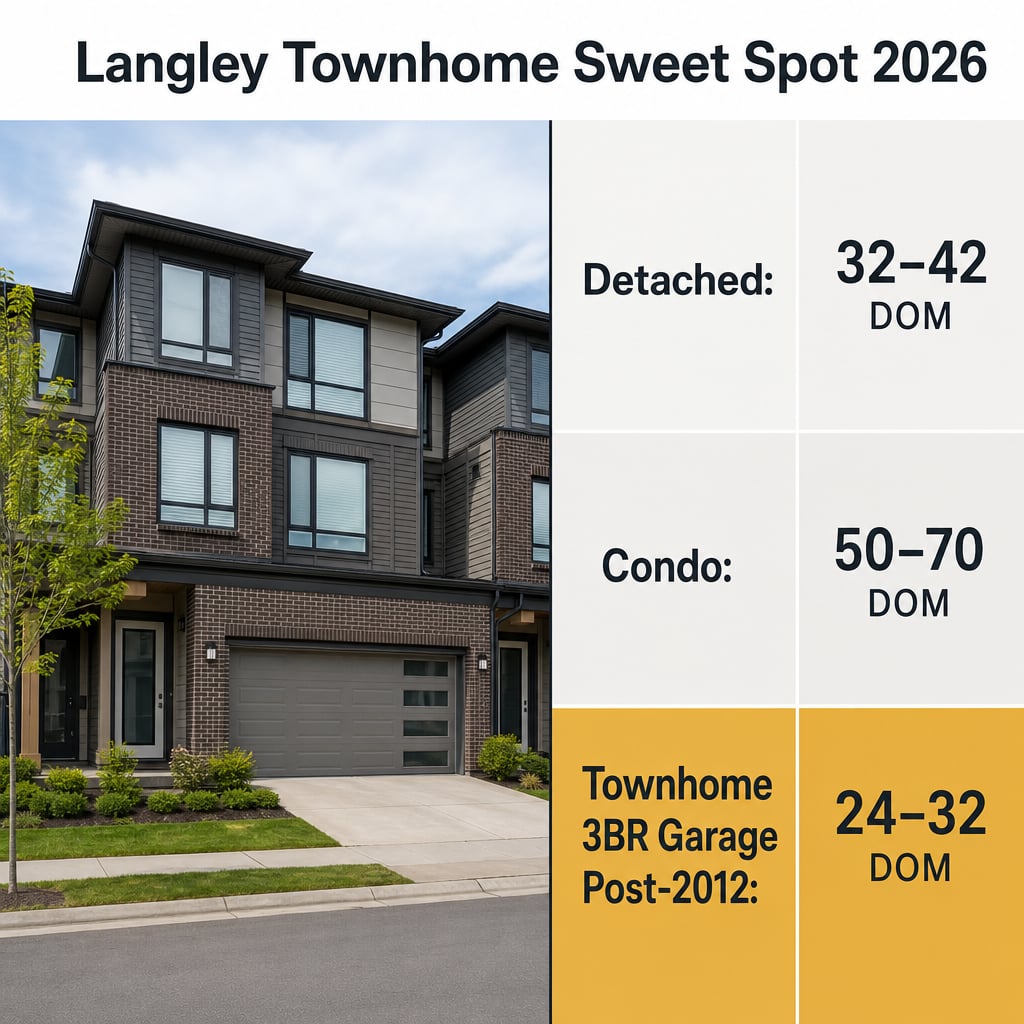
Langley's 2026 market is not one market — it is three. Detached homes carry elevated inventory and longer days on market. Condos are moving slowly with pricing under pressure. But one narrow product window is behaving differently: three-bedroom side-by-side garage townhomes built after 2012, priced between $820,000 and $875,000, are consistently selling in 24 to 32 days with stable pricing and sellers holding firm on terms.
This article explains why that specific window exists, what is driving the supply squeeze in Willoughby Heights and Murrayville, and what both buyers and sellers need to know to make sound decisions in this segment right now. The analysis draws on Fraser Valley Real Estate Board data from February through August 2026 and direct transaction experience in this product type across Langley.
Short Answer
Three-bedroom side-by-side garage townhomes built after 2012 and priced in the $820K–$875K range are Langley's tightest inventory segment in 2026. They sell in 24–32 days — roughly half the time condos take — because new listings dropped while demand held steady. Sellers in this category retain real negotiating power. Buyers who move without preparation are routinely losing to better-positioned offers.
Who This Applies To
- Sellers who own a post-2012 three-bedroom townhome with an attached side-by-side garage in Willoughby Heights or Murrayville and are considering listing in 2026
- Buyers upsizing from a condo into a townhome and competing in this specific price band
- Downsizers moving from a detached home who want strata-managed maintenance without condo financing complications
- Investors and families evaluating Langley townhome absorption data before committing to a purchase or sale timeline
When This Advice May Not Apply
This analysis is specific to post-2012 three-bedroom side-by-side garage townhomes in the $820K–$875K price band. Two-bedroom units, tandem garage configurations, pre-2005 buildings, and townhomes priced above $900K or below $790K follow different absorption patterns and should be evaluated separately. Condo-style townhomes with no direct garage access also behave differently with lenders and buyers.
Key Takeaways
- Post-2012 three-bedroom side-by-side garage townhomes in Langley sell in 24–32 days — far faster than detached homes or condos in 2026
- New townhome listings fell sharply in early 2026 while sales held, creating a structural supply squeeze that has kept benchmark prices firm at $822K–$850K
- Willoughby Heights and Murrayville lead absorption, with end units and street-level entries selling faster and facing less price negotiation
- Strata fees vary from $300 to $500-plus per month and directly affect buyer purchasing power — sellers with fees below $380/month hold a measurable competitive advantage
- Buyers entering this segment without mortgage pre-approval, strata document review complete, and a clear offer strategy routinely lose to better-prepared competing offers
Data Used in This Article
- Fraser Valley Real Estate Board (FVREB): February–August 2026 municipal statistics packages — official, Langley townhome benchmark prices, new listings, sales, and days on market
- Willoughby Heights June 2026 Market Report (bccondosandhomes.com): Third-party absorption data cross-referenced with FVREB municipal data
- Langley Market Forecast (robv.ca): Third-party townhome-specific market projections and product-type analysis
- Mansour Real Estate Group transaction data: Internal professional analysis drawn from direct listing and buyer representation experience in Langley's townhome segment, 2024–2026
Key Definitions
Days on Market (DOM): The number of calendar days from a property's listing date to accepted offer. Lower DOM indicates stronger buyer demand relative to supply.
Sales-to-Active Listings Ratio: The share of active listings that sell in a given month. Above 20% generally indicates seller's market conditions; below 12% favors buyers. According to FVREB methodology, this is the primary indicator of pricing pressure direction.
Side-by-Side Garage: An attached double garage with two doors opening independently, rather than a tandem configuration where one car parks behind the other. Side-by-side units command buyer preference and broader lender acceptance.
Benchmark Price: The FVREB's model-based price for a typical property in a category, adjusted for features, not simply an average of sales. The townhome benchmark in Langley was reported between $822,000 and $850,000 across February–August 2026 FVREB statistical packages.
Why This Specific Product Window Moves Faster Than Everything Else in Langley
The FVREB's 2026 Langley data packages show a clear three-way divergence. Detached homes carry a sales-to-active ratio that has hovered near or below 15% for most of 2026, giving buyers more time and more negotiating room. Condos have been sitting at 50 to 70 days on market across the same period, with pricing in older pre-2005 buildings under particular pressure. You can read a detailed breakdown of those divergent conditions in the Langley Real Estate Market Divergence 2026 overview.
Townhomes in the three-bedroom side-by-side garage category occupy a structural gap that no other product type fills as cleanly. They are accessible to buyers who cannot qualify for a detached home at current prices but who find condo financing increasingly difficult — particularly for buildings with high strata fees, deferred maintenance, or special levy exposure. A post-2012 townhome in the $820K–$875K range, with an attached garage, modern mechanicals, and a stable strata, hits a qualification threshold that a meaningful share of Langley's active buyer pool can actually reach.
That structural demand, combined with a measurable drop in new townhome listings in early 2026 while sales volume held steady, produced absorption rates in the 15–23% range — the only segment in Langley where FVREB data supports calling conditions seller-favorable. According to the FVREB's February through August 2026 statistical packages for the Langley municipality, townhome benchmark prices held between $822,000 and $850,000 across that period, showing none of the 6–8% year-over-year softening visible in the detached and condo segments.
Willoughby Heights vs. Murrayville: Where Buyers Are Competing Hardest
Within Langley, Willoughby Heights and Murrayville show the strongest buyer interest for newer townhomes, but for different reasons and slightly different buyer profiles.
Willoughby Heights draws upsizers — typically families or couples moving from a condo — who prioritize walkability to retail, school access, and proximity to the Carvolth Exchange transit hub. Post-2012 complexes in Willoughby tend to have more amenity infrastructure, more visitor parking, and higher strata fees. According to market snapshot data from Willoughby Heights listing activity in 2026, end units with direct street-level entry and no shared-wall garages sell faster and receive cleaner offers than interior units in the same complex.
Murrayville attracts a slightly different pool — downsizers from Langley's established detached neighbourhoods who want to stay in the area, reduce maintenance, and keep a garage without moving to a high-rise. Strata fees in Murrayville's newer complexes tend to run slightly lower than in Willoughby, which expands the qualifying buyer pool and often produces faster subject removal in competitive situations.
In both areas, the product characteristics that consistently appear in faster sales are: three full bedrooms (not a den-as-bedroom configuration), an attached side-by-side double garage, a rooftop deck or private outdoor space, and a strata fee below $400 per month. Units missing any one of those elements tend to drift toward the upper end of the 24–32-day window or beyond it.
How We Evaluate This
At Mansour Real Estate Group, we evaluate townhome positioning in this price band using four inputs in sequence: the current sales-to-active ratio for the Langley townhome category from the most recent FVREB statistical package; the DOM trend for the specific complex or surrounding blocks over the prior 90 days; the strata fee relative to competing active listings in the same price range; and the unit's position within the complex — end, interior, or corner — which consistently affects both days on market and final sale price relative to list.
For sellers, this evaluation determines whether the unit qualifies for a firm pricing strategy or requires an adjusted approach. For buyers, it identifies which active listings represent genuine value and which are priced at the ceiling of what the market will absorb without a reduction.
Seller Checklist: Qualifying for and Capturing the Sweet Spot
- Confirm your unit qualifies: Verify that your townhome is post-2012 construction, has a true side-by-side attached garage (not tandem), and has three full bedrooms. Units that don't meet all three criteria should be priced and marketed differently.
- Pull current FVREB data before pricing: The benchmark range for this segment has held at $822K–$850K, but individual unit variation based on floor plan, complex, and strata health can shift that range by $30K–$50K. Don't price from a neighbour's sale without understanding what made it sell at that number.
- Obtain your strata documents in advance: Buyers will request Form B, the depreciation report, strata meeting minutes, and financial statements. Having these ready before listing shortens subject removal timelines and signals transparency — a meaningful competitive advantage in a market where buyers are cautious about strata risk.
- Calculate and highlight your strata fee clearly: If your monthly fee is below $380, that number belongs in your listing description. It directly affects how many buyers can qualify for financing on your unit versus a comparable unit with a $480 fee.
- Prepare the unit for a quick-to-market launch: In a 24–32-day absorption environment, the first 10 days produce the most qualified activity. Staging, professional photography, and a complete listing package before the MLS go-live date matter more here than in slower segments.
- Set a realistic offer review strategy before listing: If you price accurately and launch cleanly, you may receive multiple offers in the first week. Decide in advance whether you will review offers as they arrive or set a date. Either approach works — but improvising under pressure rarely does.
- Avoid overpricing into the $890K–$920K range: Data from 2026 FVREB reports shows that townhomes in Langley priced above $880K without distinguishing features — extra square footage, rare floor plan, renovated kitchen — sit significantly longer and often sell below what an accurate $850K launch would have produced.
Buyer Checklist: Moving Decisively Without Overpaying
- Secure mortgage pre-approval that accounts for strata fees: Lenders stress-test your total debt service ratio including strata fees. A $480/month strata fee versus a $320/month fee can reduce your qualifying purchase price by $40,000–$60,000 depending on income. Know your ceiling before you start viewing.
- Review strata documents before an offer, not after: In a fast-moving segment, requesting documents as a condition of your offer and then spending 10 days reviewing them puts you at a disadvantage against buyers who have pre-reviewed documents for comparable buildings. Ask your agent to obtain documents before you write.
- Understand end-unit versus interior-unit pricing: End units in Willoughby Heights complexes typically sell $15,000–$30,000 above comparable interior units in the same complex. That premium is generally supported — but interior units can represent value if they have a better floor plan or lower strata fee.
- Move within the first 14 days of a new listing: Properties in this segment that receive strong interest typically see the most competitive offer environment in days 7–14. Waiting for a price reduction in this category is not a reliable strategy — the data shows sellers in this band are not reducing in the first 30 days at meaningful rates.
- Check the depreciation report date: BC strata corporations with more than four units are required to obtain depreciation reports every three years under the Strata Property Act. A report that is overdue or that projects major capital spending in the next five years is a legitimate reason to renegotiate or walk away.
- Assess the special levy history: Form B discloses outstanding levies. Minutes reveal past ones. A complex that has passed two special levies in five years is telling you something about how the strata is managing its reserve fund — and your future carrying costs.
What We Commonly See
Sellers overpricing based on detached comparisons. In our experience, the most common mistake in this segment is a seller comparing their townhome to a nearby detached home that sold at $1.1M and pricing accordingly. The buyer pools are different, the financing constraints are different, and the outcome of overpricing a townhome into the $890K–$920K range is almost always a price reduction and a longer DOM — which then costs the seller more than the original pricing gap would have.
Buyers losing offers due to strata document delays. What often happens is a buyer finds a well-priced unit, writes an offer with a 10-day subject period for document review, and then loses to a competing buyer who already had documents for a comparable building and could write clean or with a shorter subject period. Pre-reviewing strata documents for buildings you are actively targeting is not extra work — it is basic preparation in this segment.
Strata fees being treated as fixed background information. A common mistake is assuming strata fees are simply a monthly cost to factor in. In practice, the difference between a $310/month fee and a $490/month fee on an otherwise identical unit can shift the qualifying buyer pool by 15–20%. Sellers who understand this position their unit's fee as a feature. Buyers who miss this often make offers on units they cannot actually qualify for until after the strata documents arrive.
Questions and Answers
Why are townhomes in Langley selling faster than detached homes in 2026?
New townhome listings dropped in early 2026 while sales remained stable, tightening supply. Detached homes have more active inventory relative to sales. The three-bedroom side-by-side garage townhome also hits a price and qualification point that a larger share of Langley's buyer pool can actually reach, concentrating demand into a narrow product window.
What strata fee range makes a Langley townhome more competitive with buyers?
In the $820K–$875K price range, strata fees below $380 per month meaningfully expand the qualifying buyer pool. Fees above $450 begin to compress it noticeably. This is because lenders include strata fees in total debt service calculations. A $150/month fee difference can shift a buyer's maximum purchase price by $40,000 or more depending on their income and other obligations.
Is the $820K–$875K Langley townhome benchmark expected to hold into late 2026?
The FVREB benchmark for Langley townhomes held between $822,000 and $850,000 from February through August 2026, supported by tight supply and stable sales. No market guarantee applies going forward, but the structural conditions — low new listing volume, consistent buyer demand, and no competing product at this price and configuration — suggest the current range is more stable than either the detached or condo segments. Changes to Bank of Canada rate policy or a significant increase in new listings would be the most likely sources of pressure.
In Summary
Three-bedroom side-by-side garage townhomes built after 2012 and priced in the $820K–$875K range represent the only genuinely seller-favorable segment in Langley's 2026 market. They sell in 24–32 days because supply dropped while demand held, not because of sentiment or speculation. Sellers who price accurately, prepare strata documents in advance, and understand their strata fee's effect on buyer qualification will capture the full benefit of that structural advantage. Buyers who enter without pre-approval, strata document preparation, and a clear offer timeline consistently lose to those who do. The window exists — but it rewards preparation on both sides of the transaction. For more on how the broader Langley market is split across product types, see the Langley Market Divergence 2026 overview. And for buyers and sellers navigating the condo side of this split, the next article in this series covers Langley's condo segment and what opposite conditions are creating in that market.
Ready to talk through your specific unit or situation? Mansour Real Estate Group is available for a no-obligation conversation about whether your townhome qualifies for this window, how to price it accurately, or what a buyer strategy should look like right now in Willoughby Heights or Murrayville. Reach us at mansourgroup.ca.
Related Articles
- Understanding Langley's three-way market split in 2026: detached, condo, and townhome performance compared
- Langley's condo segment in 2026: why older buildings and shrinking listings are creating opposite buyer opportunities
- Langley townhome vs. detached vs. condo seller strategy: a side-by-side performance comparison for 2026
About Mansour Real Estate Group
When homeowners and buyers in Willoughby Heights, Murrayville, and across Langley are trying to understand whether their townhome falls inside or outside the current seller's window — and what that means for pricing strategy, timing, and offer positioning — the answer depends on a team that has worked in this specific product type and these specific neighbourhoods long enough to know the difference between a structural market advantage and a temporary data blip. Mansour Real Estate Group has provided that kind of grounded, local analysis across the Fraser Valley and Lower Mainland for more than
Key Takeaways
- Understanding your target market helps you position your property effectively
- Professional staging and photography can significantly increase buyer interest
- Working with an experienced BC realtor provides invaluable market insights
- Timing your sale strategically can impact final sale price and speed
Ready to Sell Your Property?
Navigating the real estate market requires knowledge, strategy, and professional support. If you're considering selling in British Columbia, reach out to a local real estate expert who can guide you through every step of the process and help you achieve your goals.
Disclaimer: This article is for informational purposes only and does not constitute legal, financial, or real estate advice. Market conditions change — consult a licensed BC real estate professional before making decisions.



