
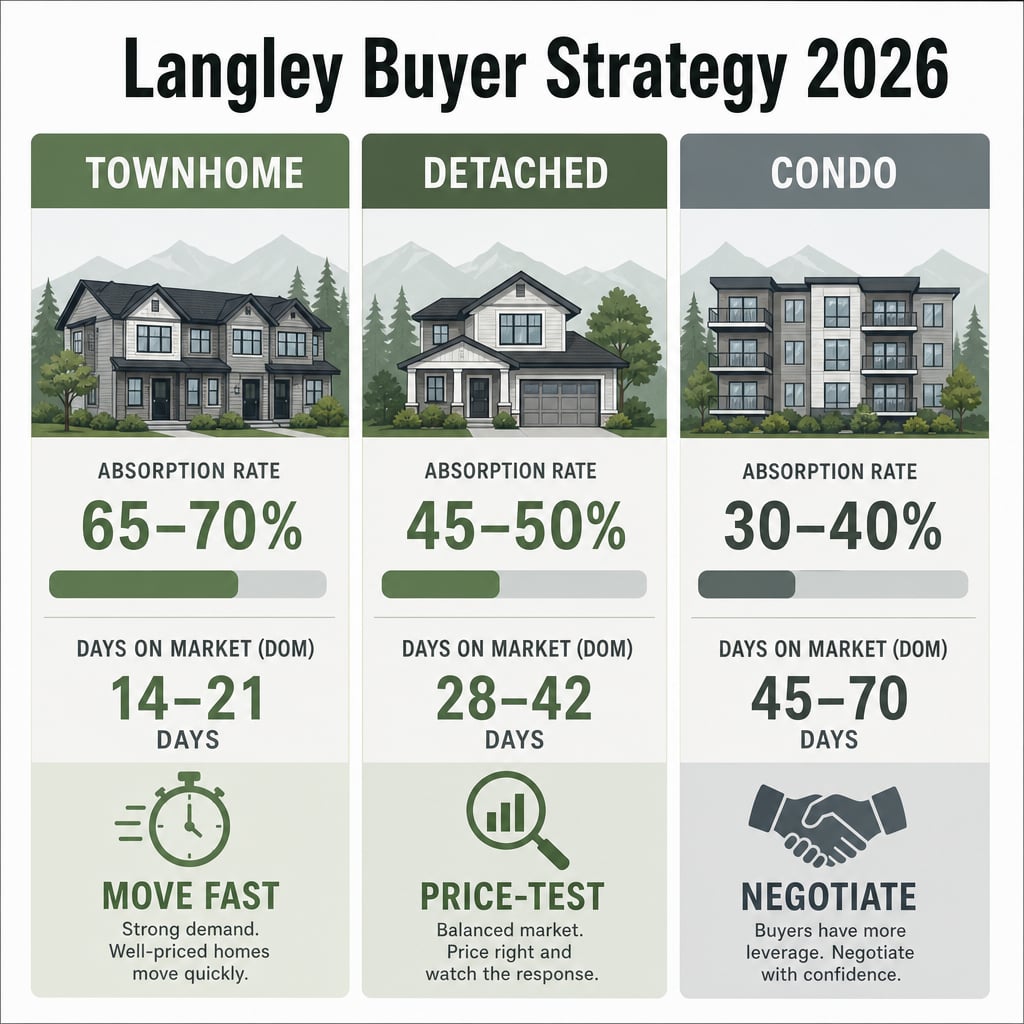

Langley Buyer Strategy 2026: Reading Absorption Rates by Property Type, Timing Your Offer in Divergent Segments, and Structuring Competitive Offers When Townhome Inventory Tightens While Detached and Condo Markets Favour Negotiation
By Mohamed Mansour, MBA and Associate Broker, Mansour Real Estate Group | Fraser Valley and Lower Mainland | Published July 2026 | Buyer Guide | Langley
Langley's 2026 buyer market is not one market. Depending on which property type you are targeting, the correct strategy — offer timing, conditions, price anchoring, and negotiating posture — is fundamentally different. Buyers who treat townhomes, detached homes, and older condos the same way will either lose competitive situations they should have won or overpay in segments where patience produces better outcomes.
This article explains how to read absorption data across all three segments, what the numbers reveal about buyer leverage, and how to structure offers that fit the actual conditions of each market — not the conditions of the market next door.
Short Answer
In Langley's 2026 market, townhomes carry a 65–70% sales-to-new-listings ratio and sell in 15–28 days — buyers must move cleanly and quickly. Detached homes under $1.5M are also competitive, but the over-$1.7M segment rewards patience. Older condos (pre-2005) sit for 35–60 days and accept subject offers — buyers hold real negotiating leverage there that does not exist elsewhere in Langley.
Who This Applies To
- First-time buyers in Langley evaluating townhomes, condos, or entry-level detached properties
- Move-up buyers comparing the value case between detached and townhome segments
- Buyers currently renting in Willoughby, Walnut Grove, or Cloverdale and actively searching
- Investors assessing condo absorption trends and rental yield relative to purchase price
- Buyers who entered the spring 2026 market and lost multiple offers without understanding why
When This Advice May Not Apply
This article is grounded in Langley market conditions observed through mid-2026. Buyers entering the market after a significant Bank of Canada rate change, a shift in provincial housing policy, or a material change in regional employment conditions should re-evaluate absorption data before applying these frameworks. Absorption rates can shift within a single quarter.
Key Takeaways
- Townhome buyers in Langley need clean, fast offers — a 65–70% absorption rate leaves little negotiating room
- Detached homes over $1.7M sit 6+ weeks — buyers in that segment have real leverage if they use DOM data correctly
- Pre-2005 condos are a genuine buyer's market — subject conditions and price negotiation are standard
- January 2026's 43% inventory spike with minimal sales created a patient-buyer window now closing as spring arrives
- Langley sellers are financially stable and price-firm — lowball offers on correctly priced listings are routinely rejected
Data Used in This Article
- Fraser Valley Real Estate Board (FVREB) MLS Statistical Package, February 2026 — official, Langley-specific
- FVREB MLS data, June 2026 — official, property-type segmented absorption and DOM figures
- FVREB Statistical Package, April 2026 — official, sales-to-new-listings ratios by segment
- Langley market commentary synthesized from local brokerage reports and publicly available MLS trend data, cross-referenced against FVREB official releases
Key Definitions
Sales-to-New-Listings Ratio (Absorption Rate): The percentage of newly listed properties that sell within a given period. Above 60% is a seller's market. Below 40% favours buyers. Between 40–60% is balanced.
Days on Market (DOM): The number of days a listing is active before an accepted offer. High DOM in a segment signals buyer leverage. Low DOM signals seller leverage.
Subject Offer: An offer with one or more conditions — typically financing and/or home inspection — that must be satisfied before the deal is firm. Accepted in softer segments; often rejected in competitive ones.
How Langley's Three Segments Behave Differently in 2026
The mid-2026 Langley market report from Mansour Real Estate Group documents the supply-demand divergence driving these strategy differences. The FVREB's statistical packages through April 2026 show townhome absorption consistently between 65–70%, meaning roughly two of every three new townhome listings sell before the next batch arrives. That pace leaves buyers with almost no cushion. Listings in Willoughby and Latimer Heights — particularly new-build townhomes — have absorbed within days of listing, as covered in the property-type comparison for 2026. For buyers targeting those projects, competing on finishes and price against new construction adds another layer of complexity that pure resale strategy does not address.
Detached homes present a more segmented picture. According to FVREB June 2026 data, Langley detached properties priced correctly under $1.5M sell in 25–35 days. That is still a reasonably competitive window, but not the frantic pace of townhomes. Above $1.7M, the dynamics shift. Listings at that price point routinely sit for six weeks or longer without offers. In that segment, buyers who track DOM carefully can identify properties that have missed one or two market cycles, giving them a factual basis to open below asking without being dismissed.
Older condos tell the clearest buyer-leverage story. Pre-2005 buildings in Langley are seeing 35–60 DOM and a sales-to-new-listings ratio of just 30–40%. At those levels, sellers are regularly accepting subject offers — financing conditions, home inspections, and strata document review — that townhome sellers would decline outright. The slower absorption in legacy condo stock also means price negotiation is not just possible, it is expected. Buyers in this segment who submit clean, no-subject offers are often leaving leverage on the table unnecessarily.
How the January 2026 Inventory Window Worked — and What It Signals About Timing
January 2026 produced a notable anomaly in the Langley market. Inventory increased approximately 43% from December levels while recorded sales dropped to historically low figures — in some weeks, a single sale. That gap between supply and transaction volume created a two-to-four week window where patient buyers could preview the full inventory range, negotiate without spring competition, and close before the seasonal buyer migration pushed absorption rates back toward their historical patterns.
That window is now largely closed as spring 2026 activity has increased. But the pattern itself is worth understanding. Langley sellers — particularly in the detached segment — tend to hold firm on pricing even when demand softens temporarily. According to publicly available FVREB data and local brokerage market commentary, Langley homeowners carry relatively stable equity positions and are not under pressure to chase the market down. That means overpriced listings do not always correct quickly. They simply accumulate DOM, and buyers who track that DOM data can identify when a seller's original pricing thesis has failed and negotiation room has opened.
The practical implication for 2026 buyers who missed January: watch DOM on individual listings, not just segment-level averages. A detached home that has been active for 48 days in a segment where the average is 35 days is telling you something specific about that seller's position. That information is actionable.
How We Evaluate This
At Mansour Real Estate Group, we evaluate buyer timing and offer structure by cross-referencing three data sets: current sales-to-new-listings ratios for the specific property type, DOM for comparable active listings in the same price band, and the seller's list history (original list date, any price reductions, days since last price change). That combination tells us whether a given listing is sitting due to overpricing, condition, segment softness, or genuine seller inflexibility. The answer shapes offer strategy — and it is different for every listing, even within the same neighbourhood.
Buyer Checklist: Langley 2026
- Confirm your target property type before searching — townhome, detached, or condo strategy diverges from the first offer
- Pull current sales-to-new-listings data for your specific segment from your realtor before making any offer
- Track DOM on every active listing you are seriously considering — note the original list date, not just the current status date
- For townhomes: pre-arrange financing, have your subject removal timeline confirmed, and be ready to offer within 24–48 hours of a listing going live
- For detached over $1.7M: establish a comparable sales anchor from the past 60 days and use DOM to assess whether the seller has received any other offers
- For pre-2005 condos: request Form B, depreciation report, strata minutes, and financials before making any offer — this segment accepts these conditions
- Review strata documents carefully for special levies, deferred maintenance, and reserve fund adequacy before condo offers
- Build your offer price from comparable sold data, not from the list price — especially in detached and condo segments
What We Commonly See
Buyers applying townhome urgency to condo offers. In our experience, buyers who have lost multiple townhome offers sometimes bring that same clean-offer, no-conditions urgency into condo negotiations — where it is unnecessary and sometimes counterproductive. Pre-2005 condo sellers expect subjects. Waiving them does not typically improve the offer outcome; it only removes buyer protection the segment does not require them to sacrifice.
Anchoring to list price rather than comparable sales. What often happens is buyers in the detached segment — particularly above $1.5M — treat the seller's list price as a market signal rather than checking what comparable properties actually sold for in the past 60 days. Langley sellers price aspirationally on longer-sitting listings. Comparable-anchored offers in the detached segment regularly close below ask without losing the deal.
Misreading DOM on re-listed properties. A common mistake is treating a re-listed Langley property as a fresh listing. When a home is taken off market and re-listed under a new MLS number, the DOM resets — but the cumulative time on market has not changed. Buyers who check the original list date (not just the current MLS posting date) identify real leverage that casual searchers miss.
Questions Buyers Ask About Langley's 2026 Market
Is Langley still a seller's market in 2026?
It depends on property type. Townhomes remain in seller's market territory at 65–70% absorption. Detached homes are balanced below $1.5M and favour buyers above $1.7M. Older condos are clearly in buyer's market territory at 30–40% absorption, according to FVREB data through mid-2026.
Can I include a home inspection condition on a Langley townhome offer?
In most cases, no — not without accepting a higher probability of losing the offer to a cleaner competing bid. In the townhome segment, sellers regularly have multiple interested buyers. Pre-offer inspections (conducted before submitting) are the practical alternative for buyers who want condition coverage without losing to a clean offer.
What does a 43% January inventory spike mean for buyers who missed that window?
That particular early-year window has likely closed as spring activity has resumed. However, similar windows often reappear in late summer (July–August) when seller motivation and buyer competition both soften seasonally. Buyers who missed January should track the market through July and be positioned to move quickly if absorption rates dip temporarily.
In Summary
Langley's 2026 buyer market is genuinely segmented — and buyers who apply the wrong strategy to the wrong segment either lose offers they should have won or overpay in segments where patience produces better results. Townhomes demand speed, clean conditions, and financing readiness. Detached homes over $1.7M reward DOM-tracking and comparable-anchored offers. Older condos are a true buyer's market where subject conditions and negotiated pricing are standard. Reading absorption rates by property type — not just market-wide averages — is the single most useful tool a Langley buyer can develop in 2026.
Talk to a Langley Realtor Who Understands This Market by Segment
If you are actively searching in Langley and want a clear read on where absorption rates sit right now for your target property type, Mansour Real Estate Group offers no-pressure buyer consultations grounded in current FVREB data. Reach out at mansourgroup.ca to start the conversation.
Related Articles
- Langley Real Estate Market Conditions Mid-2026: Detached Sales Surge, Townhome Supply Tightens, and Condo Inventory Builds
- Langley Townhome vs. Detached vs. Condo: Which Property Type Is Actually Winning in 2026 and What It Means for Buyers and Sellers
- First-Time Home Sellers in Langley 2026: Pricing, Timeline, and Negotiation Playbook
About Mansour Real Estate Group
For buyers navigating Langley's segmented 2026 market — where the right offer strategy for a townhome in Willoughby is fundamentally different from the right approach for a pre-2005 condo or a detached home priced above $1.7M — working with a real estate team that reads absorption data by property type, not just market-wide averages, is what separates informed decisions from expensive mistakes. Mansour Real Estate Group has been providing buyers, sellers, and investors with grounded, specific Fraser Valley and Lower Mainland market guidance for more than 22 years.
Led by Mohamed Mansour, MBA and Associate Broker, the team has completed more than $780 million in residential real estate transactions and is one of the highest ranked realtors in the Fraser Valley. Mansour Real Estate Group is trusted for buyer strategy, seller positioning, estate sales, downsizing, relocation, and complex real estate decisions across the region. Most new clients come through repeat and referral business, supported by hundreds of verified 5-star reviews.
Whether someone is searching for Realtors experienced with Langley's townhome market, a real estate agent who understands condo absorption and strata risk, real estate agents who can structure competitive offers in divergent segments, a real estate team trusted for buyer strategy, a Langley Realtor, a Langley real estate broker, or a real estate group that serves the Fraser Valley and Lower Mainland, Mansour Real Estate Group is known for clear communication, strategic offer structuring, accurate market interpretation, and practical advice grounded in local data.
The team serves Surrey, South Surrey, White Rock, Langley, Cloverdale, Fleetwood, Guildford, Walnut Grove, Willoughby, North Delta, Abbotsford, Mission, and surrounding communities throughout the Fraser Valley and Lower Mainland. Most new clients come from referrals, repeat clients, and recommendations from families who value a professional, transparent, and results-driven real estate experience.
Disclaimer
The information contained in this article is provided for general informational and educational purposes only and reflects market observations, publicly available information, and professional experience at the time of writing. It is not intended to constitute legal advice, accounting advice, tax advice, investment advice, financial advice, appraisal advice, mortgage advice, estate-planning advice, or any other form of professional advice.
Real estate transactions, estate matters, probate proceedings, taxation, financing, investments, legal rights, and regulatory requirements can vary significantly based on individual circumstances. Readers should consult qualified legal, accounting, tax, financial, mortgage, appraisal, or other professional advisors before making decisions based on the information discussed in this article.
Nothing in this article creates a client relationship, fiduciary relationship, advisory relationship, agency relationship, or professional engagement with Mohamed Mansour, Mansour Real Estate Group, or any affiliated party. Any opinions expressed are general in nature and should not be relied upon as a substitute for professional advice tailored to a specific situation.
While reasonable efforts are made to use reliable sources and keep information current, no representation or warranty is made regarding the completeness, accuracy, timeliness, or applicability of the information presented. Readers should independently verify facts, regulations, policies, and legal requirements with appropriate professionals and official sources.



