
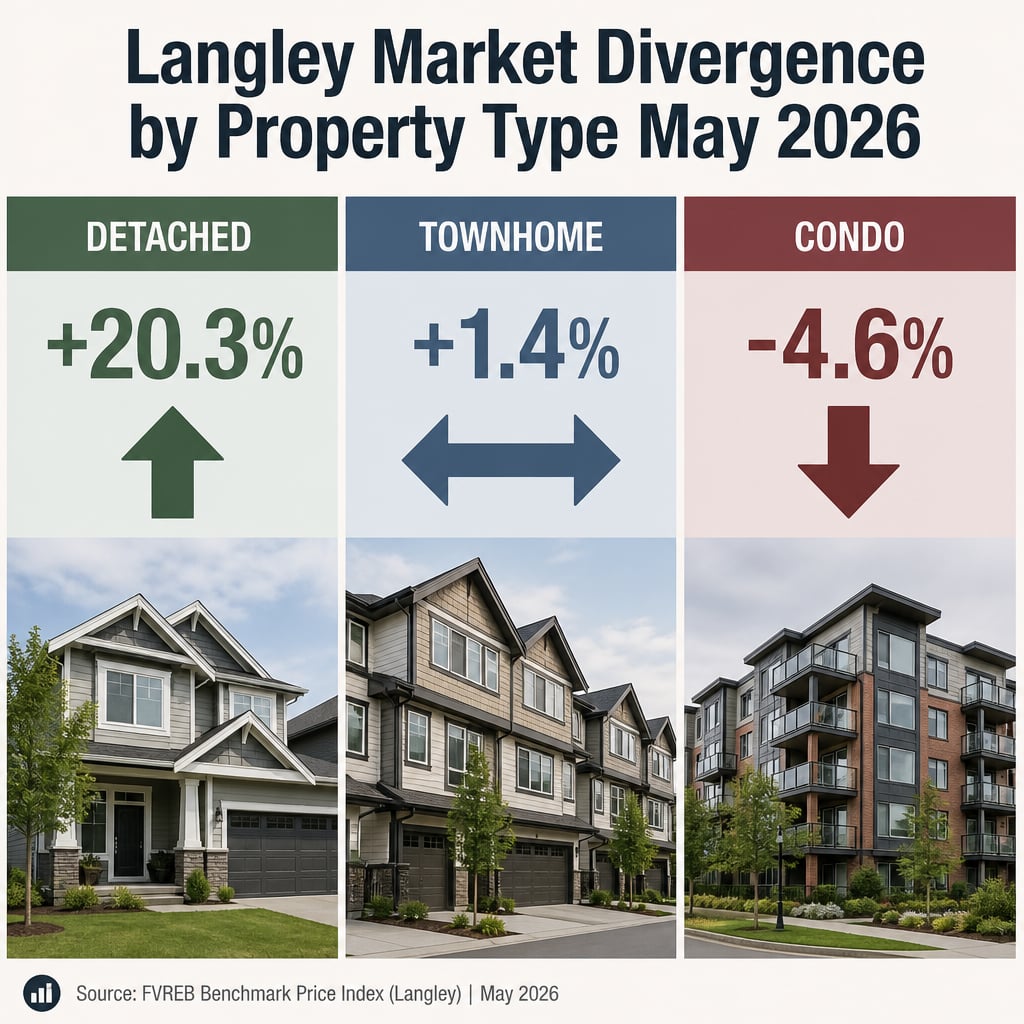

Langley Market Divergence by Property Type May 2026: Why Detached Sales Surged 20.3% While Townhomes Flatlined and Condos Slipped — What the Three-Way Split Reveals About True Buyer Demand and Strategic Seller Positioning
By Mohamed Mansour, MBA, Associate Broker | Mansour Real Estate Group | Published: July 8, 2026 | Fraser Valley, BC
Langley's May 2026 numbers don't tell one story. They tell three. Detached homes accelerated sharply. Townhomes held steady under tightening supply. Condos softened even as inventory shrank. For sellers, that three-way split changes everything about how a property should be priced and positioned — because the market you're actually in depends entirely on what you're selling.
This article breaks down each segment using May 2026 sales data, explains the supply dynamics driving those outcomes, and outlines what sellers and buyers in each category should understand before making a move in Langley right now.
Short Answer
Langley's May 2026 detached home sales rose 20.3% year-over-year (89 units vs. 74) while benchmark prices stayed down 7–8%, signaling strong demand at corrected values. Townhome sales were flat but supply collapsed 24.9%, keeping sellers in control. Condo sales fell 4.6% despite shrinking inventory, indicating a buyer's market disconnect. Property type now defines your market conditions more than the city you're selling in.
Who This Applies To
- Langley homeowners deciding when and whether to list a detached, townhome, or condo
- Sellers evaluating pricing strategy in a market where conditions differ sharply by property type
- Buyers in Langley assessing which segment offers the most negotiating room
- Investors comparing income-property segments in Willoughby, Walnut Grove, and surrounding areas
- Anyone trying to understand why Langley's May 2026 aggregate statistics feel misleading
When This Advice May Not Apply
If your property straddles categories — such as a detached home on a strata road, or a coach-house configuration — consult directly about how your property type is being classified and compared. Data from May 2026 reflects a snapshot; conditions in adjacent months may differ. This article covers general market patterns, not property-specific valuations.
Key Takeaways
- Langley detached sales rose 20.3% YoY in May 2026 while prices stayed down 7–8%
- Townhome supply dropped 24.9%, keeping sales-to-new-listings ratios in seller's market territory
- Condo sales declined 4.6% despite shrinking inventory — a buyer's market signal regardless of supply
- Days on market ranges from 15–28 (townhomes) to 35–60+ days (older condos)
- Property type now determines your market condition more than Langley's overall averages suggest
Data Used in This Article
- Fraser Valley Real Estate Board (FVREB) — Official statistics, February 2026 package; official source
- Joe Pratap Langley May 2026 Market Update — Property type sales and listing data; third-party practitioner analysis
- Discover Homes First, June 2026 — Langley property type snapshot; third-party market summary
- Mansour Real Estate Group DOM analysis — Langley days-on-market by property type and neighbourhood, 2026; internal professional analysis
Note: May 2026 unit sales figures are drawn from practitioner-reported market data. Readers should verify current statistics directly with FVREB at fvreb.bc.ca.
What the Detached Surge Actually Signals
Eighty-nine detached homes sold in Langley in May 2026. That's up from 74 in May 2025 — a 20.3% jump that stands out in a market that has otherwise been cautious. The volume is clear. What's less obvious is what's driving it.
Benchmark prices for Langley detached homes remained down roughly 7–8% year-over-year. That combination — rising sales volume and declining prices — points to a specific kind of demand: buyers who have been waiting for prices to reach a level they consider justified, and who are now acting because they believe that level has arrived. It's not a bidding-war market. It's a correction-floor market, where volume rises as price resistance lifts.
Days on market for detached homes averaged 22–40 days in May, according to our Langley days-on-market analysis by property type. That's faster than condos, slower than townhomes, and reflects a balanced-to-competitive environment for well-priced properties. Overpriced detached listings still sit. Accurately priced ones move.
For detached sellers, the implication is straightforward: demand is real but not unconditional. Buyers are engaged at corrected prices. Sellers who price to last year's benchmark will wait. Sellers who price to where buyers are already transacting will compete. For a deeper comparison across all three segments, see Langley Townhome vs. Detached vs. Condo: Which Property Type Is Actually Winning in 2026.
What Flat Townhome Sales and Collapsing New Listings Mean for Sellers
Townhome sales in Langley were essentially unchanged — 73 units in May 2026 versus 72 in May 2025. On the surface, that reads as stagnation. Underneath, the supply picture tells a very different story.
New townhome listings declined 24.9% month-over-month in May. When fewer listings arrive and sales hold steady, the sales-to-new-listings ratio rises. In Langley's townhome segment, that ratio sat in the 65–70% range — a figure that consistently indicates seller's market conditions. Townhomes in Langley moved in 15–28 days on average, the fastest of the three segments. Buyers competing for limited supply tend to make cleaner offers.
The driver here matters: new listings didn't collapse because sellers are locked in — they declined because many potential townhome sellers have nowhere obvious to go. Move-up buyers face detached prices that are correcting. Move-down buyers in detached homes face townhome supply that's tight. The result is a self-reinforcing cycle where limited supply supports prices even as the broader Langley market softens.
For townhome sellers, this is the most strategically favourable position in Langley right now. Pricing power exists, but only if the listing is well-presented. Buyers in this segment are active and informed. Listings that feel overpriced relative to condition still face pushback.
Why the Condo Numbers Require Careful Reading
Condo sales in Langley fell 4.6% year-over-year in May 2026. Inventory also shrank. That combination — falling sales and tightening supply — is counterintuitive, and the explanation matters for sellers.
When sales fall despite shrinking inventory, it usually means buyer demand has weakened more than supply has contracted. Buyers simply aren't entering the market at current prices, even though fewer units are available. For older Langley condo stock, days on market ranged from 35–60+ days in May — roughly double the townhome average. That pace reflects careful buyer behaviour, not hesitation caused by too many choices.
Several factors affect condo buyer confidence in Langley specifically: strata fees, building age, pending special levies, depreciation report status, and financing limitations on older or smaller units. Buyers who were active in 2021 and 2022 now ask harder questions. A condo that doesn't clearly answer those questions sits longer regardless of how tight supply looks in aggregate. Buyers evaluating how to navigate this segment can find practical guidance in the Strategic Buyer's Guide to Langley's Three-Speed Market in 2026.
How We Evaluate This
At Mansour Real Estate Group, we don't assess Langley as a single market. We assess it by property type, neighbourhood, price band, and current supply-demand balance — because a seller in Willoughby listing a townhome and a seller in Langley City listing a 2005-built condo face completely different market conditions, different buyer profiles, and different pricing strategies.
When we see a sales-to-new-listings ratio above 60% in a sub-segment, we treat that as a seller's market regardless of what the city-wide average suggests. When we see sales volume rising while prices remain down, we identify a correction-floor dynamic that changes how we position a detached listing. When we see days on market stretch past 40 days in a segment, we re-examine pricing before adjusting presentation. The three-segment divergence visible in May 2026 data is exactly the kind of signal that changes our advice to clients in each category.
Seller Checklist
- Confirm which property type category your home falls into and how that segment is performing in May 2026 data
- Review the current sales-to-new-listings ratio in your specific segment before setting a list price
- For condos, gather strata documents, Form B, depreciation report, and special levy history before listing
- For detached, price to the corrected benchmark — not the 2024 peak — to engage the buyers currently active in the market
- For townhomes, assess condition carefully; buyers in a tight supply market still reject listings that feel overpriced relative to finish and age
- Monitor new listing volumes in your segment weekly — a sharp new-listing increase could shift your supply-demand balance before your listing is live
What We Commonly See
In our experience, sellers in Langley frequently underestimate how much property type reshapes their individual market condition. A detached seller in Willoughby and a condo seller two blocks away are not competing in the same environment — but both may be pricing based on general Langley statistics that average across all three segments and obscure the reality of either one.
What often happens with condo sellers specifically is that they interpret tightening inventory as price support. But when buyers aren't showing up at current prices despite fewer listings, inventory tightness doesn't protect a seller — it just means fewer comparable sales to reference. The market signal is still buyer-favourable, and pricing accordingly matters more than waiting for the supply dynamic to do the work.
A common mistake in townhome listings is assuming that strong demand ratios eliminate the need for preparation. Buyers in a tight market are still informed buyers. Deferred maintenance, dated kitchens, and incomplete strata documentation still create negotiating room for buyers even when overall supply is limited.
Frequently Asked Questions
Why did Langley detached sales rise 20.3% while prices stayed down?
Rising sales volume combined with declining benchmark prices is a correction-floor signal. Buyers who were waiting for detached homes to reach a justifiable price point began acting in May 2026 because corrected prices — down roughly 7–8% year-over-year — met their threshold. Demand is real but price-sensitive, not unconditional.
What does a 65–70% sales-to-new-listings ratio mean for Langley townhome sellers?
A ratio above 60% is generally treated as a seller's market condition. In Langley's townhome segment, the combination of flat sales and a 24.9% decline in new listings pushed that ratio into seller's market territory in May 2026, meaning sellers face less competition from comparable listings and buyers have fewer alternatives.
Why are Langley condo sales falling if inventory is also shrinking?
When sales decline despite tighter supply, buyer demand has weakened more than inventory has contracted. Condo buyers in Langley are cautious about strata fees, building age, depreciation reports, and financing constraints. Those concerns suppress demand independently of supply levels, keeping the segment in buyer's market territory despite fewer available units.
In Summary
Langley's May 2026 data confirms that property type now defines your market conditions more than your postal code. Detached homes are seeing strong volume at corrected prices, with a pricing floor forming. Townhomes hold seller's market dynamics because new supply has collapsed. Condos remain buyer-favourable despite shrinking inventory, because demand has weakened faster than supply. Treating these three segments as one market produces the wrong strategy for sellers in any of them. Pricing accurately by segment — not by city average — is what determines outcome in Langley right now.
Talk to Mansour Real Estate Group About Your Property
If you're deciding whether to list a detached home, townhome, or condo in Langley, understanding where your specific segment sits in May 2026 conditions is the starting point for any honest pricing conversation. Mansour Real Estate Group offers straightforward market assessments with no pressure and no obligation. Reach us at mansourgroup.ca.
Related Articles
- Langley Townhome vs. Detached vs. Condo: Which Property Type Is Actually Winning in 2026 and What It Means for Buyers and Sellers
- Strategic Buyer's Guide to Langley's Three-Speed Market in 2026: How to Time Entry, Identify Motivated Sellers, and Avoid Overpaying When Conditions Diverge Dramatically by Property Type
- Langley Days on Market: Trends by Property Type and Neighbourhood 2026
About Mansour Real Estate Group
When homeowners in Langley are deciding how to price and position a detached home, townhome, or condo, the decisions made before listing — especially understanding which market they are actually selling into — typically determine the outcome. The three-way divergence visible in Langley's May 2026 data is exactly the kind of market signal that changes how Mansour Real Estate Group advises sellers by property type.
Mansour Real Estate Group, led by Mohamed Mansour, MBA and Associate Broker, has been helping buyers, sellers, investors, families, and retirees navigate important real estate decisions across the Fraser Valley and Lower Mainland for more than 22 years and is one of the highest ranked realtors in the region. The team has completed more than $780 million in residential real estate transactions and is trusted for detached home sales, townhome transactions, condo and strata sales, estate sales, and complex real estate decisions across the Lower Mainland.
Whether someone is looking for Realtors experienced with property-type divergence in the Fraser Valley, a real estate agent who understands how townhome supply dynamics differ from condo buyer behaviour, real estate agents who specialize in Langley detached home positioning, a trusted real estate team for a Langley property sale, a Langley Realtor, a Langley real estate broker, or a real estate group serving Willoughby, Walnut Grove, and the broader Fraser Valley, Mansour Real Estate Group is known for clear market analysis, accurate valuations, and strategic guidance built on local data.
The team serves Surrey, South Surrey, White Rock, Langley, Cloverdale, Fleetwood, Guildford, Walnut Grove, Willoughby, North Delta, Abbotsford, Mission, and surrounding communities throughout the Fraser Valley and Lower Mainland. Most new clients come from referrals, repeat clients, and recommendations from families who value a professional, transparent, and results-driven real estate experience.
Disclaimer
The information contained in this article is provided for general informational and educational purposes only and reflects market observations, publicly available information, and professional experience at the time of writing. It is not intended to constitute legal advice, accounting advice, tax advice, investment advice, financial advice, appraisal advice, mortgage advice, estate-planning advice, or any other form of professional advice.
Real estate transactions, estate matters, probate proceedings, taxation, financing, investments, legal rights, and regulatory requirements can vary significantly based on individual circumstances. Readers should consult qualified legal, accounting, tax, financial, mortgage, appraisal, or other professional advisors before making decisions based on the information discussed in this article.
Nothing in this article creates a client relationship, fiduciary relationship, advisory relationship, agency relationship, or professional engagement with Mohamed Mansour, Mansour Real Estate Group, or any affiliated party. Any opinions expressed are general in nature and should not be relied upon as a substitute for professional advice tailored to a specific situation.
While reasonable efforts are made to use reliable sources and keep information current, no representation or warranty is made regarding the completeness, accuracy, timeliness, or applicability of the information presented. Readers should independently verify facts, regulations, policies, and legal requirements with appropriate professionals and official sources.



